036- Interview w Brent Penfold of IndexTrader.com.au
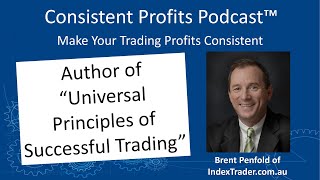
This is a YouTube video titled "036- Interview w Brent Penfold of IndexTrader.com.au" published in October 2023. It features an English interview conducted by Brian McAboy on his Consistent Profits podcast, where he interviews Brent Penfold, an experienced trader and educator. The discussion covers Brent's trading background, his development of trading systems, educational courses, and key trading principles such as risk of ruin and the importance of being a disciplined loser. The content is focused on trading strategies, risk management, and trading education.
Hello and welcome to the Consistent Profits podcast brought to you by Inside out trading and Brian McAvoy, where the focus is on consistency because when you have the consistent part down, profits become easy. Well, hello everyone and this is Brian McAvoy with a new episode of the Consistent Profits podcast. I'm excited today to be interviewing Brent Penford, creator of Innextrader.com Brent, thanks for so much for being on the podcast today.
Thank you for having me.
Glad you're here, man. Now for everybody who's not familiar with Brent, Brent's been trading for nearly 40 years. He's got experience trading his own accounts, plus he's traded for other firms. So he's got some unique perspectives on, you know, on the markets and trading in general. He's written two books, the Universal Principles of Successful Trading and Universal Tactics of Successful Trend Trading. And he also provides a daily study guide, three different level courses on trading. And since 2004 he's been publishing the newsletter Index Alert to which he offers a 21 day free trial. Brent's a firm believer in transparency and he's also very down to earth guy. I love my Aussie buddies and again, thanks for being here and being game for the interview, man.
Oh, thank you very much for reaching out and you know, it's, I'm looking forward to talking with you. Yeah.
Now I always have to ask everybody just because trading is kind of an outlier occupation that not many people choose to be traders, you know, what led you to choose trading? You know, back in the 80s, how do you wind up like, you know, joining bank of America as a trainee dealer back in 83.
Oh, it was a combination, a hybrid of purpose and then fluke or random essentially. I was at university studying a bachelor of commerce degree and, and I was enrolled to do my, my honours. My fourth, my fourth year was going to be an honors year. And I spoke to some people just about my future and my dad's asked me to talk to his accountant because dad had been retired for 30 or 40 years so he thought his accountant could give me some advice and he, he gave me really good advice and he said you can always, you know, employ people that manage factories but in here I'll, I'm helping the promise note trader, which is just short dated notes, quality a little bit less than bank bills. And we made a million dollars over a week because people were just buying Aussie dollars to speculate that it's going to be revalued. It had to be parked in, you know, short term paper like can you imagine if you're 21, when a million dollars was a million dollars and it was just, it was, you know, it was just mind blowing. I was so excited. Then after that one month they sent me to banking and they, we had quite a very high profile entrepreneur called Alan Bond who, you know, eventually paid a billion dollars to pay to buy one of our leading TV channels. And at that time I think he was trying to buy, you know, pub, pub alcohol, you know, beer companies. And he came to bank of America wanting for a loan. And I said, Brent, here's, here's all our stuff on Alan Bond. Give us your opinion. And I had three volumes of Lee Ratchbinders in the boardroom and I shut the door on me and I think I fell asleep a dead set. I just, just glazed. Anyway, long story short, because Bank America wanted to apply for a foreign banking license, they decided to redevelop the trading room and they opened a brand new trading room. This was, this is, you know, my fifth or sixth week at bank of America. And they had opened a brand new baking room with, with the confidence that they would be awarded a foreign banking license, which obviously they did get one eventually. And they had all these pods. They said, brent, we loved you. You engaged, you interacted with, everybody would love you to join us full time. And of course, you know, it wasn't my intention, but after that one week, particularly where we made all that money, I was sold. So that, so yes, it was deliberate because I wanted to get experience about my future. The family accountant said, work for a bank, understand how money flows. Bank of America was generous to, you know, employ me on the condition that I would, you know, join them if they were happy with me. And I did my honors. And anyway, what happened was I joined bank of America on this securities desk, so, so in the domestic money market. And they put me onto the securities desk and, and a long story short, what ended up was I was there for three, three years and I ended up, I didn't finish my honors, but I convinced our chief accountant for money markets and our treasurer, who was an American, lovely guy, Peter Nielsen. He's now in charge of the large bank in London as the CEO. I convinced both of them to do their master's degree. So we all went off to the university to complete our master's degree because I always felt I hadn't put the cream on my degree. And so we all went off and did our master's degree and a fantastic time. Yeah, the large bank in, in London. As the CEO, I Convinced both of them to do their master's degree. So we all went off to the university to complete our master's degree because I always felt I hadn't put the cream, the cream on my, my degree. And so we all went off and did our master's degree and a fantastic time.
Yeah, how cool. That's, that's a cool story, man, how you wound up that, how neat. Now so, but, so you did complete your master's degree or your Master's of commerce degree. So how long did you stay with Bank America?
I left just before, Just after the crash. Just after the crash.
Oh, cool. That's, that's a cool story, man, how you wound up. But how neat.
And my last, oh, you know, share market crash in 87. So I was there, so 83. Four years. Four years. Okay, four years. Because I was there and I, and talking about being imprinted as a duckling, I was first introduced to Elliott Wave at Bank of America and News Corp. Buddy Murdoch, right. Newscast succession always in the paper. So I remember my dad ringing me up and asking me if I was okay after the crash because he just thought, you know, I'm a, I'm a speculator and was I okay? And, and actually we made, I made money. I bought a, bought a put, a put option on News Corp. And, and it's very volatile and actually, you know, I made about $12,000, which is just, just, just, you know, based on the back of Elliott Wave. And that was fantastic. So I, I left just after that. And essentially at the time, Bank America had what was regarded as one of the best corporate asset liability foreign exchange management systems. So if you were an international business and you had obviously assets and liabilities in your domestic currency, but you also had assets and liabilities in foreign currencies. You know, you had to manage FX risk. And I, I finished up on the FX desk. So, so during my journey at bank of America, I won an internal competition at bank of America. Bank of America used to run these competitions. Not competitions, training courses, in house training courses for, for corporates and their own staff. It was fantastic. We'd go to a hotel and the Buddy up everybody in the. It could be 20, 20 students. It was a worldwide program. The, it was run by, you know, head office in America. So all the stuff that came to Sydney, they're all Americans and they go, went all around, you know, North America, South America, Europe, and they'd run this course and basically they go to a hotel, buddy everybody up, all connected and, and the head guys would basically be the central bank. And they would make announcements and they'd simulate fx. And I think it was three days, and two days was all education. The third day was going live, and I won that. And so they put me onto the forex desk and put me in charge of swaps, because swaps is just a differentiation between yield curves, which I knew all about anyway. And that's how I got. I got familiar with this corporate software package because something was on the FX desk and we have corporate clients that have an FX exposure. And it was a really good bookkeeping system. But one thing it didn't have was a decision matrix for the corporate to say, if you've got a liability or an asset, regardless of whether it's domestic currency or foreign currency, where's the best place to puts your surplus cash? And where's your best place to borrow, regardless of whether it's a domestic liability or a foreign liability? Because through the fx you can borrow money from wherever you want. And essentially I developed, in conjunction with a senior person at the bank who was a programmer, and we all did it on the weekends. I developed an arbitrage program and as a pricing tool for corporates to say, regardless of whether you have surplus assets or surplus liabilities, you gotta understand what the yield curves are doing domestically and internationally. And you can bring it back to one decision matrix. Which way should you jump? And so I left Bank America to basically sell my arbitrage program. And I sold those to merchant banks in Australia and New Zealand and some corporates. Yeah.
Wow.
Very cool, man. Well, especially considering the. The technology of the day.
Oh, well, I was walking around, I probably had, you know. Do you remember compact compact computers? Oh, yeah, yeah, yeah. My. My first compact computer was basically like a big fat lunch. Yeah. Lunchbox, you know, big chunky ones. You know, the big chunky ones, like the big square ones. Yeah, you know, you carry around on your hip. It was like a big box. Yeah, yeah, yeah, yeah, yeah, yeah. That's what I had cost. I think it cost about $10,000 back then. And, and, And I was doing it all in. I'm not sure if you remember, today we have Excel, but back then, you probably remember, there was Symphony. Symphony. Symphony, yeah. Symphony is like what Excel is. And it had a web, had spreadsheet, it had word processing, and it had a database. It was actually more advanced than Excel. It actually had more. And it had a macro script in it. So my friend wrote the arbitrage program in Symphony. So, you know, it worked all right, huh?
Well, so at what point? So you left bank of America to go sell this, but you started trading on your own, right?
Oh, yeah, yeah. Oh, yeah, yeah. So at the bank, the bank had a very strict policy. You cannot obviously trade. You trade in the markets where you, you run a book, right? And I ended up, before I moved to fx, I was in charge of bank bills. I was a manager of short term securities, which basically meant, you know, we did everything, we hedged everything in the future. So I was basically in charge of. I tried bank deals, but I, you know, do most of my stuff in the bank bill futures for 90 days. So we're a bank. So banks basically dealing in deposits and currencies, not equities. So it's okay for us to trade. You know, we can trade shares. We're trading the. What. What's called the Australian equivalent of the s and P500, and that's called the share price index in Australia. It's called the spy Spy futures contract. So we traded this, the spy futures contract on our. On our personal account. And I can tell you the first trade I put on was on my bank card. Now the bank card in Australia is like your MasterCard or your Visa card. So, you know, talk about the confidence or the enthusiasm of youth. I put that trade. I told my, I went through my broker. I said, angie. And Angie's still there. Would you believe? She's still a broker As a. It. It was actually more advanced than Excel. It actually had more. And it had a macro script in it. So. So my friend wrote the arbitrage program in Symphony. So, you know, it worked all right. Huh?
Well, so at what point. So, so you left, you left bank of America to, to go sell.
And Angie, I want to do this on my personal account, not trading bank bills. I'm. I'm gonna, I want to put a trade on the index, a spy. And she goes, okay, Brent, that's fine. And. Yeah, and she said, well, I need a deposit of margin. I said, well, do you take a credit card? Yeah. Yeah. So did it on bank card. Yeah.
So. So how did that go?
Made money. You know what's terrible is that we basically. So my, my early influence was Elliott Wave and Fibonacci, right? So a discretionary trader. And the worst thing you can do is make money following that. And we'd be all there. And, and like, I had some. You know, I was a baby. I wasn't the baby on the desk. And my. There was two bosses. One. Well, two senior guys. One was my boss. The two senior guys Was one was in charge of bonds and the other guy was in charge of all of us.
Right.
And the guy's charging charge in charge of bonds. He was ex treasury from Canberra, senior economist and my boss. And we're all seeing the same stuff. And we'd be there watching, you know, the spy had sort of rallied and it come down and we said, oh, you know, it's going to come down to 0.618. And we'd watch the spy tick by tick, come, come down to that magic number and we'd just buy it, right. We wouldn't wait for any confirmation. We just buy the dip and the thing would stop and buddy reverse, you know, and we just think we were geniuses and we discovered all the answers to the universe and you know, all the things that I've now, I now know aren't true, but that's, that's how I started. And it took me a long time to shake off Elliot Wave. And I will say today, I still can't help counting waves. I still can't help it. I'm a mechanical trader. Today I have got some, some elements of Elliott Wave into some of my mechanical models. Right. Yeah, but it's, it's, it's hard like when you're, you're so young and you, you, you know, that's what your first introduction and you had successes. This is before I blew up two accounts and almost blew up a third account. But that early success sort of reinforces, I suppose, you know, bad habits.
Oh, sure. Well, yeah, the, or the early days as a trader for, for everybody, I, and I try to get this across to people is most of the problems that you're facing today, or at least some come from your early days as a trader. Just because those are formative months and so many perspectives and attitudes and responses get, you know, wired into you in those early months and you know, maybe even a couple of years and it can be really hard to shake them. And so, yeah, got it. Got to rewire that stuff if you're, you know, if you're struggling. So very cool. Now, over the years you've been exposed to a lot of information on trading. You know, you gotta, you know, do different books, I'm sure seminars, software, probably seen a lot of different strategies, methodologies. What are some of the lessons and insights that you've gained along the way?
Sure, sure. My number one thing, I mean one of my books I sort of asked in my Universal, Universal Principles of Successful Trading, I did a bit of a market wizards thing at the Second half of the book where I basically reached out to a lot of traders. I, I gotten to know, to know over my years, and I asked them for what's your one piece of advice? If all you could do was just. They've been training for 20, 30 years. You can only give one piece of advice, what would that be? And if somebody asked me that question, my question is simply, please understand the importance and ensure that you embrace, and if you forget, tattoo it on the back of your eyelids. The importance of risk of ruin. Understand what your risk of ruin is. So we all know instinctively when we engage with the market, there's a risk. We know that. We're not stupid. We're not stupid. We know there's a risk. And we do know that we should only trade with what we can afford to lose. So we sort of intuitively know that. But there's a concept called risk of ruin, which is a mathematical concept. And in my opinion, there's only. There's two key factors about why, you know, you and I and others are successful in trading, in my opinion. And number one, it's the math. And number two, we're both really good losers. We don't mind losing, happy to lose. We take all our losses.
Right?
The math. The math. The key component of the math is that you need to trade with a zero percent risk of ruin. So when we engage with the markets, of course there's a risk. We know that. I can afford to lose $500. I can afford that. That's good. But did you know there's a mathematical measure on what you're about to do?
Right?
What you're about to do? There is a mathematical measure on what you're about to do with that $500. And in my opinion, if that mathematical measure is not at 0%, you're just wasting that money. You're throwing it away. Because any risk of ruin over a 0% is a guarantee that you'll go bust. Somebody with a mathematical risk of ruin will say 30% will go broke quicker than somebody who has, say, a 1% risk of ruin. Okay? Because obviously 30% is higher than 1%. The person with even 1% risk of ruin, they will go broke. It's just a matter of time. And risk of ruin is a really simple idea. It's a simple idea and essentially it's a combination of the two main things that we do as traders, how we engage the market. We have a particular way that we approach the market, which is our edge, our methodology. And that edge that methodology has. What what we call a mathematical expectancy, we have. What's our edge? What's our expectancy? That's mathematical. Second thing we do is our position sizing. How much are we prepared to risk? Is it $500, $100, $5,000? So we have a money management approach which dictates our position sizing. When you combine your position sizing or money management with your positive expectancy, that comes together, that gives you a mathematical risk of ruin. It's a number, it's science. And most people are unaware of what their risk of ruin is. Now, if they go back and look at their, their ledger entries or their trades, they, they can retrospectively, they can retrospectively calculate what the risk of ruin is because you will have, you know, what's your percentage of wins and losses? What's your average loss? What's your average win? They're all the key components for expectancy, right? Then when you look at all those position sizing, compare them to your, your, your capital base, and that will give you, tell you, how many units of money have you been trading with? If I risk a hundred dollars, how many, what does that represent in terms of units of money that I have? Like, you know, what, what's the units of money? If I, if I risk $500 per trade, then I'll obviously have a less number of units of money as opposed to if I risk only $100 per trade. When you combine your money management, which basically tells you how many units of money you have compared, compare combined with how you trade your expectancy, that gives you a mathematical risk of ruin. And in my book, I say, you know, we're not stupid. We're not stupid. And if you're in a position where you can afford to lose your risk capital, you're not stupid because along the way you've accumulated risk capital. But most people are a bit ignorant, right? They don't understand. What they're engaging with is, you know, if your risk of ruin is 20%, 15%, don't stop trading. You may have a bit of fun for six months or a year, but eventually you'll go broke. It's just mathematically, you know, determined. So my big thing is understand and embrace what is this risk of ruin and unpack it. Unpack it. Now, I trade with a fixed percentage risk of ruin, and I try to risk less than half a percent of my capital. I trade really small compared to my risk capital. And I do that for two reasons. One reason is I trade over 30 markets and I can have five or six signals triggered, you know, during a session.
Right.
So suddenly I'm not risking half a percent, I'm risking two, two and a half percent.
Right.
But more importantly, risking half a percent of my risk capital. That gives me 200 units of money. I've always got 200 units of money. So even if like right now I'm in drawdown, I was in draw, I was in drawdown in 2001. I came out of Drawdown last year. I was so happy. I'm back in drawdown, right. I have an expectation I'll come out, but it's just the life of the trader. Now I have, my expectation is that my models are just going through a dip and my expectancy is robust. But even if my expectancy or my systems continue to operate poorly for the next six months or 12 months, I always have 200 units of money because my fixed percentage is, it's a half a percent of my current account base. So as my account loses money, loses money, I'm still risking only half a percent, but my dollar amount is less. So I'm never going to go broke, right. I can be frustrated, I can be just sad, I can just scratch my head. But I know I'm trading with a 0% risk of ruin and that gives me confidence. So yeah. So my number one thing would be for people just to, you know, dust off a few books and just read up about risk of ruin and understand that anyone who engages actively like we do in the markets, we all have a risk of ruin and it's just a function of what's your edge? What's your edge, I. E. How often do you win? How often do you lose? What's your average loss? What's your average win? You put that into a simple formula that gives you your expectancy and then look at your, how you position size, you know, what's your money management technique, how many units of money does that give you? You bring it together. Now if your average win and average loss is equal one to one, there's a very simple formula to calculate your risk of ruin. And it's, it's in my book. You can find it anywhere. But unfortunately for most of us, our, our average win is not equal to our average loss. It's not. For those who are really short term traders, they may find the average win is less than the average loss. For those who trade, trade with the trend, they usually find their average win is a lot bigger than the average loss. Unfortunately, there's no simple formula that you can put the values in. So you have to run a simulation with a, with a random number generator and you run it 30 times and you got to put into your simulator, how do you train in terms of expectancy? How do you train in terms of position sizing? So you input how many units of money you trade with, you put in your edge and you just run the thing 30 times. So it's statistically significant and it's just random to see how many times equity curve stays positive or goes negative. And that's how, that's how I calculate the risk of ruins. Because I traded with a 40, I trade a portfolio of strategies and in my basket they give me a 40% expectancy and I've got 200 units of money and I just know I'm trading with a 0% risk of ruining. Nice, huh?
Now as far as what you trade, you, you focus on futures and indices.
Correct? Okay.
How do you wind up settling on those, having all the choices that you.
Oh, if I could turn back the clock, I could do a completely different dead set. I'll do it completely different. But like everyone, we just start off, you know, one step at a time. I, I ended up at bank of America and really, really random. It's just dad said, talk to the accountant. The accountant said, find out how money operates. Accountant said, get, you know, job experience, work experience with the merchant bank. And I just, I got very lucky that in Australia things were happening and Bank America was here. So I got very lucky. Can't trade anything that I trade for the bank. So we all, basically all of us, we all punted the local index, right? We all punted the S and P or what we call the spy. And it started off with one market, you know, that's all you can afford to trade. So I just said, I just traded one contract, one market with one account and essentially I blew up two accounts and I almost blew up a third account. And this is during my whole experience with the Elliott Wave. And the progression was essentially I had to be more mechanical. I had to find something essentially that had a higher probability and something where I could actually measure the evidence that if I wanted to go, go down that path, there was a probability that I'll have a positive edge.
Sure.
And essentially to it from a single index contract. And what happened was in Australia, the biggest trader education business was a business that was promoting Gan WD Gan. And they had a notorious reputation with experienced traders because all the experienced traders who persisted had worked out it was a scam.
Right?
It's a dead set scam, you know, And I shouldn't use those hard words because I'm a true believer in saying you should listen to everyone. Listen to everyone because you're not sure what ideas will resonate and whatever those, whichever ideas hit a snap here and go, oh, that's interesting, that's good. But follow a good process to validate it. Follow a good process to validate it. So I probably shouldn't say it's a scam. If it takes your fancy, that's fine, go down that path. But be, be, be objective, you know, be, be, you know, process driven and look for evidence, right. So anyway, this guy was the general manager of this educational business in Australia. They by far educated the most number of traders in Australia. And the courses went from, you know, introductory intermediate to advanced to super advanced, and the super advanced. They're selling that course for $20,000. Wow. Yeah. Selling the dream. Selling the secret of Gan.
Right?
So he appeared on a forum one day and, and because he left, he left the business. So the general manager appeared on the forum and, you know, it was six of us and I think it was about 2,000 members. And back then, 2,000 members was a lot of, a lot of members on this forum and it was about six of us that were posting live trades. And I was one of them. And so he comes in and he says, oh, this is something that's quite interesting. And it was like A chart from 1940 based on corn. And so that just, it's like a, just, it's like a red rag to a bull. And so I jumped on there and said, that's just not relevant to what we're doing here. There's only six of us who are here. And the whole, you can see the whole philosophy, what we're doing is life stuff, you know, it's not historical, you know, and it's mainly indices or local shares, not corn. And I just think I said, accused, I accused him of trawling for customers, right? And I said, the way you guys should, by the educate people is that you should demonstrate the people that you trade what you teach. You should trade what you teach, you know, I said, you know what? I want to go off. I'm getting myself licensed by our Australian securities and Exchange Commission. You know, it's called the Australian, it's asec, like your SEC or in America. I said, I want to go off and get licensed and I'm going to make available a simple mechanical system. It's available for sale, I'm going to trade it and I'm going to put My real time results, you know, on the website, so people can say, so it's all about transparency. I said, by the way, I'm not going to reply to any email that you send me because I know you are a wordsmith, you are a wordsmith and I won't be able to compete with you. You'll make me look silly with your clever talk. But I'll tell you, I think you're trolling for clients. You're selling the dream and the hope. While what we're here is we're showing live trades, we're showing you the losses and the profits and keeping it practical. And really I think teachers should be demonstrating to people that you, that you trade what you teach. So that's how, that's how I got into this educational business. So I so like my website. It was all by accident. It was just basically, you know, you know, up, up big, up yours to this expert, this educator expert to demonstrate how it should be done. Yeah, yeah.
So, well, so how do you, how do you end up deciding to write a book?
Oh, so sorry. Yeah, so, so I started off with one market, the Australian index market. So this model that I developed, right, everybody was asking me, sorry, I forgot where I was going. Everybody was asking me, brent, I love that you trade the Australian index market, but does it work on other markets? I said, look, I don't know, I just straight, I just trade the Australian index market. I don't know if it works on the FTSE or the S and P or the Nikkei or the Hang Seng. Anyway, after six months of people saying, oh, Brent, do these patterns work on these other markets? And I kept saying, sorry, no, I just trade the local market. It made me curious. I think I had eight patents for my local index market and I ran them over the global portfolio of indices and made money, which surprised me. And then half the patterns were really good and the other half of patterns were rubbish. And so that got me thinking, I'd probably prefer to trade those patterns which are more versatile because they're obviously more robust. And so I pushed aside half the patterns and kept the four and I increased my portfolio from one market to six markets. So I started trading the Nikkei, the Hang Seng, the Taiwan, the ftse, the DAX and the S and P. So that's how I went from one market to a portfolio of indices and then the next step after that was to now trade a global portfolio of all markets in the indices. Now remember in the early 2000s, volatility was going down, really diminished Volatility really diminished and for index trading, my stuff really needed the markets to be volatile so I had to diverse. So that moved me into trend trading and trading global markets. So nice. That's, that's my pathways.
Very cool. So, so you wind up kind of putting, putting your site together by accident. But now you've also developed courses over time. So what, what are your courses about? Because you have like beginner, intermediate and advanced courses.
Yeah, yeah. But basically tell us about your courses. Yeah, the courses, they, they didn't happen overnight. They took 20 years to develop. Because my educational thing, I love it because it gives me an opportunity to talk to people like, like yourself and have some engagements. Because as a trader I'm essentially a hobbit, you know, I don't talk to anyone, you know, Cartier. My boys don't really know what I do. You know, they just see me just think I'm an investor, you know, and I'm happy for that.
Right.
So having an educational business, you know, it gives you a bit of contact. So, so everything's happened by accident. I just thought. I do a lot of workshops, right. I try and do a workshop every year and then I was invited to present in China one of their largest futures brokers and they invited me to the Peking University to present to their economics department. And that was an amazing experience. And, and you know, I've always, always want to, you know, do my best. And I, I did that. And that's amazing. In China I've been there quite a few times now. But in Peking, like they put me up in this hotel, five star hotel that happened to be like 30 yards from the Peking University. And I said to my host, this is amazing, like how good is this, that this, you know, the five star hotel so close to the Peking University in Beijing. And I, and, and how convenient is that? And I said, oh, Brent, Brent, the hotel, it's owned by the university, it's crazy over there. And then yeah, I, I presented and it was fantastic. And yeah, this, this auditorium was unbelievable. It was circular. The, the stage, can you imagine the normal stage with just curvature, curvature like LC, big LCD screens, I don't know, 30 or 40 yards stretching from one corner. It's a circular room. It's unbelievable. Anyway, I thought that's an outstanding course. And, and, and so I just thought, you know what, I'm gonna make that for those who can't attend my annual workshop. They just want to basically just jump in and just do a video course thing. I just thought, yeah, I'll do it and I'll do it piecemeal, step by step. And so the first introductory course is only $150, as cheap as chips, but it gives people a taste of who I am. So rather than saying, hey, you know, I think what I offer is valuable and do a big dive in for, you know, thousands of dollars, I make it just incremental. So it's just, you know, the introductory course is the foundation, foundation principles. I talk a lot about risk ruin and money management psychology. And then we build on that and we talk about, well, we have to be a cynic in this market of trading in this global thing, like, welcome, welcome all ideas, but you have to independently validate the idea before you actually put money behind it. And so I talk about a lot of that in the introductory course about how do we validate these ideas. And I talk about a library of books and go, look at those short library, look at me, shorts of trading books there are. And I pick one particular category of the market and say, my God, look how many books talk about that particular part of the market. Like, wow, that, that, that, that particular mark. Part of the market's got like three shelves on that wall of books. Isn't that amazing? That must be so good. And so I use that as an example to say, okay, well, you know, everyone's familiar with this and, and these books talk about all the same stuff and, and look at all these. And then I just basically, you know, I do the analysis and say, oh my God. And, and I run the ideas over a simple portfolio of eight markets covering eight sectors. So it's just small. But I've got a soft, I've got a grain, I've got a metal, I've got a meat, I've got a currency, you know, a diversified portfolio and the expectancy is negative. I go, wow, you know, despite how many books. And it's still being published today, right? Still new books, you know, crazy, isn't it? But that's okay. That's okay. At least, you know, one path where it ends and ends in a cul de sac. That's worth, that's worth knowing, right? It's worth knowing. So that's, that's, that's the introductory course to say, get the foundations in, work on all ideas, but independently, you know, validate the ideas. Because be a cynic, you know, listen to everyone, but you reserve the right to say whether it's got value in your hands and look for evidence. And if there's no evidence, then, then disappointing, but a positive thing. Is at least, you know, that's not a path to go down. And then I share some, some tools, which I think I call them universal tools, that they, they've got an edge on all markets. So I teach, teach a number of tools and then I say, hey, let's put some of these, let's measure these tools. Because in the course I measured these ideas and these ideas had a negative expectancy. Hey, I'm teaching about these tools. Shouldn't we measure these tools? And so I put these tools into simple systems and say, there you go, there's an edge. Really simple ideas, primarily based on price. And, and that's the introductory course. And the intermediate course just builds on that. The advanced course builds on that. And so it's just, just incremental.
Yeah, very cool. Very cool indeed. So if somebody wants to find out more, then they should go to your website. That best place to catch up with the index. Index.
Absolutely. Indextrader.com au and before I even consider my introductory course, just buy one of the books, you know, for $20 or $30. It's just a cheap way of, you know, understanding, you know, how I approach the market and how I do it may not resonate with everyone. You know, it's a cheap way to get an insight into somebody who's prepared to share what they do. And, and another thing I do, which is, which is a little bit unusual, is that when I do run my workshops is that. And all I'm doing is just sharing what I do. So it's no big deal is I provide 90 days of live trading. So we have the weekend and we teach the methodologies, entry exits, all of that. And then I'll give them a period of time so they've got time to carry it up, to verify my ideas. And then we have live trading for 90 days where they basically watch me trade. Well, I teach 90 days. Some people will do a weekend. And a weekend's usually just one evening session on a Sunday.
Right.
Like, you know, when the market's open in the US So it's not really a whole weekend. It's like one session. I do 90 days and I don't know any, I don't know anyone who will allow their students to watch them, you know, try what they teach. Yeah. What's nor. And the whole idea is it's about habits, isn't it? It's about, you know, developing new habits. And, and, and that can be. What happens is they start off excited, but by the end of the three months, they're exhausted because they suddenly realize it's work. You know, it's repetitive. It's repetitive. You know, download your data, run your setups, what's your open positions, adjust stops, add new waters, all of that. It's just, it's a, it's a job.
Yeah, very true. Oh, well, very cool. Very cool. And, and I like the way you do that where, yeah, you got a progression to what you're, what you're offering there. That's, that's excellent. So, very well. Now, one, one thing I got to ask, just because this is the Consistent Profits podcast, so what, what do you see as, as one of the primary obstacles or mistakes traders make to keep them from realizing consistent. Prof. After.
Most people cannot handle losses, now we, I, you know, you, you, you, you teach good ideas. And I, I think I teach good ideas, right? They can come to you or they come to I, and we'll help them, right. And love to help them, but they don't need to go to you or I to get ideas on how to make money. And in my universal tactics of trend trading, I discuss or share a lot of old ideas. They're not unique to me, and they wouldn't be unique to you. These are old ideas that are like 50 years old, right. They make money. I got a really simple idea. If you want to be a trend trader, which statistically, the science says it works. Coles and Jones in 1933 published a research paper and I looked at relative trend trading, and they had a simple, simple model just based on the end of month, the close momentum, if today's month, or if, if today's end of month closes higher than the previous month's close, go long and you stay long. And then as you come to each month, just, just compare the closing month's price to the prior month's price. And if it's gone down, if it's, if it's below, then you stop and reverse. So you stop yourself out or you take your profits on your long and you go short, so you're always in the market. And that idea is, it's like it's 90 years old. 90, like today's 20, 23. They published that paper in 1933. It makes money now. But why don't people follow it? And it's because it has bumps in the equity curve. You know, you know, the losses, you know, the, the hypothetical, you know, stops, because you can't really measure the stops because you don't know, you know, where the months are going to end up.
Right.
But what holds people Back is losses. People cannot, can handle losses. It's, it's what stops people. You know, it's just losses. It's, it's like. That's why I think, that's why I say that the most two important factors in successful trading, as I mentioned before, in my opinion, the two most important factors behind my success, and I suspect it's behind your success, is number one, the math, which is trade with a 0% risk of ruin. Mathematics does not lie. Does not lie. Number two, you have to be the best loser.
Right?
The best loser is a long term winner. That's equally as important as trading with a zero percent risk of ruin. So you got all your techniques and your methodology and money management super, super important, right?
Right.
You want to trade with a zero percent risk of ruin. But equally important is you have to be a champion loser. And I'll tell you, I am a gold medalist at losing. I'm losing all the time, right. I take my losses quickly and I'm a trend trader. I'm also a counter trend trader, but generally I lose probably 55% of my trades.
Right.
So I have, I have to be good at losing. If people can embrace the idea of losses, I think they will become more successful. Because when we come to trading, most people are emotionally disorientated. Okay. I came to training probably for the same reason as you, is that is to make money. We don't trade to lose money.
Right, Right.
We trade to make money, we trade to win. So our focus is on accuracy. You know, I want to trade a 100% system or a 90% system. Hey, I'll, I'll even be happy to trade an 80% system. Accurate, accurate, you know, system.
Right.
You know, I prefer 90%, prefer 100, but you know, I can live at 80%.
Right.
And so, and, and so we want to, we want to win. We want to win. And what we realize with age and wisdom is accuracy is only one half the equation.
Right.
The most important thing is expectancy where, where accuracy is a component of that, but it's only a component, right? And so we come into this, this, this, this, this world being emotionally disorientated. We come in wanting to win, to win, to win, to win. Where really what we should be doing is we should have an objective to manage our risk capital with a modest expectation. You know, manage our risk capital with a modest expectation and understand that the inventory that you have to carry in this business of trading are the losses. It's inventory. We have to, you know, we're going to embrace it. So I think get people to understand risk of ruin.
Right.
That's, that's front of shop. Front of shop is in my opinion, understand risk of ruin because that's going to make sure you trade with a positive edge, that your methodology has a, has an edge. Whatever. Whichever way you want to trade, it has to have an edge.
Right.
And then when you sort your money management out or your position, sizing that will give you a certain number of units of money. You combine that with the edge that gives you a risk of ruin and hopefully it's zero percent. If it's not zero percent, please don't trade. Just, just think about what you're doing and where. That's your front of office, your back of office is. You got to finance this business of trading. Losses are part and parcel. Learn to embrace it. But it takes us so, so long to sort of understand that. Yeah. So to get to be consistently profitable after you've got your front of house sorted, which is your risk of ruin, I think the big thing is trade really, really small.
Right.
So you don't care about the outcome of any individual trade. Yeah. And understand it's, it's just part and parcel of trading. It's the business, it's the inventory you have to carry. You can't, you can't avoid it. Well, I don't, I don't know how, how to avoid it.
No, indeed. No, you're right. Being able, being able to deal with losses. Yeah, that's something that, that's a must have if you want to be a trader. If you can't deal with losses, if they screw you up, it's just going to be not a good situation.
So.
Yeah, very good. Well, I'll tell you what, Brandon, this has been enjoyable talking with you, man. Thanks for taking the time and sharing your thoughts and everything.









