038 – Interview w Daryl Guppy of GuppyTraders.com
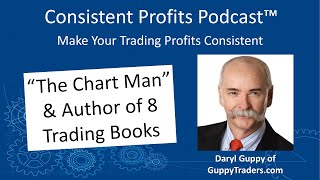
This is a YouTube video titled "038 – Interview w Daryl Guppy of GuppyTraders.com" containing an English interview recorded in November 2023. The content features Brian McAboy hosting a detailed podcast episode where he interviews Darrell Guppy, a renowned Australian financial columnist and creator of the Guppy Multiple Moving Averages (GMMA). The discussion covers Darrell's unique trading background, his development of trading tools, insights into market psychology, and current trading methodologies including the impact of AI and social media on markets. Brian McAboy leads the conversation throughout, engaging with Darrell on various trading topics and personal anecdotes.
Hello, and welcome to the Consistent Profits Podcast, brought to you by Inside out trading and Brian McAvoy, where the focus is on consistency, because when you have the consistent part down, profits become easy. Hello, everybody. This is Brian McAvoy with a new episode of the Consistent Profits Podcast. I'm really excited today to be interviewing Darrell Guppy of. He's the creator of the Guppy Traders. Thanks so much for being on the podcast today, Darrell.
Thank you for the invitation.
For those of you not already familiar with Darrell, he's known as the Chartman, and he's a prominent Australian financial columnist and author renowned for his expertise in stock market trading techniques. With a career spanning several decades, Darrell has become a recognized figure and in the finance industry, having delivered speeches at conferences worldwide and making appearances on various finance television programs. He's credited with inventing the Guppy Multiple moving averages, the GMMA, a widely used tool incorporated in charting programs like MetaStock, which is very cool. I didn't know that prior to this week. In addition to his contributions in FinTech, Darrell's a prolific writer, having authored eight books, including one specifically focused on the Chinese stock market. So also a regular columnist for publications such as the Edge, China Daily and Shanghai Security News, and he also maintains a CNBC.com column titled Charting Asia Again. Daryl, thrilled to have you here, man.
The pleasure.
So, you know, one thing I was. I love getting started with things on, you know, how. How did you wind up in trading? I mean, because trading is. We're a bunch of out, you know, outliers, and so. And especially somebody like yourself, where you're kind of unique within the trading space. How did you get started in trading in the first place?
I blame Warren Buffett. Oh. That's the core of all of my problems.
Okay. How's that?
So, and this is hard to imagine unless you visited Australia.
Okay.
So at the time, I was living in a very small and very remote community. Small. Let's define small. Less than 200 people. Oh, wow. Let's define remote. Remote means that the nearest town which has 2,000 people in it is convert this now. Won't convert it. It is 600 kilometers away.
Oh, wow.
And there is nothing in between. This, as you realize, is a great place to start being involved in the market.
Yeah. Okay.
No tv, no radio, no newspapers. Almost a complete communications blackout.
Okay.
Although, to be fair, we did get a newspaper once a week coming in by the mail plane, and we did have access to a satellite telephone that cost $40 per minute, so we didn't use it. Oh, wow. So I'm working there and I think we need to do something to generate some income. So I go into, into the nearest major city, which is 3,000 kilometers away, and I'm reading about this Warren Buffett fella and he says, invest in things, you know. So what do I know? Well, I've pushed around, I've put mining roads in, I've worked under the ground chasing gold, I've put mining camps in. I know a little bit about mining and I decide this is where I'm going to focus. Buy what you know, buy quality companies. So I bought a company called Mount Isa Mines. Then of course, I didn't have very much to put into place. I started with all of my savings. Probably not a wise thing to do, but all of my savings, a total of $2,000, and bought Mount Isa Mines, returned to this isolated community. And of course there's this interesting tracking. How's the investment going? I know we're in for the long term, but it's nice to see if it's doing something. So we get the newspaper once a week. And I've got a brand new Apple Iie computer with this program called Excel. Oh, well, it's got automatic lines and columns, so I can put a little dot here at this week's opening price and another dot next week, another dot the week after. I'm creating what I now know to be a weekly chart, but it's lagged by one week. By the time I get the newspaper, it's a week old. Okay, So I bought it at a price and it's gone up 100%. And I'm feeling pretty smart, to say the least.
Oh, yeah.
Then the next week is down a bit, down a bit further and down a bit further and back before too long, couple of months back to where I purchased it and I felt pretty stupid. So the next time it went up a reasonable percentage, 70%, I sold it. But of course, remember, this is lagged by a week. So in fact, prices continue to rise. I got an extra 10% on top of my sale price.
There you go.
This is good news. But putting all that to one side, what's it teach me? It teaches me a number of things because I'm so isolated, no news, no way to access any information about the company, what's happening and so on. I have to rely on other people telling me what is happening. I have to assume that everyone else in the market knows more than I do. But that knowledge will be revealed through their price activity. If they're confident price goes up. If they're not confident, price goes down. It's a pretty simple calculation. So by keeping a chart, a very primitive chart of what was happening, you were able to identify how other people were thinking. You were identifying the psychology of the market and the market participants, not the individual stock. Forget Warren Buffett, he might have got me there, but he wasn't going to get me out of there at a profit. So that's how I started trading. And of course, things developed from there. Having made some money on the market, you go and buy other stocks, you look at what's happening. And the important thing is that you see repeated behaviors in the market.
Oh yeah.
So because I'm not distracted by outside information, by newspapers, by news, all I have to focus on is this literally hand drawn Excel Apple 2e chart. And you see patterns of behavior, patterns of price behavior, and you see it repeated and you see the same outcome as a result. So that opens up a whole lot of what I call chart analysis. And there are two distinct methods in the market of understanding it from a trader's perspective. There is chart analysis, which use the basic price information on the chart without the addition of any indicator. Okay, so if you want to identify an upward sloping triangle or a downward sloping triangle or something similar, it doesn't require an indicator. All it requires is a pencil and a ruler, as it were. Then you have technical analysis, which aims to manipulate the underlying price data to extract a moving average, for instance, at its most simplest. And all of our technical indicators rely on that manipulation of the underlying price data and that reveals something else about market behavior. So at half, I'm a chartist, a chart man, as distinct from a technical analyst, even though I've done lots of work there. That's a long answer to a simple question.
Oh yeah, very cool, very cool how you got started though. Yeah, especially out in the middle of nowhere with no information to work with. But you turned it to your advantage, which is cool. So yeah, now as far as, okay, so you got started trading, found some success. How did you wind up going from your remote location to actually getting out and involved in the world and working with other traders?
Well, remember, this is going. If you remember the date of an Apple 2e, you realized that this is the, let's call it the pre gestation period of the Internet. And there was this wonderful thing called CompuServe, which of course was an old fashioned bulletin board. And when I moved into proper civilization, that's 600 kilometers away, the town of 2,000 people, we had access to dial up Internet and so on and this bulletin board thing called CompuServe. And I talked to a few people around trading and so on because in the Australian environment at that time the only financial information available was on investing. Traders didn't exist as far as publications, the media and books were concerned. We only had access to books coming out of the United States. So to a large extent I had to reinvent the wheel. I didn't realize it at the time, but a lot of what I thought, oh, this is brand new stuff, in fact of course has been covered by, by other people. So once I moved into that environment I continued to trade because there is an Australian dream and the Australian dream is to make a full time income from, from part time work. And that's the way I treat trading in time. Yeah, it became a full time work but never full time in the sense of having to work full time. Even today I might spend, well seeing I'm trading at the moment, I spend maybe 10 or 15 minutes looking at the screens. That's it. My decisions are made for the day. That's all that's required. The big problem is what to do with the rest of the day. But that's, that's another set of questions altogether. So from there I ended up talking to Alexander Elder and cutting long story short, he came to Australia and stayed with me for a bit of time. And he seemed to be of the opinion that what I was doing wasn't quite what everyone else was doing. Okay, I'm already a writer. I've written quite a bit of stuff prior to, to that. But I sat down and wrote a book to share trading, which was the right book at the right time in Australia. So that established a reputation within the Australian environment. Talked about trading for the first time. It talked about being able to understand market activity based on chart analysis. It talked about the ability of retail traders who were just beginning to emerge to be able to take on the market and to develop good returns out of that activity.
Yeah, very cool. Well, so what, what prompted you to, prompted you to write your first book?
I mean a lot of people writing since I was a small child. So you know, I mean it's just an extension. Prior to that I would write in, in four wheel drive magazines in things like National Geographic, the Australian version, not the international version, a variety of stuff. So I've been writing for years and years and years. Putting a book together was just an extension of what I'd already been doing in that sense. But of course the challenge is and hopefully I succeeded. The challenge is to make the book interesting because, let's face it, apart from you and me, technical analysis is pretty boring one way or another. I mean, if you want to go to sleep, read some of the standard text on technical analysis. So you have to take it into the broader public. And to some extent the success of the book would indicate that, that we were successful in doing that. This isn't a field for specialized people. This is something that you and I can do now, although we accept that today, we accept the democratization of the markets. You go back 30, 40 years and I'm sorry, that's why I've got no hair. I'm quite old. Going back to that period, the market was an exclusive domain of the rich and the wealthy. Wasn't for ordinary people. And it wasn't until we had computerization, Apple 2E's, the early PCs, that for a brief point in time, couple of years, the playing field leveled out. We had access, albeit expensive, to the same sort of charting software that was used by the professionals. Now computrack was an example of that. Computrack copy track. I mean, my, the weakest, the poorest Internet app does more than computrack ever did. But at the time, computrack was at the top of the list. Cost me two and a half thousand dollars to buy at that stage. I was living in town, you see, and I'd ordered computer tracks in the United States and it arrived with a box of about, I don't know, 12 or 14 or 15 floppy disks, little square ones. Unfortunately, I wasn't home when the package was delivered and a good friend of mine was the delivery man, so he knew it, so he just dropped it off at the door. Unfortunately, my dog, which is, and it would be popular these days, I owned a blue heeler at the time. And blue heelers are renowned for their protective skills. My blue heeler decided that this box was not a good thing, so it chewed it to pieces. $2,500 worth of software disappeared. So what I did is I wrote a letter explaining not the dog ate my homework, but the dog ate my discs. And I dipped her pouring ink and made her sign the letter and send it off. And computrack was kind enough to replace those disks.
That's pretty cool. Very cool that they did that too.
So I was very appreciative of it at that price. That was a lot of money in those days.
Oh, yeah, yeah. Well, yeah, there was things, things were a lot more challenging than they used to be. Things are so much. In so many regards, things are so much easier than they used to be. But, yeah, very cool now. So. Well, so you got. So you got popular in Australia and establish yourself there. At what point did you kind of start hitting the international scene?
Well, the important thing is I live in Darwin, which is at the top end of Australia.
Okay.
So our nearest capital city, in fact, is Jakarta, not Sydney or Melbourne.
Okay.
And we traveled frequently. It was quite easy to travel between Darwin and Singapore, which is only four hours away, versus four and a half for Sydney or Milan. And I was invited to do some work in Singapore, and for that I made a number of contacts and that began, I suppose, my. My exposure to. To international markets. John Wiley International, based in Singapore, picked up my Australian book and wanted to publish an international version of that. We did that. That involved doing some work around the region. And in fact, my book is one of my books, was first picked up by Pearson Publishing. And in that remarkable skill, just as I have that remarkable skill of being able to pick the absolute top of the market and buy it and go long, not buy it and go short. Pearson's offer to modify the book for. To encompass all Asian markets came in 1997, and it was released just a few days prior to the collapse of Asian markets, whereupon Pearson left the publishing deals. That was a bit of a flop from Pearson's perspective, but John Wiley stepped into the breach and we published a different version. So that offer from Pearson put me into broader markets. I was fortunate enough working in Singapore to work with Singaporean Chinese, not with expats. And that gave me a different perspective that took me into China for the first time. When I came back, I employed some casual staff, including a lady who was completing a degree when she returned to Beijing, I went back to Beijing. I was invited to speak at the Shanghai Futures Exchange, which I did. And then in typical Chinese fashion, a gentleman came up to me at the end of it and said, oh, can you possibly speak at the Dalian Futures Exchange? I said, yeah, we can do that. When? Tomorrow, of course, darling. And there's 3,000 kilometers away at the other side of China. And I said, well, maybe next week, not tomorrow, but you look at the expansion of those Asian markets and the China markets in particular. Oh, yeah, there's a tremendous thirst, continues to be a tremendous thirst for knowledge on how to trade, how to manage those markets. And in some of those markets, they are more compatible with technical analysis and charting approaches because of the. Let's call it the disrupted flow of information. Information is not as transparent as it is in, say, US Markets or many Western markets.
Huh. Now, do you see a big difference between, like, retail traders in the, in the Western markets and the Chinese traders, the individual retail traders, as far as, like, their attitude and their approaches.
They'Re essentially the same. We're all driven by greed, and greed is simply greater returns expected every day. That's why we're in the market. We're not in the market because we want to be a charity. We're not in the market because we want to feel good about greens or the climate or whatever. We're in the market because we want to generate a return from the movement within the market. We're in the market because it is the most effective way to deploy our capital and get a return compared with putting it in the bank or buying a property or something similar. So, again, looking back a little bit, Alvin Toffler, remember Elvin Toffler? He was great talking about the way the future was going to develop. Future Shock, I think, was his major book. But his most important book, the book called Power Shift, which wasn't very widely read, and what he argued in Power Shift, amongst other things, was that the same information could be used by multiple people at the same time and they could all benefit. And that's the market. The market gives us that same information. What became important, what becomes important, is how you grow your capital. You grow your capital through the price movement. And that's where Warren Buffett and I bid a hasty goodbye to each other. Because Warren Buffett's concerned about buy quality companies. How do we know it's a quality company? Well, I've still got it after 20 years, so it must be quality if it failed. Well, it obviously wasn't quality. That's a bit of sophistry that Buffett goes on with. But I'm not a shareholder. I don't know anything about the company. I don't pretend that I'm smarter than their executive board team. I don't pretend I know more about accounting than their chief financial officer. That's rubbish. I don't know anything about the company whatsoever. I'm not a shareholder. I'm not buying the business. I'm buying the price movement. So my task, your task as a trader, is to understand that price movement, to identify points where there is a high probability of either trend change taking place or of trend continuation taking place after a minor retracement. So we look at S and P at the moment. For instance, are we looking at the confirmation of a long term downtrend based on the head and shoulder pattern, or are we saying those targets have been achieved, therefore we're looking for a trend change that's taking place and we'll go long rather than short. So that's our role, that's our task. And I know you're going to ask me a question about why you think traders fail. Traders fail because they don't understand what they're doing. Even though they've bought a stock, I still think that they're a part owner of the company. Well, I got news for you. Your 100 shares don't count for nothing. You don't get a seat on the board, unlike Warren Buffett. You don't get to change the management. You don't get to see the insides of what's going on. You don't get to play golf with the CEO. So your hundred shares gives you an opportunity to join a price movement and get a return on your capital that is greater than if you deployed it in alternative sources. Buying a property, putting in the bank, buying bonds or something similar.
All right. Well, actually, it's funny. I mean, you just hit on something that I've been, I've actually gotten in arguments with, with some trading psychology book writers and, and those in the space and, you know, from psychology and of course we have to understand market psychology. And it's funny, a lot of what you're saying I totally agree with, but does the fact that you said, you know, with a lot of traders, they don't know what they're doing? And that was one very prominent book author in the trading psychology space. And I got, got, got on the phone, first time we're ever talking and everything. And he's like, yeah, you know, all these traders that are struggling because they have these, you know, deep, you know, psychological issues probably go to their child, you know, go back to their childhood orever. And I'm like, no, most, the biggest problem most traders have is they're trying to do a job that they haven't been trained for. They, they don't know what they're doing. Not that they're stupid. They just haven't been properly trained. And that's why it's so rough. And yeah, just learning things like what you're talking about. It's under start to understand price movement and learn how to deal with the market, understand your real role in all this. And it's a, it's a skill set that most people can learn. It's not, you know, a natural gift. It's just, okay, are you going to learn what you need to learn. And so that's hilarious. You're. The way it came out was a little bit harsher than I might have put it, but it's still spot on. So hilarious. Well, now, as far as one question I did want to ask you, as far as, you know, of course you're not necessarily what traders, you know, lose, you know, lose or fail. But, you know, since this is the Consistency Profit podcast, I have to ask, as far as traders who are kind of, you know, they're, they're, they're surviving, why, what do you see is probably one of the bigger obstacles to being able to make consistent profits for most traders?
The first goes back to my previous answer, and that is we are not buying the company. I'm not buying the family business, I'm not buying part of the corner store. So push that to one idea, push that to one side because that's a major barrier to your understanding the relationship with the, with, with, with the market and the price that you're, the trading that you're doing the other. And it slipped my mind from that, which is a bit of a problem. It will come back. The other is to understand that you don't know what's going to happen. And it comes back to a philosophical standing. We all like to believe that we have some control over the outcome of any event. If we're driving a car, it's better than an AI driven car because we're smarter than any AI and we know that we can avoid that pedestrian. Oh, snap, were quite right on that one. We know that if we pick the numbers in a lottery, that that's better than having the numbers picked for us, this illusion of control and we bring those attitudes to the market. So really, if we're talking about the underlying elements of success in the market, it comes back to our thinking about the market. And we very rarely examine this in any detail. We charge off with a whole baggage train of preconceptions and habits and ideas that are unacknowledged trading. The market is first and foremost about harm minimization. Okay, let me say that again. It's about harm minimization. Now you can put that in terms of lacing a stock loss. How many people use a stop loss? Everyone says, oh yeah, I use a stop loss, except I haven't actually put it into the market and I forget to put it. And when it gets to that price, I know it's going to go up, so I won't put the stop loss there. So very few People, the correct question is, who uses an automatic stop loss? Something that's pre positioned in the order very few people doing it. We talk a lot in these trading psychology books about habits. Yeah, quite true. And what are they going to do about it? They're habits because they're habits. They're habits because we can't or won't or don't change them. Let's take the most serious stuff. Not losing a couple of thousand dollars in the market. Not losing $100,000 in the market. Let's take the first heart attack that you have, and you go to the doctor and he says, oh, you got to do this. You got to stop drinking grog, you got to stop eating so much chocolate. You got to exercise more. You got to get out of that chair you sit in nine hours a day, blah, blah, blah, blah. And we do that for about four weeks and then we stop. Because those are habits that we have. And eventually, of course, we die. Get run over by a bus. Not a heart attack, but nevertheless, you know, that's the ultimate conclusion of life. But the important point is our habits are there for a reason. We can't change them easily, but we can minimize the harm that we do. Now, what are my nasty habits is that I've never met a bar of chocolate that I didn't like. If I have, we live in a hot climate. If I have chocolate in the fridge, then it has a limited lifespan. The only way I can avoid, the only way I can break that habit is not to have chocolate in the fridge to make sure that I'm as far away from chocolate as possible. But I can't change the habit. I can change. I can minimize the harm that it does. Same in the market. We can't change our behaviors. We should have sold at the top, but I didn't because I wanted more. That's a habit I should have bought here when the market gave me the first entry signal, but I didn't. That's a habit. Okay. Recognize what your habits are, then develop strategies to minimize the harm that those habits are doing. That's a much more successful approach than saying, oh, yes, I've got to change this habit. I've had it for all my life. But I'm going to throw it out the window and change it as of tomorrow. Yeah, well, good luck with that.
True. Very true. Yeah. And we're all human, so.
Yeah.
We're all susceptible to things. Sure. Actually, you know, that was one of my favorite things in Nicholas Darvis's story, when, you know, he Was traveling Europe and, you know, had his, Had a successful run and came back to the States. And because it was, you know, being all proud and everything and, you know, Z goes a little boosted. He set up an office in his brokers or set up a desk in his broker's office. And then he's hearing all the, all the other brokers talking and all this kind of stuff. And his performance just started tanking and he's losing money left and right. Packed up and moved into a hotel and said, don't call me. I don't want to even talk to you. Just send me a cable like I've been doing. Because I know that if I'm hearing all this stuff, I'm going to fall prey to it. And I just, I can't do it.
And so I can't, I can't remember which of the market wizards wrote it in Jack Swager's book. But he said at the time, you put a ticker machine on your desk and you will feed it money. We don't have a ticket machine anymore. We've got a computer screen sitting in front of us with all that stuff running and we feed it money. Nothing wrong in doing that. Inevitably, it's what we're involved in, but we need to recognize those, those changes and changes. Now the other thing just. Can I have a, can I have a little pet whinge here? A bit of a groan, bit of complain. Psychology in the market is essential. There are two factors. If I'm looking at a stock and a chart and whatever, how I am thinking about that chart, how I am reacting to that chart, is probably the market psychology writ large. I'm not thinking something different. My reaction to a rising stock where I'm sitting on a large profit is the same as yours and anyone else's. If I can recognize those reactions, I can trade with them or I can trade against them. That's the emotions of the market. That's number one. Number two, these psychological studies that are done with university students, and then we extrapolate from those to say, this is how investors behave. Well, as soon as I read that page, I take the book and I put it to one side, usually for disposal. Why I've been a university student. You may have been a university student. When I was a university student, to use an Australian terms, I was on the bones of my ass, no money. So if someone's offering me a free pizza or $10, I'm in for it. No problems at all. So we've got all of these psychological experiments where what's at risk? A cup of coffee, $10. You try making $10,000 at risk or $50,000 at risk or $100,000 at risk. The psychological changes are dramatically different. So the idea that we can extrapolate from some poor poverty stricken university student who thinks two cups of coffee is Christmas, all come at once and put that into market behavior is false. And if we rely on that idea of psychological analysis of trader behavior and market behavior, then we are misled and we end up making decisions that are not optimal in a trading environment. So, yeah, that's the end of that particular Winjian complaint. It's one of my favorite complaints about the behavioral analysis of the market.
Oh yeah, no, well, you got a valid point though, but hilarious at the same time. So. Yeah, don't be talking to college students because everybody, most, most college students are. Yeah, like I said, they are flat broke and, and learning. Learning to be poor. Yeah, how hilarious. Okay, well, all right, okay. So switching gears just a little bit, you actually created like the gmma. And, and so, I mean, there's a lot of people, you know, they've written books, they've, you know, they've done some things in, in the trading space. But as far as coming up with, you know, your own like, trading tool, how the heck did you do that? And as far as actually being able to, you know, claim it for your own, how'd that go?
Well, the simple answer to that is that it's designed around the limitations of software. So like everybody else, I'm sitting down there and I'm trying to work with moving averages to move the point of the moving average signal crossover as close to the actual pivot point, low of a downtrend to an uptrend.
Okay.
So I want to get in as close to the absolute bottom as possible. And the software I was using at the time would only allow me to plot six moving averages. So I plotted six moving averages and I plotted another six moving averages. They became long term and short term moving averages. And what I observed was that despite the tremendous differences in length from a three day moving average, in other words, about half a week, half a trading week, to the 60 day moving average, which of course is commonly used in the United States for investment purposes, that the crossover points, the compression point behavior in those was almost simultaneous. You would expect to see this tremendous divergence, this tremendous separation between those two sets of signals. So the question becomes, this is repeated behavior. We see compression in the short term group and we see compression in the long term group occurring Within a narrow, an unreasonably narrow window of opportunity. Why is it happening? First you observe the behavior, then you try and explain that particular observation. Now my observ, my explanation may not be accurate, but the way I understand, the way I interpret it is that the short term group represents the thinking of traders. And when there is compression, there is a point of agreement about price and value. Now this isn't Walmart. There's not a set price of what's sitting on the stock, on the shelves. As soon as there's an agreement about price and value, some I hesitate to use the term, smart ass is going to come along and say, oh, it's worth more than that. I'll buy it at this price because I think it's going to be up here. Or I'll buy it at this price because I think it's going to be down here. So the points of agreement about price and value are fleeting, they're not extended. So when you've got this compression that takes place in the short term group amongst traders, agreement about price and value, it is most often followed by disagreement. That's a useful observation in itself. But when you see the fracture, repetition and you can go into all the detail around chaos theory and complexity theory, fracture, repetition and strange attractors become an important part of the background of, of this analysis. It's not where I started from, but it's what explains what happens. So you look at the long term group and you've got this compression that takes place almost simultaneously with the short term group. What's it tell us? It tells us again that there is an agreement about price and value. Now if that occurs at pretty much the same time as the traders are reaching the same agreement, then you've got a powerful force that's saying the value is going to change. The, the price assigned to the value of this stock is going to change and change substantially. Now initially we applied that purely to stock markets, but we found that it also applies to futures markets, to commodity markets, to foreign currency trading. The same relationships, although we still talk traders and investors, just for convenience. It's about capturing the point at, where fractional repetition begins to replicate. And that's, that's where you're jumping in. It's the psychology of the market. So think about it. You and I are traders. We can be represented by the short term group. What are we after? I'm not greedy. I want anywhere between 30 and 50 to 60% from the trade. That's it. Anything less than 10%, it's a mistake. I don't want to really be involved in it. So a couple of trades I've taken the last couple of days. Returns have been 25 to 45% and they've been over a 10 day period or less. That's easy. You and I can make that decision and if it works out, we can choose to tell our partner. And if it doesn't work out, she never needs to know about it. But the investor is a different environment.
Right.
I've got a Monday morning meeting and I've got to convince my panel that it's worth putting our funds into this particular stock. And that takes time. There is a lag in that process. You and I saw the opportunity last week. This week I'm taking it to my fund manager board and they won't make a decision for another 10 or 12 days. That's interesting in itself. But what's more important is although the fund managers advertise themselves as having points of difference, the reality is that those points of difference are so small that in effect they all think in much the same way, reach much the same conclusion at much the same time. And we see that reflected in the long term group of moving averages or where they slowly compress but then begin to slowly or quickly expand. Expansion shows disagreements about price and value. Compression shows agreement about price and value. So when both groups, short term traders and investors reach the same conclusions about price and value, then you have the beginnings of a powerful move taking place. That's what I want to identify. So I've done chart analysis. That's my starting point. I've used really complex tools. I've drawn a trend line and prices moved above the trend line. I've applied a self adjusting volatility measure to determine whether the breakout that's taken place is a genuine breakout compared to previous volatility or whether it's just an aberration. But then I want to understand whether the market is thinking the same way as I am. And that's when I apply GMMA analysis to confirm that basic chart analysis. And if it all ticks up, that's where I buy. And there's a high probability, an increased probability that that breakout will be genuine. Not all the time, but consistently enough to provide me with a comfortable living.
Very cool, very cool and excellent insights that are, that's good reminder for everybody. Yeah. As far as just keeping in mind the difference between price and value. Yeah, that's, that's, that's excellent. Now as far as what you're doing now, you, I mean, you know, you still you still, you're speaking, you're still writing stuff, right?
Oh yes.
What's one of the main things though? Like if, if one of our listeners, they want to, you know, find out more about or you know, maybe they want to follow you or learn more, do you have the, you know, particular place that's good for people to connect with you and what do you have going on right now that would be useful for the, you know, for the individual retail trader?
There's a whole series of questions there. So let's see if I can remember them all and answer in detail. First of all, we produce a weekly newsletter. In the weekly newsletter, it's not about stock tips, it's about trading methods and techniques that are suitable in the current market conditions. So what's the biggest challenge we have at the moment? What keeps us awake at night besides losing positions? Artificial intelligence. Is artificial intelligence going to make you and me irrelevant? Does artificial intelligence spell the end of independent retail trading or does it give us a whole range of opportunities? Now we think I only trade from the long side because I'm always optimistic. I think it gives us a whole range of new opportunities. It doesn't invalidate the tools we're using, but it may need to change the way that we apply them or the weightings that we apply to them. So we say GM and A is most important, followed by a trend line break, followed by a countback, line confirmation, etc. So we have weightings in the indicators that we use, we may need to change those, we may need to introduce some new material. And what we're finding, AI and social media, that's it, that's its bastard's child, as it were, is giving a whole range of recommendations to the uninformed, the ill informed, the ignorant, all of whom have money and they put it into the market. So how is that changing the behavior of the market? It's being driven by AI, but doesn't mean it's smart. The followers don't have AI in their favor. So what changes in behavior are taking place? So one of the things that we're being investigating in our newsletter, just an example of the sort of work that we do, is some old work that was done at the turn of the century by two gentlemen called woods and up around float analysis. Now the idea behind that is that we know that let's say there's a million shares on issue, but only 500,000 of those are available for trading. The rest are tied up in fund management, in escrow or scroll or whatever. So Although there's a million shares on issue, only 500,000 is available for trading. And there are some services in the US in particular that help you identify what they think. That free float is not a big favor of that. I like to work with the basic information of the chart. So what we've done, and we have it in our own software that we use, we're working with Meta stock to have these in Meta stock coming out in the next upgrade. Let's take a chart. Okay, it's gone up, it's gone down, it's gone up, it's gone down. Clear trend behaviors. Let's plot the cumulate accumulative volume between that low, okay, trend low and that trend high. Let's say it's 500,000. Just to use the build on the example I gave before. Okay, let's project that 500,000 volume forward. Does it match another trend changing point that's projected backwards? How reliable is that figure in matching changes in the trend? And what we find with some stocks is that it is exceptionally reliable. It is exceptionally compatible. We might need to optimize it a bit. 550,000 for instance. But we can overlay this on a chart and we can identify that this price move has consumed most of the available free flow. And that's inferred from historical trend movements.
Right.
That's an important point because if I've got a signal, a breakout above a trend line confirmed by a volatility measure and we use either traders atr, which is around our own adaptation of the way that Wells Wiser's ADR is displayed, or whether using a countback line. So we've got a variety of confirmation signals that the breakout is developing and 98% of the free float has changed hands. That becomes an additional confirming factor that says there is now a higher probability that this trend change is going to develop. Or we get a mid trend entry, temporary price weakness comes back to the uptrend line. Do we buy or not? Let's look at the volume turnover. Oh, only a quarter of the free flows has changed hands. Therefore there's a higher probability this uptrend will continue. There'll be a rebound and a trend continuation. So it's an added tool. What we're finding is in the last 10 or 15 years it was largely archaic. It was an interesting anachronism. Didn't really have much significance in the market. But with the increased impact of AI, we're finding that float volume analysis inferred. Float volume analysis is giving us an additional edge in identifying those stocks that are likely to genuinely move in a breakout, they confirm the breakout or help us to identify an entry opportunity on temporary trend weakness. Because you know that situation, you buy, the price comes down, it hits the trend line, you buy, and then it continues to keep on falling down. And that's been happening in increasing levels. What's it driven by? It's driven by the surges of uninformed buying and selling that comes into the market that are driven by social media. And social media itself is more being driven by AI. I think there's probably a third question there that you asked that I haven't answered. If you can remember it, I'll answer it, but I can't, so I won't.
No, no. And you did really well with that. Mostly, you know, just what you've got going on now. And, and yeah, as far as, like we talked about, you know, want to circle back to your, your newsletter because. And, and actually I do encourage everybody that's listening if you do like staying on top of, you know, develop current developing trends and what might be on the horizon and how to take a look at it, you know, or, you know, utilize it in your trading. It sounds like this newsletter would definitely be of interest to you, so definitely want to.
Let, let, let me say two things. I remember the third video. I was going to say the newsletter examples, they're not theoretical, all right? So we apply them to contemporary current markets we don't have. We don't identify the stock we're using as the example because we're not licensed investment advisors. And we track that performance over the next three or four or six or seven weeks, depending on how the trade develops. If the trade fails, we analyze why it failed, what changes we need to make in the methodology to make it work. If it's successful, we need to verify it across multiple trades and so on. So it's not, it's not theoretical stuff. It's not based on 162 years of analysis of the Dow. No, it's based on stock ABC at the entry price based on Monday this week. And we track it over the next four weeks to see how the technique has applied and whether it's valid. So although it won't give you which stocks to trade, it says, here's the situation and we provide all the search criteria that we use, all the analysis techniques that we use, and say, okay, now you go out, you apply this metastock coding to your own searches, and when you get something that looks like what we're talking about, then Maybe you can apply the same techniques that we're doing. But the bit that I did forget to mention is that we finally achieved international social media notoriety.
Really?
We've got a scam in operation. So be aware, the only place where you can get genuine material from Guppy Traders is from our website, Guppy traders dot com.
Okay.
Anything else that's out there on social media that claims to have me giving you stock tips, etc. Etc. Is a scam. Okay, now that was an honor to be the subject of a social media scam. It's not something we want people falling for.
Yeah, funny. I mean, not. Not cool, but still funny. Yes, in that point where people are going to copy it. Yeah, very cool. Well, Daryl, this has really been excellent. I've thoroughly enjoyed this conversation with you. And yeah, you've got some really cool perspectives on things. So, yeah, thank you for sharing your insights and your. Your outlook on different aspects of things.
And for everybody, let's remember, yeah, uncommon results do not come from common thinking.
True, true good advice. Well, and common actions too, like, so the uninformed. So, yeah, very cool. Well, any other final words of wisdom for. For our listeners today aside from swing by and get your newsletter?
I think I'd repeat what I said earlier, Brian. Yeah, There are two features. One, trading is about harm minimization and the use of a stop loss is part of that process. The second is you need to decide whether you are with Nostradamus or whether you are with the French philosopher Albert Camus. Nostradamus says, of course, I can predict the future. And there are a whole range of approaches to trading that say that this is the case. Albert Camus, of course, is one of the French existentialists who came out prominence in the 1950s and 60s, and he says, I have no idea what's going to happen. The best that I can do is manage my reaction to the future as it develops. And that's where I sit, and that's where I think all traders should be sitting.
Good wisdom indeed. Well, again, Darrell, thanks. Thanks for. Thanks for doing this. Everybody that's listening applaud you for being here and taking the time to, you know, learn and develop yourself as a trader and broaden your knowledge base. So, you know, if you enjoyed the podcast, definitely subscribe and share it with your friends. And Darrell, again, thanks for being here today, man.
No problem. Thank you very much.
And we'll go and wrap things up. And yes, everybody, make sure you go in and subscribe to the Consistent Profits podcast. We'll see you on the next episode. Cheers thank you for joining us today on the Consistent Profits podcast brought to you by Inside Out Trading. Make sure to swing by Inside Out Trading and pick up your copy of the proven formula for consistent Monthly Profits. If you enjoyed the show, make sure to subscribe on your favorite channel and we'll see you on the next episode. Cheers.









