039 – Interview w Rob Carver, Book Author & Systematic Trader
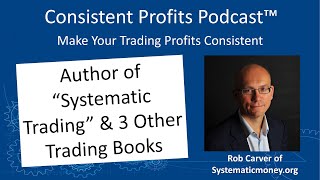
Rob Carver, a systematic futures trader and author, discusses his career path, trading philosophy, and strategies. He covers backtesting, risk premia, and how retail trading differs from institutional approaches.
Hello and welcome to the Consistent Profits podcast brought to you by Inside out trading and Brian McAvoy, where the focus is on consistency, because when you have the consistent part down, profits become easy. Hello, everybody. This is Brian McAvoy with a new episode of the Consistent Profit podcast. And welcome. I'm excited today to be interviewing Rob Carver. He's a writer and professional trader. Thanks so much for being on the podcast today.
Thank you, Brian. It's a real pleasure to be speaking to you today.
Yeah, glad to have you, man. Now, for those of you not already familiar with him, Rob is an independent systematic futures trader, writer and research consultant. He's also currently a visiting lecturer at Queen Mary University of London and a research advisor to Stylus Digital, a hedge fund trading digital assets. Rob has authored several books including Systematic Trading, Smart Portfolios, Leverage Trading and Advanced Futures trading strategies. Until 2013, Robert worked for AHL, a large systematic hedge fund and part of the Man Group. He was responsible for creation of AHL's fundamental global macro strategy, and then he also managed the fund's multibillion dollar fixed income portfolio. Prior to that, Robert worked as a research manager for CEPR and Economics think tank and traded exotic derivatives for Barclays Investment bank. Spent his early career in the Middle East. Rob is also. He also has a bachelor's degree in economics from the University of Manchester and a master's degree also in economics from Burbank College and the University of London. Again, thanks for being here and being game for the interview, Rob.
No problem.
Now, trading is kind of an outlier occupation. It's, you know, not one of the normal things that people do and choose for, you know, what they want to do for their living. So I always have to ask, you know, how did you wind up in trading?
Yeah, so you read my bio there briefly. So what, what it doesn't say is that basically I went to university when I was 18 to study computer science and decided after about a year that that wasn't for me. And then I worked for a few years and then. And then I. I wasn't still really sure what I wanted to do, but I got quite interested in markets of finance, so I did a degree in economics. And then at the end, towards the end of that degree, I was applying for jobs and the first people to offer me a job was an investment bank as a trader, which was a bit of a surprise to me because I hadn't actually written under my form, I hadn't put trading as one of the things I was interested in. And I was quite surprised when I got to the interview stage and the guys interviewing me were head of this trading desk and head of this trading desk. I'd kind of expected, given my background and the fact that I'm a massive nerd, that I'd be working in research or something, or economic research. But yeah, the only thing I can possibly think of is that when I apply to the bank, they do this psychometric test to work out your personality type. And presumably, although I like to think of myself as a nice guy, presumably the psychology test came back saying, oh, this guy's a sociopath, he should definitely be a trader. And I'm not a huge believer in the sort of accuracy of those tests because actually that wasn't something that I really enjoyed either. So I did that for a couple of years and decided I really didn't like trading, went, did something else for a bit, but. And then, and then what I worked out was actually I actually do enjoy trading, but I don't enjoy trading in a, what I would call a kind of manual discretionary fashion. So, you know, making trading decisions myself, what I actually really enjoy doing is designing trading systems that do the trading for me. And I was very fortunate to get a job doing that for AHL for many years. And then, you know, for the last 10 years I've been doing the same kind of thing, but with just my own money.
Oh, okay, Very cool. Well, so how did your academic studies, you know, at the University of Manchester, how did that kind of shape your understanding of the financial markets and market strategies that, you know, that you took into your, to your job?
To be completely honest with you, I don't think, I mean, you know, learning stuff like macroeconomics, it's, it's useful to have, to have a kind of vocabulary. So, you know, when, when I was working as an interest rate trader. So it's useful to have vocabulary to understand what central banks are talking about when they talk about, you know, monetary policy and things like that. But I would be surprised if there are really many traders who are using kind of, you know, these economic models to make trading decisions. I, I certainly wasn't. The closest I can come to it was when I was designing trading systems for ahl. We designed a system which basically tried to model the policy response of central banks. In other words, to say, okay, what do central banks say that they do? Well, they look, broadly speaking, they look at inflation and they look at economic growth, unemployment, measures of how well the economy is doing. And what we found interesting was that although at the time, take the bank of England or the ECB explicitly said that they did not consider economic growth, they were purely focused on inflation, whereas the Fed had a broader mandate. We actually found, we looked at their response functions that, well, they were lying or not telling the whole truth because actually they were responding to levels of unemployment, inflation, which is what you'd expect. But we're doing that purely, of course, to try and predict the path of interest rates more accurately than the market and therefore build a profitable trading strategy on that basis. But that's the closest I've got to using kind of economic theory, I would say. On the other hand, the kind of quantitative tools I learned doing economics, I use every single day. So that's been a massive help. Okay.
Yeah. And actually you touched on one thing that's kind of a big deal for me in trading. And really when somebody's learning anything, and that is that you got the vocabulary that is so huge, it blows me away how I'll talk to traders and, you know, we'll be talking about things and I'll say, well, okay, we're, you know, we're throwing the term trend back and forth. What does trend mean to you? And it's funny because I found I can ask, you know, eight different traders, you know, how do you define the term trend? Or how do you define a trend when it begins, when it ends? And I'll get all kinds of different answers, same thing, with support and resistance. And that's just, you know, the, the sloppiness of the use of the words within trading or the lack of clarity about them. And, and a lot of times traders, you know, I'll ask them, oh, you know, okay, so you're using the macd. What does that tell you? What does MACD even stand for? And they're like, oh, I don't know. It's like. But you're using this and you're trading. You don't even know what it is and what it's telling you.
So, yeah, this, yeah, this reminds me of an old joke, actually, which is if you, you ask two economists for an opinion, you'll get three back. Actually, if you ask me what trend means, I can give you about 17 different answers because I actually use seven different ways of modeling trends in my model. In fact, there was actually a specific issue with maybe not the word trend, the word momentum, because the momentum factor in theoretical economics and also as it's used in equity neutral hedge funds means relative momentum. Whereas to futures traders, CTA traders like myself, it means absolute momentum. It means the price of an asset Ignoring everything else, not relative to something else. So that's an example of a kind of a jargon failure. The other thing I found actually in the last 10 years I was working in a sort of purely institutional environment and actually the kind of language used and the models used in that environment, completely different from what the average sort of trader in the retail space, we call them a technical analysis, would use. So for example, you use support and resistance. Ten years ago I didn't know what they are, what they were, although, you know, I was managing a portfolio of billions of dollars without knowing what those things were because that's a concept that wasn't used in the institutional space. Now I know what they mean, but I still don't use them because I'm still using models that are more institutional in nature rather than retail in nature.
Cool. Interesting. Interesting to know because, yeah, support and resistance, that's like almost everybody uses them in some form or another. That seems in the retail space. Huh, Very cool. Now, one thing I wanted to ask about, you know, kind of again, going back to your, your early career that you actually haven't noted in your, in your bio that your career started in the Middle East. Why is that noteworthy?
Oh, it's not noteworthy. It's just my shorthand of way of saying, oh, I, I used to do stuff that wasn't finance. So yeah, when I, when I dropped out of university after I said so backstory, I was actually brought up in the Middle east in Divine, to be precise, I moved there as a kid. And apart from this brief spell at university when I was 18, I actually lived there till I was 25. So I spent quite a lot of, I spent quite while a, almost half my life they're living there. And yeah, and the sort of gap between being thrown out of university doing computer science to going in back into university to do economics, I was working in the Middle east in completely unrelated field relating to sort of obviously the oil industry, but also the shipping industry. So it's quite, quite fun for me actually now when I'm trading commodities to actually think about the times when I was literally standing on a ship, you know, counting bales of cotton, going into a ship or something or you know, doing a dry bulk survey on a, on a crude carrier too to, to measure how much crude had gone out of it. And now I'm trading this stuff. So one step removed. But I, I guess in most futures traders probably haven't had the experience of dealing with a physical commodity and I have, has absolutely no bearing whatsoever on, on My trading. But, but it's, you know, it's quite cool, I guess.
Oh yeah, yeah. Well, being able to, to do that though, that gives you a different kind of sense of reality about it though. I mean, one thing I've. I took note of when I very first started trading, I started in commodities. It was what. And one of the things I liked about them is at least they're a tangible thing. Stocks and stock prices, very abstract.
Why does that matter?
Say again?
Why does that matter?
Well, for me, I just, I liked it because at least the way I looked at it is the price of those things because they're physical goods.
There.
Will be some basis in reality for supply and demand. A lot of other instruments like currency pairs, stocks, those things, it's purely abstract and it's what people think. And so those things, that's why stock can go to zero in a day with real estate and commodities, tangible things, like I said, at least there's some attachment to reality.
So, I mean. Yeah, I'm going to interrupt. I'm going to interrupt and disagree with you quite a bit, to be honest. I mean, I remember when crude oil futures went below zero like three years ago. So not for a brief briefly, but yeah, yeah, so. So I take quite an opposite view, I guess. So my kind of starting point because I'm trading systematically and I want robust trading models is that unless I have strong evidence otherwise, I'm going to. I treat everything the same. So I treat S and P the same way as gold is, the same way as bonds, the same way as corn, the same way as butter and so on and so on. And actually the, the kind of identification of the asset I find unhelpful. So, so, you know, understanding or having thoughts about how an asset trade actually find unhelpful. So I have to really stop myself from kind of doing something different, say in a fixed income space because that's my kind of, you know, financial background. Because I, in my head I know more about fixed income space. But actually that's quite dangerous. What I really want to do is treat all of these things like exactly the same and just as they're just numbers basically. And my prior view, and I have strong evidence is that the behavior of those numbers should be no different from the behavior of any of the other numbers. I sometimes think maybe I should just relabel all of my instruments, just A, B, C, D, E and so on and so forth. But you know, that that will lead to practical problems and it obviously is quite useful to be able to say okay, what's my position in, you know, instrument xyz? Well actually it's easy to say what's my position in us 10 years. So. But yeah, I guess this is a difference between discretionary traders think and how systematic traders think. To me, as a systematic trader, your prior should always be to treat things in a very abstract way and because you don't need to understand the fundamentals to, to build the model.
Oh yeah, that was just, I was just referring to my affinity for the marketplaces, that's all. But yeah, yeah, and as far as what you're saying with, you know, how to trade. Yeah, indeed, because we're talking markets, we're not talking the actual things themselves. So yeah, yeah, on that we agree. I think that was just that that's a little bias mine that I've heard that I've always had from preference, that's all. Well, so somewhere along the way you decided to write a book. So what prompted you to write your first book?
Yeah, so as I said, I left, I left the sort of institutional trading 10 years ago and I wasn't sure what I wanted to do. One thing I did want to do was build my own system from the ground up, sort of a full stack. Whereas before I'd focused on a quite a small part of the system, which is basically the part of the system that says, you know, given price, what is position? I'd never worked with the kind of nitty gritty of getting prices in, cleaning them, having price databases, you know, and then actually connecting to trading APIs and all this kind of stuff and building execution algos. And as my background, you know, way back wasn't computer science and I'm still very much interested in programming, I thought that'd be a fun thing to do. So I, I set about doing that and while I was doing that, I was, I was contacted by a, a publisher who was like, well, you know, you got any ideas for books? And I'm, I, I'm, I thought well yeah, I could, I could write about what I'm doing now. I could write about the process of designing a, a systematic training system from the ground up and that, and that's basically where, where the, the first book came from, which you know, unimaginatively I call systematic trading. But I was surprised that no one else had already taken that title, to be honest. So it was too, too good, good of one to turn down. So yeah, that, that's where it, where it came from. And this, the same goes in my second book. I was looking at My sort of long only investments in ETFs and shares and that's something I had actually been. But whilst I was working in the systematic space, actually quite ironically, my share in ETF investing was very unsystematic and I had a very messed up portfolio with lots of names and no kind of real process behind it. So again I sat down about thinking about what's the way to apply what I know about trading futures systematically to trading stocks and ETFs systematically on a long early basis. And again that's where the second book came from. So it's all kind of grown out of things I've been doing and then trying to explain to people how I do things.
Very cool, very cool. Now as far as the, in your systematic trading book, how did you wind up settling on and just in what you use? I mean there's, there are tons of different strategies for trading as you know, I mean literally dozens of just high level, at the high level, you know, different strategies. What strategies do you favor or strategy areas or thought processes do you favor and how do you address them in your book?
Well, I think a lot of this is path dependent. So I came out of a fund ahl that was part of the CTA space and therefore the bedrock of what we did was trading trend, trading momentum and specifically at the time when I was there, I'm not pretty sure it's no longer true. The kernel of our models was using exponentially weighted moving average crossovers to determine trend direction strength at a given speed. So that was the. And also those models are really good, I mean particularly. And they work across lots of different asset classes and they work across a range of different speeds and they're probably the, they're quite a, I mean they're not as simple as some other, you know, rules out there but, but they're probably one of the simpler rules is actually any good, I would say. And they do things like for example, adjust for the level of volatility in markets automatically so you don't need to have special calibration for different markets because as I said my prior is to use the same model in every single market if I can. So that, that was the, the first trading rule that was in there and the other second trading rule. And so this surprising thing perhaps about this book is it only has two trading rules in it because I didn't want to say to people here's a bunch of rules you can trade with because actually I believe that's not the most important part of building a trading system. I Believe it's all the other stuff around those rules. So I only included two rules, but I thought it would be one of the things I wanted to explain was how to combine rules of different styles. So the other rule I turn to is carry, which is, you know, kind of well known in FX trading, but you can apply it to any asset class and you know, academic work's been done showing that in, across all asset classes, carry plus momentum explains quite a big part of the return, you know, sort of 70, 80%. So with just those two trading rules, you can actually build a pretty decent trading system. So that, that's why I chose those two rules. Now what I did in my last book, Advanced Futures Trading Strategies, was to say to people, well okay, everyone, everyone wants more rules. So here's a whole bunch of rules as well. But that first book was not about so much about rules. The rules were just there to explain how the system worked around those rules.
Okay, now again, going back to jargon for those not familiar with the term carry. How do you use that, what does it mean and how do you use that?
Carry is basically the expected return if spot prices remain the same. So the easiest example is probably something like, let's say buying stock on margin. So if you buy some stock, let's say the stock's yielding, I don't know, 4%, but to borrow money to buy that stock you've got to pay 2%. So the difference between those two rates is 2%. So that means if the spot price of the stock remains unchanged, you're going to earn 2%. So your carry on that stock is 2%. So that would give you a long carry signal. If, on the other hand, the dividend yield was lower than the funding rate, it would be a negative carry position. And you can apply this to FX where the, it's the difference between the two currencies, interest rates. You can apply it to futures where you can compare the spot and the futures price or you could look at, you know, two different futures price prices potentially. So there's, there's different ways of calculating, but fundamentally the same, it's the same thing. It's what, you know, what's my expectation if spot prices don't change? And this, this would not. Basically the way I think about this is the following, this is sort of, you know, if, if kind of there was no way of making money out carry, then what would happen was the, the spot would move against you by exactly enough to offset this return you expect to get basically. But that's not what Happens in fact, you end up on average earning that return over time and actually even slightly more. So it's quite a nice strategy and it complements momentum quite well because generally speaking it's not always true. But generally speaking it's a bit more like a value or a mean reversion strategy. Generally speaking, if prices go down, the carry you're likely to earn on something will go up. So let's think about stocks again. If prices of stocks go down but dividends remain unchanged, then the dividend yield will increase. So you know, if the price halves then instead of having a yield of 4%, you'll have a yield of 8% and the carry will go from being 2% to being 6% so it becomes a much more attractive asset. So generally speaking, carry is a bit more like a value, I mean reversion strategy. So it tends to be quite low correlated to momentum. So it makes a nice package putting them together, huh?
Very cool. Excellent. So you said in your first book you just, you look at those two but in your last book, the Advanced Futures Trading Strategies, you, you have a bunch more in there. What are, what are some of the, what are some of the others? And why did you include them? Or they just like one or two. What are, what are one or two of the others and why did you include.
So a big theme of what I do is I, I, I'm not, I don't believe that I have what I would call alpha, which basically means I don't believe I have an edge really. So people may find surprising. So the reason I think I make money as a trader is because what I'm doing is collecting what academics would call risk premia. So basically I'm taking all risks that the market is unhappy taking on and therefore the market is willing to pay me for taking on those risks. And so the kind of most well known risk premium is the risk of owning stocks. So stocks are risky, people don't like that risk. Therefore on average owning stocks earns money because you're being paid a risk premium for owning stocks. But I believe there's also a momentum risk premium and a carry risk premium. Therefore I expect to earn returns from hauling assets with exposure to those factors. So what I'm, what I try and do. My, my trading strategies have as many different of these premium as possible. So to take another example is there's something called the SKU premium. So skew is the asymmetry of the return distribution. So if you think about something like stocks, stocks tend to be negative skewed in other words, really bad days are more common than really good days. So if you look at the S&P 500 over the last 100 years, the number of times there's been a fall of more than, say 5% in one day, it's probably about four times more than the number of times there's been a rise of more than 5% in one day. So those extremes are much more likely on the left, the left tail. So people don't like negative skew. People don't like owning negative SKU assets, they like owning positive skew assets. And the most extreme example of the positive skew asset is a lottery ticket, because it's an asset where your downside is very, very small, but your upside is extremely large, but obviously very unlikely. People love lottery tickets. We know they'd love lottery tickets because they're willing to buy them even though their expected value is roughly 50 cents on the dollar. So you know, you buy all the lottery tickets in the draw, on average, you'll earn 50 cents in the dollar. So we can make money from this by saying, well, skews are risk premium. So therefore, if we own negative SKU assets or assets that are more negative skew than they are normally, then we'll earn extra money. So what we can do is something like look at the skew of returns over the last, say six months. And the more negative that is, the longer we want to be that asset. And what that will mean is you will tend to be long assets like say stocks which go up over time. You'll tend to be short assets that have very strong safe haven characteristics, like for example, VIX futures, which are basically a bet that volatility is going to rise. And therefore, you know, they tend to go down over time. But you'll also be long assets that have just recently had a horror show. So if something sells off drastically, you know, then, you know, so if the stock market's just crashed, then you'll load up even more on stocks because stocks have become much more negatively skewed, basically. So that's an example of another one of these sort of risk premium type strategies that I like.
Huh? Yeah, very cool. Well, just the, the whole way you're viewing your trading in the markets and I mean, even speaking in terms of risk premium and stuff like that, I've only heard that in a very small, with a small percentage of people that I've talked to. So very cool you're taking that approach to it. Now as far as the. So you've gotten your books, um, how, how are you generally? Well, do you have any other books that you still want to write or that you're working on?
Yeah, so the only book we haven't mentioned is my third book which is, which is about trading with leverage, but sort of a bit more for kind of beginners, if you like. Okay. So I want to write a similar book but for unleveraged trading. So that would be, you know, again, stocks, ETFs and whisper it, crypto. Um, that would be my, the book I'm planning to write next. And then I want to write a book on backtesting because there's that I think there's a big gap in the market for a good accessible book on backtesting. There are some very good books out there, but they tend to be quite advanced. And there are also some books that are written at the right level but frankly aren't very good and endorse some pretty appalling practices. So I think there's room for a good book about backtesting.
Well, if you don't mind me interjecting just because you mentioned it and you said bad practices, what do you see as bad practices with back testing? Just because back testing is one thing most people are aware of and they want to do it. What do you consider bad practices? Just so they can avoid it if there's an issue.
I mean overfitting is the obvious one. That's where you fit your trading model too closely to what's going to happen in the past. And I think the, the problem is that, well, there's two main problems I think. One is that people are using kind of off the shelf tools for backtesting without really understanding what's going on under the hood. And the second problem is that people are doing things while they're backtesting that they don't making them effectively overfit without realizing it. So an example would be testing a model, then testing an alternative to that model and then choosing the best one. That means you've basically done a form of in sample fitting and that because you've done that kind of outside of the, you know, the actual process of say you're doing a full of, you know, a rolling forward refitting process, you basically just, you know, you're going to lose a lot of statistical significance. So, so that, you know, that's the, that's the main one. Obviously there's things around costs and leverage and so on and so forth, which I've talked about at length in my books before. But you know, that's the obvious thing that people should stop doing and it's actually quite, it's actually quite a big hard topic to do. I mean it's certainly big and hard enough to write another book about it. So yeah, probably that's my next two books. And then I think I want to write a book about bringing kind of some of these sort of things about quantitative finance but trying to explain in a very accessible way. So we talk about risk premium, for example. I think every trader or even every person perhaps if I'm going to be really greedy about potential buyers of this book. But I think every trader should, should kind of have a, a sort of intuitive understanding about risk premia even if they don't understand, you know, use it in their trading. And I think there's a quite a few other con. Key concepts like that around. For example position sizing where it's not necessarily about doing what I've done in my books, which is saying, well, here's the maths about how this works but explaining more in more intuitive terms about why these concepts are important. So, so yeah, so I've still got a few ideas in me. I mean I'm not, not 50 for a few months so I've got plenty of, plenty of mileage left. So.
Yeah, not even. You're still in your 40s.
Yeah.
You're a kid man, youngster in this in his field. Cool. Well, no, it's cool that you want to write a book on back testing. Yeah, I'm having a quality background. Yes, testing is, is a big deal and yeah, I know that. I agree a lot of people, the way they're going about it, they're, they're doing it in a manner that ultimately is not helpful and, and they wonder why they're getting frustrating results when they go from back testing to live trading. And yeah, a lot of times, and it's funny because, you know, when I talk to people they'll be like, oh yeah, you know, yeah, back testing my system. It's like, okay, so how did you go about it? And it's like, well this is why you're frustrated because you don't understand testing. I mean it for some people it's like, oh yeah, sure, easy. Yeah, I know, I know how to test. It's like, no, you have to understand like when you mentioned one of my favorite words, the sampling is huge. Is huge. Your sampling screwed up. All your other testing can be a waste of time. So yeah, very cool it's going to do that. Now as far as, so you got these books Coming up. Any other, any other projects or things that you want to get out into the world?
Yeah, not really. I mean, not really. So I mean I do, I do a few other things as well. You know, I do a bit of teaching, I do some blogging. I have a, an open source sort of trading system that people can, if used for testing and also implementing trading strategies. Although it's, it's not, it's what I use myself. It's my own system actually, so it's not kind of designed to be kind of very accessible. So it's not necessarily got a massive audience for it. But. So yeah, I'm not, I'm not really kind of intending to go down the path of, for example, you know, delivering courses or becoming a kind of YouTube trading guru. It's not really my personality. And also it sounds like quite a bit of work. So yeah, no, I'm happy to write a few books gently, sort of do research, publish it on my blog, do a bit of tweaking and updating to my trading system every now and then. But yeah, I left hedge fund management 10 years ago because I felt like it was way too much like hard work. So I'm certainly got no intention of working hard, hard now that's for sure. I'm very lucky to be in a position where I don't have to do that. I certainly couldn't be, you know, a, a non, a, you know, a manual trader. There's no way I could sit in front of the screen all day clicking. I'm afraid that's not for me. I can only trade as a fully automated trader, that's for sure.
Gotcha. Well, so as far as your books, you said you have four right now. Systematic Trading, Smart Portfolios, Leverage Trading and Advanced Futures Trading strategies. So if somebody's interested in starting in on your books, which would systematic trading be the best one for them to start with?
I would say no actually. So I would probably recommend they start with leverage trading because that, that's written at a much more of an accessible level and then, you know, so the, the, the, the book I plan to write would, would potentially go before that even. But, but then, yeah, so let's start, I would start with that and then, then maybe look at some of the others. Systematic trading most advanced book, I would say. One thing I found quite difficult is moving from, you know, a world where I'm sort of writing, explaining my ideas to people who have, go back to what we said earlier, very specific vocabulary and understanding of things at quite a high level. To explaining things to, you know, the average deer on the street. It's not, not necessarily that straightforward. I mean, I can tell you a funny story. The, the very first chapter I submitted to my publisher, my very first book, I sent it to him and he wrote back saying, yeah, Rob, this is really good, absolutely fantastic. The only problem is that I estimate that only 14 people in the whole world will understand this, which isn't a massive problem, but it does mean that every copy of your book will have to cost a hundred thousand dollars. And so do you think you can make it a bit more accessible? So I managed to make it accessible enough that a few thousand people have now bought that book. But I do feel like gradually through my career I've been trying to make things more and more accessible and working my way to reaching a wider audience. So, so that, that's why my, my first book is actually the one you should probably read last right now, because it's, it's less accessible than the others because it's taken me a while to, you know, we've, we talk about some fairly complex ideas just in this half an hour and. Well, maybe not complex, but ideas that are unfamiliar to a lot of people. So it's, it's, it's quite, it's quite a trick to explaining these ideas to, to people who haven't got that kind of background. And I feel like I'm gradually getting of it, but maybe still some way to go.
Very cool. Well, now, one, one question I have to ask. Just because this is the Consistent Profits podcast, what do you see is probably one of the primary obstacles that most traders encounter regarding being able to produce consistent profits?
I mean, I have to say, and I risk being deleted from your listing here, but I have a real problem with this phrase consistent profits. I mean, what do you define as consistent profits?
Well, just being able to make money on a consistent basis.
What do you mean by consistent basis?
For me personally, and what I try to get across to everybody is, and this goes along with being able to treat your trading as a business where you're doing it in like, you like the systematic approach. Systematic. Making anything systematic is so that it becomes predictable, at least to a degree.
So I think we agree on one thing, which is the importance of consistency. But for me, it's consistency of method, not of outcome, because the outcome, the profits, are very hugely driven by luck, especially over relatively short periods of time.
Periods of time, yes.
Yeah. So, so, you know, I, for example, I don't know what, you know, if you say to me Rob, are you a consistent trader? I'd say, well, what do you define as consistent? And if you said to me, which you haven't, which is probably good, but some people might say, oh, do you make money every month? I'd say, no, no. They'd say, well, do you make money every year? I'm like, no, I don't. Do you make money every five years? I will be like, well, yeah, so far I have, I've got two five year periods. I've made money in both of them. Okay, so does that make me consistent? I don't know. It's still a statistically insignificant period of time, to be honest, to say. But, but if you ask me about my process, my process is very consistent because it's purely systematic. So, you know, it's, it's in a sense perfectly consistent. But I do not, I'm a bit uncomfortable, I guess, with the idea of getting people to focus on profits, in other words, on outcome, because it is driven very much by luck. And I think it can lead to potentially unrealistic expectations and those in turn can lead to poor behavior in doing things like, for example, taking on too much leverage, overfitting trading systems, or trading too quickly in a sort of search to find the consistent profits that may not be achievable for, you know. So as a, as a retail trader trading things with a holding period of a few weeks, it's extremely unrealistic for me to expect to make consistent profits every single month. As a high frequency trader, institutional high frequency trader, I'd expect to make money pretty much every day. But that, that's not the reality for, you know, 99.9999% of traders out there. And it's the reality for 0% of retail traders. I'd say so anyway.
Okay. Well, no, and I appreciate you being candid about it. Yeah. I mean the fact that you, you hold a different perspective, that, that's cool. I mean, that's part of why I ask. So, and, but even, actually the funny thing is, even in, within the context of your answer, we're still in agreement on a certain amount of things. Yeah. On, on the short term, can anybody say I'm going to make money in the markets today and, and do it knowingly and you're going to do it every day? No. Pretty thin odds. But over a period of time.
Yeah.
Do you want to be able to say, yes, I have my process down consistent enough that yes, I can say with a certain degree of confidence, yes, I can, I can expect these type of Results reasonably. Because if you think about it with any business, you know, a lot of people say, well, you know, trading stuff because you have the uncertainty of the markets. Well, there's uncertainty in any business and you never know what kind of factor might come along that just can totally wreck your business. I mean, even if you're in like a restaurant city comes along, they decide to do, you know, road work right out in front of your restaurant. Nobody can get in the parking lot for two months. That's going to screw you up. So anyway, no, that's cool.
Yeah, we can continue, we can continue having this debate, but because, you know, I think the uncertainty is much greater in markets than it. But one thing I think is in terms of thinking about is business, I'm very, very focused on my costs of trading, which are very predictable actually. And you know, I be, I, I would know within a few, within a day or so if my cost of trading would say twice what they should be and I would be concerned about that. So I think that that is an example of thinking about trading as a business. That's, that's a good thing. But I think we disagree on the predictability on the revenue side because for me it's the, you know, the distribution of outcomes, even as a, as a good, as a trader who's pretty good is, is too wide to, to know really anything with certainty except perhaps with multiple years, if not multiple decades of performance. But anyway.
Yeah. Oh, no, fair enough. Sure. Yeah, we can agree to disagree.
No problem.
Very good. Well, yeah, this has been excellent and, and everybody, you know, if, if you like what, you know, Rob has to share today and his, you know, views and perspectives, definitely check out his books. I take it they're available on amaz us or do you have another.
I mean, they, they are, but I, I actually prefer if people go to my, my webpage, which is systematicmoney.org and then if you click on the links, the books there, you'll be taken to the publisher's website and as long as you're in, in a kind of reasonably major country that that should be price competitive with. And, and you know, kind of. I get more money if you do that. So you know, if you're feeling like generally speaking, if you want to support authors, you should try and order direct from the publishers rather than from Amazon. Although you know, I have to admit I do use Amazon myself and it is very convenient. But you know, one day, one day all the, all the bookshops will be gone and we will look at, we'll look at the smoking mess of and say, you know, what have we done? So I'd like to delay that day a bit longer if we can.
Yeah. Yeah. Good call. Yeah. Worthwhile to bring up, too. Well, yeah. Rob, thanks so much. And for everybody listening, you know, applaud you for taking time out of your day to, you know, learn and, and grow and develop as a trader, broaden your understanding, not just, you know, chasing strategies and the latest tips. So good that you're doing that. And we'll go and wrap things up. And you know, again, Robert, thanks for being here. Thank you for joining us today on the Consistent Profits podcast brought to you by Inside Out Trading. Make sure to swing by Inside Out Trading and pick up your copy of the proven formula for consistent monthly profits. If you enjoyed the show, make sure to subscribe on your favorite channel and we'll see you on the next episode, Cheers. And we'll go and wrap things up. And you know, again, Robert, thanks for being here. Thank you for joining us today on the Consistent Profits podcast brought to you by Inside Out Trading. Make sure to swing by Inside Out Trading and pick up your copy of the proven formula for consistent monthly profits. If you enjoyed the show, make sure to subscribe on your favorite channel and we'll see you on the next episode, Cheers.









