040 – Interview w Andrew Mitchem of TheForexTradingCoach.com
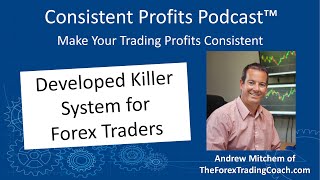
This is a YouTube video titled "040 – Interview w Andrew Mitchem of TheForexTradingCoach.com" published on November 23, 2023. It features an English-language podcast interview hosted by Brian McAboy on the Consistent Profits podcast, where Brian interviews Andrew Mitchem, founder of The Forex Trading Coach. The discussion covers Andrew's background transitioning from farming to forex trading, his trading philosophy, strategies including candlestick patterns and risk management, and the importance of proper training and community support for consistent trading success.
Hello and welcome to the Consistent Profits podcast brought to you by Inside out trading and Brian McAvoy, where the focus is on consistency, because when you have the consistent part down, profits become easy.
Hello, everybody. This is Brian McAvoy with the consistent Profits podcast, and we've got a new episode today. I'm excited to be interviewing Andrew Mitchum, the creator of the forex tradingcoach.com Andrew, thanks so much for being on the podcast today.
Hey there, Brian. Good to see you. Lovely to be here.
Yeah, great to have you, man. Now, for those of you who aren't familiar with Andrew, he started, first started trading the Forex market back in 2003, which is in, you know, in dog years and Internet years, it's like forever. And he's been trading ever since. In 2009, Andrew formed the Forex Trading Coach, and in that time, Andrew and his fabulous team have helped over 4,000 traders in 104 countries. The strategy requires very little chart time per day, and clients can learn, can over time, learn how to become independent and successful traders. Along with, you know, being a trader, Andrew's also a dedicated family man and a pretty cool guy. Again, Andrew, thanks for being here on the show.
Awesome. Looking forward to it, Brian.
So one thing I gotta ask, just, Just to kind of give you a little bit of a hard time, because it was cool, but I noticed on your site your, Your family picture, y' all are, you know, standing. It's like you're. You're with the helicopter. So is that yours or was. Was that like just an outing or what?
Yeah, it is. Yeah. I, I learned to fly on my 40th, which was 10 years ago, and I passed my private pilot license and been through, like, what most people do, the smaller helicopters, the Robinson 44, and now we own a what's called a B105, which is a twin turbine machine. Yeah, I fly, Try to fly once, ideally twice a week.
That is totally cool. I mean, for, you know, for people have like, a small plane license. I've known some people throughout my life. You're the first person I've ever met who had their own helicopter, though. That's very cool.
You know, New Zealand's kind of built for them because, you know, we're quite remote, quite mountainous. And so, you know, we go and do some cool things, Land on beaches, land on mountaintops, you know, land at some remote places that you just couldn't do in a fixed wing. I mean, fixed wing would be far cheaper, far quicker, far more sensible. But. But helicopters are more Fun and I just enjoy the challenge of it and I kind of liking it to good trading in some ways you can't, you know, you can't shortcut flying. You've got to do it properly and learn properly.
Yeah, huh.
Well, interesting, yeah, interesting that you would make that the parallel there, huh? Very cool. Well, yeah, in a mountainous area, you know, imagine there's, you know, runways all over the place. So yeah, helicopter definitely makes more sense. Very cool. Well, so he started way back in 2003, which is around the same time that I started. Yeah, things were a lot different back then. I mean you were about 2003, that was when you started. I started a little bit before that. When I started it was still pick up the phone and call your broker to place a trade. The Internet hadn't quite caught up yet, but it was, it was shortly far behind. So. But yeah, I mean you started in the days of dial up, huh?
Yep, yep, I didn't start on the phone days, but it was definitely dial up and it was very, very patchy, very poor quality. Took a long time for it to connect. And as soon as I was connected I was out there desperately trying to find a trade, not because the market was ready, but because the Internet was on. Yeah, we've moved a long way since then, thank goodness.
Oh yeah, well, just in general, I mean, the other thing, I mean, the technology has come an amazingly long way because you figure it wasn't too long after you know, got past dial up and actually had, you know, broadband and now some decent, you know, bandwidth for signal and everything. It wasn't long after that, and remember was around 2008, 2009, the bots and the expert advisors got real popular and then things just really blew up. And especially with the Forex, markets have come a long way for, you know, individual retail traders. I mean, now being in New Zealand, how are the markets different there? I mean, because here in the States we're kind of spoiled. We got like tons of access to everything. Is it pretty fairly readily available for, for the, for the New Zealanders as well?
Yeah, it is. I mean, only a handful of my clients are actually here, but for me personally trading, it actually works out pretty good. I mean, I base my trading off New York time anyway, you know, the closer day being 5pm New York time and then you just work that out during the day, like saving with my own time and I use MetaTrader 4, MetaTrader 5 and you know, pretty much most of those markets are available. One of the things I do like with the forex market, I suppose is that, you know, where you live in the world doesn't really matter. It's not like, you know, my early days on, I was trading news announcements or tried trading news announcements. Didn't get very far. But you know, I was up at like midnight, 2 o' clock in the morning, 4 o' clock trying to trade us announcements because that's what I thought at the time was, you know, it's part of the journey I think everybody goes through realized that one, I couldn't survive physically doing it mentally and two, I was making no money. But in terms of everything else, look, we've got access to pretty much exactly the same as anybody else. So it's.
Oh, that's cool, that's fine. Yeah. Huh. Pretty cool.
Well, so you know, when it comes to trading, I mean before trading you.
Were a farmer, right?
Yes, correct.
So how did you go from farming, which is like a tangible, you know, hands, physical thing, how did you end up going from that to trading which is like, in a lot of ways it's like clear at the opposite end of the spectrum as far as tangible, it's like totally abstract. And forex, especially forex is even more abstract than some of the other markets. So how do you want to that transition?
A little bit by accident really Brian. I had a son who was three years old at the time and I was going through divorce so that pretty much quickly put the end to the farm through no choice. And, and when you got a three year old child who you're looking after pretty much, you know, most of the time, which I was, I needed to find something that I could do from home. And remember back then there wasn't a lot of options, you know, especially for a single male, you know, looking after a child, working from home, it was kind of frowned upon a little bit. You tried this weird thing called trading, you know, especially like you said, going from, you know, hard physical work, seven days a week, farming. So suddenly there was a few eyebrows raised and it's like you need to go and get yourself a real job now, you know, because I was doing this sort of play, gambling type of thing that people thought it was. But no, that's how I got into it. I needed something I could do from home. I couldn't go back to practical farming. I didn't want to be like a sales rep traveling around the country. And that's how I got into, I stumbled into it. I found a course in Auckland, which is north island here in New Zealand, and did a Weekend course up there. And I love numbers and patterns and I had some interest in the New Zealand dollar, US dollar because that's how as a farmer we kind of got paid. And apart from that I knew nothing more. So it was a big learning curve.
Well, yeah, yeah, well, being a farmer, see, I mean initially I would have thought that you would have kind of leaned toward the commodity markets just because there's some.
Yeah. Didn't really have that as an option when I did that course, to be honest, it was a Forex course and I didn't know anything about commodities. Yeah, that looking at it in hindsight that makes perfect sense. But I suppose at the time I did this course purely on this thing called Forex and that was all that was available on the platform at the time. And you know, it was kind of sold to us as we can do it from New Zealand. It doesn't matter where you live in the world as opposed to, you know, certain markets that do open in US time only. And I, I suppose what also got me at the time is one, the leverage was very attractive and to the ability to sell something was very attractive as well as in like, you know, trading currency pairs.
Yeah.
You know, thinking otherwise if it's like the only other thing I kind of knew is shares or property when you kind of buy it here and hope it goes there. And I like the option of trying to sell something as well.
Now the reason I was chuckling is just what I was talking about was the leverage of the Forex, though that's also one that it's like the death of so many people. It's appealing.
Oh look, it's a double edged sword, isn't it? Having said that though, when I was thinking about, you know, in those early days what Forex was, I was thinking like you needed a absolute fortune, as in like I was thinking, okay, I need a million dollars New Zealand and if the US dollar's at 60 and it goes to 65 and I take it out. And that's how I was thinking because that's all I knew. And then when I did this course and I realized, oh look, I could have an account of say like 10,000 or $20,000 and do really well on these tiny little movements. To me that was quite attractive because it was completely new to me and it wasn't like this big long term sit and have all your money, all your capital tied up for potentially months and months, which is what I initially thought it was.
Oh yeah, yeah, indeed.
Well now as far as kind of tools of choice. You like candlesticks, right?
Yeah, I do now.
I've always. Was that useful? Was that part of your initial training, the initial course?
It was, it was. I've yeah, I like them. Obviously there's many different ways and many different people have created lots of them but I've found by just selecting like two or three different candlesticks and what they tell me the market's doing gives me a massive advantage. And I suppose you could argue that they like indicators are lagging in some degree. But you know a lot of people get into trading and they look at this moving average crossing over that moving average and this MACD and all these really cool looking indicators but I just found that not any of them, you know, and everybody goes out, they're looking for this magic formula. If I do something that no one else has ever created and the setting of this and you know it looks amazing but of course we all know it doesn't ever work. And so I needed to basically take all that off my charts once I got to that stage is like, come on Andrew, you need to figure this out, we'll do something different. And I started looking at the price and I started looking at these two or three different candles and quite often if I saw this pattern and it was at this price then the market would move in this direction. And so you know, as we know, markets and trading are probability, aren't they? They're not an absolute certainty. So yeah, kind of that's how I develop candle patterns. Just an observation to start with.
Oh yeah, well, so one thing that I find is cool about that is and I talk, I mean I share this with my clients all the time. Just being aware and like you're talking about observing the market, not just, you know, where is my trade working out or not that kind of observation. It's like just kind of paying attention to the markets and the things that go on there is huge. And if you think about it, almost every like legendary system that's ever been developed was through that method. It's like yeah, they were just observing the markets and they saw this over and over and over again and then they were able to capture it and correct.
Cool.
And so yeah now so you've got your, your site, The Forex trading coach.com did what's, what's the name of your method? You have a name for your specific method that you like to use or your special method.
I mean we call it the successful trader system but I mean it's not really, that's just a name we've given the system. But you know, we add a few extra things on there as well. I mean we, we look at things like you know, pivot point and price. I think the price is something that so many people don't look at. So I'm a big fan of Rand numbers like a price. Give you an example, the New Zealand dollar, US dollar right now it's up against 66.0.6000 and traditionally that's always been quite a strong support level. The price has always come down and hit 60, bounced right now because we're below it. It's now coming up and hitting 60 as resistance. Like you know, as we're doing these interviews around that price. So I like to don't just look at just a candle, I like to put it in conjunction with something else. And then I'm looking at, you know, has the trade got room to move? Is my stop loss protected by something like a Rand number? And then we kind of bring in. Obviously the important part as well is, is not only the strategy, it's risk management. Oh yeah, because you know, risk management can make or break or system. We look at strength and weakness. You know, if I use the New Zealand dollar US dollar example, is it the, if, if the New Zealand US is heading up, is it the New Zealand that's strong or is it the US that's weak? Because if the New Zealand's like weak against the yen and the Frank and the Canadian, it may just be that weakness in the US that's pushing the New Zealand dollar up against the US So we kind of analyze, you know, bigger picture as well as just that one individual chart. Yeah, and I've always been a fan of removing pips from my trading. I, I never talk pips. I have no idea how many pips I've ever made because to me they're completely irrelevant. I have low and controlled risk on every single trade. And that's another thing that helps so many people with the whole psychology of trading as well.
Okay, so you said loan control.
Correct.
Low and controlled. So every single trade that I take has the same risk account percentage risk on it.
Oh, okay.
So I could be trading on let's say a weekly chart or a four hour chart. It doesn't matter. It doesn't matter how big the stop loss is. Each trade, if it goes against me will lose the same amount of money or percentage of my account.
Okay, what do you typically use? I mean the rule of thumb is.
For me, I risk a maximum of half of 1%. Per trade.
Oh, okay.
So very low risk. But then we have trades that have reward to risk depending on the trade. Somewhere between about a 2 and a 4 to 1 would cover the majority of our trades.
Yeah, cool.
Well one thing you mentioned that I think is really cool and I haven't heard it brought up in the longest time talking about Forex and I, I haven't traded forex in a while. I got back to commodities but I did, I did have my go of Forex for a bit. I found all consuming though. I just, it's totally consumed me and it was like I was trying to trade almost around the clock six days a week and it's like I burned myself out. Anyway, one of the things I thought was totally interesting and the first person I've heard mentioned bring it up in the longest time is the, your strength and weakness that you were just talking about and looking at. Because with the forex markets they are so much more interrelated or, or they can't versus other venues or marketplaces trade like stocks or commodities. Things may or may not be related but what you're talking about, it's like. Yeah, and that, that totally makes sense and it's really a smart thing to do. And yeah, I gotta, I gotta, I remember that too for when I am, when I'm working with somebody that's trading Forex because yeah, that's, that's huge or.
Can be what makes a big difference. And what it also does is because each day we analyze the market at 5pm New York time, we're not only looking for specific trades to take, but we're also saying his strength or likely his weakness in these currency pairs for the next 24 hours. And so what that can help you do is stay out of a shorter time frame trade that might look good on your charts. Let's say you went down to a four hour chart or a one hour chart and it looked like a bullish setup. But overall your daily analysis says that pairs looking bearish. So what it can help you do is keep out of that, that shorter time frame by trade, let's say because it may work, it may not work, but it's against where the bigger picture is going for the day. So I much prefer to wait for pullbacks and then trade it what I call a continuation pattern so that we're, we're trading our shorter time frame chart in the same direction as the bigger likely direction for that day, all based around strength and weakness. So if a candle pattern is saying the market's falling a Short position and the strength or weakness of that pair looks like that pair is likely to fall. Then to me that adds even more probability that my trade's going to work out.
Gotcha. Yeah, that makes sense. Yeah.
Okay, well now how do you handle kind of the, the, the counter case to that? And the metaphor I like to use is, and, and I do this with, with some of my clients because I'll have some, some people and you know, they want to trade like the one minute charts, which is pretty fast and you know, so you know they're going to be in and out of trades in minutes. A two hour trade is a long trade, you know.
Right.
So. And it started years ago, but I like, I remember the first guy that came to me that was doing this, he would look at the daily chart and because he wanted to get a feel for, you know, the overall mood of the market. Yeah, but he was trading a one minute chart when he's trading and I'm like, yeah, dude, that's, that's kind of like irrelevant again, relevance. Yeah, it's like, you know, if your girlfriend's, you know, been in a great mood for the last 30 days, but she's pissed off today, you better pay attention. She's pissed off today.
That's exactly right. Yeah, yeah. No, a daily chart on the one minute chart is completely pointless.
Well, no, that's cool. As far as what you talk about. Yeah, that does make total sense. And, and I'm glad to hear you, you know, talking about relevance because yeah, it, absolutely. Well, the thing is, you know, with a trading system and, and I love the way, you know, I can just tell, kind of tell a little bit about how you work that you, you kind of look at things this way. You know, trading in its essence is nothing more than a decision making process.
That's right. And you mentioned at the beginning about, you know, how things were back in the early days. I mean we have, you know, moved on to other markets as well. Although we still call the Forex trading coach. You know, we've, we've kind of stumbled into other markets and we look at the indices and commodities and know metals cryptos as well. Because the strategy and the logic of what we're doing probably less so the strength and weakness, but the actual technical chart point of view is relevant on those other markets as well. So we've now got to a stage where I trade and look for these patterns that, these couple patterns regardless of what the market might be and, and that's just given us even more opportunity and because we only look at a, like you mentioned earlier, one minute charts and things like that. Personally, I don't ever really trade under an hour. I, I, most of the time My trades are 6 hours, 812 daily, weekly, monthly because that's what suits me. But because we look at the close of a candle, I can look at like a, a 12 hour chart twice a day and it doesn't matter whether it's on Bitcoin or on zinc or on the euro, US dollar, it doesn't matter. I'm just looking for that pattern.
Yeah, well and the fact that like I said this, that you, you know, you're doing what you're doing based on observation, to me it's huge because I mean I've talked with some, you know, some trading gurus and you know, their whole thing is they just kind of theorize stuff, you know, this should work. And it's like, but have you like just watched the markets to see, you know, if we get back testing. But just pay attention to what the markets are doing. And does it make sense when you're looking at what the markets do?
Yeah, yeah.
The other thing I found to add to that is that you know, markets always have different like characteristics and different conditions. It depends if it's northern hemisphere, summertime or you know, you never know what condition you're really in right now. You can look back in hindsight and go, oh, that was a very quiet period or that was very trending. But it's very difficult when you're in the moment to know. But what I've found is that when I'm looking at candle patterns and the right part of the chart, etc. If there's no pattern, it doesn't matter, you just move on to the next chart, you know, and, and yet if there is a setup, a reversal or a continuation, then it's like going back to the farming analogy. Make hay while the sun shines. You know, they're all setting up and showing the pattern. Take the trade. If there's no pattern, don't take the trade. And, and you know, if you break it down and make it real simple like that, that's where I think the advantage of looking at candles and price are really good. Whereas people who use all these moving average crossovers and all these lovely dots and arrows and things all over their charts, you know that they, they don't tend to look at what's actually happening in the market. It's just, oh, this line's crossed, this line. Therefore it must be a buy trade.
True True.
Well, the other, the other thing that's fun is. And I mean, I was guilty of it in my early days too, where.
It'S like, so was I. We've all done it.
You know, when you sit there and it's like you're just itching to get into a trade. And so it's like, well, that, you know, that kind of maybe. Yeah, that kind of looks like. And so it's like, you know, you wind up talking yourself into seeing something that ain't necessarily there.
That's right.
So guilty that so many times. And I was like. And I paid for it every single time I did that.
And you kind of. The old time that you fluke it and it works, you go, oh, that was really cool. And then you do it again and you lose all that on the next few trades anyway, so it didn't work. We've all kind of. I suppose that's the journey that we've all been on. But you kind of, as you get a bit older and done it for a while, it's like a lot of things, you realize that what you thought you knew when you were young is not quite so. Quite so good. And sometimes less is more, you know, just looking for qualities far better than looking for quantity of traits.
Oh, yeah, you said a mouthful there. Oh, absolutely.
Yeah.
Now, yeah, that's excellent. So what. Okay, so you see, figured it out for yourself. At what point did you decide, did you decide to start helping other people?
That also started a little bit by accident. I entered a competition back in around 2005, I think it was. And I used to supply basically like trade signals to an auto company back in the day and people could subscribe to those companies. Anyway, I ended up after the year winning this competition.
Okay.
And people ended up subscribing to it. And then I had somebody, a guy over in Australia who wrote to me. He must have found my name on there or email address or something and. And said, look, would you come and teach me how to trade the system? Because I'm really enjoying it and I'm paying you a monthly fee and it's doing well, but could you come and teach me? And I basically went, yeah, I can do that. And then spent the next week going, oh, my goodness, I need to put together this, this document. And took it down to the local printers in the day and laminated it and flew across to Australia and taught him. And that's. Honestly, that's how it started and I quite enjoyed it. And I've always, you know, we've got five kids. You know, it's like with kids, you always wanted to see them do well and teach. And I taught various sports and I kind of enjoyed the interaction because I also found that trading can be such a lonely business. You sat there, oh yeah. You know, and the whole self doubt and like I said, people were telling me, look, you really need to go and get a real job and look after your kid and all this type of thing. And I actually started to enjoy as time went on and more and more people joined the actual interaction as well between people. Because you're talking to people who understand what it is that you're doing.
Oh yeah. Oh yeah.
And there's sometimes there's not many of them around.
True.
Well, actually that's one of the most prevalent comments or irregular comments that I get when, when people sign up, you know, for my help is that, yeah, they're just tired of trying to figure it out on their own or you know, through books or videos. It's like I want to have somebody to talk to that I can talk to. You know, my friends and fans, you know, they're, they're, they're, you know, they're nice and I love them, but I can't really talk with trading because they don't know what the hell I'm talking about.
Right.
And so. Yeah, and it is, it's huge. Well, the other thing is, I mean, and you know, trading, you can either go about it, you know, the way some people do, where it's like you just beat your head on the rock for 10 years until it you finally figure it out. Or you can go, you know, learn from somebody who has already figured it out and shorten that time, that time down to months instead of years.
Exactly.
For so many people. No, I actually surveyed my list a while back and my subscriber list and it's like, okay, so before, before you met me, you know, how long had you been trading? And the average was 4.6 years. And so I said, okay, you know, so you know, how, where are you with, you know, where were you with your trading at that time? You know, were you happy? Were you kind of happy? Were you struggling or did it just suck? And 86 of the people were not happy with their trading after four, after four and a half years. And it's like, it shouldn't take that long though. And it really doesn't have to. If you get good help and you have somebody that can teach you, you know, what you need to know to actually do this. I mean, the Biggest problem I found was like, people will come to me looking for psychology help. And it didn't take long doing that. And it's like, you don't have psychological issues, you have lack of training issues. You're trying to do a job you don't know how to do. No wonder it's rough.
That's right.
And, and, and once you get that training, though, and, and I, you know, I would teach them, you know, it's like, okay, yeah, you don't have psychological issues. Let's stop talking about that. Let's take a look at your system, what you're doing, and fix that. And what do you know? Oh, you're okay. And then go off and trade and they were fine. And it's like, it was so cool though, because it's like, yeah, instead of spending a year, you know, doubt, like you said, doubting yourself and, you know, trying to figure out what's wrong with me, it's like, no, there's nothing wrong with you. You're not screwed up as a person. You just need some training.
Yeah, exactly. Right.
Yeah. Well, that's cool, though. And for me, absolutely, it is.
It's really cool.
It's redeeming, though. It's like, no, I'm not screwed up. I'm okay.
It is.
Classic example of that is the podcast I did last week. This guy was the opposite to what you've mentioned. He was brand new to trading. He joined us in August of this year and what are we now, the first week of November, and he's now about to put a large amount of money of his personal funds in and go into a prop firm. And he's done that in three months from nothing because he's gone and done the work, done the time, asked the questions, listened, learned, and go, look, I don't know anything invested in the system and people. And now he's ready to. He hasn't done the prop firm yet he's about to start, but potentially it's life changing.
Oh, yeah.
Well, and it's cool. I mean, yeah, I saw that when I was checking out, when I was looking at your podcast the other day. Oh, the other thing I noticed, yeah, you're up over 500 episodes, which is remarkable.
That.
That's a lot of. That's very dedicated man. Big commitment that you follow through.
Thank you. Well, I suppose one thing that we like to do as traders and it's another part of teaching is it makes you, I suppose, dedicated. You know, it's the free information out there that's like the podcast and the videos. We've never missed a date with our clients of our daily trade suggestions since 2010, ever. Never miss one. You know, it doesn't matter where we've been in the world. We've never missed a weekly webinar with our clients, which we've done every week for two, two hours every week since 2010. You know, so we, we like that dedication and that commitment and I think that's a big part of one, trading and two, from my point of view, also teaching. Oh yeah, because you, you've got to show up and you've got to do it because you, you know, one, I'm doing it for my own personal trading and two, it's everybody who's following. So it makes you a better person and a better dedicated person. And when you do teach as well.
Oh yeah, yeah, I agree. Yeah.
And again, very cool that you've been able to do that and make it happen, man. That's, it's not insignificant. And so, yeah, congratulations. It's good, good work.
Thank you. Probably the farming background helps as well because that's the same thing, you know, doesn't matter whether it's Christmas, your birthday, you're feeling ill, it doesn't matter, you got to do it. And that's the way we were brought up.
Yeah, true.
Yeah, that probably did serve you well that.
Yeah, absolutely.
That experience before you came to trading. Yeah, definitely.
Huh.
Now, so at your, at your site, you've, I mean, you got a lot going on, but you have, you have courses, correct? Or do you. Is it most primarily the coaching?
Yeah, well, the coaching course is. There's one. I mean, we have three different methods of teaching it, which is like a, an online method. And then we have like a option to do some one on one online as well as the course, but the course has so much interaction anyway. And then for people in the UK and the US and in Canada, we have the option of doing that in person as well through some of my people who have, like I say, my people. That sounds terrible. My, my, my original clients who are now working with me because they've had such success out of the course that they're now helping to teach it in person as well.
Yeah, when I saw that, that blew me away though, that. Yeah, you'll actually come to, to a person's home and teach them at their place.
That.
Yeah, that's how I started, you know, so people, you know, some people still like that obviously is a bit more involved in terms of costs and travel and time of Course, but some people just really enjoy that. Sit down next to me at your computer and show me and those people that want that we still offer that.
Yeah, that is, that is totally cool. That there really is.
Yeah, yeah.
Okay. So, well, the one thing I got to ask you, since this is the, you know, the Consistent Profits podcast, I have to ask, so what do you see is probably like the top obstacle that traders have to being able to generate consistent profits from their trading?
From my course or in general?
Just in general, in general.
Not knowing what they're doing, I think, and we've kind of touched on that, I think is such a big thing. People rush into it. They're like being a painter, you know, a decorator, you know, unless you do that prep work and you, you sand everything down and you put your undercoats on and you know your finish is going to be terrible. And, and it's kind of similar, you know, people just want to rush in and get results. I always come back with this really disappointing news to people and I say, look, it's not what you want to hear, but if you want my help, it's the truth. And the truth is to forget making money to start with that you've got to learn a system that works for you, that suits you, that's your personality, etc, your style, and learn how to master it first. Because if you do that, you suddenly put yourself into that top 90, 95% of people and money will follow. There's no doubt about it, it will follow. But if you shortcut that and the outcome's almost certain that it's going to be failure long term. So I think there's that issue. People don't understand risk. They don't understand the importance of, you know, if they want to go down the coaching route, the investment, they don't. Personal investment. And we've touched on the community as well. You know, I think all those things combined, most people fail to actually have on board, so they're missing all these things and then they do these daft things like they'll go, oh, I'm not going to put a stop loss on all that trade loss. So I'm going to double my risk here. They do this revenge trading and, and I say to people, okay, so you and the other people say, I don't care about a trade on the demo account. Or it's, you know, I've only got a thousand dollar account. If it loses, it doesn't really matter. Yeah, but you wouldn't treat a million dollar account like that. So, so Treat your any size account or a demo account like it's real. If you're on a demo, open a small demo. Brokers are notoriously bad at giving you like a hundred thousand dollars or something like that. You're never going to open a real account with that amount of money. So open a small demo, all those kind of things, but just do the, the walking before you can run because it will pay off if you do that.
Yeah, well, and it would be good if there were more of us telling people that. Unfortunately there are so many that are out there saying hey yeah, come to this, you know, three day boot camp and you're set for life. And it's like, nah, yeah. And everybody, you know, they paint the easy picture. It's like here, yeah, buy my system or buy my bot and you know, just push button and it turns your computer into an ATM and it's like, no, that's right.
We all know the result of that.
Well, and so, you know, I try to be careful when I say that to people because you know, you know, when I say, you know, the biggest problem people have is they don't know what they're doing. I'm not trying to put anybody down and say they're stupid, they're not far from it, they're, they just don't know. And a lot of times, and that's why the, the, you know, going it yourself route is the hard way. And again, it's something I wish more people would try to get across to everybody is if you're trying to teach yourself something that you don't know, you are your own limitation because you don't know what you don't know and you can't see what you can't. And so that's why it is so critical that you know, if somebody, if they want to trade forex to come and work with you so that they can, they can tap on your experience and your years of expertise and your years of helping other people. Because if they're trying to figure that all out, figure that out all by themselves. That's going to be a long hard road.
That's right. And so, you know, we touched on at the very beginning that thing called a helicopter. It's the same thing. You know, you spend a lot of money, a lot of time, a lot of dedication and you seek help from people who know what they're doing. Otherwise it will kill you. And trading will kill you in a different sword. It will just kill you financially or frustration. You know, you seek good people and you surround Yourself by people who can help you when you have an issue with flying. No different to trading.
Yeah, indeed. Yeah, very cool.
Well, so any last words of wisdom? We need to go and wrap this up. We have a feeling we could like carry on for quite a while here. Oh yeah.
We've both kind of got the same philosophy and I suppose been doing it for similar length of time as well. You see you signed, you've kind of been through all different market conditions. One thing I do get asked, people say, oh, but how do you know your system's going to work into the future? You know, because all I can say is, well all this time I've been trading it, nothing's ever changed because of, you know, we are looking at price action and you know, markets move and ultimately what's the market going to do? It's going to go up, down or sideways, you know, really that's all it can do, isn't it? So, you know, I think now the, the excitement is more time frame charts to trade. You know, like I mentioned, I trade MetaTrader 4 and 5. You know, you've got more built in time frame charts. That's cool. There's more markets coming on board. That's really cool. But the actual logic and strategy remains the same. And I think that that's a very important thing as well because too many people do chop and change and they go, oh, the markets can, it's changed. So I'm gonna add this indicator, you know, oh, I'm only going to take buy trades now because it's a bullish market, you know, and, and I think by not changing and having confidence in your system is what keeps, you know, you, you know what you're doing, you see a trade instantly. It's like riding a bicycle, you know, you can, once you, you don't think about all those things that are going on that you think of as a kid, you just get on and do it, you know. So that's what I think people need to get into their, their mindset that over time these repetitive patterns become very straightforward to see. Once you gain confidence in whatever strategy you have. Yeah, but you've got to keep draw down low because otherwise I say to people there two things. There's one in here, one's your heart and one's your head. You've got to keep those two under control and keep your emotions as low as possible. Because obviously everybody loves winning trades and hates losing trades. But if you have that low equal risk per trade, emotions stand of control.
Oh yeah.
And all Those things, there's a lot of things to think about, and you've kind of got. They've all got equal kind of importance, but you kind of got to put them all together to make a system that works for you, that you like, that you can follow. And it doesn't take all day to do it. You know, some people like watching charts all day. I personally can't think of anything worse because, you know, I like to look at the charts two or three times a day and that's it. Because that's what suits me, you know, so it's finding what suits you as well as a person.
Oh, yeah, yeah, indeed. Yeah.
That's huge. That is. And an easily overlooked thing. So.
Yeah, yeah, yeah. Absolutely.
Yeah.
Very cool that you're bringing that up.
Cool.
Well, I'll tell you what, everybody, and everybody, you know, that's listening today, I applaud you for being here and taking time out of your day to, you know, try to, you know, learn and grow and develop as a trader. And so, you know, I applaud you on that. The other thing that I would say, though, is if you've enjoyed this conversation, you like what Andrew has to say and you kind of like how he thinks and everything. Definitely swing by his site, the forex tradingcoach.com and go ahead and, you know, you know, take, take some action on what you've learned today. Don't just, you know, listen to this and say, yeah, that was cool. And then you forget about it and it's, it doesn't do you any good. Go ahead and act on it because getting good help really is the way to advance your trading career and your results as fast as anything. And Andrew, definitely, he gets involved with his people and you can tell he's. He's pretty cool guy. He's got his heart in the right place and enjoyable to work with. So, yeah, if you, if you're looking to improve your trading, definitely, yeah, act on, act on what you're, you know, you're. You're finding out today. And yeah, again, you know, glad you're here, Andrew. Again, thanks for taking the time out of your day for this. I definitely appreciate it and everybody here does, so. Yeah, indeed. So everybody really enjoyed it.
Thank you.
Yeah. Cool.
And for everybody, if you enjoy the podcast, make sure to subscribe and we'll see you on the next episode of the Consistent Profits podcast.
Cheers.
Thank you.
Thank you for joining us today on the Consistent Profits podcast, brought to you by Inside Out Trading. Make sure to swing by InsideOutTrading.com and pick up your free copy of break the cycle 10 things you can do to stop reinforcing the past and and get your trading on the right track. If you enjoyed the show, make sure to subscribe on your favorite channel and we'll see you on the next episode.
Cheers.









