Futures Trading: Advice from a Seasoned Veteran – Bob Iaccino – Episode 051
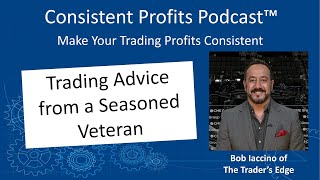
This is a YouTube video titled "Futures Trading: Advice from a Seasoned Veteran – Bob Iaccino – Episode 051" published in February 2024. It features a podcast conversation hosted by Brian McAboy interviewing Bob Iachino, a veteran trader and market strategist. The discussion covers Bob's trading career, insights on trading strategies, risk management, the evolution of trading technology, and his current projects including Path Trading Partners and public speaking engagements. The content is an in-depth interview focused on futures trading and market analysis.
Welcome to the Consistent Profits podcast brought to you by Brian McAvoy and Inside Out Trading. Because trading success comes from the Inside out. Visit InsideOutTrading.com where we focus on you, the trader, because you are the most important part of your trading. When you get the right coaching, trading becomes easy. Visit InsideOutTrading.com and now onto the podcast. Hello everyone, this is Brian McAvoy with a new episode of the Consistent Profits podcast. I'm excited today to be interviewing Bob Iachino, co founder and chief market strategist of Path Trading Partners. Thanks so much for being on the podcast today Bob.
Good to see you man. Good to be here.
Good to have you. For those not already familiar with him, Bob spent the last 28 years working in the commodities, futures, FX and equity markets. He appears as a guest analyst on various media outlets including cnbc, Bloomberg Television, Cheddar, CNN International, Fox News, Yahoo Finance and many more. In 2008, Bob began speaking on trading and investing and has given live seminars and speeches both domestically and internationally. 2013, Bob joined Tethys Partners as their chief market strategist where he consulted on economic and geopolitical strategy in their energy space and he ran the firm's internal stock Options hedge fund. 2015, he and his trading partner Mike Arnold founded Path Trading Partners, a boutique analytics firm. In addition, Bob joined Intrades.com in June of 2017 as Chief Market strategist and head of research. Intrades is based in Miami and his retail focused advanced market intelligence website using a proprietary algorithm to identify and quantify public interest in individual stock, commodity and FX markets. And we're going to come back and check that out because I got to ask you about that just because it sounds cool. In 2018, Bob Co founded Pure Exposure Growth Series, a financial media company focused on exposing the average investor to the truth in trading and active investing. When he's not strategizing, Bob likes to take part in some of his favorite hobbies which include fitness, cooking, painting and motorcycles. As you can tell, Bob's a pretty cool person. He's also very down to earth. Bob, again, thanks for taking the time to be here.
Good to be here, man. It's good. Like I said, it's a long bio and some of those things have changed slightly but not that much. Cool.
Well, one of the things I always love to ask just because, you know, as traders, trading is kind of an unusual industry for, for most people, you know, they got regular jobs and stuff like that. I always like to ask you what were you doing before trading and how did you wind up in trading?
Well, that's a great question. I. So I am the child of legal immigrants from Italy. I'm the firstborn here with my brother and then me. So I'm first generation Italian American. Spoke Italian before I spoke English. And basically first ones to go to college. But nothing certainly that people would think was prestigious. Just regular college. And took business and took political science and had a minor in economics. I just found myself fun. I ended up being the head of sales for my father's family business. I mean, it was a Italian bakery that turned into an Italian food company. We sold out of that in 1992 and approximately 92. I get those years a little fuzzy at this point in time. But from there, it was the first time I'd been unemployed since I was about 14 years old. Because my father started the business when I was 11. So friend of mine said, hey, I got a buddy that works at the Chicago Mercantile Exchange. You want to come hang out for a day? And I thought we were going to Merchandise Mart. I had no idea what the Mercantile Exchange was. And that's how I got my start. I went down there, got a job. My first job was getting a guy lunch and getting him coffee and looking for another job. That was literally the job description here for that long. He actually told me that if I got sprouts on a sandwich one time, instead of lettuce, I was fired. So spent time picking through turkey sandwiches. To make sure there were no sprouts in there. But that's how I started. That was really how I got into these markets. And I took to it. I mean, it was something I was probably meant to do. So. World works in funny ways sometimes.
Yeah, indeed. Yeah. Going from. From baking to the crazy world of trade, huh?
Bread here at the house the other day. So me now have no idea that I know how to bake bread.
Cool. Well, so, I mean, you've been in trading for an awful long time, though. So what is it about trading that's kept you interested all this time? I. I mean, I know a lot. A lot of people have been in it for a while, but they, you know, eventually get burned out. So what. What's kept. What keeps you fresh on it?
So I don't really trade for the juice of it like a lot of people do. I mean, a lot of people, you know, I just love trading. I'm excited. I love trading because of the life it affords me outside my work hours. I always tell people it's my personal opinion I could be Wrong about this, but if you trade for a living or do any sort of analytics for a living, your day to day work is boring. You're just looking at the same stuff and looking for signals. And if you're disciplined enough and you have a process that you believe in following, then you follow that process and it's pretty robotic. Outside of trading, however, I mean, I have a friend in town from New York today. I was able to shut everything down, go to lunch for an hour. Didn't matter what time he wanted me to go to lunch. I think I had to be back for was this particular episode that we're recording now. So that's only because I made a commitment to it. You would have been kind enough to let me reschedule, but I made a commitment, so that's what I like. Okay. If I want to take four or five days off, I theoretically don't get paid, but I can do it. So it's the freedom of it for me. It's not. I don't get excited when I have a winning trade and I don't get that upset when I have a losing trade. It's process based work. It's analytical. It's do the same thing every day. And if you're doing it right and if you're consistent, it'll, it'll come out okay on the end. Profits come out on the back end based on consistency, in my opinion.
Very cool. Well, yeah, on the consistency part, yeah, you're preaching to the choir here, man. That's, that's the main thing. I talk to everybody. So yeah, it's all about consistency.
Something to get people to accept. I mean, the excitement of watching Wolf of Wall street or any of these other movies, that's what people think it is. I'm telling you, it's not true.
True. Well, and, and like you were describing for yourself, when you, when you've got a handle on it, it's not a big emotional ride either. It's a regular job. And that's really how it should be.
Yeah, it's a trade, which, no pun intended because it's trading, but it is a trade. And I have always been fascinated by people thinking that they could learn a particular strategy and just start trading and it would be that simple. You could learn how to use a lathe. But you're not a machinist. You know, there's, there's, it's just like anything else. Whether you're talking about a machinist, an electrician, a lawyer or a doctor. Even doctors, they go through Three years of school, then they go through as they become intern and you know, they do the residency and that it's a good six to eight years after they've passed the medical school exams and then the boards for, they actually become a practicing physician. So I just always wonder why people think trading is any different. No, it's, it's difficult to get there, but it is about consistency. You're right.
Now you've been, you've been at it. So when you started, you said we were back in the 90s, right?
Yeah, early 90s.
Okay. So. Well so, you know, you know, I didn't start that far apart. I started in the 90s as well. And I love, I love the looks I get sometimes when I'm talking like in my, my son's generation, you know, I'm talking about picking up the phone to call a broker to place a trade instead of, you know, getting on a computer. And it's just kind of neat. So, you know, you and I have had a chance to witness some cool evolutions of the, the trading world and technology in general. What would you say are, are pro, probably some of the key events or evolutions that have occurred, you know, since, since you started.
Well, obviously since I started on the trading floor, right, you could, you could go into YouTube and type in Nova, open, outcry, just those two words and you'll see the first five, 10 minutes of that video. I appear on the trading floor as one of those brokers you would call, picking up my phone there, yelling into the pit. Could see all the people from that to what's behind you in this podcast right now, that background you've got, which is really what it is for me now it's just me and my computer and I don't even have one of those multi screen setups anymore. I did that at first and found that to be overstimulative for what I need to do. So I've got a Surface laptop that I'm looking at right now and I've got one over here and that's pretty much it. That's all I do. So that's been the evolution for me from the screaming and yelling, which actually did work when it did work, to this is the biggest thing. If there was a secondary thing I would say going from minute to minute trading to day to day to week to week trading for the individual. I honestly believe that's one of the most important things for most people who are starting out now. Most people will pick what they like best, what strategy fits with their Personality. But I always think people should start out with smaller position, size and sort of a pulled back look on markets. Something where you're looking at my Average hold times 26 days for a trade. So when I was on the floor two and a half minutes, you know, where you're just in and out of things all day long. It's like, oh, there's a loser, I'm out, I'm back in, I'm out and back in. Completely different now. Completely, just equanimous in terms of your emotions, just completely level. So that's been a big change as well, huh?
Well, for, and yeah, I totally see that. And a lot of people that, that I work with, you know, they're trying to get a handle on it. They're, they're at the stage of day trade, intraday trading, a lot of them working on one and two minute charts. What would you say is. Or what, what kind of advice would you give the current day traders that are doing the fast trades? What advice would you give them on how to make that transition?
So the first thing I would tell them is the very first thing that a person needs to get used to is to think in percentages instead of money. I use this fictional example all the time. There's two hedge funds, one returned 14% and one return 38%. Which one did better? And everybody automatically would say the one who did 38%. Well, the one who did 38% has 100 million under management. They made 38 million. And the one who did 14% has a billion under management. They made 140 million. So now which one did better, the one who made 38 million or the one who made 140 million? Right? Well, to me it's still the one who did 38 million. Right? Because they think in percentages. So you know, you and I have different size trading accounts. Actually, I don't know that to be a fact, but I guarantee you it's a fact. You know, you might have 100,000, I might have 99. You know, it just, it doesn't matter. But from a percentage perspective, people always judge us on what our return was in percentages. So even if you're a day trader of 1 and 2 shares here, or 1 and 2 micro lots in futures, whatever it is you trade, it should be tiny, tiny position sizes to me. And then gauge yourself on percentage returns, not on dollars. And that's if you start off like that and you get that becomes a comfortable function for you where it's like, I made 2% today. That was good. I lost 75 basis points, 3/4 of a percent today. Not so bad. I was up 6% today. That's good. Then it's just a matter of adding zeros to your trading account. Whether it's from other monies or from building your account up, the percentages stay exactly the same and the mental aspect of what you're doing doesn't change. And it's much easier to remain level and be consistent, which we both agree is the key.
Yeah, that's cool. Perspective and good that you emphasize that because yeah, it, it can simplify things a lot. Yeah, very cool. Now one thing I, I, I heard that you're not a big fan of dollar cost averaging. Then in Chicago they just call that adding to a loser. So what's been your adding to a.
Loser or catching a falling knife? Yeah. So dollar cost averaging is for longer term investors. I mostly speak to traders. I am a longer term investor, but for the most part, if somebody says, you know, I'm going to retire in 20 years, what should I do? You're talking to the wrong person. Okay, I'm just going to tell you, buy the QQQ and don't look at it again and buy it every month. You know, whether that's $10 a month, $100 a month or $10,000 a month, just buy it every month and don't look at it. That's what I would say. If that changes, I'll call you. That would be it. We want to be in technology because technology is obviously going to be the productivity engine for the future regardless. And whether it's AI or robotics or blockchain, it'll be in the technology sector. So there's that. So when somebody says, why don't you like dollar cost averaging? Well, you should have a standard risk per trade in my opinion and it should be a percentage of your total risk capital. Definition of risk capital, from my perspective, is the amount of money you're okay going to zero. That's how I look at risk capital. So let's say you've got a net worth of a million dollars, including your home and in your savings account you have $50,000. What amount's not going to change your life? Okay, if I lose $10,000, I'm okay. Then I've got 40,000 in savings, still got my job, I've still got my home, my kids aren't going to leave with my wife for losing that money. That's fine. So I got $10,000. So you put that into your trading account. Okay, if that goes to zero, you're okay. Your spouse, your wife, your husband, whatever it is, says I'm not going to leave you. If that goes to zero, that's your risk capital. So now you have a percentage of that and you come to a calculation of what percentage you're comfortable losing per trade. Okay, now let's say that that's just for the sake of conversation, 20%, mine's not. But let's just say for the sake of this example, it's 20% and you say, okay, I'm gonna buy 5% of the position, then 5% lower than 5%, lower than 5% lower and stop to equal a 20% risk, full position, I'm fine with that. But if your risk per trade is 20% and you buy whatever that is to equal 20% risk versus your stop and it goes lower, instead of stopping yourself out you dollar cost average, you're an idiot. You're an idiot because what's going to Happen Is that $10,000 that your wife or husband is okay with you losing is going to become $50,000 and you're going to end up looking for a small one bedroom apartment somewhere close to the city. So you can be cool single person whose whole family left him because you wanted to trade without proper risk management. That's why I don't like it. In the trading floor we used to call it catching a falling knife. And over time that's developed to a nicer way of saying adding to a loser. We like to cut losers and add to winners or let winners run one or the other. I'm sorry to be blunt, but I come from the trading floor and from the west side of Chicago. Combine those two things. I'm trying not to cuss. I'm surprised I haven't.
No, that was, that was good though. And, and yeah, that was fun. Well, I, I just had to ask, when I, when I saw that, I just had to ask about that.
I need to stress if it's part of the original strategy or process for entry. Got no problem with, I actually encourage it, believe me. Most of my trades, the process that I trade most trades go against me first. I'd say somewhere in the range of 90% go against me before they go my way. So theoretically I should probably incorporate that. But I don't because I, when I, when I change the math around, the ones that immediately go my way are usually some of the bigger winners and it screws up my whole. I have about a 164, $1.64 win to $1 loss ratio. Right. So 1.64. Right. Is my win loss ratio and the win rate somewhere around 61, 62%. That win ratio goes way down. If I do this, if I add that into my trading. So it doesn't work for me. So I just get to the point where I use trailing stops that cut my losses, which ends up getting my overall win loss ratio. I'm sorry, risk reward ratio better in the long run. And I don't scale into positions anymore.
That makes sense. Yeah, Good that you do that. What are, what are some other wisdoms that are out there that have run across that you know, a lot of people like to tap? But actually, it's probably bad advice.
I hate buy low, sell high. I think that's terrible advice. That's what. And you know, most traders, I think, have come to realize that because that's basically catching a falling knife without having a position to average into in the first place. Buy low, sell high is. That's high risk, high reward. So what I like to tell people is you cannot exercise a risk from award. You can't separate the two. They're inexorable. Okay? So if you're making huge returns because you're buying dips in stocks, maybe after earnings, things like that, that is also going to be the way you blow out. So buy low, sell high is not what I like to do. I like to buy high and sell higher or sell low and buy back lower. Right? Because I have been doing this, it's actually over 29 years now. I could count on one hand the amount of times I bought the low and sold a high of a move. It's four times. Okay? It's four times in 29 years. But I've hit the exact low and the exact high more often than not. I've tried to buy the low and I've taken a lot of heat. And the thing about lows, oftentimes you have to go pretty far back in time to find a comparable low, to find support, to find an area where you could place your stop comfortably. And that takes time to do. And until the stock or the commodity or whatever you're in, the ETF has made that low, you don't even know what to compare it to because it's still in the process of falling. So people will say, wow, this is a good company. It's really getting killed. I'm going to buy it. Okay? But that by almost by definition means that you haven't mapped out your risk. Okay? And a lot of people will Say, well, I'm going to put $1,000 into the stock and if I lose 500, I'll get out. Okay, that's fine. But you're pulling $500 out of your ass. It has nothing to do with the value of the stock, the price action that's going on, what happened in the past, price action, or what might happen in the future, you're just taking a shot. As long as you're honest about that, no worries. You won't get anything bad said from me, but you're just taking a shot. But what most people do when they do that, Brian, is they then go to a cocktail party and go, I killed it today. I'm so smart. And you're not. You're just lucky. You got lucky that you picked the right spot again, part and parcel to a process. Different story. If you go to options. Different story.
Absolutely. Well, as far as speaking out, how did you wind up moving from being a, you know, for trader and everything? How do you want to being a speaker in the trading space? That's kind of a cool jump that not everybody makes.
Yeah. So it was a really weird thing. I didn't intend to do it and I actually really love it. And if there's anyone watching this that hires or represents speakers, please call me. Because right now it's all me. But I still do quite a bit of it. I basically told CNBC to go F themselves. I would have actually said the word if I knew that I could swear on this. And I'm not asking you for permission. So I told them to go after themselves. Because to me now, CNBC is the TMZ of financial news. All they want is something that gets people to turn up the volume because it's quiet on the screen there. Most people have it. I have mine up there and it's quiet. I watch Bloomberg now and Bloomberg has gotten too political. So it's very difficult. I started speaking because large institutions who had seen me on TV liked the way that I presented things. And the first one was the CME Group. And I started at the cme. So the first couple of speeches for them I did for free because I was like, look, I have the life I have because your company existed, so I'm happy to do this. And then it became paid for spots by customers at the cme. After a couple people had me see things, large brokers would come and have me speak on different subjects. I became kind of a crude oil expert working at Tethys. Okay. I had traded crude oil in the past, but I learned the fundamental side, quite a bit of the fundamental side from the guys I worked with there. And it became something that I was asked to speak about on TV a lot. So then it became something that I was asked to speak about in public a lot. I actually got asked to appear on a documentary called Planet Finance that came out first in the Netherlands. A Phil Crew crew came from the Netherlands, followed me around in Florida. If anybody watches that, by the way, I was about 20, 30 pounds heavier at the time, but that's my vanity speaking. So they came and followed me around in Florida to talk to me about when crude oil went negative and what that day was like. So again, I became an expert on that. And then I started speaking a lot on risk, and I still do every Friday, I do a show for Trade Zero on risk management. Then I was asked to be the co host of a podcast by my friend Jim Iurio, who I think you should call and have on here. He said that he wanted to do a podcast, but he had no knowledge of how to do the technical side of it, how to get it set up, how to get guests, how to sign them up. He just wanted to show up and talk. So that became part another generator of speaking gigs for me. I like speaking to people one on one, or I like speaking to people in groups. Because a person who worked for the cme, I don't think she'd mind if I mentioned her full name, but her name was Caitlin. She came up to me after one of my speeches one day and she said, there's a market for you. And I said, you mean for what I talk about? She goes, no, for you. She goes, you used to drive a bread truck, for Christ's sake. You were a baker. She goes, and now you do this and you simplify these things and you say them in ways that people understand. And I think there's a market for you. And she convinced me that there was, and it expanded from there.
Huh. Very cool. Very cool. Well, speaking of cool, I totally wanted to ask you about In Trades. Yeah, yeah. Could you tell us more about that? You know, how it works and your involvement there?
Yeah. So In Trades is. It's a business I left, but it still exists. And it's somewhat of a signal service.
Okay.
They had a really good AI generating machine, but the partners all kind of split up. It was based in Miami, but it was a South American company.
Okay.
So we were focused on South American markets. Basically, they had artificial intelligence and machine learning very early on from a scientist that was actually based in and around Colombia. And I was then charged with the inputs of that AI. So I went with what I did in my normal process and tried to get that programmed in. It worked good. And then they weren't able to get enough funding to actually keep it going. So I sold my shares and resigned. And they kept going for a while and they turned into a company called Tree, which is T R I I, which I then owned a small part of. And it's basically the first electronic stockbroker in South America. So in the past you would literally have to go to a. Like in Colombia, for example, or in Bolivia, if you wanted to buy shares in their local bourse, which is what their stock markets are called. You had to literally, the brokers would set up tables in front of supermarkets, people would get in line and buy shares. So Tree, which again is T R I I, which is what in trades became, is a total fully electronic stock broker. That's in Columbia, Bolivia and a couple of other South American countries now. So that's what it turned into. But they approached me, they approached me through LinkedIn.
Wow.
And they said, hey, we've seen you on TV, we've seen a lot of what you do. We'd like to talk to you about this. And after weeks of conversations, that's how we ended up, huh? Very cool project. But it's, it's changed and it's somewhat non existent in the form of in trades anymore.
Gotcha, huh? Very cool. Well, now, so what do you have going on over at Path Trading Partners?
So Path Trading Partners is, as you said, it's a boutique analytics firm. So if there's a small, whether it's a broker or whether it's a small RIA or research firm or whatever they want to be, that does not. They want their own research, but they don't have the capital or capacity to hire a research team. They hire us. And so they tell us, okay, we'd like coverage of precious metals, base metals stocks in the consumer discretionary space. Can you craft that for us? We craft it for them. They approve the final structure of the product and then they pay us to produce it for them and they put their name on it. So that's what we do within that entity, although the profits don't own that entity. My partner Mike Arnold and I generate trades for ourselves and friends and families. We share information back and forth, and then we either individually do the trades or we don't. So that's where trading still comes from. But that's what Pat Trading Partners does It's a boutique analytical firm that provides research to smaller firms.
Huh. So you're almost like a fractional analyst.
Yeah, yeah. I mean, whatever people want analyzed outside of ags, because we don't do agricultural journals for pretty much anything else.
Huh. Wow. Well, man, I'll tell you what. Yeah, You've got. You've lived quite an adventurous career with your. Everything you've done. What. What do you see ahead of you? What? What? Got any. Got any stuff on the horizon?
Yeah. So we have a podcast as well called the Future's Edge, which is on every podcast platform. I really enjoy doing that. I'm sure you enjoy doing this. I see that growing and continuing to grow. I have a content firm now called Kingston Financial Markets. That firm is starting to bring clients in and grow there. And that's basically what I'm doing right now. Like some of the things I told you about percentage trading, for example, as opposed to dollar trading. I've done content for firms through Kingston on that. And then obviously, still trading. I mean, I love doing the analytics. I have pulled back from TV because TV has changed. I still do Yahoo. I still do some Bloomberg. I don't do Cheddar any longer. I don't do CNBC any longer. And then the public speaking, that's. Those are the stuff that I'll basically do that until they say that I'm too old to get up on stage. Because. Because it's just. I love being with a group. I want to sit a speech with this company. They flew me in, and I don't even charge an exorbitant fee versus what a lot of people do because I just enjoy doing it. They paid for my travel, paid for me to come there. I gave a speech after the speech about. It was about 2,600 people, but 2/3 of the room came out and lined up to ask me questions. I had a little table outside. Right. So then that night, I went to dinner with the guy who owns the event. And I said, so, you know, that went well, right? You know, do it again next year. And he goes, I don't think we'd have you back. And I said, really? It surprises me. I thought it went pretty well. And he goes, well, it went well, except we had our sales pitch after your speech, and about 2/3 of people are in the hall talking to you. They didn't hear our pitch. Well, that sounds like a scheduling problem to me. Why don't you have me after your pitch? That might be the better idea, but yeah. So that was actually the Event that Caitlyn came up to me afterwards and said for a living. So that's what I see for the future. It's that side of it is all building. But luckily the trading side is something I'm still very engaged in in order to help build that.
Very cool.
I don't think I'll ever give that up.
Very cool indeed. Well, if somebody wants to connect with you, where's the best place for them to do that yet? Do you've got a favorite social channel or just a website?
Yeah, yeah. The mostly on X. That's where I engage the Most.x or LinkedIn. You can find me on LinkedIn and request a connection. I usually accept everybody. Then if they creep me out, I reject them after that. X is Bob underscore Iachino My direct messages are not open but if you tag me in something and again you don't creep me out. I usually open my messages to you and then again the podcast. And then we also have a live show that we do on Wednesdays at 4pm Eastern Time and that runs on the Tradier hub and then it also runs live on YouTube. You'd have to find the Tradier channel for that. That's not my project, just something we get paid to do and we get a lot of Q and A in that which we really enjoy. We really enjoy the questions on that. Last but not least, Trade Zero is the Friday Risk show that I do and that also we encourage people to come to that. So you can just go to tradezero.com and find my Risk show half an hour show on how to actually protect yourself while trading. Because the best way to trade for a living is to trade for a long time. And the only way to trade for a long time is if you don't put your capital out there like it doesn't matter to you. That's a very big deal. That's the best way for people to reach me.
Excellent. Excellent. Very cool. Well, let's go and wrap things up. Bob, thank you again for taking the time with this.
Yeah.
And everybody's listening. I applaud you for taking time out of your day to learn and grow and develop as a trader. Good to you're wanting to learn. That's a good thing. If and if and if you know Bob resonates with you, what he's got to say, you like it and everything, definitely connect with him. I'll have all the the links and everything that you mentioned in the show notes down below in the description. If we're on YouTube. So again everybody, glad you're here. Bob, thank you again and we'll see you next time on the Consistent Profits podcast.
Good to see you, Brian.
Thanks Cheers. I hope you enjoyed the podcast today. If you did, make sure to subscribe share this with your friends. Also, feel free to share it on your social media channels. And lastly, make sure you visit InsideOutTrading.com where we focus on you, the trader, because you are the most important part of your trading. When you get the consistent part of trading down, the profits become easy. Thanks again and tune in to the next episode of the Consistent Profits podcast. Cheers.









