How to Be Successful When You’re Day Trading Live – Jason Sen – Episode 045
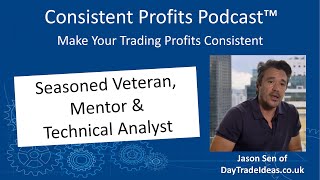
Jason Sen, a day trader with 35 years of experience, talks about what actually works in day trading. He covers trading psychology, technical analysis, and how AI and algorithmic trading are changing the markets.
Hello and welcome to the Consistent Profits Podcast brought to you by Inside out trading and Brian McAvoy, where the focus is on consistency because when you have the consistent part down, profits become easy. Hello, everybody. This is Brian McAvoy with a new episode of the Consistent Profits podcast. I'm excited today to be interviewing Jason sen, creator of daytradeideas.com.uk Jason, thanks so much for being here, man.
Hey, thank you for inviting me.
Yeah, I'm glad you're here, man. And for those of you not already familiar with him, Jason Sen is a day trader, mentor and technical analyst with a career spanning over 35 years. He began in 1987 and traded his own account on the floor of the London International Financial Futures Exchange. And at the age of 19, for the last 15 years, he's also been practicing technical analysis to study and understand the dynamics of the financial markets. His extensive experience on the LIFFE trading floor market making and technical technical analysis give him a deep understanding of the financial markets and the factors that drive them. Along with being a pretty well seasoned person with a broad background, Jason's also a pretty cool person, Very down to earth. Again. Jason, thanks for being here, man.
Thank you.
Now, I gotta ask because, you know, everybody, trading is an unusual occupation and I know you got a cool story as far as how you got started, but what were you doing before trading? Were you, was this like, you know, were you just in high school or had you done other work?
Yeah, no. Well, as I was 19, you know, I was obviously pretty young, so I was studying what we call A levels here in the uk and just before I took the A levels, I was sending off CVS to try and get a job with a bank. And luckily someone did hire me. So I was kind of three or four months before I took my exams. I, I started working and, and then took the exams. You know what, I still sometimes get dreams where I'm panicking about taking exams because I haven't done enough revision. And then I, I wake up and I'm like, oh, it's okay, you know, I've got a career now, I'm going to be all right.
How funny, huh? Well, so, yeah, so you started with the investment bank, but that was in 87. That was right before the crash. Right. And so now, so where did that go from there? Because obviously, you know, that was a tumultuous time for a lot of people in the trading world.
Yeah, it was pretty crazy. You know, I was young, I didn't really fully understand what was going on And I was working on the floor, so that was very exciting. And then the crash happened and I'm just watching everything go crazy. I was on the broking side and, and we were just, you know, we were inundated with orders that we couldn't fill by the end of the day. So we just had stacks of cards that we couldn't get through. So it was exciting. And obviously I learned a heck of a lot. But that By December of 1987 I was out of a job, you know, the volumes had died and so we were taken to a room, said, hey guys, I'm so sorry, it's last in, first out. So I thought, wow, that's the end of that nine month career in the city and it's all over. But actually ended up being a huge piece of luck for me because I ended up managing to get a job with a market making company, quite a young company. So I went from broking to market making, which was for me more exciting, you know, trading my own account and learning how to actually take risks and make a profit.
Well, for those not familiar with it, what's the difference between broking and market making?
Okay, so broking, you're basically executing orders on behalf of clients. So we would have banking clients that were, and we would execute options on their behalf. The market makers are on the other side. So when a broker is looking for liquidity, looking to execute an order, he goes to the market maker and the market maker then trades with him and, and takes the risk so the market maker will have the open position on. And for me that was exciting because it meant I could. As a broker, your earnings are kind of are based on commission. So you know, you can do extremely well. But as a market maker, you can potentially make even more because you're taking risks, you know, you're holding positions.
Now you said you were, you were market making with your own account though, is that correct?
Right. Well, when I was 20, then I got a job working for a Dutch company and they trained me, they taught me how to trade options. So that process took about two or three years. I mean, it wasn't an overnight thing. I know traders, these guys these days, they think they can pick trading up in three to six months. You know, it doesn't work like that. And even in an intense trading environment on a floor, it still probably took me at least two to three years to learn how to make a profit consistently.
Yeah, well, the way you started, it's kind of like learn how to swim by getting thrown into the shark pool. Right.
It definitely was, it was scary.
Yeah. Not the typical initiation into swimming. That's pretty cool. Now you had some traders that you, I remember reading at one point that you had like five traders. You said that you were your mentors and were just really excellent at helping you come along. So what was the main thing that they were doing with you to really, that really helped you as far as, you know, getting, getting your confidence down, knowing what you're doing?
Well, as I said, we were options traders and I was working within a trading group, so I was on the floor all day. Know, initially I was clerking, so I was, you know, taking the. In those days it was so analog. You wrote your trades down on a card, so I would collect the cards and, and you know, punch them in a, into a computer so that the, the trades could match. So, you know, you're basically starting with admin and as you're doing that they're teaching you about butterflies and call spreads and you know, two by ones and those kind of things. You're understanding the structure of options and the mechanics of them. And then eventually they let you loose in a pit. And which is the scariest thing ever for me when you, you know, because the guys in the pit are not welcoming. They're not like, hey, come in, you know, come and, come and make some money with us. They're, they're out to tear you to pieces, basically.
Yeah. Okay. Well, you did pretty well, I mean eventually, because that's, this was the end of the latter part of the 80s. What, so back in 92 you made a million dollars in a week. And so what's, how, how did that come about?
So that was. I, I had been approached then by an American trader who was building an operation in the uk. He was extremely successful and had a team of traders in the US. He'd come to the UK to start on life. And then by 1992 there was a thing, there was, think in the UK there was a thing called the erm, the exchange rate mechanism. And the pound was tied to the deutsche mark. It was an unsustainable situation. That was actually when George Soros famously broke the bank of England and made a billion overnight. So I didn't do quite that well, but the, the options market just went crazy. I was trading short sterling options, which is an interest rate contract. So that was really right in the thick of the events of the time. So it was huge volatility and I was just, I was just in the right place at the right time really. And it was an intense week, huge volumes. And yeah, I managed to make quite a bit of money that week. And I was only like 24, so it was a crazy time.
Wow now. But the, the 90s were good for you. I mean, bio on your, on your site says that you, from 92 to 98, you bought a property in London every year and you were a millionaire at the age of 30. So that's pretty cool and definitely not the normal path. Now how did that. Well, as far as dealing with that though, I mean, how did that affect you being in that position at that young age? Did you deal, did you have to deal with self sabotage? I mean, was it like way out of alignment with how you grew up or was it kind of aligned? So it wasn't that tough?
Yeah, it was pretty crazy. Self sabotage, I'd say was an issue. I tell you what, the biggest problem actually with that specific aspect was I'd made so much money so quickly in a week. Going back to, you know, just trading and making a regular consistent amount of money each day wasn't satisfying. And the problem was I was constantly looking for that, wow, swing the bat and get the big one, just six figures or whatever on, on a position and it never happened again. So I probably spent the next two or three years not, not making much. Well, not, not much money actually, and certainly not the money I should have done. If I just gone in there and done the normal job and eventually I had to say, come on, you know, you're just being greedy. This isn't working for you. You have to get back to basics.
Huh? Very cool. Well, switching topics just a little bit. And this one I was, I got to ask especially the guys have been, been in the game for a long time. What, what is it you love about trading and what's managed to keep you captivated for 35 years?
It, I'm just absolutely addicted to financial markets. You know, it's not even the actual trading. I don't trade that much these days. I have other businesses so that keeps me occupied. And you know, I'm 55, so I don't want to sit in front of a screen for eight hours a day at my age, having done this for, you know, for over 35 years. But every morning I get up for two or three hours, I go through all my charts and I create my trade ideas for my subscribers. And that is the challenge for me. You know, when you've got people depending on your calls, you've got to get it right. It's more important to get it Right. For other people than it is for your own trading account. I'm sure you can understand that. You know, you have a responsibility and you're offering a service, you want it to be a good one, and you want to, you want to stay in business. So that is the challenge for me, and I really enjoy that.
Huh. Very cool. Well, again, going back to the wealth of experience that you've got, and you've also got experience that a lot of even, even a lot of seasoned traders don't have, where you actually were down in the pits and dealing with cards, you've gotten to watch the whole trading world evolve. I mean, for me, that's been one of the cool things. It's just like pretty much since the mid-90s and with the Internet coming around, how everything has evolved, not just the technology, but the trading world itself and how it's really opened it up to so many people and how that's changed the landscape, plus the different markets and rules and all kinds of stuff. But so with all this experience that you've gotten. Well, and additionally, also working with banks, you've worked for a lot with banks. Have you ever thought about writing a book? And if so, what would you write?
That's crazy that you should say that because I did another podcast like this recently and someone reached out to me and said, hey, you should write a book. So it's kind of being talked about. But you know what my problem will be? I'm, I'm very adhd. My memory is appalling. So for me to write, sit down and try and remember all the events for 35 years and get them into a book, I think that will actually be a challenge for me.
Well, okay, fair enough. And, and I can totally relate, especially the adhd. I think that's part of just living up and growing or living in the technical world or technological world that we have over the last many years. Very different 80s when it was like, okay, we got three, three channels on TV and you know, radio on a cassette deck in the car. And other than that, that's about all the electronics we had going on. Otherwise it was just the real world. And now it's like everything's electronic. So I think, yeah, built into a lot of us. But anyway, as far as a book, how about if you were just maybe to pick one aspect of things or maybe just talk about the financial markets, not try to have an all encompassing book, what would you like to focus on? As far as maybe a smaller, smaller area of your experience? What would you like to what would you like to talk about?
Yeah, I think that's a good idea. I tell you what I'd love to do. I'd love to tell some of the stories about the unique experience of being on the trading floor. To be in my 20s, you know, so young, full of energy, full of ambition, and to be on a trading floor in London, that environment was just crazy. You're in, you're in a. You know, there's 3,000 people on the trading floor. We're all in our 20s. We're all, you know, doing quite well and. Well, the survival rate was, was low, obviously. I mean, lots of people tried trading. Of course not, not that many survived. That's normal even today. So I was lucky in that respect. But, but just the whole environment was just so unique and we really had a special bond from surviving those years. And, you know, if I meet with my friends now from the floor, we definitely have that special bond. So that would be something I'd really like to, to explain.
Very cool. Well, I tell you what, after the interview, let's have a little conversation about getting, helping you get the book, right? Because that would be excellent.
Yeah, terrific. I really need help to do that. I have no idea where to start.
Yeah, we can do that. Well, that's cool. Well, now, speaking of, you know, having been able to, you know, being able to see the markets go through the different phases and evolutions that it has, you know, what if. What would you, what would you change about the markets? The way they work, regarding individual traders or, or any aspect of it. What would you change about the markets if you could?
Wow, that's a good question. That's going to take some thoughts, actually. By the way, I love your point about what we've been through, you know, over the years, going from that really analog world to where we are now, I mean, I feel pretty privileged to experience all that. My kids have just got devices, you know, all over the place and my daughter, I think the phone's actually glued to her hand because she doesn't seem to be able to put it down. So it's just an interesting transition for us and I feel quite privileged to experience all of that. Question. I guess the first thing I'd like to sort of emphasize to traders, maybe this doesn't directly answer your question, but I think it's an important point for traders who are watching. I think so many traders, especially when they start out, they think that the key to trading is to guess the direction of the markets every day. I actually did a webinar earlier on today and one of the questions was do you think gold can go down, you know, over the next few days or do you think gold can go here and you know, time limits and direction. And I said, look, you know, even after 30 over 35 years experience, I have no idea where the markets are going to go within the next hour, day, week, month. I'm not really prepared. If I, if I tell you what I think, I'm only going to be guessing. You know, it might be an educated guess, it might be an experienced guess. It's a guess. I try to emphasize. The point of being a day trader is not guessing the right direction of the market every day. It's, you know, having a, having a strategy where you can develop low risk trades, you know, and you know you're going to lose, but you're understanding why you're losing. You're not just buying something because you think it might go up. And then you hope it goes up. And if it all goes wrong, you end up getting out when you can't take the pain anymore. You know, that's gambling. It's not trading.
True, true. Yeah. And you make a good point. Well now that said, it's, it's like the, the endless debate. I'm curious to see what, which side you're, you're on. Some people say, yeah, the strategy is key, you got to have a strategy. And then there's also, you know, others on the other side of the aisle that are saying, well, strategy is kind of irrelevant, it's arbitrary. You got to focus on the psychology. So which side do you lean toward?
You know, I think both are as equally, as important as the other. And see on the, on the trading floor and you know, in those days, decades ago, psychology and mental health just was never even mentioned. It didn't exist. It was like, you know, you're stressed at work. And I was really stressed at work. I mean, I didn't tell anyone I was stressed at work. I would come home from the trading floor, might have lost 50, 60,000 pounds. And you know, that was just, I'd sit in the, in my kitchen with the lights off. I couldn't, my neck was so tense I couldn't move, you know, and I had to get up the next day, go into the trading pit and pretend everything was all right because people read your face. It's like poker. And of course, nowadays I think it's terrific that there is an awareness of mental health issues and anxiety and stress and frustration that people go through in their daily lives and Trading. Absolutely. You have to have a very clear head and it's something I've really focused on teaching lately. But you also do have to have a strategy because like I said, you can't just wander into the markets and think, what shall I do today? I'll buy that and I'll just sell that and see how I get on.
Yeah. It's one thing, and it still cracks me up when, when I have somebody, you know, reach out to me and get to talking with them, find out what, what's going on. And even after, even after they've been at it for like three, four, five years, that's still how they're trading.
Yeah. Really?
And it's like. Well, and, and not to pick on a certain group, but I find it, it seems, it seems to be most common among stock traders really. They'll just, they'll, they'll fall in love with a certain handful of stocks, you know, whether it's Amazon or, you know, Facebook or whatever. Whatever. Whatever the, you know, and they'll like get, they'll get hooked on that particular stock and. Yeah, they're kind of trading their fields and the hunches and.
Yeah.
And it's like, no, you wonder why you're struggling and why it's a crap. That is straight up gambling, what you're doing.
Yeah, exactly. That's straight up gambling.
Yeah. You're not putting really any, any reasoning or thought into it except, you know, what you think, you know, your hunch.
Yeah.
And. And I'm not, I'm not meaning to pick on anybody because, I mean, heck, I know my first year, I, I was clueless. I, I was just. Oh, yeah, all the time. And, and my broker, he, he didn't care as long as I was placed trades. He didn't care if what made on my. Exactly as hell he didn't care.
Yeah.
They were also making a lot bigger commissions back then too, you know, 50.
Yeah.
A trade was not uncommon back then.
Well, when you wanted a price, you had to call the broker to find out what the price was. There was no other way to find out what the market was doing.
Yeah, true. Yeah. There wasn't even an Internet to go check. Yeah. So. Yeah. Well, now the thing is like you're saying it is about, you know, being able to, you know, bring yourself mentally properly every day, have any particular routines or diet or exercise or meditation or anything that help you stay in, in, you know, good shape mentally or physically. So you're always bringing your A game and dealing with the stresses of it.
Yeah, I think that's really important. I don't really meditate, but I certainly exercise every day for at least an hour. I'm either in the gym or I go for walk. I think one of the key things for keeping your head straight just for trading, I mean we all know how to, you know, there are ways to keep, to control anxiety and your frustration in your life and obviously your diet is important and your fitness. But one of the things with trading for me it seems that and, and I, and this was a big problem for me, greed. So I would always have a position that was too big. I was risking too much because I was thinking, oh, you know, what's the point in making 200 on this trade? It's not enough money. But the problem is when it, when it went wrong and I didn't have enough discipline and I was losing 500 and I was like, ouch, this actually hurts. If I have three losing trades, I'm down fifteen hundred dollars and that's too much money for me to be losing in a day. So for me it's about controlling the size. If you start to feel emotions and you're feeling anxiety and you're feeling worried about a position, if, and if you're trading normally and you have a strategy and you know where your stop loss should be, then if you're, if you're, if you're worried in that situation when you're doing everything right means you're trading too big and you've got to, you've got to cut the size down and be prepared to make consistent amounts of relatively small money. Because if you do that, you know, I mean, you know, trading should really be quite robotic and unemotional if you're doing it properly. In fact, it should almost be boring if you want to trade for entertainment and like you said, if you want to gamble, that's fine, but don't lie to yourself. Yeah, I'm gambling, I'm having some fun, I'm messing around, you know, and I'm going to allocate X amount of my income per month to do that. And if I, if I have a great time and I make a bunch of money, that's terrific. But you're right, don't lie to yourself. You're gambling, you're not trading.
Well, you brought up one thing that I've actually gotten in a couple of debates with, with other, other traders about and that is the notion of comfort zones. I know a couple of guys and one, he was, even, even ran his own brokerage for a While. And his whole thing was you're always outside your comfort zones. I mean, one of his favorite things that. The sayings that he had was, you know, as soon as you enter that trade, as soon as you click that button, it's like taking a shot of heroin. You're just, I mean, you're, you know, you're. You're gone. And my, my perspective is you should always be trading within your comfort zones.
Yeah.
Because if you're outside your comfort zones, by definition, you're in an emotional state.
Yeah.
And that's not a healthy way to trade. You don't want to be in an emotional state. You want to be in a calm state so you can think clearly and not make stupid, stupid decisions. And so. Yeah, I love how you're talking about. Yeah. It's just if you're feeling. If you're feeling it, that's the sign you're trading too big.
That's actually a perfect description of the way to put it. And I'm gonna steal that from you, you know, about being in your comfort zone. And that really is perfectly put.
Now, the flip side of that, though, is because for some traders, they have to take it down so small. They're only like trading five or ten bucks.
Yeah. But they can scale it. When things go well, you know, in six months, that, that five, ten bucks might be 15, 20 bucks, and then 35, 40 bucks. Eventually. It's about building your account slowly.
Well, yeah. And. Well, the. One of the other challenges with just dealing with the trading world as it is is how it always changes to them. Because, like, when crypto started taking off and now, you know, over the last few years, it's like, been a big deal, and a lot of traders have moved out of stocks or, you know, currencies or futures and stuff. They moved over to trading crypto. Just dealing with the changes. Now. What do you foresee as far as. Since you've been able to see a lot of the evolutions of things and see how things have changed since crypto has evolved? I see it. It's been developing into something similar to Forex. What are your thoughts on that, and will it ever become part of the foreign exchange market?
Yeah, it's fascinating, isn't it? I'm not really an expert on crypto. I tell you, I got into it from a technical, technical analysis perspective. Someone asked me, you know, obviously I get people, hey, can you look at crypto for me? So I started looking at Bitcoin and all the big ones when I realized I don't I don't know these days because I haven't followed it for a while. But when I first started looking at was a technically perfect market. I've never seen a market adhere to the technicals. The Fibonacci levels, the moving averages, the trend lines. I've never seen them work so well as I did in crypto and I'm guessing that's almost a self fulfilling prophecy because how else do you value crypto? You know, it's not like a forex currency. I know the Aussie dollar which is dependent on order flow from companies that need to buy and sell dollars and Aussie dollars or economic policy or interest rate policy. You know there is, there is nothing like that out there. There's no politics involved. For example, it's pretty much just raw price data. So you know, how else do you analyze it? So I don't know, I'm just guessing that this is why it seemed to trade so perfectly. As far as the technicals are concerned.
That actually is a really cool perspective that yeah, without all the kind of background influences it can behave like a natural market. Which is cool because. Yeah, yeah, yeah, you brought up some really cool stuff as far as. Yeah, the different things that influence the currency, the foreign exchange markets. Yeah. They aren't necessarily coming into play with the crypto markets. Very cool.
Right now the dollar is completely dominated by the potential interest rate policy of the Federal Reserve. We're constantly speculating will they hike, will they hold for longer. Now we're talking about a cut all of a sudden. So the dollar is definitely influenced by that and crypto doesn't have any of that influence.
Huh. That's really cool. I'm have to, I might have to think thanks more on that and maybe we can have another conversation about that because that's a really cool perspective and you're the first one I've heard that's brought that up.
Oh really?
Yeah.
Oh, you're making me sound intelligent now. I feel quite flattered.
Well, you, I mean I've heard you speak before and just the fact that you've got the experience that you do and you're still here, you're still standing, you haven't lost your mind or you know, gone on to other things. Yeah, those are definitely good indicators that you know, you got a good head on your shoulders. So yeah, it's, it's cool that you know being able to ask it and as far as you having a good insights and I mean that's why I asked because it's like cool. You Know, people do have the different perspectives. So now that said, as far as like technical, technical advancements, I mean you also, you said you've got other businesses, you've got the intelligent AI solutions that you founded earlier this year, right? What, what, you know, how did that come about and what do you have going on with that?
Yeah, that's really exciting actually. So I've got together with a couple of guys in Manila and one of them is, is our CEO. He's 40 years old. He's got 15 years experience of product development at Deutsche Bank. He ran a team of 150 people. He's super smart and super nice and he, he, he only hired the top talent at Deutsche bank and so he's now hiring that top talent again for our business. So we've got a guy who's only 29 years old, you know, super smart as far as coding and programming and you know, computer intelligence goes. I mean, I honestly don't understand it very well at all. And I'm getting excited because I'm starting to understand it. But I'm not the brains of the business. I'm really just kind of the finance and business advisor. I've got business experience, but I mean, you know, I wouldn't have a clue how to structure any sort of AI, you know, program. So, but, but yeah, we, we talk every week and it's, you know, the whole world is just so electrified with this and the, the people that we're talking to. It's really exciting. So building that business, I, every, literally every week some new development comes along. It's a really exciting time.
Now of course, you know, AI in software that can cover a ton of ground depending on where you're at. And yeah, a lot of it is focused in the business world, a lot of it's focused in the, the marketing world. But a lot of people forget actually AI has been around for quite a while.
That's true.
So many people have been carrying it on their purse and without realizing it. I mean seriously, like the first publicly out there AI. Yeah, it's a piece of software you can talk to and it will.
Yeah, exactly. It's generative AI. That's the new thing, isn't it? Since Chat GPT was launched about a year ago. So, so that's what' accelerated that whole technology.
Well now do you guys, do you have a particular area of focus? Are you looking toward the business sector, the financial markets, the consumer markets? I mean, like I said, that could cover a lot of ground. You guys have a particular area, you're.
Looking to penetrate because of our financial markets background, that's where we thought we would focus. But the kind of clients we're getting coming to us now are just such a wide spectrum and well, my, the guys are finding it an exciting challenge. So for example, we've got someone who's come to us who's creating a whole renewable energy company and he's explained that renewable energy in itself isn't actually that profitable. You know, it's very heavily subsidized. But what he's talking about doing with AI will actually make it profitable within itself. So this is a huge challenge for us and we're going to be hiring a bunch of staff. So. So I mean we're tackling things across logistics and energy and, and a wide spectrum. We're basically customizing software for, you know, for people. So. Yeah, yeah, yeah. I, I wish I could say more, but I don't. So I fully, I don't understand it enough to actually get to an in depth conversation. That's the truth of it.
Oh yeah, well, the one, the one that I heard most recently that I got to look into, I mean literally it's like just in the last matter of days is having your own personal GPT.
Yeah.
And, and developing it. So yeah, it's like you have your own AI for.
Yeah.
And so I, I, like I said, I just heard of it, so I got to dig into it and see what that's even about.
Yeah.
Because yeah, I've been playing around with some of the different AIs and some of them are pretty cool. Definitely. And of course a lot of people are curious how it's going to affect traders and you know, individuals that are trading in the market.
I'm very curious. Yeah. I mean, I think I might be out of a job because I can't with an AI that's going to be, you know, identifying low risk trades.
Well, I mean, that said, Algo trading has been around for a while, so how, what would you, what would you say is the difference between the two?
Good question. And I must admit I didn't think that. So my, my tech technical analysis based signals business has been around for 15 years and I'm surprised that I'm still in business because I, I did think eventually computers would just take over and I wouldn't and I, and I also thought technical analysis would eventually go out the window because, you know, the road, the bots would, would kill it. But what I do still works and I haven't particularly changed it that much over the years. I've learned more, I've developed it, but I haven't had to change my approach, particularly technical analysis, as far as I'm concerned still works. So yeah, I don't know where it's going to go. I don't know whether AI will completely out, out to compete the human trader. It's certainly possible.
Yeah. Well, we'll see what your thoughts are on this as far as algorithmic trading, personally, because, because when that really started taking off a few years ago, I had some people coming to me, they were kind of concerned like for reasons like what you just said. The more I've thought about it and watched how things have evolved over, over the years, especially recently is personally, I think algorithmic trading works just programs, not necessarily AI, but programs. Actually I think it has been beneficial for individual traders and because, well, if you think about it, our edge in the, in the markets is the fact that prior to computers and everything, the markets were people.
Yeah.
And people can be very predictable, you know, like how people respond to certain events. And that's a lot of, you know, we've been able to get, gather an edge or have an edge in our trading is when we see something happening in the markets, it's like, oh, seen this before, know how.
Sure. Well that's the basis of technical analysis.
Yeah. So that's been. Our edge is it's like, okay, yeah, there, there are these behavioral response patterns.
Yeah, absolutely true.
Algorithmic trading really was nothing more than the programmer sitting down and saying, okay, I'm, I'm programming a trading strategy, but it, they were programming it to execute the way a person would, but with better execution.
Good point.
And so actually in a way it's kind of made the markets a little more predictable.
Wow, brilliant. Maybe that's why technical analysis works so well because algos are actually, you know, basing their trades on that. Yeah, because, because, because and that technical analysis is just a visualization of demand and supply. So actually that's a really good point. Algos are probably actually just emphasizing that whole process now.
Yeah. So the, the question will be is how are, how are the AI is going to do, are they going to kind of continue along that and, and basically just again make it a better, a better place for the individual traders trading as humans or are they going to bring a twist to it that makes it more challenging?
It's a good question.
So yeah, that'll be fun to see how it plays out. Yeah, very cool. Now you mentioned that at your site Trade Ideas day Trade ideas that you got your Service and you also do some mentoring. Tell us, tell us a little bit about what you got going on with your, with each of those.
Okay, thanks. Yeah. So the key thing that I do, and I talked about it earlier, is I help traders that are learning to trade and one of those things I do is I provide a signal service. So I wake up in the morning and because I'm in Asia I can, I'm ahead of the most of the world. So I can sit there for two or three hours and generate and look at all my charts and generate my signals. So I'll, I'll generate. I'm mostly focused on Forex but I also do gold, silver, oil and I do the U.S. stock indices, the SB, NASDAQ, Dow Jones. So I just draw through my charts and using my, my, my particular strategy, I identify low risk trade opportunities. So I've got my entry point, my stop and my target and I can generate around a dozen signals each morning, put them all on a spreadsheet and then I throw that into my telegram group so as people wake up across the world they can look at the trade sheet and decide, yeah, I'm going to try that trade myself. I call it like a set and forget strategy because most people who trade well, certainly people that come to me, they're not full time traders, they've got a job or a business and they're trying to do this on the sideline. They, I even spoke to a doctor the other day who's starting his rounds at 5:30 in the morning and he logged on for a quick chat with me from his, from his surgery. So, so I'm just stunned at the, the amount of people that are into trading. I mean like earlier, you know, through all these algos and things that you've talked about, I just thought retail trading would die, I just didn't think, but it's actually exploded and I think crypto has drawn young people in. I get a lot of young people saying, yeah, you know, I started with crypto and now I moved on to Forex with crypto kind of died for a while. So I'm absolutely stunned at the, you know, the diverse section of people that are getting into trading. I really thought it would be a thing that would die. So anyway, I really enjoy that and I enjoy the interaction with my subscribers and then I also mentor so I'll do one on ones or I have a course and yeah, I, I actually do genuinely enjoy that more than actually trading for myself because it's, it's a lonely world, isn't it when you trade for yourself?
Oh yeah. Now as far as your, your trade.
I actually do genuinely enjoy that more than actually trading for myself because it's, it's a lonely world, isn't it, when you trade for yourself?
Oh yeah, yeah. Now as far as your, your trade trade signals that you send out every day, are those generally just intraday trades or do you also have some swing trades in there?
So I try to have a combination of both. My typical trade would be risking 25 pips on a forex pair. You know, again, primarily I'm a trend follower, so I'd be buying at a support level in a bull trend, risking 25 pips, hoping to make at least 50, maybe even 100. You know, sometimes those, those four to one trades at the moment, they do exist. I'm not saying it's easy, it's not easy. And I do have my losing days and I do sometimes even have losing weeks. But generally, yeah, we do make money over time and the strategy works. So I just, I keep it simple.
Very cool. And so the best place for people to catch up with you is@daytrade. Ideas.com.uk correct.co.uk.co.uk that's right. Okay.
Yeah, thank you.
Yeah, well, and you said, so you got the, the signal service, you got the one on one metering. You said you also have courses.
Yeah, so I have a course. So basically the course teaches you everything that I use in technical analysis in the first half, then in the second half it goes into that psychology that you mentioned earlier that is now so important. Risk management, account management, trade management, all the important things, not over trading and controlling your size and all the important stuff, having a strategy. So yeah, I go through that. And included in my course is basically access to me for free. So you get all my contact details and if you have, if you're struggling or you need a chat, just reach out. In fact, anyone can call me. I mean, my contact details are on my website. So every day I have people contacting me.
Wow. Very cool. Very cool. Yeah. Well now, before we wrap this up, one, one question I have to ask, just because it's the Consistent Profits podcast, what, what do you see as like probably the number one obstacle that traders run into as far as being able to achieve consistent profits?
Profits. I absolutely see it as the psychology now.
Okay.
Yeah, it's just crazy. As human beings, we just can't seem to control ourselves. And you mentioned self sabotage earlier. That, that's just something that seems to happen. Some people, they Make a profit. Make a profit, you know and they're doing quite well and they can't help that self sabotage kicks in. So yeah, I really, the psychology aspect has fascinated me now for two or three years. I've really got, got into it about that whole thought process and it's allowed me to examine my thought processes over 35 years which as I said earlier I just didn't do. You know, I was just trading and trading and you know, I didn't have much structure to my trades on the floor. So yeah, I find that aspect fascinating and I absolutely think that that's way more important to start with even than even than a strategy. Understanding your own brain and, and how you self sabotage and how and why you do. You know the fear and greed thing.
Huh? Yeah. Good perspective. Very cool. Well yeah, we can go and wrap things up here. I appreciate you taking the time. I know it's late where you are, you're in, you're in Thailand, right?
Yep.
So yeah, it's early, early morning for.
You in the middle of the night but I've really enjoyed it. It was worth waking up for. Brian, thank you so much. I really appreciate more important to start with even than even than a strategy understanding your own.
Yeah, indeed. Thrilled to have you on and I would love to have you back on because I know there's some other topics.
Within brain and how you self sabotage and how, why you do, you know, the fear and greed thing and trading.
And all that we could definitely dive deep into. So definitely got to do that. And for everybody that's listening, all our listeners, I applaud you for taking time out of your day to you know, come and listen and learn and you know, seek to grow and develop as a trader. Broaden your abilities and your understandings and as far as with Jason, if you like what he's got to say, say and you know, you could use some help. He's a good guy, he's been around for a long time, got a wealth of experience, definitely cares about his people will take good care of you and so make sure you swing by his website, the daytrade ideas.co.uk and the link will be down in the description as well as social links and that kind of stuff. So but yeah, don't, don't just sit back and say yeah, that was kind of cool and then forget about it. If you like what you heard, your trading, you know, could be better, you'd like for it to be better and you like what Jason had to say. Yeah, definitely reach out go and connect with him and improve your trading and you'll be glad that you did. So again, Jason, thanks for being here today, man. Really appreciate it. And everybody, thank you.
Yeah, we really, I think we covered some great topics, actually. Thanks so much.
Oh, yeah, yeah. This was, this was a fun conversation. We got to do it again.
Yeah, sure.
We'll go ahead and wrap things up. And everybody, I appreciate you coming and we'll see you on the next episode of the Consistent Profits podcast. Cheers. Thank you for joining us today on the Consistent Profits podcast brought to you by Inside Out Trading. Make sure to swing by InsideOutTrading.com and pick up your free copy of break the cycle 10 things you can do to stop reinforcing the past and get your trading on the right track. If you enjoyed the show, make sure to subscribe on your favorite channel and we'll see you on the next episode. Cheers.









