How to get rich from the stock market during recessions & high inflation - Jason Brown – Episode 043
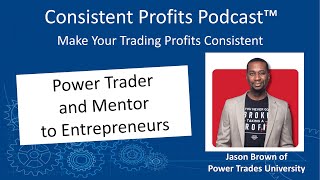
This is a YouTube video titled "How to get rich from the stock market during recessions & high inflation - Jason Brown – Episode 043" published in December 2023. It features an in-depth interview conversation between Brian McAboy, host of the Consistent Profits podcast, and Jason Brown, creator of Power Trades University. They discuss Jason's personal journey from challenging beginnings to successful stock trading, the importance of mindset and self-confidence in trading and entrepreneurship, the founding of his educational platform, and insights into trading strategies and consistency in profits. The content is a detailed, multi-speaker dialogue focused on stock market investing, trading psychology, and financial education.
Hello and welcome to the Consistent Profits podcast brought to you by Inside out trading and Brian McAvoy, where the focus is on consistency, because when you have the consistent part down, profits become easy. Hello, everybody. This is Brian McAvoy with a new episode of the Consistent Profits podcast. I am totally jazzed today to be interviewing Jason Brown, creator of Power Trades University. Thanks so much for being on the podcast today, man.
So good to be here. And I love your background.
Oh, yeah, gotta do it. Trading, right? Anyway, so for those of you not already familiar with Jason, he's a finance graduate from Wayne State University with over a decade of experience in stocks and options trading. At the young age of 23, Jason started trading with a $10,000 student loan and grew it into a six figure trading account. His passion for teaching others about stock market investing led him to create his own online education company for the Power Trades University, which has helped thousands of traders and students worldwide to start investing. Jason is an active YouTuber with over 80,000 subscribers and his videos have reached over a million views. He's also the host of Money Markets and Mindset podcast. Jason believes that anyone can profit from the stock market if they know what to look for and how to spot low risk, but high reward times to buy and sell combined with the right option strategies to supercharge returns and minimize risk. Well, Jason's somewhat of a celebrity. He's also very down to earth again. Thanks for being here, man. Being game for the interview.
Thanks so much, Brian.
Yeah, indeed. Now, like, we're, like, we're talking about. Mindset is a great place to start. I mean, that really is so critical for everybody. So I, I'd love to hear your take on it because, I mean, you're well versed in both, you know, finance world and, you know, entrepreneurship. So. Yeah, what's, what's, what's your take on, on mindset that can cover a lot of ground or come from a lot of different directions.
So mindset for me is everything. And I know sometimes you hear people say they're like, oh, it's everything, but it really is because two people can know how to do something or two people can have the same information, but one person's mindset might not give them the I believe in myself, go do it. It might not believe it could happen for people like them. And so you can have two people with the exact same information. One is afraid of starting a business, one is afraid of investing in the stock market. And the only difference typically is mindset. And so for me, when I grew Up. We grew up pretty poor, and we grew up in Detroit. Single parent household. And because, you know, I look at my mindset, how I was different from people around me in my age. Like, some people had the mindset, let's join gangs. Let's sell drugs. And I had that mindset, too. I was in the gang. I sold drugs, but I was like a smart gangster. Like, my mindset was like, I'm leaving here one day. I don't want to be here forever. So I remember one time in the hallway, like, all kind of the gang members got together and was like, what'd you get on your report card? One was like, I got three Fs, two Ds, and the C. The other was like, what'd you get? He's like, I got two Fs, 3Ds and an incomplete. And it's like, jason, what you get? And I was like, you don't want to know what I got. It's because I had, like, three A's, two B's, two C's. Like, I was like, I'm getting up out of here someday. But what was the difference between me and them? It was mindset. When I started my stock trading and investing career, I started with two of my cousins, and they had money to go to, like, a seminar. I didn't have money to go to a seminar. They came back from the seminar. One cousin was like, man, that's too risky. I didn't even go to the seminar. I was like, I want in, right? And me and the other cousin was like, let's figure out how to do this. So two people with the information and one person, which was me, didn't even get any information. I was just like, can I look at the notes y' all took from the session so I can learn this stuff? And so I just think mindset is so critical because that's usually, like, the deciding factor. A lot of time between whether someone is successful or they're willing to take calculated risks or how they look at trials and tribulations when it comes their way. One person gets a speed and ticket, and it's like, can't believe my luck. Another person gets a speeding ticket, and it's like, probably stop me from getting into a car accident to kill myself. Mindset. So when I say it's everything, it's not just trading. It's not just business. It's marriage, it's your health. It's how you view when you get a ticket or something that you perceive to be negative happens to you, if your mindset is correct, you can kind of find the positive in everything.
True. True. And. Yeah, well, one of the big things that, that you, you're kind of alluding to with all that is how you deal with adversity coming. That all comes from your mindset is, yeah, something bad is happening to me or something bad just happened. How am I going to interpret that? Is it, is it ultimately for my benefit or is, yeah, I'm just cursed and I'm suffering and I'm the victim here. So. Yeah, that's, that's cool.
And I'm sure, you know, if you go try to be a trader or entrepreneur, you go deal with some adversity.
Oh, heck yeah. Oh yeah. Well, well, I mean, and you know, just in business in general. Yeah. Entrepreneurship, it's like, yeah. If you can't deal with some, some failure and some adversity and some challenges, if you, if you got to have that smooth road all the way, it's like you're in a wrong spot. Yeah. Go find a job.
Wrong spot. And even there you go realize it ain't smooth the first time you get laid off or you get fired or there's budget cuts. Right. So, so you got to learn how to deal with adversity and you definitely need to have the right mindset.
Well, the other thing that you touched on with that also really in the mindset is self confidence. Gotta have that for both too. If you don't believe in yourself and the possibility that it exists for you. Yeah, that's huge. So now as far as, you know, like you said, your, your career though, or you know, your path. So you started off in, you know, bad circumstances and you know, you wound up going to school, you know, you started trading with funding your account. I take it you funded your account with the student loan, is that correct?
I did. But there's a story behind that story or before that story that I'm not sure if you know, you, you're familiar with. And I could share it if that's okay with you.
Yeah, yeah. Because no.
And so, so when I was 18 years old, you know, where we come from, like I said, we're in gangs, people get killed, people get locked up. And so there's huge celebration if you just make it through high school. And so when I graduated from high school, we had what's called like this open house and huge celebration. I actually got $2,000 of high school, like graduation money. I actually took that $2,000 and I went to a well known bank and I Was like, I want to invest. And the girl was like, so, what's your goal? I was like, I want to be rich. Why does anybody do this? Like, what do you mean, what's my goal? And so she was like, so you want aggressive funds? I'm like, yeah, I'm 18. I want aggressive funds. So that was it. That's the only two questions she asked me. I handed over $2,000. And I used to people, I'm like, why did you do that? Right? Because I would hear stuff like, if you had invested $2,000 when you were 18 and 20 years later, you would be a millionaire had you bought this stock or had you put it in the market. So I didn't know anything about the market. I just thought, why didn't Everybody just put $2,000 away when they were 18? So I'm like, I got 2,000 from graduation. I'm 18. I'll come back around 38 to 40. I'll be a millionaire. That's what I thought. I come back two years later. I'm about 20 years old. Like, how's my investments doing now? Mind you, they're sending me statements every quarter, but I didn't know how to read them. I didn't really know if I was doing good or bad. And so, because you might be like, well, how did you not know you weren't doing good? It's like, well, I didn't know what I was looking at. I mean, I saw the paper, but I was just like, what does this mean? And so I went and checked on my investments. It was down to $700. So they lost $1300 of mine. I told the lady, give me my 700. Well, first I asked what happened. She's like, oh, the market doesn't go up. I don't know what to tell you. But then I was like, give me my $700 back. I could have did this myself. I spent $200 on some gym shoes. I got 500 bucks. So, Brian, I'm making $8 an hour working for Sprint PCs. I'm selling cell phones inside of Best Buy as a sprint rep, making $50 on the Saturday after they take taxes out. So I'm like, if I can make 50 bucks with this $500, I don't have to work Saturdays anymore. So I bought Sprint. Our stock was $5 a share. I was able to buy a hundred shares. Sprint falls from five to four. I'm like, oh, man, this doesn't work. Maybe I'm not as smart as I thought. Then the stock Goes back up from four to five. I'm like, great. I just needed to go to 550 and I'll make my first 50 bucks. Then the stock fell again, the four. Until now. I'm like, the stock market's rigged. It's a scam. They know I needed to go to 5:50 and won't let it go there. That's why they got my Social Security number. When I opened the account, they know exactly what price I bought it at. I just thought it was rigged. So the stock goes back up to five, and I have this epiphany. I was like, I've seen this before. So I was like, I'm going to get out at 5. I got out at 5, stock fell to 4. I was like, I'm getting at 4 and went back up to 5. I made my first $100 from there. I started. I didn't know that that was called a channel and stock pattern. So I started studying these patterns and like, what other patterns exist? So I get really good at identifying these patterns. And then I had the confidence to say, so I was growing my $500 account. So then I was like, how do I get more money into the machine? Because I was doing really well with my 500 bucks. And I was like, so if I had 5,000, I would have made this much. If I had 10,000, I was like, where am I going to get 10,000 from? And so that's when I had the scholarship to Wayne State university. I'm like 21 at this time. And then I applied for the student loan because I saw people getting student loan refunds and they were partying and buying clothes and shopping. So I was like, I wonder if my tuition is covered from the scholarship, Will they give me the student loan refund? And that's when I had the idea of, like, I can take that and put it in the market. Because I was already doing well with the 500. I just needed to do it with more money and do the exact same thing. And so it kind of comes full circle back to that confidence thing or that mindset. I had a mindset when the lady at the bank, the so called professionals, lost my money. Most people's mindset would have been like, well, if they lost money, I would have lost it all too. My mindset was like, no, I can do better. Like, I could have lost my own money. That was the first step. Second thing from a mindset standpoint was I saw opportunity to use my student loan to make money. And that's when I Grew it to over $110,000 as a 21 year old college student. Whereas other people's mindset was like, let's go shopping with this money. Let's go party with the student loan refund check. And so that's actually how I got into the stock market with the student loan money.
Huh. Very cool. Very cool. Yeah. What a, what an excellent. Yeah, thanks for sharing that. That was, that's a cool path you follow though.
Yeah. I didn't just wake up and take the student loan and like, yeah, let's go invest. But like, I was trying it with my 500 bucks and I got really good at it. And then I was like, how do I get more money?
Yeah, well, at least, at least you wound up using that, that credit in the right way. What kills me is, well, every now and then, fortunately not that often, but once or twice a year, I'll have somebody call me up or email me and they're like, you know, Brian, you know, if I, if I, if I can just get my hand on, you know, $5,000 and, you know, maxed out my credit cards, but I know I can trade my way out of this mess. And it's like, no, stop, stop looking to borrow money. You need to be smarter with your money, dude.
And what's so funny about that? It's like I tell people, you know, I say stuff like that too, like, if I could just trade and get out of debt, if I could just trade and do this. Or, or, but, but they say, wait till I get some money, then I'll learn. And I'll, I'll say like, no, no, no, no, you don't understand. The only reason I was confident in taking that $10,000 is because I was already doing it in my practice account as well as with the $500. And so if you're, if you're going to trade your way out of whatever situation or learn this industry, prove yourself in a practice account first. Learn the skills. Because when you finally get some money, it's like, I've already been doing this. I've done a hundred trades. Here's my results. Here's my average win rate. Here's how I manage risk. You should already have that under your belt by the time you actually come across $5,000, which if you work a job, you get probably a $2000 tax return. All you got to do is find $3000 more. But it's so much easier to find that 3000 more if you could go to people and show you have a Track record. Instead, people want to say, once I get some money, Brian, I want to trade my way out of this. It's like, you've never placed a trade before this. It's like. And you think now under pressure, under the gun, with borrowed money, you're gonna trade your way out of this? Probably not.
Well, you touched on a couple of things that, that I find just are so crucial for people to understand. Whether it's, you know, entrepreneurship, but especially in trading is this isn't something where you can just look at the game and say, I get the game so I can jump into it and do it. There are skills that go with this, and you got to have the skills. And that's why a lot of people, you know, they'll complain about the prop firms where, you know, money used to be the only barrier to trading, and now the prop firms basically remove that barrier. You know, if you can come up a couple hundred bucks, you can trade at a prop firm. And the thing is, the, you know, they'll complain saying, you know, these prop firms, you know, they're so strict, they got so many rules. And I'll try to explain to them, it's like they just want you to prove that you can do what you need to do, that you have the skills to make money. And if you prove that to them, they'll give you the money to trade. That's the deal. But you got, you know, you have to show up with the skill set. And so, you know, yeah, like you're talking about, you know, you got to learn, you know, we know how to do it. And then. And then have your own track record, get some experience, prove to yourself that you can do it. I mean, a lot of the psychological issues that I see so many traders with, you know, they'll come to me and they're like, you know, hey, Brian, you know, I got a good strategy, but I just can't stick to it. You know, the problem must be me. I must have some psychological issue. I'm like, you know, a psychological issue. You got lack of training issues. You don't know what you're doing. That's why you're struggling. That's why it's rough. You're doing a job you haven't been prepared for. And so that's why it's cool that you got the, you know, the power trades university and stuff where, you know. Yeah, you're helping people understand the mindset and the skill set that goes with this. So now, as far as, you know, what. What prompted you to Go ahead and start up the, the university though. Power Trades University.
Yeah. So the, the, the second half of my life story that's not so glorious is what prompted me to start Power Trades University. So let's go back to that college student who made $113,000. I dropped out of school, Brian. I'm full time trading for like two years. I grow the account to about a quarter million dollars. I do everything a young black kid, inner city with no guidance would do. I buy Alexis, put it on 20 inch rooms, I move out to the suburbs, party and girls, paid no taxes, got some bad tax advice. And so now I'm like, I'm going to buy the ultimate bachelor pad condo downtown, Royal Oak, Michigan. Cost half a million dollars. I'm like, no problem. Like I'm killing it in the stock market. I'm gonna make a half a million dollars cash pay for this thing. Moving to the ultimate bachelor pad. I risk a quarter million dollars trying to make half a million dollars. By the time I'm 24, I'm flat broke. 24 to 25, I'm flat broke. I lose it all. There's a quarter million dollars after move back home with my mother in Detroit to the drug infested neighborhood. Bars on the window, people still in your cars. And I'm feeling defeated. And you talk about like mindset. You know, I was reading books at the time, like Think and Grow Rich. I was, you know, just feeding myself with like positive motivational stuff. This is before I lost the money. I was always just reading books and trying to learn what wealthy people do, how they think. And I came across Jim Rome, one of the motivational speakers. He passed away obviously now, but one of the things Jim Rohn said was like, take a picture, like write things down so like you can journal or remember. Like, it won't always be like this. And what you thought was such a big deal, you'll look back and laugh at it, but you'll also be able to tell your story and how you came out of it. And so then there was one line where it was like, and if you don't believe in yourself, think about your hero and ask what would your hero would do? And so I was like, all right, what would my trading hero do? I'm like, warren Buffett. I'm like, do you think Warren Buffett's ever lost a quarter million dollars? J. I'm like, of course. I'm like, but if he quits, he never becomes Warren Buffett. He never becomes a billionaire. I said, so if I Quit. I never become Jason Brown. And so whoever that person is meant to be, whoever I'm meant to become, right? And so I had this crazy idea. I said, Jim Rohn talked about taking like a picture of your situation. Well, I said, I'm gonna do one better. I said, I'm gonna record my situation. I was like, I'm gonna record myself making the money back. I'm like, anybody could make money, lose money and quit. I'm like, but the people who become the greats are the ones who you hear about that didn't give up and, you know, kept pressing forward. So I started recording myself making the money back. That's how I started my YouTube channel. I was like, I lost all my money. I'm going to. Well, I didn't say that one. I still have that video in my private collection. But I just was like, I'm going to show you guys. I'm going to take you on a journey as I place these trades and try to grow my account back to a hundred thousand. And so like, I just recorded myself making the money back. And then people started asking me, like, how are you finding these trades? Why'd you pick that one? And by the time I had got back on my feet, I'm back, you know, making money move back out of the house. I was like, I figured out how to get $100,000 in my account and grow to a quarter million. I was like, how do I get a million dollar account? And at the same time I was like, how come people don't explain the stock market like this? Now that I really know how it works, how come they don't say this? Why do they use fancy words? Why do they try to confuse, confuse people? And so I was like, man, I'm gonna explain it how I wish people would have explained it to me. And then I was like, I wonder if people would pay me for that. And that was the transition into starting power Trades University. Because people's like, well, what kind of trading are you doing? Are you day trading? Are you swing trading now? It's like, well, I'm power trading. And I was like, what does that mean? I was like, well, it doesn't matter if it's a day trade, a swing trade, a long term trade. I look for these predictable, repeatable patterns. And I put a lot of power behind it. Whether that's power being money or buying a lot of call or put options, I put the power option strategy behind it. So that's where I was like, I'm a power trader. I Guess like I'm not a day trader, I'm not a sw. Like I'm not a long term trader. I just, when I see opportunity, I put a lot of power behind it. And that just, that just stuck. I was like Power Trades University. And so I started teaching people how I wish I would have been taught. Like in normal, everyday, regular language. I don't manage anybody's money, so I don't have a need to make them feel stupid or look smarter than them. Because that's a tactic in the financial industry. People don't know that is most financial planners or people, they want to sound smart so that you say the word that they love to hear, which is I trust you. You sound like you know what you're talking about. I'll turn my money over to you. I'm the opposite. I want to make it so simple and easy because I don't manage your money. I need you to believe and know that you can manage it for yourself. And so that's literally how the company was born, huh?
Very cool. Yeah, that's funny. I started laughing because you were talking about, yeah, people want to sound sophisticated and everything there. I mean, there are whole industries built on that law. Absolutely. And half the, half the medical industry is just based on making sound, making things sound confusing and intimidating so that, you know, people take care of it. It's like, you know. Yeah, okay, you got separatic dermatitis. What does that mean? You got dandruff, but we'll call it. Right. Or you know, you got signs.
Just sounds so bad.
Yeah. And it's like, oh yeah, I got a runny nose. Okay, so. So that cost me 150 bucks. So. But yeah, if they were just speaking, if they spoke in plain language though. Yeah. They wouldn't have the positions that they do and, and Right. The fees that they do. So. Yeah. And like you said in the finance world. Yeah. Rampant. Yeah, let's make it sophisticated and confusing. So people depend.
Oh, yeah, yeah, Absolutely. Right. All the charts, the flash and lights they want to put. You know, when you think about anytime you see a trader, what do they show you? People yelling on the floor, six to 80 monitors. If they're trading at home, they got six different computer screens. Right. So the average person is like, I can't do this. I don't have six computer screens. I definitely can't fly out to New York. I don't even know what they're yelling about on the floor. It's like, it's not even like that in real life. You know, but like, that's the perception. And so they keep pushing that narrative which makes people feel like, what? I can't do this myself? I need somebody else.
Yeah. Yeah, indeed. Well, it's good that you do that the way, the way you do though. Yeah. Just making it, making it understandable. I'm the same way. It's like if I work myself out of a job, cool. Yeah. If I, if I could teach you to stand on your own two feet and make you self sufficient, cool. I don't, I don't want to keep you as a customer for life, but you know what?
When you do that, we never work ourselves out of a job because those people love staying connected to the people who help them see the light, who helped them come out of the dark and finally get it. And they, you love being a part of a community or attached to a person like that. And those are the type of people that's like, I gotta refer my cousin to you, Brian. I gotta refer my friend at work to you because Brian helped me see it. So you'll always have a job, we'll always have business, so we don't even have to hold our cards close to our chest. And we'll always have business as long as we do right by people.
True, true. Well now, so you got the Power Trades University. You also have the Brown Report. So now that's, that's a whole separate thing. So what, what's the difference between the two? What's the Brown Report?
So again, the Brown Report started off with me just videotape myself, make the money back. So like that was just like my personal vlog. That's how it started. I didn't know I was building a personal brand. All that wasn't really a thing back then. I was just like, I'm gonna give a report on how I'm making this money back. Like, here's my report on the stock market. Then when people start asking like, how am I doing it? I was like, well, I'm power trading and I've switched and built Power Trades University so people can learn that style of trading. But the Brown Report is more like, you're following my life as I make money, spend money, manage money, deal with taxes, deal with building wealth. It's more my personal brand, which is the Brown Report. More behind the scenes stuff.
Okay, no, fair enough. Now you got your degree in finance though, correct?
Yeah, so I actually did end up going back to school and getting my degree because now I knew what I wanted to be. I was first going for Engineering. When I lost all that money and I had to move back home, I got a job at Verizon Wireless. And Verizon had tuition reimbursement. So I actually went back to school and ended up getting my finance degree. And Verizon paid for it. And all the time I was kind of reinvesting my commission checks and stuff to get back in the stock market and recording myself doing it at the same time.
Oh, very cool. Well, one thing, one thing he did that I've recommended to so many people. Smart move. Go to work for a company that will pay for your schooling. Oh, my God. Huge.
Yeah, I'm. I'm forever grateful for Verizon for that. I mean, not only did they pay for my school, right? I mean, I was flat broke. So they also gave me a cell phone when, like, my phone got cut off, I had, you know, I was able to get a job and get the discount and then get a company phone, you know, So I was super grateful for the company, was able to invest in the 401k, make commission checks to get back into the stock market. And as you mentioned, I took advantage of the tuition reimbursement. So I'm, you know, I always tell people I'm not that guy who comes on and bash his company and, like, hate your boss. Quit your job. You may want to quit your job, but I think there's a right way and a wrong way to do it. And I was definitely one of those employees that I was a good employee because the better employee I was, the more money I made, the more money I made, the more money I had to invest. I wasn't really mad at my employer. It wasn't their job to get me rich. That was my job. And so I'm not really ever a employee basher. I'm like, you can learn a lot from the company. If you work for a Fortune 50 or Fortune 500 company, you can see how they report earnings. You can see how your sales contribute to them hitting earnings, see how Wall street responds. There is so much you can learn from being inside of a publicly traded company. So people just gotta change their mindset and take advantage of it.
Oh, huge. Well, just the job in general. I remember when I was. When I was like, you know, high school and college age, worked a lot of different jobs, and I totally appreciated it because I like you. I was going in there to learn. I wasn't there just to get the paycheck. It's like, yeah, I'm here. I'm here to do a job, but I'm also here to learn and like, I mean even like my very first job back in high school, washing dishes at a restaurant. I walked in there and it was a cool restaurant and I noticed, yeah, this place is thriving. And so I paid attention to like how the managers treated their employees, how they treated customers, customers, their whole like, philosophy that they, that they ran by because I mean it was a, it was a really good restaurant. It was a unique, it wasn't a franchise. And we were on the southwest corner of Kansas City. There were people who would drive clear across town 45 minutes on their lunch hour just to eat at our place. So it's like this is worth paying attention to. And this was in, this was at the end of the 80 or end of the 70s and rolling into the 80s when recession hit, we had a management turnover and then the new managers came in and they're all cost focused and treat the employees like crap and don't pay any more than minimum wage and argue with customers, you know, if they weren't happy their food and stuff like this. And I'm like, they're going to kill this place. They're just going to totally kill it. Because we were thriving before just crushing it. And now these guys are coming in and it wasn't two years later close the doors. And so for me, just watching the management, the management philosophy and the practices they put in place, I was like, yeah, I learned a ton. And so that right there, just every job I went into after that, it's like I paid attention how the company was running and their philosophies and again, how they, how they handle their, you know, their finances, their, their, you know, philosophies about cost versus profit and all that kind of stuff. And so every job I ever had, not only was I learning skills, I'm getting to watch the business and I thought that was great. And so.
Right, yeah.
So, yeah, I mean you were doing the same thing. You went into job, you obviously you chose very well because there were some good things about the job.
Oh, I chose strategically. I strategically looked for something that gave a discount on a service that I had to use if they had tuition reimbursement. And it also was important for me to have commission as well because I wanted to live off my hourly and then the ability to make a little bit more money so that I can put it in the stock market.
Yeah, yeah. And it was, that was super smart, man.
And it obviously very calculated.
Obviously served you well to do that though.
Yeah, it really did. It really did also learn a lot about managing people. I ended up working my way up into management. Learn a lot about management, sales, which. All things that help me in my business today. So, I mean, I got a lot of on the job training, you know, so it's. I'm super grateful to all my previous employers.
Yeah, well, actually, it's funny you mentioned on the job training for people who are really smart about it, because there are a couple times I've taken jobs strictly to learn, not for the paycheck. I would have done it for free, but with my kids, I would tell them the same thing. It's like, don't be, you know, don't be shy to work, but be smart. Be, you know, choose your job well. Go do something that you want to learn and, you know, look for employer pay attention how they're doing it. And look at it as paid training, not on the job training. You're actually getting paid to learn.
Hey, train. Yeah, that's true.
Yeah, you can, you know, you can pay to go to college and you're just paying money out of pocket to learn from other people. You can come over here and you can get paid while you're learning and you get. And you're developing skills and a resume bonus.
Heck yeah.
Oh, yeah.
Score.
Yeah. So, yeah, that's. That's really cool. So the fact that you've grown your YouTube account up so, so much, I mean, that, that's, that, that is, that's impressive. How's your journey on YouTube been? I mean, because, you know, there's some people, you know, they'll start off great and then it kind of falter or whatever. So how'd you. Have you been able to maintain your Momentum on, on YouTube?
You know, I look at YouTube as like, it's a documentation of my life. And so I, I don't know how far I'm gonna take this investment thing. You never know who I'll become, who our company will become. And I think it'd be so cool to look back 20, 30 years back and be like, what was this guy thinking back then? What was he saying? What stocks was he looking at? And so I look at YouTube, you know. Yes, it's nice to see the subscribers. And Stu, I look back and it's so fun to be like, I'm not a pandemic trader. I'm not a guy who just, you know, when the market crash in the pandemic, I said, I'm going to be a teacher now. It's so cool to look back and say, like, well, he's been doing and talking about stocks for a long time. And I think in doing that sometimes you make some great videos. You start to learn what people like and want to see and then you get a little bit of growth. Obviously there's guys doing and girls doing way better than me, but I'm having fun with it and I'm talking about the stuff that I want to talk about versus trying to make stuff that people click on and go viral. It's just like I'm just documenting my journey, document what I see, talking about the stuff I'm going through in the stock market real time that I'm like, oh, somebody like, I did a video called the Mental and emotional effects of Stock Trading. Well, it came because I had placed a trade, I had made. I don't know, I made like $26,000 in a day in a trade. But I, if I had a stayed in it, I would have made something like 46,000. So there's this emotional component where you're not even happy that you made 26. You're just mad you didn't make 40. And that happened to me. And so I just, like I said, let me cut the mic on and let me talk about the emotional side of trading, right? Like you mad you got out and you mad you stayed in. You mad you made some money, but you didn't make all the money. So I just talked about like the psychological parts of it and some of the things I do to kind of come out of that dark hole and be grateful. So. But that wasn't like a. Let me research and see what people want to watch. I just was documenting what's going on in my life and after I got out of a trade, so that's, that's how I use YouTube and some people find it and they like it and rock with me.
That's cool. Well, yeah, actually, I mean, what you just talking about just being genuine though. And so, yeah, that in and of itself is huge. And, and yeah, people do appreciate it. It's. That's very cool. Yeah, I know what you're talking about. With like, it was, God, the clickbait. Oh my God, it's, it's gotten worse over there. It's supposedly been, you know, supposedly clamped down on it and it's like, it's, it's just as bad as it's ever been.
Oh, people will always try to game a system or, you know, true do things the throw off balance of what stuff was intended for. It's just life, right.
Yeah. Very true, Very true. Well, one thing, one thing you mentioned earlier on, and we'll go and wrap this up. We're rolling up on our time here, but crack me up. You're talking about how, you know, you had. You're a power trader and how that came into being, you know. Yeah, you got a solid trade. What came to mind when you were saying that you heard the story. Nicholas Darvis, way back in like the 50s and 60s, he was the guy that wrote the book how I made $2 million in the stock Market. Anyway, one thing I thought was that.
Was that the one where he's like, he wrote a book about the stock market and sold it. Was that it or. No. Did he really make 2 million?
No, he was. He was actually a ballroom dancer and he was traveling around Europe and stuff. And.
No, I haven't heard about this.
Yeah, it was kind of cool. I mean, he's got a cool story. Anyway. He was. He was a dancer and some, some gig that he played. The guy didn't have money to pay him, so he paid him and didn't have cash to pay him, so he paid him $3,000 in stocks and he wound up trading it up to $2 million in $1960. And so, yeah, you know, and then he wound up writing the book and he got pretty famous. But one thing I thought was hilarious in his book that you'll see in a cut in some of the books about, you know, by trading legends, is they. They didn't follow the. The standard practice of, you know, just stick with, you know, like a 1% risk on any given trade. I'm reading the book and he's talking about what he would do, and it's like if he had. If he had a winner and he knew it, he would. Man, he's swinging for the fences. So he's loading up on those trades. And there was this one. I don't remember what the trade was, but it's like he. He was actually like hawking the stuff in his house to get money into this trade because he knew it was a winner. And yeah, he. He was swinging for defenses and man, the guy was good at it. And that's why, that's how he was able, like three years ran his account up like that. And this was back trading. They didn't even. He wasn't even doing about phone. He was getting his information by cable across. So. Yeah. But anyway, yeah, as far as swinging for the fences, and, you know, I've known a few traders that do that. You know, it's like, yeah, man, they got. They know they got a winner. So, yeah, they're putting. They're putting everything. They. Because they know. It's like, yeah, I'm. I'm. I'm on this one, and I'm not taking a small winner on this one. This one. This one's going, so that's cool.
Yeah, I actually got one like that on my. On my video where I made $460,000 on DocuSign. And that was back when, like, the world was shutting down. And I was like, man, everybody's going to be using this. Everybody's gonna. I'm like, I know they're going to be earning. Zoom already announced earnings and beat. I'm like. So I had this, like, I had fundamental and technical reasons to believe, and I put, like. I think I invested, like, $200,000 into that one trade, and then I brought back 600,000, which 400,000 was profit. That was. That was my biggest trade so far. I haven't had a as big of one as that one. But. But that's my thing when I. When I have researched technical fundamentals, whatever, and I. I put power behind it, and I, you know, I take a calculated risk and go for it.
That's cool, man. That. That is very cool. Heck, yeah. Yeah, Very cool. Well, one thing I also have to ask, just because this is the Consistent Profits podcast, so what. What do you see is probably the. The biggest obstacle traders have to making consistent profits?
Probably the biggest obstacle is trying to pick a direction. And so, you know, directional trading is very hard. And when I do directional, like, people think I just trade stocks all day, it's like, I don't. Because there. You can't pick a. I try to wait for extreme highs, extreme lows of support, and so then I may take a direction. But people who try to take a direction every day, every week, it ends up being a losing game. And so one of my favorite ways to be consistent, profitable. I don't talk about this one as much because people don't understand iron condors and stuff like that, but credit spreads is really one of my favorite strategies to do for consistent profits. You give yourself room in case you're wrong about the direction. You don't even have to be right about the direction, and you still can make money. And so I think that's probably the biggest mistake most traders make is they try to pick a direction. And most of them try to pick a direction without even learning how to read a chart. So they're like double flying blind and they end up blowing up their account.
Yeah, yeah, Flying blind. Yeah, true. I actually worked with this one gal. She'd been trained for two years and she didn't even know really what a put was she. But she'd been placing them for two years and I started explaining it to me, she couldn't explain it. Stop training with real money for a little bit. So. Yeah, yeah, yeah.
A lot of people out there doing stuff, I have no idea. I mean, I've seen people get in the trades and then they'll message me. It's like, like, how do I get out? I'm like, you didn't finish going through the course to learn how to get out before you got in. Like, you know, sometimes I'm like, whoa. And they, you know you're doing this with real money.
Yeah, oh yeah.
Now in this case, the stock went in his favor, but I'm like, what if it would have went against you and you don't know how to stop the bleeding or cut the loss small and get out? I'm like, ouch. You know, so yeah, that's the biggest threat to consistent profits.
Well, no, I like your take on it though. And yeah, as far as Iron Condor and selling options, non directional trading, yeah, it can be very good. But again, it does take skill. It's not.
It takes knowledge too though, right? Most people just don't know how to do it. They don't understand it because there's math involved. You're doing two to four options at once and if you don't understand one option, let alone using two to four of them, you're like, huh, you know, it could be confusing, but when someone breaks it down, it's like, here's how it works, here's how you do it. And not only that, we use like cheat sheets. So it's like, put that number here, put the one you're buying to open here. So I mean, if you follow the formula, it's hard to mess up unless you just get lazy and don't even print the sheet. So you know, we try to do things to make it easier for people, but it's knowledge. Knowledge is the, is the key factor. Right. When you look at people making money in the stock market, we're not really smart. We just have knowledge that you don't have. If you could get the same knowledge coupled with experience, you can get a similar result.
Yeah, true, true, very true.
Yeah. None of us have a monopoly on the market. I don't have enough money to buy all the Microsoft stock or options like I, I'm, I'm just a dude at home with couple hundred grand to a million. Like that thing trades like 40 billion a day or so. I don't know, I don't, I'm making up numbers, but like the amount of shares traded per day, it's like not even my account ain't even close to taking up the first 30 minutes of it, you know.
It's true, True, very true. Well, now, if somebody wants to connect with you, which, where's probably the, the best, best place for them to do that at the Power Trade University or your Brown Report, where's probably the brownreport.com.
Is the best place because my YouTube, you can connect with me on YouTube from there, on Instagram from there. All my social handles, LinkedIn, all of those are right there. So thebrownreport.com best place to connect with me. We also have what's called for people who are just getting started in the stock market who don't understand how to open an account, when to buy, when to sell. We have something called a stock market starter pack, which is free right now at this time. Then we also have the stock option starter pack, so if you don't understand calls, puts, you know, how to protect your account, different things like that. We also have the stock option starter pack. So both of those can be found just right on the homepage@thebrownreport.com wow.
Excellent. Very cool, Very cool. Well, and for, for all our listeners, if you know what, what you've been hearing and you know, you like what Jason's got to say and it kind of resonates with you and everything, make sure you swing by a site and go ahead and connect with it. Don't just sit back and keep doing what you've been doing. If it's not working, connect with him. He's, he's a good guy. He's, he wants to help you. He's, he's had the rough road himself and he's, he actually, I mean, I can tell, you know, he's got his heart in the right place. So definitely connect with him and, you know, move yourself in the right direction. So any last, any last words of wisdom for our listeners today?
Last words of wisdom is one of the quotes that we live by over here at Power Trades University, which is you never go broke taking a profit. So when you have some profit, bring it home. I watched so many people watch their account go all the way up and watch it come all the way back down. And I was one of those people, which is where the saying came from. So you never go broke taking a profit.
Yeah, Very good. Well, again, thanks for being here, man, and, and taking time, time out of your day to do this. I appreciate it. And for everybody listening, I appreciate you guys taking the time to, you know, learn and, and grow, develop as a trader and, you know, improve yourself. Not just chasing, chasing signals and strategies and stuff, but actually learning and becoming better trader. So thanks everybody for being here again. Jason, thank you. And we'll see everybody on the next episode of the Consistent Profits podcast. Take care.
Thank you as well, Brian.
Thank you for joining us today on the Consistent Profits podcast, brought to you by Inside Out Trading. Make sure to swing by InsideOutTrading.com and pick up your free copy of break the cycle 10 things you can do to stop reinforcing the past and get your trading on the right track. If you enjoyed the show, make sure to subscribe on your favorite channel and we'll see you on the next episode. Cheers.









