How to Optimize Your Trading System The Right Way
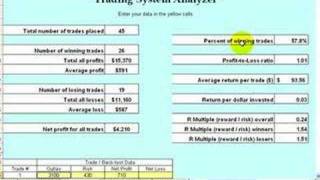
A trader walks through using a performance analyzer tool to backtest system changes and track key metrics. The focus is on data-driven adjustments rather than guessing, with examples of how to read the numbers and improve profitability.
You okay? I wanted to show you the latest additions to the trading performance analyzer. If you haven't seen this before, this is really cool. Trading can be very full of anxiety just because all the factors have come into play and a lot of decisions that you have to make. And the analyzer is to, to kind of help you get your head around a lot of it. A lot of traders, if they're not running their metrics, basically this is what you have to look at every month, how much you had going into your trades and your net profit and loss on each of them. If this is all you have to look at, you might be sitting, reviewing your account at the end of the month and say, oh, looks like it was a pretty decent month. It was mixed up here. Had a few winners, having a short run, losing trades, but finished out the month pretty strong. It was a pretty good month. This right here makes it really tough to tell how you're really doing and especially how can you look ahead to next month, what you're going to do, if this is what you got for this month, by keeping track of your metrics, and that's what this tool is for. These are your metrics that you want to watch and this is what makes the huge difference for so many traders. Now I've added a couple of features. The net profit for all your trades for the time period that you're looking at and also the R multiples, as I've heard in turn. Some people call them risk reward, which is really backwards. Everybody should say reward to risk because you're talking like three to one. But we're talking about your overall reward risk, what your real reward risk is on your winners. I mean, you may have a general plan whenever you enter a trade. I'm going to have, I'm shooting for a 3 to 1 reward to risk, but you're not likely to be hitting it all the time. And to know what you're really doing is very, very powerful. As far as looking ahead to the coming months, same thing on your losers. Are you keeping your losses where you really think you are? You may be thinking, well, I'm only going to risk $200 on this trade. You need to know, am I really keeping that there? That's where your average loss metrics, your average profit. Are you really winning as much money as you think you are? That's where your percentage, these are the key things that control your bottom line is your percentage of winning trades, your profit to loss ratio. What is your average return for every trade you place, how much money are you making every time you place a trade? These are the important things to be looking at. To give you some examples of the power of this, let's say here's where you are right now. Last month. This is a summary of your trading for last month. You won almost half of the time, which is pretty cool. You had a decent profit to loss ratio. Your average return per Trade was about $170. Sweet. Every time you went and placed a trade, you could plan on making $170. And your net profit for the end of the month was about $7,600. Not bad. Now here's where this gets really cool because say you want to make a change to your system rather than just try it and find out if it's going to work. Because when you go and make a change, let's say you decide to tighten your stops or loosen them, but you do something that affects your stops, which is likely to affect this. Well, let's see what would happen here. Wow. My percentage winning trades went up. But man, look at this. My average loss went way up. It almost went up double from what it used to be. So now my average return per trade went down. Here's where the power back testing and everything comes in. Say instead of just making that change and throwing money into it, you made the change and then you back tested over the same time frame. You took your system, you made the change and then you went back over that same time frame and saw what happened. Wound up with the same total number of trades placed, but it affected your winning percentage. Yeah, it didn't stop you out of as many trades perhaps, but it really affected your profit to loss ratio, which hurt your average return per trade substantially. Okay, so you did that back testing, found out, no, don't want to do that moving forward. So you decide to try a different change this time. You make a different change. You're back to about where you were as far as your percentage, but your profit to loss ratio went up. Cool. From where you were. Now this is really cool. Before we were making about $170 per trade. Now with this different change over that same time frame. Now we're making $227 a trade. Look at this. That's almost $3,000 difference over the same time frame. So, okay, yeah. Now this is a change that we want to make and we can move forward with it and have some confidence in it. That's the main thing. You got to have some confidence in your system to be able to stick with it. Now the big thing is, let's say we decided to make just one more slight tweak and see if that works. Then we back test it again. Whoa, sweet did even better. We kept our profit to loss ratio about where we want it to and our percentage of winning trade. So hey, this is working and that's exactly what this tool is for now keeping an eye on these is really important. Are you controlling your losses? What's your real reward to risk on the average for your winners? These are really critical things. This stuff here is what controls your bottom line. Now by being able to make measured changes and see what the effect is on these, like I said, you may get a higher percentage of winning trades, but is it going to kill your profit to loss ratio or vice versa? Because everything works in combination. Now went and added these and this here to the, to the analyzer. And with this sheet here that I added, I changed the layout a little bit as far as entering your information. Now you can enter up to 10,000 trades if you want to. It's virtually unlimited. I don't know anybody that's going to get that busy. But I also on each of the sheets we've got the basic system analysis which was the original sheet. I added this one we still have the performance tracker so you can track things over time, which is really important because you want to be seeing if you're progressing from month to month. And also got an equity graph there and then the income scorecard so you can make projections over the year, which is really powerful. I know when I first started trading, looking ahead to next month, how's my trading going to be over the next six months? There was a lot of hopes but very little confidence, a knowing confidence. And that's where this right here can be just huge. The other thing that I added on each of the sheets I now have a link to video where you can go straight to a video that shows you how to use a sheet. I wanted to keep this all very simple, very user friendly, very printer friendly. You can pretty much just jump into it without any help. If you need it, you can just come up here and click and you're right there. Insideouttrading.com is where you want to come to get this. But it's a really powerful tool as far as lowering your anxiety, protecting yourself moving forward, as far as making changes. It's part of the continuous improvement process with trading. You want to make measured and calculated changes to your trading to continuously improve your profitability so you can make more money, but you want to do it in a very calculated fashion and preferably through back testing. Or you make a change. And if you want to test forward rather than back test, you do it in a demo account so you can see before you lose money with it if it's going to be worthwhile or not. That's what this is all about. And there will be some more changes coming and when you get this lifetime upgrade. So every time I update this, I send it out to everybody who's got it. That's the latest. Again, come to insideout Trading to get it. If you have any questions, my contact information is on the site here at insideout Trading Facebook. Feel free to shoot me your questions.









