InsideOutTrading's What-If Analyzer
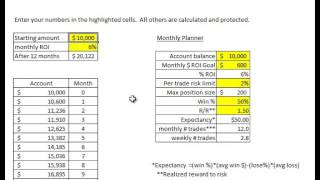
Brian McAvoy from Inside Out Trading walks through a what-if analyzer tool that lets traders test different scenarios for ROI, win rates, and position sizing. The tool helps you see how changes to your strategy affect profitability and risk.
Hi there. Brian McAvoy with Inside Out Trading. And congratulations on getting this what if scenario analyzer. I made this tool because of all the conversations that I've had with traders. And really, these are some things that they struggled with kind of getting their head around. And when you can get it down on paper and, you know, it just, not only is this kind of fun to play around with, but it also really, believe it or not, will help you to become a better trader and to trade better in your daily trading because you'll be more focused, you'll be more relaxed, you can have some more peace of mind because there's clarity brought to your trading and help you have more confidence as well. So as far as how you use this, and like I said, this is kind of fun because you can play around with the different, different things. Now, this side is where you're wanting to say or you want to see how you know, the year will plan out, pan out if, you know, producing a consistent roi. And so you know, because, hey, that's part of the fun part of trading is how much money can I make? So Instead of, say, $5,000, let's say you're starting with a $10,000 account and a 5% ROI. Let's say, well, you want to be just a little more aggressive than that. Let's make it 6% ROI. The cool thing about it is if you can make the 6% ROI and you leave the money in your account, yes, you will double your money at the end of a year. It's right here. It's 6% a year. You can run the math yourself and see how it works. It's really cool. Okay. People ask me all the time, what's reasonable to expect to make if I say 6% a year, doubling your money every year. Some people are like, no way. Because they got that stuck in their head. They can only make a couple of percent a year. You talk to a financial planner down at any of the big investment houses, let's say 8% a year is doing good. Well, they're crazy. 6% a year, believe it or not, is very conservative. And the monthly planner, this is how you can see that, yes, it is actually good, very reasonable to expect. So again, understand these cells, the yellow cells, is where you put your numbers in. Everything else is locked out and protected and calculated for you. That's why I locked it out, so you don't accidentally overwrite one of the formulas. But they're not tied together. These are just input cells. Again, say you got $10,000 and your monthly goal, you want to make say $600 at least for the first month. It's going to change as the year goes along. So there's your 6% ROI. And being reasonable again suggested a nice conservative per trade risk limit of 2%. And that gives you a maximum position size of $200. That tells you any trade the biggest position you can have on is $200. This is a topic in and of itself, position sizing, not just stops, but position sizing. So anyway, that's a conversation for another time. If you also want to look at your win rate, again, being conservative and reasonable about this, to have a 50% win rate being right half the time, anytime you enter the market, you say it's going to go up, it's going to go down. All right, you got a 50, 50 chance. And as far as the realized reward to risk of 1.5. And again, it's got to be what you realize. I've had a lot of people that are sitting there saying, no. My trading system, it's got a 3 to 1 reward to risk ratio. Well, maybe that's the plan going in. But what's important is what you're realizing, the results that getting. So this is important to know that, okay, you're actually getting one and a half times or one and a half for your reward to risk. Now again, these are kind of conservative numbers. You look at this 2%, not overly aggressive by any means, 50% win ratio and 1.5 R ratio. That gives you an expectancy on These numbers of $50 per trade, all trades included, winners and losers. This is going to be your average return per trade. That's the term I prefer to use. Instead of expectancy. This is the average return per trade. If you take all the money you make at the end of the month and divide it by the number of your trades, it's the same thing. It's your expectancy. What are you going to average on every trade, whether it's a winner or loser, you're going to make $50 per trade. Well, that means then, and this is where it can help you be a better trader is if you know that you only need to be placing 12 trades a month and sticking to your system. This will help you to avoid overtrading. You won't feel that you have to jump on every single trade out there. As long as you're making 12 trades a month and your system's working and you're following it, you'll make your goal. That's cool and really three trades a week. These are conservative, realistic numbers. 50% win ratio, 1.5% reward of risk, 2% risk limit. That's not super aggressive. So this is cool. So you can play around with this, Play with different numbers. You can change your monthly ROI goal. So you do want to be aggressive. We want to make $1,000 a month. Since your per trade risk limit and these didn't change, your expectancy stayed the same. But now, okay, now you got to place a few more trades. Instead of 12, it's 20. You can be more aggressive on the number of trades, but again, that's just one task tack on. Let's say you want to see how things change when you maybe go a little bit bigger risk limit. Oh, 3%. Yeah, now things change. Your expectancy goes up. If that doesn't affect your win rate, play with a little bit bigger position sizing because now instead of 200, it's 300. But again, you can come down here. Let's say I've had a number of people come to me with scalping systems. Personally, I can't trade scalping systems, but some people, they like it because it's got a real high win rate. This one gal, she brought her system to me and had about an 82% win rate. If we put that number in here. The problem with her system was the reward to risk was terrible. She was risking way more than she was getting on every trade. Her reward to risk was like about a two. That's why she was struggling with the system because yeah, she might be winning a lot, but when those losers did come around, they just crushed her account. So this lets you know, okay, if you're going to be playing shooting for a high win rate, you better have a reward risk ratio of say maybe three to get you in the positive or at least let's say 0.25. So like I said, you can play around with this. See how this is to run different what ifs. What If I'm making 82% win rate but I got a crappy reward to risk ratio. My profit to loss ratio is terrible. Or maybe, hey, it's killing it. I got a high win rate and a decent reward to risk ratio. Yeah, I can be tearing it up over here. Now. One guy helped him get his system tweaked and oh my God, his system was killing it. He actually literally had about a 95% win ratio and one to one on the risk to reward. And I mean, it's just crushing it. But not when it came to me. It was hilarious because over the years he had added so much stuff to a system. The main thing we did was stripped it back down to where it really cleaned out all the stuff that didn't need to be there and it just tore it up so you can find out what works. I mean you don't have to have a crazy system here. Like I said, you can start with one where it's just a 50% win rate and a 1.5 ratio and you got a profitable system where you can double your money every year. That's cool. Anyway, two things I would ask you to do. Like I said, play around with this. This is like the super simple version. I also made another version of this that's just a little bit more in depth, lets you look a little further out, not just the first year, but first couple of years and also include some costs so that it's more realistic. And also at some point you build your account up enough, you're going to want to start taking some cash out as well as put some money back into it. So it's got that kind of stuff in there. It also changes the position, size as time passes and these things are happening. I call that because really that's part of your wealth plan. How are you going to have trading build up your account to where now it's really providing a wealth generation and income producing situation for you where it's really providing a nice lifestyle for you and your family. Again, it's a simple tool, but it's one that will really help you get started. In keeping with treating your trading as a business. That's the whole point of really doing all this is if you can treat your trading as a business, it will become reliable and it will pay you and it will give you that security that you're looking for. I hope you enjoy this and you find it useful. If you do, I would ask a real simple favor of you. This takes some effort to put together. I wanted you to have it for free. But what I would ask is if you do appreciate it, to share it with your friends on Twitter or Facebook or Google or through email however you want to. But let other people know about this. I mean it's free, it doesn't cost you anything, it won't cost them anything. And if it helps them out, helps them become a better trader, then cool. Now the other thing is if you like this, also have other tools, real simple tools which are readily available to you. And I like keeping things simple. I mean my whole focus is making things work and keeping it simple, keeping it easy. Because all this stuff, there's so much misinformation. It's so easy to hit overwhelm. And for things to get confusing and overwhelming, the overload is just no fun. It takes all the fun out of it and it makes things way tougher than it needs to be. Good profitable trading does not have to be difficult. You just have to have the right information and the right training and the right tools. Once you have those things, profitable trading is very straightforward. It can be made very confusing and complicated. Some people capitalize on that to take advantage of people. It doesn't have to be that way. As you can see with this tool here, I like keeping things simple and straightforward. I've got other tools. I've got the Wealth Plan Analyzer, which is this kind of taken to the next level. Also have the Trading Performance Analyzer. Those are spreadsheets as well. If you like those things. Cool. Also, what I've put together, if you like. I call it the Successful Trader Starter Kit. And it's a group of tools including the Wealth Plan Analyzer, the deluxe version of this spreadsheet that we've just been looking at things that were missing when you first started training, things that weren't part of your training that really should have been. It's those gaps in your training really that are making things difficult. Now, I'm sure that the trading is well within your abilities if you're just given the right training, the right tools. So what I would ask that you do is swing by my site, InsideOutTrading.com and pick up a copy. It's free of the proven formula of all highly profitable traders. After you get that, then you can find out about the Successful Trader Starter Kit, which includes a whole bunch of really good stuff and it's dirt cheap. It's a real tiny investment and like I said, it will just help you fill in a lot of gaps. Fun tools like this, useful, enjoyable tools that will make your trading easier and better and more profitable and less stressful. So go check it out. Let me show you the page. Okay. So if you come by my site, Insideouttrading.com you'll get to see my smiling mug right here in a short video. If you click on this button, then you get to go to the proven formula download page Again, excellent report. You'll find it very helpful. I've gotten a whole bunch of really good reviews on it. A lot of people liked it when I wrote it. Again, you can get it for free. Just come down here, put in your name or excuse me, all you need is your email address. Click the button and it will take you to the Successful Trader Starter Kit where you can get a whole bunch of really cool stuff that you wish you would have had when you first started trading. So come check it out. Like I said, go ahead and get the proven formula for free. It's a good report, you'll find it helpful. And then you can also get the Starter Kit and again, a whole bunch of useful information, tools. And you know I'm here to help you, so take advantage of the offerings that I have. You'll be glad you did. Talk to you soon. Cheers.









