Life as a Professionally Employed Day Trader – Nishant Porbanderwalla – Episode 052
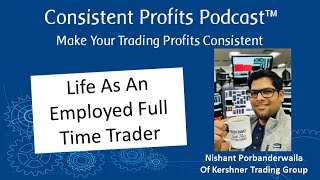
Nishant Porbanderwalla, an equity manager at Kirschner Trading Group, talks about his path into day trading and what the work actually looks like inside a proprietary trading firm. He covers his strategies, how he navigated major market swings, and what separates professionals from the rest.
Welcome to the Consistent Profits Podcast, brought to you by Brian McAvoy and Inside Out Trading. Because trading success comes from the Inside out. Visit InsideOutTrading.com where we focus on you, the trader, because you are the most important part of your trading. When you get the right coaching, trading becomes easy. Visit InsideOutTrading.com and now on to the podcast. Hello, everybody. This is Brian McAvoy with a new episode of the Consistent Profits podcast. I'm excited today to be interviewing Nishant Porbandarwala, equity manager at the Kirschner Trading Group. Thanks so much for being on the podcast today.
Thanks, Brian. Thanks for having me. Always a pleasure.
Yeah. Glad you're here, man. For those of you not already familiar with Nishant, he's had a more focused career than many traders, while still one with a lot of experiences, stories and lessons. He went to college at the University of Texas at Austin and then went to work for the Kirchner Trading Group, and that's where he's been ever since. Nishan, thanks again for being here, man.
Thanks again, Brian. Yeah, I went to ut, a true Longhorn. I still live in Austin, so I've seen actually Austin grow the way, you know, now the whole California has moved here, but before that, I've been living here for 23 years, so it's nice.
Yeah. Yeah. Texas has been a popular place for the last couple last few years with all the craziness going on.
Yeah, for sure. For sure. Like, I feel like we got discovered again in Covid.
Oh, yeah, yeah, true. Well, now, so as far as when you went to school, you got. You started with a bachelor's degree in economics, right. And then you also had liberal arts and economic in school of liberal arts, the economics and finance. Correct, Correct. Okay. Now, so with your. So it was. Was it more really the economics focus or more on the finance end of it? I asked because a lot of people also get into trading are, you know, they're in the finance, some in economics. So which would you say was probably the majority of the influence on you or where did you find your area of strength?
Oh, I don't know if this answer is going to be good for most people. I was never good to go to college, to be honest. So the easiest degree was economics. I used to like finance. So in my life, I kind of found out very early that if I'm passionate about something, I do really well at it. If I'm not, then I do really bad at it. So the finance classes, you know, all that was a lot of fun and I enjoyed it. But I didn't enjoy accounting. I enjoyed numbers. I enjoyed finance. I enjoyed. My father was always in the stock market too. I used to manage his portfolio a little bit out here. So I think that's where I was intrigued by. I wanted to be a portfolio manager. That's what you have your dreams. I don't know how to go about it, but you're like, oh, yeah, I want to be a portfolio manager. I want to buy all these stocks. I want to make this perfect portfolio which is going to go up and beat the S and P and everything. So I kind of managed my father's portfolio and that's how I got interested in trading as such. I didn't know what day trading was, which is, I think, a great way to start, because if you don't know anything about it, you don't have any bad habits. And back in the day, also, day trading was not such a popular profession as it's today. I see a lot because of Twitter and, you know, these glory stories everywhere. A lot of people want to become trade day traders, especially, you know, during COVID when, you know, you could make so much money so quickly. They thought this profession is, you know, for everyone, but it's really not for everyone. It's a really hard profession.
Oh, yeah, yeah, indeed. Well, so, so you knew before. Was it before you got, before you went to school or sometime during, during your term in college?
I would say during my four years in school, I've, I've, I, I said, I want to do something in the stock market now. I didn't know where to start and how to start and where to go. I just tried to, like, chaperone a portfolio manager in Austin. It didn't really work out. It. I was like, you know, he was managing my dad's portfolio, so he helped, he said, okay, you know what, why don't you come and, you know, help me out? But it's very different, you know, I was like, this is, it seems like a very, you know, job where you sit and you talk and you convince people which stocks to buy. I said, that's not what I want to do. Coincidentally, I was, you know, the business school, Koshno Trading came by and I went and spoke to the guy and I, you know, I think one of the biggest things that you need in trading is passion. And so this guy saw a lot of passion. He said, you know, why don't you come to the office? So I went to the K office and, you know, all these computers and it looked like, you know, like, it looked like, like a war zone in a way. Like everyone's like talking and screaming and someone's angry, someone's happy. I was like, wow, what is this? And that intrigued me. And I was like, oh, I want to try this out. And. But I also knew at that time it was a lot of these cold calling jobs. I was like, I hope this is not one of those. So I kind of figured out it was not one of those. It was go trade and if you make money, you take some home and that's it. And I was like, okay. But what I love the most about it is that sky is the limit. Right? And in a proprietary trading firm like Kirschner, like, you know, your downside is kind of limited because they take the risk of giving you the money and your upside is unlimited because you can make as much money as you can. And so I like that. The amount of work you put in, that's, that's the amount of profit you make.
Very cool. When you, when you were first talking about the room and you saw everybody yelling and screaming, it's like, so, so was it kind of a Wolf of Wall street experience?
I wish there were no women. There are no women in trading, unfortunately. So there was no Wolf of Wall street kind of experience. But we used to have who would go out late in the night and walk in at seven in the morning for trading and like, you know, they've been partying all night. So we had a lot of that. But I was, I was, I was a kid that time. But all the older traders were partying all night and walking in at like 7am and start trading the morning session now.
So when they brought you on board, you were actually, I mean, and still are. You're like an employee of the company though, right?
Correct. Yeah, we all like, you know, employees of the company. Right. We share a split a profit and they take the losses. And you know, if you, if you lose too much, you know, you get fired.
So now do they, do they work typically of other trading groups? And if so, one of my big curiosities was being being a trader working for a firm, that's kind of cool. And not very many people, I mean, it's a real small percentage of the population that winds up in that kind of a role. I was curious what their onboarding was like. And if they, you, they want you to trade a certain way or they get, they're pretty flexible. So when they brought you on board, what was it like?
So they are very flexible. You can pretty much do whatever you want the way you want it. The way when I started, they kind of, you know, there's a coach or a mentor and you're his student and he kind of teaches you his strategy or you look at his strategy and you know, you figure it out. And you know, you, he kind of helps you figure it out. And once you feel like you're comfortable that, you know, you're trading on your own and you know, there's, there's still your mentor throughout, throughout your career, and he gets a certain percentage of the company's profit that you make. So that's how it works. It becomes like, you know, which, which is what I tell everyone who wants to come in this profession, that if you really want to learn, then you got to sit next to someone and that's the only way you can learn how to day trade. I don't think anyone can help you via Insta or via Twitter or all these things. You have to sit there because it's very easy to come and say, listen, this is where I sold the stock. This is where I bought the stock. Anyone can say that. But between this and that, what emotions did you go through? How many times did you panic sell? How many times did you think that this was the wrong decision? You know, that's what, that's what you need to learn. You know, it's very easy once the trades over, like, oh, yeah, this trade is perfect. You know, I bought it out here, I sold it out here. Yeah, but did you feel like selling it out here? And why didn't you sell it out here? Those are the questions that you need to keep telling the person who's sitting next to you that, you know, hey, this is my strategy, why I'm doing this, why I'm not doing that. I think so for me, I think that was, for me, my coach was the biggest reason for me to move up. And then, you know, we have this, you know, because it's, it's a firm, it's a lot of other traders. You talk to them, you learn from them. You see, you see something, you add something, becomes your own strategy after a while, you know, you fine tune things a little bit different than the person next to you and that becomes, you know, a trade in the long run.
Okay, well, as far as your, your strategy and, and not to ask you to give up anything proprietary, but just in general with your, with your trading. Again, generally speaking, are you somewhat of a discretionary trader where you're pretty flexible and responding to what the Markets are presenting you or are you more methodical and mechanical and you're looking for specific things and you got a very specific process that you go through as far as, you know, placing and managing trades.
I would say more discretional. Basically I look at what is moving in the market, right? I mean today, Today is what, 14th, right? 14th February today, the last two days, small caps have been going a little crazy, you know, which is what I expected for a while because we, the market's all time highs. Usually when markets are all time highs, there's nothing else to buy. It's the, it's the shittiest stocks that go up, which is what is happening right now. So then I'm trading, I'm trading short, you know, small caps right now, you know, you know, if, if something else is what I kind of trade anything that moves and that's my strategy, you know, if it's moving, I'm trading it now. Which direction to go and why to go and when to go is the game.
Gotcha.
Which if someone tells me to explain them, I cannot explain. You have to sit next to me, I have to talk to you as and when that's happening and then you know, if you can figure it out from there on, great. If you can't, I don't know, you got to go with your own 10,000 hours of trading to figure out what, you know, what is your strategy, what works for you? For me, it's a very fast pace. I'm like in and out of stuff very quickly. I'm trying to make quick money, you know, I'm trying to manage my losses for you, for some other, for someone else, you know, that might be a too quicker strategy. Like, you know, if I make someone sit next to me and they see me doing like, hey, I'm not getting anything what you're doing. And I'm like, yeah, it's become second nature to me because I've just done the 10,000 hours. It's just like the hands and the fingers move automatically and why they move and how they move is AI. These are data sets that are there in my head, which I don't know if they're there or no, but they're there. And I'm somehow catching every data set that I've seen before. This pattern, that pattern that I've seen before. I'm using that and trading off it. Even I don't know from where it's coming from.
Gotcha. Well, but you had the advantage of managing your dad's portfolio for a While.
Yeah, but that was more like buying Microsoft and seeing what it's doing. It was just more on a very basic level like any other person would manage a portfolio, like your long term portfolio. But it just got me interested at least in stocks.
Well, and it got you familiar with the environment.
Correct.
And, and then when you, when they brought you on board, they had you working with, with a trader. So. And, and you were like with them like all the time, right?
Correct.
So yeah, that's good. Now with that coming a kind of an environment where yeah, you've got like a full time mentor if, if somebody else were to step into the same situation or when people are coming on board with the company, how long, how long does it usually take for somebody to get proficient enough where they can stand on their own two feet and start trading on their own?
Honestly, if you're a normal person, I would say it takes about 18 months.
Okay.
But it also depends what kind of market it is. Right. In a Covid market in 2020, 2021, you could be there much quicker because it's much easier at times, the liquidity on both ends and this and that. But, but, but in markets like this it's much harder. You know, it could, I would say it takes 18 months to be a good, to be a trade away, you know, you know, you feel like, okay, I can sit here and I can trade stocks. Not saying you can make money, but you know, you can not stop losing money at least right now.
Have you always worked strictly with stocks or have you ventured into some of the other arenas like crypto or Forex or futures?
So I mean I'll trade crypto through GBTX. So I bet you know, these new ETFs, but not really my scene as such. I'll trade them as stocks, but yeah, I'll do a little bit of options, but my primary bread and butter is equities.
Gotcha. Gotcha. Now, since you've been at it for a while and you said you're, you know, you're managing the company's money, what do you, what is like a typical trade size for you? Just like as far as how much you're, you're putting at risk out there on a typical trade.
So at Kirschner, once you reach a certain level, you know, capital really doesn't become a constraint as such. So I've never had a capital constraint as such. I'm always good in amount of, they give me enough capital that I need. So usually I don't even look at, at things like how much I'm risking at times, you know, it's about what's the opportunity that is in front of me. And if it's, you know, a great setup, then, you know, you're. You're going to risk it. It just depends how great a setup it is. And that's how, you know, I've always been. It's like, you know, if the market is not there, it's not ready to give. I don't snatch. But if the market is happening, I'll snatch. And that means, you know, me being more aggressive, me being, you know. You know, you could make a lot more mistakes in a good market, and, you know, that's fine because there's so many good trades happening. But in a bad market or in a. In a bear market or in a market where liquidity is a problem, you're going to make very less mistakes. So then I'm like, you know, my, my, you know, I only do best setups that I can find. I won't go for anything and everything around.
Yeah, well, yeah, that's good enough. Yeah. I was just curious since you've got the, the time on, because you've been there for quite a while now. I mean, you're rolling up on 20 years.
Yeah, yeah, yeah. 2006. So, yeah, it's been a long time. I've seen the flash crash. I've seen the 2008 crash. I've seen. Yeah, Covid. It's been fun times.
Well, what have been some of the more memorable experiences that you've had? Any particular days or like, you know, maybe short periods where it was. It was particularly noteworthy?
Oh, yeah. So many right before I start that I always tell this to most people who are traders for a long period of time and why this profession is so good is that every five years you get a nice bonus and every 10 years you get retirement money. So if you're there for this period, you'll get those big bonuses. The other years, you just have to, like, make enough money where you can survive. So. So just like that, I mean, 2008 was one of those years where I just started trading. And honestly, I've never seen panic like that before. I've never seen thereafter. It honestly felt like at some point that the world is coming to an end. Some nights when things were going bankrupt and we were like, oh, the whole financial system is going to go away. And those are one of the. The craziest times. But I wasn't experienced enough to take advantage of it like, the way I am today. And if I was, I guess I would be retired by now. If those markets ever come back, they were much illiquid, all sorts of things moved a lot more and they came back much faster. A lot of other stuff that was happening, there was so much happening at that moment. And it was the first big crash after I think 2000, so which I had not seen. So for me it was like, oh my God, what is happening out here? It felt like the world is coming to an end after that, I think 2014, I think was the big flash crash where China devalued the currency and the market I think gapped down about 6, 700 points which was I think about 3 and a half, 4%. I think we went limit down on options overnight and then it opened and just, I think just flashed down I think in the first 15, 20 minutes, about 400, 500 points in probably 20 minutes. And I guess a lot of stocks had no idea how to manage that kind of, I think high frequency trading was just getting in and they just pulled all their bids out and there was really no liquidity. And like, you know, I think I remember like Home Depot falling 40, 50 points on that day for that 20 minutes. So those were. That day obviously is one of my best days ever in my history of trading. I won't forget that. And then I think the COVID times, I think if you fast forward to that so 2008, 2014 and 2020. So every six, seven years you get something where if you don't take advantage of it and if you have the experience, you will do well on those markets. And 2020 was one of those, those time and Covid just came and you know, just created again. You feel like the world is coming to an end. You know all those times you felt like the world's coming to an end and you know, obviously those are the best times to really invest money in. And for a day trader it was just, yeah it was, it was a lot of opportunities all day I think, I think those two years I think I've worked harder than I ever worked in my, in my 15, 20 years career. I was waking up at 3 o' clock in the morning, start the pre market trading and I would stop at like seven in the evening when the, you know, the post market would be done. And it was just, it was just not. I would like sit with my, my son after that and, and do puzzles because I couldn't, I had to get out of that zone because you know, you're in that zone for a long period of time. And then, you know, you're sleeping. You're dreaming of stocks and dreaming of what's going to happen tomorrow and what's. So it gets a lot, and I'm glad.









