Mr High Win Rate w Reliable Income – Tony Pawlak – Episode 066
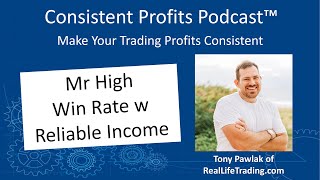
Tony Pawlak left his trucking business to trade options full-time, focusing on credit spreads and covered calls for steady income. He shares how he built a high win rate strategy, the early mistakes that cost him, and what he teaches traders now through his courses.
Hello, and welcome to the Consistent Profits podcast brought to you by Inside out trading and Brian McAvoy, where the focus is on consistency, because when you have the consistent part down, profits become easy. Hello, everybody, and welcome to another episode of the Consistent Profits podcast. It's brought to you by Brian Macable Trading. That would be me. And today I'm excited to be interviewing Tony Pollock of Real Life Trading. He's a. A stock and options trader, and he's been. Been in the game for a while. Part of the Real Life Trading Group, whom I've worked with before, been on their podcast. I had you guys on here before as well. Tony, Tank, thanks for taking time today to. To do this, man. Appreciate it, man.
My pleasure. I was excited as soon as you reached out. I was like, let's make this happen. So thank you for having me.
Yeah, yeah. Now, as far as, you know, with trading, how. How did you get started in trading? What were you doing before?
It's a great question. I was running a family business, so we were in the trucking industry. And, yeah, I started dabbling. Robin Hood kind of piqued my interest years and years and years ago, and I always kind of liked options, so I lost a whole lot of little bit of money just messing around with options on Robin Hood. And that's how I got started. I just kind of caught the bug of like, man, this is cool. I. I like the fact that I can trade, press buttons and make money. It was just. It was fun. So that's kind of how I got started into that.
Huh. So what. What was your business you were running?
Yeah, so we ran trucking. The business is still there on the family. I was. My dad and I were running it.
And were you driving brokering or what?
We were driving. So, yeah, we. We ran our own trucks hauling groceries. And then the other part was lumber around Arizona. So I was the driver, sometimes the mechanic. I was the. The accountant, the HR rep. I pretty much just did it all for the company, me and my dad.
That's. Well, that's awesome, though, because you had some business experience before you got it into. Before you got into trading, which is huge. I mean, one of my favorite questions to ask people, you know, when. You know when. When they're coming to me for help with trading is like, have you ever run a business before? And because if they haven't, if they've only been an employee their entire life, it's like, no, you got two learning curves. You got to learn how to. How to run a business, and you can Learn how to trade. Yeah, because there is a whole learning curve to running a business and, and self management and the whole nine yards. So that's. Yeah, that's cool. That so. Well, speaking of which, I mean, were you able to bring over some of your learnings from the trucking business to your trading?
Yes, yes, very much so. Really, just, I would say in the trucking business, it's. It kind of hardens you in the sense of, like, you go through a lot of trials, a lot of stress, a lot of hard times, you have things breaking down, a lot of unknowns, a lot of uncertainties. And so that was one of the biggest parts that I took into my trading because there is so many ups and downs. I think people just kind of look at it like, oh, you just click buttons and make money and it's, it's not smooth sailing. It's managing the bad and riding out as long as you can on the goods and just letting them even themselves out and turning a profit. So that helped me a lot when I was faced with those hard times. Instead of kind of crumbling backwards, I started solving problems. So I started figuring out what's in front of me, how can I solve it instead of letting those things identify me and me start crawling into a corner and failing?
True, true. Well, no, and it's cool to even, you know, present that in and of itself because, yeah, I mean, you know, people like to identify as a trader because, you know, you know, we're. We're the rogues, you know, we're the risk takers. And it's like, nah, not really. If you want, you want to, you know, you want to have some big cojones, there are a lot of other endeavors you can go try to take bigger cojones than trading.
Oh, yeah.
And, yeah, I can see how trucking can definitely be one man where. Yeah, it's, it's, yeah, a lot of risk riding out there and you're having to invest a whole lot of time in and yourself and money a lot of times before you're getting ahead and making profit. So.
Oh, yeah, before you're getting paid. Right. I mean, you're waiting six months sometimes to get a paycheck, and in the meantime, your trucks are going out every day. And so you have drivers insurance, repairs and. And there's a lot that goes into it before you even see money coming in. So it's, it prepared me pretty well to get into trading and having that mindset of, like you said, running a business. I love that analogy because it is it's running a business and it's, you know, it's, it's planning for the expenses. Right. Just like you would a business. That's a big part of trading is. I don't view it as losses. It's just part of doing business. I have my edge and my risk is actually very calculated and very set. So like you said, I, I don't have this unknown. I think people see risk as the unknown. I'm just going to lose everything. No, I know exactly how much I'm going to lose. If I'm wrong on this trade, I lose this much. If I'm right, I make this much. Rinse and repeat, find something that works and just keep going. And that's, in a nutshell, is trading right there.
Right. Well, so, I mean, you know, with trading, I mean, that's only one of like a thousand different things you could do.
Yeah.
So. So why trading? Why. Why not one of the other thousand things you could do?
Man. You know, I honestly felt like I was just like, trading was for me. When I figured this out, I was like, trading is what I want to do. I, I love the fact that it's on me. I'm not having to rely on some other employees to show up to work. And, and I can, I can hold it down myself. It's low expenses, so to say, when it comes to actually operating. And so I was able to kind of get into it. I didn't have enough size. I'll tell you my story here in a second of, of the crazy journey that I had when I started trading. And, and what's. So people can know what not to do if they decide to trade full time, because I didn't do what you're supposed to do, and I paid the price for it. But I'm glad I did because now I can help someone else make a better decision. But yeah, it's, it was, it was a long journey getting into this, and I just, I was always interested in this. It's just like I said, it was my calling is what I was supposed to do. It's what I enjoyed. And the pros of just being able to do this anywhere at any time lured me into, I can do this, make a lot of money. No one's there telling me I, I can't make this much or I can't get a raise. I can. I'm in control of it all and I get to do it at my own schedule.
Yeah, yeah, that's, that's one of the, one of the absolute best things about trading is. I mean, the markets have their schedules, but as far as getting involved in trading, there are enough different markets and different exchanges around the world and everything that it's like, yeah, no matter when you want to trade, what kind of hours you want to keep, you can find a way to trade and fit it into those hours, which is awesome.
Yeah. Yeah. The freedom is a huge. It was a huge draw to me, and it's a huge draw to everyone out there. Usually that wants to learn how to trade, that can do anything anywhere is really cool.
So what's your story and the things everybody wants to avoid here?
Yeah. So I was about eight years into that trucking company, working 14 hours a day, pretty much every day I was in it, and I was ready for that freedom. And I just had a feeling from God just like, I should do this. And so I'm like, done. Go to my wife. I'm like, let's quit. We were in Arizona at the time. I was like, let's move to Utah. That's where she's from. So she'd been wanting to get back there. And I was like, this will help her say yes to this crazy idea. Let's move back to Utah. Right? Give her something. And so, of course, she was down. She was like, yes, let's do this. And so we sell our house. We sell everything that we have. And I think I have $100,000 to my name. We go out and we buy a house in Utah, and I put $30,000 into a trading account. And I was like, we're going to be rich. Like, this is just millions of dollars going to come our way. You know, it's. Life is going to be great. So we go and buy cars. We bought this house. We didn't even rent. We just, like, we're all in. No backup plan. This is going to work. And with. Within the first month, I had lost that entire trading account. And I knew how to trade, but I was not prepared for. You need to make five grand in the next three weeks. And then losing on a trade. Now I've got to make $6,000 and losing. Now I got to make 10 grand in four just to pay the bills. And I just crumbled under the pressure. I made every mistake you can make in the book. And so then we took our life savings out, put it into a trading account that was gone in a month and a half, and I have nothing. Like, we went from being well off. Nothing.
No, I'm. I'm laughing because it's like, I Made similar mistakes. And looking at myself, it's like I'm, I'm lucky I survived because I'm lucky my wife didn't kill me somewhere.
Exactly. No, I, I laugh at it every single time because it's just how, how the fortunes came along, just how everything came into place is, it's, it's insane but it's, it's comical because if I knew what I was going to get myself into, I don't know if I would have done it. But at the exact same time I look back and it's one of the things that I'm most grateful for because the life I have now is greater than I've ever dreamed. But it didn't come without cost. And so when I had lost everything, like we had nothing, we were hitting zeros. I had good credit for my job and so I went out and took out a personal loan at a high interest rate put that, I didn't tell them what I was using it for. I put that into a trading account and I got down, I think to my last, I think 11,000 in the trading account, all on credit cards and have nothing else in the bank. That's when I sat down, I was like I need to figure this out. This is not working. I have burned through everything. I need to figure out what I need to do. And that's where that experience, right, of running that business. I sat down, I wrote down my problems. I'm like, what's in front of me, what I need? I need a thousand dollars a week with 13 something thousand dollar trading account. I can't remember. It's somewhere like 10 to 13,000 I think. I was like that's first off, that's insane. Like I don't know how I'm gonna do that, but this is what I've got to do. I didn't have a backup plan. So I started thinking credit spreads are really good for consistency. But with that size account I can make a hundred dollars a month. How can I make a thousand dollars a week? And I started solving problems and I came up with a strategy and I back traded to that strategy for probably 60 hours. Just non stop day and night, back traded, figured out what might work and it worked on paper. So then I started applying it and it worked in life. And I started making $1,000 a week off of that tiny little account. But the problem was every dime I made, I'd pull out. Just to keep us alive and pay our bills, right? That's what I needed just to stay alive. So the Account's making a lot of money, but it's never actually growing. And I would make a crucial mistake and lose 7,000. And we've been paying off some credit cards to load those back in to get me back up to 10 or 12,000 and try it again. And it was just a never ending circle of learning and failing and blowing up things and being like, okay, okay, don't do that, right? Don't, don't sell these spreads here and don't do this over earnings. And okay, now I know, let's move forward. And that's how I built it is this strategy of using these short term credit spreads. And at the time I was putting on crazy leverage. Like I don't do that now of course, but that's what I had to do to stay alive. And that was my story got me through. And it got me something that was making me consistent money so that I can spend my time learning how to do the rest, how to swing trade and how to day trade and how to invest. If I had something that I was just, the markets were rewarding me, I had something I could always fall back on to keep my bills paid. Now I can go out and learn other things that were going to bring in some more money in the future. And so that was my story. That's how it all came from. But it was probably about a year and a half before I really even got back on my feet and then another six or seven months just to get out of some more debt. But that strategy is still the thing I use today of just simple, easy selling some credit spreads. And the reason why that works and the reason I teach you that, because you don't have to be perfect, you just have to not be dead wrong, right? It's credit spreads like I win as long as it stays above this. So the marks can go up, sideways, down and do whatever it wants as long as it doesn't go down to here or up to there. And getting out of the perfectionism method of trading and giving myself some room to be wrong made all the difference because I only lost when I was dead wrong. And I wasn't dead wrong very often. It was just hard to be perfectly right. So that, that strategy kind of saved me in just solving problems. And now I, I've taught that strategy to thousands of people and they use the exact same formula to go replace their salary. So it's been a, a really cool cycle that came out of all this crazy story.
Okay, huh. Well, so you like options? You like selling options? Obviously, yeah. Well, tell us a little bit more about your philosophy on trading. And are now you're working with options on stocks, right, or options in the other arenas as well?
Mainly equities? Yeah, yeah, just stocks. And I do a lot on ETFs, on SPY, NASDAQ, stuff like that. But yeah, yeah, mainly just options. Selling it. And you're never going to make massive, massive amounts, but you'll make consistent returns. So I average 5 to 10% of my account a month with a 90 win rate. And that's good. Right. And so I have other things like I'm investing and I'm, I'm buying some stuff and doing other things. But my go to has always just been that strategy of just slow growth and doubling the account in a year and keeping bills paid and the lifestyle intact.
Well, one thing that cracks me up and, and you're like the perfect example of it here, or not. Not example of it, but anyway, I remember years ago I got on this forum and it was forex form and got to talking about, you know, what, what's reasonable to expect for like a monthly roi. And I said, you know, you really don't want to be working. You don't really want to be doing anything less than 5%. I mean, realistically, because there's so many other businesses that the average is 6% or better. Why the hell should you be over here, you know, settling for less than 5%? And I had a bunch of different people and they're like, oh, man, you're, you know, you're full of crap. You know, if you're, if you're a trader and you're making more than 1, 1 or 2% a month, you're a liar. And I'm like, no, this is like real business life here. I mean, you know, a lot of, a lot of businesses, you know, if your margin is less than 10, it's like, that's razor thin margins. And so with trading, yeah, 5 to 10amonth is perfectly reasonable if you're going about it. Right. Yeah, yeah. And so, and, and like you're talking about, yeah, selling options. It's not, you know, necessarily super sexy, but it's, it's pretty reliable. It's pretty consistent and it allows you to not have to be perfect or even close to it. You can be, you know, even not that great at it and still survive and do and do okay. Which is awesome. Yeah. So. But it's not necessarily sexy. I mean, you know. Yeah. Spread certain. Not necessarily all that exciting, you know. Yeah, you're not Hitting, you know, the massive, you know, you know, life changing amount of money on this trade. It's like, no, but I'm getting that regular paychecks, so. Yeah, yeah, very cool. Well now as far as over real life trading, I mean you got a group over there about how many people are in real life trading. As far as the organization.
The organization, I would say there's probably, man, I would say around 15 of us or so in that, within that organization total kind of doing some doing back end work, a lot of us teaching kind of our specialty. Like I'm the options guy, there's, and we have some future traders and, and so we have a mentor basically for every type day trading, swing trades, investing, to kind of fit whatever niches you guys need. So we kind of put an expert in every corner and, and kind of provide as much value as we can in each area.
All right, cool. Now, now how long has real life trading been around?
Oh man, I, I, Jeremy Newsom started real life trading, I want to say back in 2013.
Oh yeah.
Somewhere in that ballpark. So it's, it's been, it's been a while now. Yeah.
Huh. Very cool. Very cool. Well, as far as the before, before we get too deep into real life trading, as far as looking at, you know, some of the recent evolutions of things, I mean, you know, it was like maybe a handful of years ago, I guess it was about 10 or 12 years ago, you know, the, the EAs, the expert advisors, you know, that was a big thing. And then the, you know, of course the Forex bots, that was the next big thing. And then just general algorithmic trading got to be really big. And you know, now we've got like AI on the, on the horizon and there are some, you know, some outfits that are, you know, trying to blend AI into trading. What's your take on how that's going to affect things for, you know, the regular individual retail traders, you know, with AI and, and the further development of algorithmic trading. What are your thoughts on that?
Yeah, I would say use them to assist you. Right. There's, there's so many, there's so many things out there we look at like, man, it's just going to ruin things. But in the exact same time there's always a pro and a con to everything out there. That's what I believe. So I would say find the good in that. I don't know AI, what it could bring for the future. It might be a whole different story than what we think when it comes to the markets. But at the exact same time, I think the benefits that come from it could be really beneficial if someone can look for that and expect that of how can I incorporate this into trading? The automations that are there and the ways that this could improve our brokers of using at home, whatever broker you're using, AI can make things really beneficial. When it comes to the educational side of trading, you know, people are like, is it just going to ruin everything? It's like, I doubt it. You know, we've had bots trading the markets for who knows how long, right. And I, all I do is I look, where are the bots? Where is the big money? What are they doing? And I just play alongside with them so I don't fight it. They're not like undoing what I'm doing. I'm learning how they act, learning what they look for and I simply just ride that wave with them. So it's going to be the exact same thing. I think when AI starts to roll in. I'm not smart enough to know exactly how that could be, but I will always be on the lookout to figure it out and then just keep trading with the big money, keep riding those waves and play with them instead of trying to go against them.
Yeah, I'm, I'm kind of curious to see how AI is going to be when, when the algorithmic trading really started taking off. I, I looked at it as actually a big benefit because one of my favorite notions for the longest, longest time has been and you know, getting, helping people understand that the markets, when, you know, when you're looking at a chart, it's not just a random scatter plot. There's an order to the markets. Because the markets are people. Yeah. And for the longest time, you know, it was just almost exclusively people. And you know, people are predictable. You know, there'll be something happens, you know, some, some news event or whatever, whatever triggers something in the market and there'll be some emotional response to it that you see play out in the charts. You know, whether it's fear, greed, whatever, complacency, you know, but what we're seeing in the patterns that develop in the charts, it's because, you know, the groups of people that make up the markets, they're responding to something. And when we see, you know, a particular, you know, pattern, it's like, yeah, we're seeing the beginning of something. I mean, almost every, every good method that's been ever been developed is because somebody saw something that was happening over and over and over again and they're like cool. I can, I can identify that at the beginning and capture it and, and ride it out. And I'll have little windows of predictability in the markets. And so when, you know, algorithmic trading started taking off for me, that's like cool. That's actually going to add predictability because now it's not even people that are responding and following predicted patterns. You have computers that are following programs that are going to make it predictable. But with the AI, I think what that's going to really bring an interesting wrinkle into it is how the AI is, you know, it's supposed to be a learning thing and adapting and not just necessarily running on a straight up program. So I think it'll make things a little interesting. But yeah, I agree with you that definitely traders should use it as, as an assist if, if anything at all. But really if, if you think about it with trading, I mean, you know, we've got a good, we've got a pretty good computer in between our ears if we train it right. And so, you know, if we can, if we can train it right, the subconscious processing that we can do in our brain, you know, looking at a chart and everything, you know, you, you, you stacking a good, you know, good number of trades under your belt and into your head and you're doing it right. That's kind of hard to beat a good, you know, a good human as far as being able to look at the markets, make good sense of it. So yeah, I think it'd be kind of, I think it'd be pretty interesting. Well, so that's been one of the recent advents prop firm trading. Are you guys seeing much of a big change in things over, you know, prop for the prop firm explosion?
Huge. Yeah. So we, we also have partnered up with prop firms to help people have trading money. You know, they can come in, learn certain stuff and then trade with it. The rules that they're changing on that though, it's, it's really pushing into the futures markets now because most of these guys are getting out of the equity trades and actual stocks. So futures are actually having a lot more volatility in the sense of like, I guess I should say liquidity, more, more volume coming through since everyone's getting pushed into that and crypto. So we're also seeing that big uptick in trading volume coming in through crypto ever since they made that, the rule changes across the board. So prop trading I think is, is a great thing especially because that's, that was one of the biggest Barriers that I wish I could go back and change realizing that in order to trade successfully it's, it's, you need, you need a good capital fund like you need at least a hundred more, a hundred thousand dollars or, or more to really be able to pay bills without putting the entire account on some crazy stuff like I used to do, which I don't recommend doing and I don't do to this day. So it is nice in the fact that you can do a profit share with another company, they can give you some funds to trade with. So that way you have access to day trading, you have access to be able to do a lot of these different trades that you couldn't do with a thousand or $2,000 in a trading account. So yeah, there's benefits to it and, and again I think it's going to continue to affect some more markets especially out in the future side. But it's, it's gonna be fun to see how it plays out that that's all I say I, I got, you know, just looking at the options market right now, they introduced zero dtes and I feel like that had some of the biggest changes in the market that I've seen in a long time. It changes the way people hedge, especially the big money. Right. It's now I use even more than ever. I use option expected moves and I'm paying attention to where the large strike are sitting. Right. If there's 30,000 contracts sitting at this strike on a, on the market at 5:30 on SPY, it's going to be really tough for it to get through that level. And if it does get through that level, it tends to make a large run because now you have hedge funds and all the big other dogs hedging because now they're losing against that when before they didn't have that option. You just had Friday's expiration type thing which limited what they would do. So they would really try to keep things in line with, with expected moves. So I use those a lot more. And then whenever those expected moves are broken or the heavy option areas are broken, you can get a mount of really big move coming off of that. So I pay attention to those a lot now too. So again just changes in the markets and that's something that's happened over the last year, year and a half. That's you understand the trend and you, and you run with those new changes. Because that's really what I pay the most attention to are these are the options markets and it's crazy how predictable they can help you Be when it comes to the option movements and the markets movements.
Yeah, yeah, yeah, the zero dt. Yeah, that definitely, that brought an interesting wrinkle to things. So now you said that over real life trading that you've partnered up with a couple of prop firms you might try who you're working with.
Yes, we have. Our prop from now is Apex is who we are with now. We actually just changed out from a few other guys that just didn't quite meet our standards after a little bit, after they've made some rule changes. So we're happy with where we're at on those guys. But yeah, that way we can teach you how to trade and then you can get some money, some money to actually apply that knowledge of what we've taught and without having to have hundreds of thousands of dollars in the bank to be able to do it on your own.
Yeah. Well now as far as you know, the, what, you know, what you guys offer as far as help for traders, you got, you got a couple different communities, you got mentors, you got courses. What once you tell us a little bit about, you know, what, what all you got, you guys do have going on how you help traders and stuff.
Yeah. So we offer a variety of different packages to help you and whatever phase of trader that you're in so you can come trade live with us every single day. You can come just be a part of our community and we have a slack community where we're posting trades and answering questions and kind of just teaching because we're an educational based company. We want to, we, we're not here to give you trades or say follow us. We want to teach you how to do it so that you can go out and do it on your own instead of being a, a following type thing. We also have a lot of mentor groups and one on one coaching that people sign up for. So we're always hosting mentor groups where people can kind of get into it and, and figure out their own niche. And we have a specialized mentor in each section. So for futures and, and options and crypto and all these different other aspects, we have someone that's an expert in that field and investing and all that other stuff. Something that we're really pushing right now is to help people retire. So we have a retire in 90 days program that we just started and what we're teaching them is, is how to sell rent against their shares, how to sell covered calls, how to sell puts, how to protect yourself with insurance in the markets. Right. Most people don't realize so they have their Money sitting out with just a money manager who's not really doing a whole lot with it. And we teach them, manage your own money. This is how you do it. Don't just do it blindly. But here's how you can know where the good price is. Here's how you can read some price action to figure out what's going on if markets are about to reverse. How you can buy your own insurance to protect yourself. People don't even realize you can buy insurance on the stock market, right? Puts and put options, what they're called. And so now it's like if you bought Apple at $50 and you've been owning it for who knows how many years and it's at two, whatever, you don't have to sell it. You can just buy insurance and that insurance will pay you cash out on everything that it drops down. So you can stay in your shares and be protected against drops. And in the meantime, sell renting it to shares to bring in some consistent income. So for people that meet the criteria of wanting to look to retire, but like, man, I still need this. It's like you can bring in 1 or 2% of your account a month pretty easily just by selling some covered calls against the shares that you already own.
So you want something that's kind of cool. What's that now? Especially covered calls. As soon as you mentioned cover call, this grin ran across my face because now, years ago, put together this back testing tool and was, you know, working with a handful of people. Anyway, this one day I had this guy email me and he's like, you know, Brian, I don't understand because, you know, I'm, I'm running my back testing on this one strategy, but I'm coming up and it's actually, this is, it's like zero risk. And I'm like, he's like, I don't, I don't understand. I'm like, well, so you know, what do you got going on? And he started telling me, it's like, all right, you're doing covered calls. He said, yeah, but I don't understand how I can have zero risk. And I'm like, well, actually with covered calls, there actually is zero risk of loss. Your only risk is that you might miss out on profits after you sell. Yeah, but other than that, all the risk exists with the underlying asset they use only to cover calls on. So as we got to talking about it, it's like, yeah, I need to have a talk with my mom about it. She's got a bunch of stocks she's sitting on. They're super stable blue chip stocks just kind of sit there. She needs to be selling cover calls on them and get some additional cash flow on and because it's at zero risk.
Yeah, it's so true.
It's just income that's there for free and if, if they happen to get exercised, you're selling at a profit. Cool.
Yeah, exactly. And you know, you can always roll out of it. So you can always exit the contract if you truly don't want to sell. So there's always a way out. It might cost you a little bit of money on that, but still there is no risk. And that's the cool thing is, is the only risk you have is just like you said from owning the shares that you already had without selling, you might as well sell calls on it and make a little bit extra money. So it's a great method for those that are wanting to bring in some extra income. And if you own a decent chunk of shares, there's a lot of money on the table for you each and every month to be able to sell against those.
You know, where else you can use covered calls that some people don't think about.
What's that?
If you own physical gold. Oh, you know, because a lot of people, they like to buy and hold gold.
Yeah.
And I started doing that years ago because me and my son, we, we had bought up some gold coins and some, you know, some shares and stuff like that. And it's like, yeah, you know, okay, so we're sitting on it, looking for some decent appreciation. I mean it was mostly a hedge anyway, but it's like, yeah, how can we cash flow this? It's like, oh yeah, we can do covered calls because it's just going to sit here. Fine. Yeah, fine. Yeah. All day long.
Yeah.
So yeah, pretty much any asset that's going to be, you know, super stable and everything. But, but there's a demand for it. Yeah. Run cover calls on its way to cash flow and it can still sit there, you still own it. And yeah, it's a zero risk strategy by itself. It's like, yeah, this is cool stuff.
So, yeah, 100 and it's, it's easy to win on. It's. It's not something that requires, you know, perfect timing and all these other things that like let's say day trading, if you try to be successful in day trading compared to being successful against selling covered calls against your shares, it's a night. Right. There's so much that goes into day trading to be successful Such a fine line to walk. This other method is, is so much easier.
Yeah, well, and, and it doesn't take.
A lot of time.
Yeah, managing the trade gets pretty easy.
Yeah, it's, it's really not, there's not much to it. I mean that's one of the reasons why I love credit spreads is I don't want trading to be my full time job. I love trading but it's kind of sell have my alerts, have my targets in place and go out and live my life and come back and two weeks and get paid and do the same thing all over and over again. It's, it's easy and it's the same, it's the same management style with covered calls.
Now back to real life trading with some of the court. You're talking about the communities and the mentors that you have. You also have courses, right? So do you have any courses on like, you know, the options trading that you, you specialize in?
I do, yeah. So I actually teach this credit spread strategy that I was telling everyone about just now. The same strategy that kind of pulled me out of the hole and, and still to this day Average is a 90% win rate and 200% ROI each year. It's a fantastic strategy and proven and not only that, but I also have hedging plans within that. So if I am ever wrong, I have ways to actually turn losers into winners in a very simple way. So that strategy in every single detail is in one of my courses that I sell. So within one credit spread you'll pay back the cost of the course and that's why I purposely charged for it. So it's $495 for that. But that's the average, my average student's making about 700 out the door on a credit spread. So pretty easy. One trade and you have a system you can use for the rest of your life every week. So I have that. I have some other courses on price action. I'm a really big price action trader. So I have some courses that are cheaper that you can just get some clues on what these markets are trying to do. What are some clues in price action? Because that's the only thing that's about to tell you what's, what's going to happen compared to being a lagging indicator. So we have that and then RLT has tons of other courses from some of our other mentors that you can look into to see what, what best fits you. But the credit spread course is probably one of the hottest ones that we have Simply because it just works and, and five star reviews on trustpilot and money back guarantee and it's just, it's there.
So as first running credit spreads there, it's depending on who you're working with. You can have some different requirements as far as being able to trade them though. So what are some of the different requirements that a person is going to run into versus other styles of trading when you talk credits?
Yeah, that's a great point. So you need to have a margin account so you can easily just go to your broker and switch it over to a margin cash. If you do cash, you can trade the SPX on credit spreads but nothing else. So that's still an option but you also need to have a certain level of options trading. So most brokers will give you approval for credit spreads. I think it's normally like a level 2 options approval. Brokers have their different options levels, right? So you just go to your broker and say hey, I want to start trading options. They'll ask you some questions and then you can get approved for an option level. So try to get the highest option level that you can because it's really easy to go down. It's almost impossible to get a higher approval. So go for as high as you can and if it give you a level two, great. But credit spreads have a defined loss. You can't lose more than you know what you're risking on that spread. You also have a defined profit so you can't make $100,000 on it. But I love the fact that it's defined. So I know exactly how much I'm risking, I know exactly how much I'm making and it's capped. So I can't lose more than what my credit spread, max losses. And so because of that it's very safe and that's why it's easy to get approved for your broker. So those are the main things. Get a margin account, which most people have anyways and then just ask your broker to get you approved for an option level.
And what, what would you recommend as far as like a minimum sized account? If they want to trade credit spreads, what would you say is like minimum they want to start working with man.
It could be anywhere from about 2 to 5,000 would be the minimum size I recommend for my strategy. Of course, the higher the better. And then I just tell everyone you're going to have about a 10% return a month on that number. So if you have a thousand dollars, this is what you can expect to make. They don't Expect to make ten grand on your thousand dollar account.
Right.
In a month. So it's the same percentages. You're just going to be putting smaller size on compared to someone that had $100,000 account. But it'd be the same trades, same everything. It doesn't take you out of it. I just wouldn't really, really recommend going less than a thousand or two. It just gets pretty hard when it comes to playing with that size on the spreads.
Okay. Yeah, I wanted to ask because a buddy of mine that I worked with years ago, he's, he's passed away. But he, he had a option, you know, option strategy that he liked and he always recommended that people have at least $10,000 account to start with just for, you know, not, not being pressured and you know, having some flexibility and that kind of stuff. So that's why I wanted to ask you as far as your strategy, I mean, 2 to 5,000, that's not bad.
Yeah, not bad. It's, it, that's very, very doable. And of course the larger, the easier it is. So if you have $30,000 account, it's much easier and a lot more opportunities. You can be in multiple different spreads at once. If you have a $2,000 account, it's gonna be hard to be in more than just one at a time. So it limits. But yeah, you're, I have students that are able to trade it with that small, small size of an account, no problem.
Very cool. Well, this is, this has been really good, man. And I think, and it's also a nice, refreshing change. I don't, I don't talk options all that much. It, to talk to somebody like yourself where, yeah, this, this is your, your, you know, your stick and you know, you've been able to make it work after, after taking a bit of a beating on trying other stuff. So. And now and, and a Real Life trading. I know you guys run a really good group over there, uh, everybody there. So I mean you got a bunch of sincere people, uh, get integrity in what you're doing and, and you're genuinely trying to help people. So that's awesome. And for everybody that's listening, if uh, if you know, you like what you're hearing today and you know, you feel comfortable with Tony and everything, swing by real life trading and you know, take a look at what they got. They got a lot of different resources, got some flexibility on, you know, what they offer. So you know, you're not necessarily stuck. You know, this strategy on these markets, it's like no you got some flexibility on what you can do, so you find a good fit. And like I said, a lot of good, good help there. Got communities, got mentors, got courses. So a lot of good resources available for you. So, yeah, this really good stuff you got going on over there, man, I, I like your group. I mean, ever since I first ran across you guys a little over a year ago, it's like, yeah, this, this is a good bunch. I'm, I'm glad, you know, to have connected with y'. All. So any final words of wisdom for everybody?
No, I, I would say in trading, just realize the stock market is mainly just a mirror that's going to reflect back what you need healed. I, I, that's one of the best ways that I could put it is go into it expecting to, to grow and to be challenged. Don't think it's easy money. It's, it's, it's the hardest way to make an easy living. But it's going to make you into your best self. If you do it right, you're going to be your best self. And that's what trading gave me. I'm a completely different person because I trade, because trading forces me to be patient. Trading forces me to control myself when before I might have just kind of run off the walls. Now it's, I have a better understanding of how my brain works, how I work, and how to be in control of it. Because if not, then I lose money in the markets. So keep standing back up. I'm only here because I just kept standing back up. That's gonna be the number one thing, is just stand back up and like you said, find mentors out there that are willing to help. I think we have over 30 hours of free stock market education. So from ground up, you can get free education from us. Enough to be able to make a lot of money and then take that money, reinvest back in with us, and we'll teach even more stuff to make even more money. So reallifetrading.com is where you can find us. You'll have my Instagram links and stuff like that. If you guys want to get a hold of me, my email, tonyellifetrading.com that'll all be on here. But yeah, that's our passion. That's our mission, to go help someone else. I know the life that trading can give, and I know that if more people have the free time to go pursue their passions, this world's gonna be a better place. Instead of spending their entire life just trying to get A paycheck. Let's show you how to click a button and so that we can start making. Making money and so that we can start focusing on others and focusing on our families and. And making this world a little bit better with the free time that we have.
Well said, man. Well said.
Thanks, Brian.
Very cool. All right, well, and everybody who's listening, I, I applaud you for taking time out of your day to, you know, attend my podcast because I like to focus on, you know, how to become a better trader and of course, yeah, better person, hopefully along the way as well. And so, yeah, again, you know, I applaud you for taking the time, not just chasing, you know, the next shiny object, trying to make money. And if you found this worthwhile and you, you know, like what Tony's got to say. Yes. Swing by reallifetrading.com Connect with him, check them out. Take. Act on what you heard. If it resonates with you, don't just let it pass and be passive. Information that's here and gone doesn't do you any good. You know, act on. Act on what you heard and make a difference in your trading. And so, you know, you realize the benefits. And other than that, we'll go and wrap things up. If you enjoyed the podcast, make sure you subscribe and share it with your friends. And we'll see you all in the next episode of the Consistency the Consistent Profits podcast. Hey, thanks again, Tony, for being here, man. Talk to y' all later. Thank you for joining us today on the Consistent Profits podcast brought to you by Inside Out Trading. Make sure to swing by InsideOutTrading.com and pick up your free copy of break the cycle, 10 things you can do to stop reinforcing the past and get your trading on the right track. If you enjoyed the show, make sure to subscribe on your favorite channel and we'll see you on the next episode. Cheers.









