Robust Algo Trader Mr Breakouts – Tomas Nesnidal – Episode 064
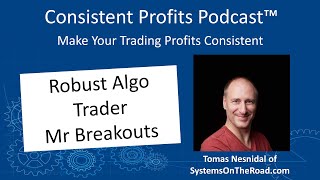
Brian McAboy interviews algorithmic trader Tomas Nesnidal about breakout trading strategies and the shift from manual to automated trading. Nesnidal discusses robustness testing for trading systems, risk management approaches, and educational programs through Better Trader Academy.
Hello and welcome to the Consistent Profits podcast brought to you by Inside out trading and Brian McAvoy. Where the focus is on consistency because when you have the consistent part down, profits become easy. Hello everybody, this is Brian McAvoy with another episode of the Consistent Profits podcast. Today I'm excited to be interviewing Tomas. I'm probably going to screw it up again. Nez Needle, the developer of Automatic Trading System. Thanks so much for being on the podcast today.
Thank you very much for having me, Brian. Nice to have. It's great to be here.
Hope I didn't butcher your name too much. I know I got it right the first time when I asked and there we go. I didn't. Anyway, for those of you not already familiar with Tomas, he's known in the trading community as Mr. Breakouts. He's been a full time trader for over 11 years, specializing in breakout strategies and market internals. Originally from the Czech, Czech Republic, Tomas has established himself as a leading expert in these trading techniques. 2017 launched his own hedge fund which is dedicated to breakout trading strategies. And this fund leverages Tomas's deep understanding of the market internals and breakout patterns to capitalize on market opportunities. His expertise and innovative approach have earned him a reputation for developing robust trading systems. The strategies are grounded in rigorous testing protocols to ensure their long term viability. And he is, he often collaborates with small teams of traders and developers utilizing high end technology and genetic programming software to optimize his trading systems. Hey Tom. Tomas, thanks again for being here today, man. I'm excited to get, get chatting with you to pick your brain a little bit. You got me too going on so well. So you've been trading for what do we say, 11 years, right? How'd you get started with trading? What were you doing before that?
Well, I've been so I've been trading more than 11 years and actually that is the part where I've been trading fully automated strategies. But I started, I, I started pretty soon after I graduated because originally I studied a film school. So I'm a professional, I used to be a professional film director. And since the industry always has been quite undercapitalized in Czech Republic, it's not like the US and Hollywood and all these big productions, it's a completely different story. I used to be quite a starving artist, literally. I loved making movies, but also starving artists and always without money. And me and my wife, we always had plans to travel the world. I'm a big traveler, that's my biggest passion besides trading. And one, one day I just Basically had to say stop. I don't want to live like this. This kind of starving, starving artist full of debts and no income and no future. And I got into trading and I originally got to discretionary trading, which I did for a while, for a couple of years. But the older I became and the more we finally started to travel with my wife, the more I started to transition to fully algorithmic trading. And I've been an algorithmic trader for right now it's over 11 years, I think maybe 13, 14. I stopped counting. We owned several hedge fund seven years ago and as you said, my specialization is breakout strategies. I, I love breakout trading. That's what I understand, that's what I do.
Very cool, very cool. Well, so now what markets do you trade or do, do you like, do you cover a lot of different, different markets are, you know, trading currencies, stocks? Do you, trading in crypto? Do, do you spread it around futures?
I'm, I'm, I, I'm a hundred percent future trade futures trader. So all the, all the kind of futures. Right now we trade in our hedge fund, 27 different futures markets. Personally I trade a little bit less, not the whole scale, but mostly IMs, indexes, lot of energies, a lot of grains, soybeans, corn. So basically any future markets with good liquidity and good volatility.
Very cool. Yeah, the energy, and that was kind of a partial the energy markets. It's kind of fun. Well, so with your, with your trading and especially with the algorithmic trading, because I've had, I've had some colleagues over the years, especially when algorithm I'll go trading was kind of taken off about 10 years ago, or at least you know, starting to get some traction. I had a couple of colleagues who, you know, try to get into it and put a ton of money into it in like two, three years and still struggled with it. So how was the experience for you, you know, switching from manual trading to algorithmic trading? How was your experience with that?
My experience at the beginning, it was definitely similar. It was definitely not an easy way. And I, I think, I think the biggest obstacle when moving from discretionary to automated trading is that there's a lot of naivety. There's a tendency to underestimate the whole bunch of things that needs, needs to go with developing a profitable automated strategy. And I was very naive at the beginning. I, I basically I started with simple ideas which I took from my discretionary trading knowledge. But discretionary trading and automated trading is a very different thing. And with this, with discretionary trading you develop kind of a, I would say, strong cognitive ability. So the more you look into Charles, the stronger your brains get trained in specific patterns and situations which, which are even sometimes hard to describe. Whereas with the algorithmic trading, we have to be very, very precise regarding every, every rule. And in the beginning it's exciting because you can code a rule, you see the backtest equity, and you think you, you have a winner. And it took me quite a while to figure out that the very core, the most important thing about any kind of automated trading is actually robustness testing procedures. And I had to burn my fingers a couple of times, which ultimately was a good thing because it led to my very, very tough robustness testing protocol. I would say no more than 1% of strategies pass this robustness testing protocol. And that's where I, where I ultimately made the leap and started to make money. So from my experience, it's all about the robustness testing procedure.
Well, so, you know, without giving away any secrets, when you say robustness, I mean. Well, first of all, one thing I think is huge in trading, making sure everybody's always understanding the, you know, words. It means the same to each of us. So when you say robustness, what does that mean to you? So that everybody listening, we're all on the same page, right?
So it's not as secret at all. So overall, robustness testing procedures means that we did everything in our power to validate the strategy on data which were not used for the development itself on unseen data. Now we have various ways to do that. We can do the very basic test which is called in sample development out of sample data validation, which of course it's a good start. But we have other techniques as well. We can use cross validation, we can cross validate on completely different markets which were never used during the development process. So it's a true unbiased look at your strategy. We can split the data into different parts and use different, each block can be used for further, further in sample training and out of sample validation. So these are well known techniques and they've been around for a, for a long, long time. I would say the key thing is, or was for me, I use all of them. And I think, I think the hard part was to figure out how to combine all of them in a viable form because each technique as a standalone technique as we know them for robustness testing, all that I just named, it's not enough, it's not sufficient. So we need to really combine them into a thorough and very precise protocol. And that took me Some time to figure out what is the series of actions, what is the order of these actions, how exactly set them up and how to create these thorough robustness testing procedures. But anything that can be used, it is part of my protocol.
Oh cool. Yeah, no that's, and I'm glad to hear you say that because yeah. One thing that I don't know about you, but one complaint that I've heard on a regular basis over the years from traders is especially when the subject of like back testing comes up and it'll be like, ah, it's such a waste of time and every time I back test the results never match my real trading results and I'll try to get across them. It's like maybe you don't understand the testing procedure.
Right.
Why if you're testing properly, your results should align exactly, then that's, that's an indication that you should at least double check your testing procedures. Make sure it is actually giving a good representation of how the strategy should perform.
Right. And, and that's not just so, it is one part and then we have the second part. So exactly as you said. Traders complain the real live trading performance is not matching my backtest. It's not supposed to be because the backtest or everything we did with the backtest it was on a certain order of data which will not repeat by itself in the future. So the first step we need to do, once we have a robot strategy, we actually need to randomize the order of our backtest data. We need to so called bootstrap the data or create a Monte Carlo permutations and then sim simulate what the outcome of a different order will, will be like and then we have a good view on the future, possible future performance. So it, it, it, it definitely is going to be little, little bit different than the BEC data but at least we can simulate it. At least we can shuffle the order of Vector Straits 10,000 times, have 10,000 different possible variations of upcoming future and see what's going to happen. And we do this properly, the strategy will work.
Very cool, very cool. So just roughly, I mean and this is something that you do on an ongoing basis working with clients and stuff, right. But how long does it take when you, when somebody, you know, approaches you and says, you know, I got this strategy I'd like to automate. How long does it typically take for you to work with somebody to take their strategy automated and run it through your various testing and everything for validation? How long does it usually take?
That's a very good question. So it can be a very, very tedious process. So that's why my main objective at the very beginning was to automate anything I can. And ultimately in our hedge fund we, we automate, we automated even the things that I never really be automated. The reason is that we really need to prototype lot of strategies to find, find a few which will be viable. So that, that, that, that, that, that comes together with another part of my trading which is having a trading model which, which I developed at the very beginning. And it's a simple model and with this model I can just swap different rules or components and create lot of various prototype strategies. So if we have to talk about how quickly it takes to create a robust strategy, it depends if the automation is set in place, it can. And if there's a framework around it and if it's all well built, it can take just a couple of days. But during this couple of days we will probably test tens of thousands of possible candidates and we will probably scrap probably at least hundreds of potentially good and viable candidates which do not pass through all the robustness testing criteria. So in a couple of days we can have a first strategy, especially on markets which are easier, mostly indexes are easier. If we want to develop a strategy on some more complicated market like bonds or currencies, it takes more time. Usually when I need to create a portfolio, like if, let's say a new portfolio for my hedge fund from H to Z, a portfolio, let's say 12, 15 strategies, it takes about between two and three months.
Sounds reasonable. Actually that's, that's pretty efficient for what you're talking about, what you have going on. I know like one, one buddy of mine who, well the one who wrestled especially with it for like about three years and he had a lot of, he had a lot of help, he had some good help. So he wasn't just doing it on his own. But yeah, it took them quite a while and so yeah, to be able to knock it out, even something, you know, fairly complex in just a few months. That's pretty good, huh? Now so do you ever venture over into the options space or are you dealing primarily just with direct strategies?
I used to trade options in the past and I like option. There's something, I know it sounds weird, but I love the complexity of options, right? Like anything you can do with it, it just totally crazy. It' just, it's, you can have so many combinations and so many unique versions to trade options. So I'm fascinated by options and actually I, I used to have a, a teacher A trading teacher many years ago. Unfortunately he passed away during COVID and he was a great guy. He was, he was a former CIA agent and he was a genius. He was very, very smart, spoke many languages, could fly all the fancy jets and military jets. Very smart guy. And he was into options. And he, he taught me a lot about options, but also about risk management. And I remember one, one year we, we did an experiment with a small group. He explained well, well about auction options. He explained that options have the advantage of having the edge being built in already because when we buy an ITM in the money options, the more it go, it goes in our favor. The higher the delta is, it's becoming 50, 60, 70. I don't know how technical I am now. And if we're losing, it's becoming 40, 30. So it basically means that the more we're getting into the money, the more we're making. But the more we're getting against the position, the less we're losing. Just, it's fascinating because once you get one point in the money, you're, you're, you're losing 50% of that point. Once you get two points, you only losing 40%. Whereas on the other side you're gaining one point, you're gaining 50% of the point and you're gaining 60 and 70. So there used to be this built in edge. It's probably too efficient nowadays. It's been 15 years ago. And we, so we, we did an experiment. We randomly, every day we randomly, absolutely randomly picked 20 markets. We bought in the money options. Sometimes we bought calls, sometimes we put, we, we, we bought puts and we just played with, with this directional built in bias and believe or not, in six months we made 100% return on our account.
Nice.
With random entries, completely random entries. So he actually taught me something very, very important which, which goes with me until today. It's all about risk management. You can, you, you literally can make money on random entries if your risk management and your exits are right. The other question, different question is how, what the equity curve will look like. Like with random entries it will be all over the place but you still can make money especially with good reward risk ratio and at least reasonable percentage in your favor. So that was a fascinating lesson for me. Just imagine something which is random and you still can make money.
Oh yeah. Oh yeah. I've run across a couple of guys who had random entry strategies and, and really?
Oh wow.
Yeah. Well, and that's great. It was all in the risk management, the trade management and it's and so. And I'm trying to remember who it was. One guy I had on the podcast, matter of fact, he was telling me that one guy that he worked with, and it was. It was kind of a famous. At least within their circle, was kind of a famous thing. The guy would. He would pick up a soda bottle and it would. He thought he was like calling aliens on Mars for his. His trading tips. Everybody, everybody else in the office, you know, they would. They were, you know, giving him a hard time about it. And when the trade, you know, would go against him, they're all giving him a hard time. It's like, yeah, you know, you're an idiot and all that kind of stuff. But when the trades were going in the right direction, they would leave them alone. It's like, nobody's saying it. They don't want to look stupid. And the funny thing was, he was profitable because they were by everybody around him, giving him that reinforcement of either silence or, you know, giving him a hard time. It forced him to. It forced him into good risk management. It's like, yeah, when he's wrong, he's got everybody telling him, oh, you're stupid. So he would. It would made it easy to cut his losses short. And when he's in a winner, nobody's giving him a hard time, so it was easy to let him run. And it was like indirect reinforcement of just, you know, basic, super basic risk management. Yeah, cut your loser short and let your winners run. And it works.
Yeah, Classic. That's a nice story.
But, yeah, I mean, well, and that's one of the cool things about trading is. Yeah, there's certain nuances about it when you run across them that can work so wonderfully well. I mean, going in a different direction. It's like. There are certain businesses that some people don't realize. You know, we first look at it, it's like, how can they make money at that? But then when you think about it, it's like, wow, holy crap, they're sitting on a cash cow. I don't know if you remember when. When ATMs, you know, like, bank, you know, automatic teller machines first came out. Where I lived, there was this one. It was a major street, real busy. And there was this one lot that the. The bank where I banked, they bought this lot on this busy street. And there was nothing on this lot except the atm, a little cover for, you know, the drivers when I come through. So it's raining, you know, it doesn't get rained in. And a light. There was nothing else on this property. And I'm like, how in the hell can they afford that? You know, how can they be making money at this? And then I got to thinking about it. It's like, well, yeah, they're not charging me because I have an account there, but everybody else driving by the banks elsewhere, okay, so they'll pull in, you know, they make a quick cash withdrawal, let's say, you know, like 40 bucks. And they're paying a two dollar fee. Well, okay, the bank just made 5% like that, right? They're rolling their money over. All they got to do is roll their money over 20 times a month and they're making 100% a month. It's like, oh my God, that's an insane business model. They're killing it. And, but you know, at a first glance, it's like, what, you know what? No, that doesn't make sense. Like, and there are other, there are other businesses I've run across where the returns are just insane. And, but they're perfectly legitimate and we pass them every day and don't even realize. And so it's hilarious because like with trading, like you're talking about, you know, certain edges, like with the options and stuff like that. And there, there are some, you know, there's some people who, yeah, they jump on, you know, they figure it out and they jump on it, they ride it and they don't say anything because it's like, make a lot of money.
Yeah.
So that's exactly, exactly. Very cool. Well, so at your, at your site that you, you run Better System Trader.
Now you over there, you Better Trade Academy. Sorry, it's Better Trader Academy.
Yeah. Now at that site, you're, you're working with traders, you're, you got educational programs going on there. And now do you do some of the algorithmic help there as well?
Yeah, we do. Yeah. We actually, we, we established Better Trader Academy together with Andrew Swanscott who runs the Better System Trader podcast. But we, we run the Better Trader Academy together and we have clients from over 40 countries, I think 45 countries, all the levels we have, from beginners to professional hedge fund managers, big guys. We have a client, for example, who manages money for like an external entity for Morgan Stanley. So we have some really, really interesting clients there. And yeah, and we, we, we, we basically provide education from H to Z about algorithmic trading, how to start, how to develop first strategy, how to test them, how to do the robustness test procedures. And we, we just keep going up and then of course we have this small group of very professional traders where we do very fancy stuff like portfolio constructions, market qualities, lot of, lot of different, different things. So that's what we do. We, we do not offer any strategies. We just, we say we love to teach how to do the fishing, but not providing the fish itself. Right.
Oh, very cool. Well, so for, for the listeners that we got on, on the show today, if they're just, you know, an individual trading their own account, what, what is it like when they first come to work with you?
So I. So usually most, most our clients, when they come out of the blue, it's because they read my book, which is called the Breakout Trading Revolution. So it's available on the breakout trading revolution.com and it book where I described and shared my model, which I used to develop a breakout trading strategies. Right now in our hedge fund, we have almost 3,000 viable strategies. So a lot of people complain it's difficult to create strategy. I'm saying it's not difficult. You just need to know how to do it. You need to have the model, you know, in. You need to have the formula. Once you have the formula, it's easy to develop. Well, maybe not easy, but it's much easier to develop vile breakout strategy. So I actually share this formula in the book the Breakout Trading Revolution. And I could share it because I lose nothing by sharing it. The formula is universal and it's just about how each individual trader uses different components inside of it so there is no way to exhaust it. And we've seen phenomenal results with this formula which I present in the book on markets in the US in Australia, in Asia, in Norway, in Russia. All over the world, people are reporting that the breakout Trading formula, which I share, works for them. And I think that's the beauty. We have something we can share while not losing anything. Why not? So, so that's basically where most clients start. They read this book and then either they just continue by themselves, which is completely fine because I describe all the important stuff in the book, or they decide to go with our more advanced teaching, where of course, of course we basically go deeper with the same stuff. We keep the same, we talk about the same stuff, but we go deeper, we talk nuances, we help clients to implement it practically, and then we go on and on and on. Cool.
Now, so is it like a series of courses or do you have a community as an ongoing kind of thing or.
Yeah, we have both. We have. So even, even, even. Anyone who purchases the book from DeBreakout Trading Revolution.com will automatically be invited to Our community. So we have a community where we share. It's completely for free. I do one once a month. I do a live hangout with all the Better Trader Academy community members so people can ask me question and I, I reply the questions and help them with. And then we have programs. We have programs, we actually have three levels of programs. We have programs for total beginners who just read the book and want some help at the very beginning. Then we have a mid tier program which is called a Protege, which is a long term six months program where we help develop and launch first portfolio and then manage the portfolio and we do everything with students and then we have just invitation only program which is called the Elite. And in the Elite program, as I said, we have mostly professional traders, professional hedge fund managers, money managers. But that's invitation only and that's a small group. We deliberately keep it very, very small.
Very cool. Very cool. Yeah, like you were talking about some of the, some of the different players you got in there. That yeah, that sounds pretty awesome. So very cool indeed. Now you guys. So you have your podcast and you said you got that on the YouTube channel as well, correct?
Yeah, we also have YouTube channel Better Trader Academy on YouTube. So Better Trader Academy show where, where I share a lot of trading tips. Then we have the webpage better trader academy.com and then we have the book which is the Breakout Trading Revolution dot com.
Gotcha. Well, so, so I gotta ask, I mean super basic question. So you like focusing on break it breakout strategies. Why? Why breakouts rather than, you know, trend following strategies? Almost like the whole rest of the world likes trend following strategies. Why instead of, you know, being a trend follower.
That's a brilliant question and I can tell you I've tried everything. I've tried breakout trading, mean version trading, statistical arbitrages, option trading. I've done it all. And there's something about breakout strategies which just resonates and aligns with me and it, it's anything else, I don't feel the excitement. I can, I'm not able to go to such a depth like I can go with breakout trading and it just, I can't explain it. It's just something. When I talk and see and do anything related to breakout trading, I'm home. I know exactly how this works. I know exactly what to do when, when traders ask me why my strategy is not working. I can just have a look at the code and I know already why it's not working because I'm very familiar with all the fundamentals of breakout And I think it's probably got something to do with all the years which I spent as a discretionary trader because as a discretionary trader I was a momentum trader, which is pretty much similar to breakout trading, automated breakout trading. So I developed a lot of cognitive abilities as I said at the beginning. And I think, I think something in me, in my brain just wants to keep harnessing these developed abilities from my discretionary trading. So maybe that's why I feel home with breakout trading and not with the rest of all the other directions.
Well, well actually you brought up something that's, that's really an important point that a lot of, a lot of traders, especially aspiring traders who, you know, haven't quite turned that corner yet. It's really important to pay attention to and it, so it doesn't really matter if you know, you like breakouts or reversals or trend following or whatever, but to find what resonates with you, what, what just plain feels right, but then to develop that expertise with it, with the method, right, that really goes a long way. I run across so many traders that are jumping from this to that to this to that to this to that. And they never stick with anything long enough to really develop the, the expertise and like you said, the cognitive abilities with that method to where you just plain. You get good at the method.
Exactly. That, that, that's it, Brian. That's the secret. From my experience does the secret. I've been working with a lot of traders and the biggest mistake I see is jumping around from one direction to another to another to another. The people I have friends who are phenomenal traders. Phenomenal traders. These friends, they focus on one thing. They go deeply, deeply, deeply, deeply. So they understand, they develop cognitive abilities and they're experts. And that's why I chose them to stay with the breakout trading. That's why Also I'm called Mr. Mr. Breakout in the trading industry. People call me Mr. Breakouts because I have such a deep expertise in breakout trading and I keep deepening it. That, that, that, that's like my sign, my synonym. It is like my nickname. It's, it's for a reason. I develop the expertise and I recommend anybody who wants to succeed in trading focus on one particular direction and develop an expertise. Expert are, are the best paid people in the world, aren't they?
Oh yeah. Well, and, and if you think about it, a lot of the mo, you know, the most famous traders, the ones who became legendary, they had a specific method or, or maybe just one or two, but it was a very small Focus and they were extremely good at that.
Right.
And that's how they were able to, you know, build, build their, you know, their account and their fame was because yeah, they just really got so good at this. Yeah, they're, they're becoming, you know, a rock star at it and could just crush it. I mean even going back to guys like Nicholas Darvis and you know, he had a very specific method and that's how he was able to, you know, do what he did traveling the world back in the days before we even had long distance phones. And a lot of the other traders, like I said, you know, the legendary traders, like they were just playing really excellent at their thing and, and if you think about it, that's also that that's where you're going to develop the confidence to be able to go to the markets and keep a cool head is when you're good and you know you're good. Right.
And, and it's, it's really, it's, it's just building up. So for example, breakout trading is my specialization. But even breakout trading can be dissected further to in day trading. Breakout trading and swing trading. Breakout trading. And, and for some reason for a long time in our hedge fund, we were much better in swing swing trading. Then we, then I had a student, actually we had a student in Better Trade Academy and he was phenomenal in day trading. Phenomenal. So of course we, we recruited him. He's part of the hedge fund team right now because that was our weak point. But all he, all he did, he narrowed it even further. He said I'm going to be breakout trader, but only day trader. He doesn't care about swing trading at all. That's his specialization and he got so good in that just because of the focus. So I think it's really important to narrow down the focus and just become specialist.
Yeah. Yeah, indeed. Well, it's, it's a good thing, you know what you have going on and it sounds like you take really good care of your people and it's cool that you have the different levels for beginners and intermediate and kind of that elite level. That's really awesome. And so yeah, and as far as being able to join the community now, the community is just kind of open. That's everybody mixed. Right.
So in the community. So anybody who at least gets the book, the deep Breakout trading corrosion book, is invited to the community. So in the community, yes, we have a mix. We have people all the age. We have people from the entire world, from the U.S. europe, India, Australia, New Zealand, just everywhere. It's a fun community. It's a nice, supportive community. And especially our hangouts are very, very interesting. Sometimes we share ideas, sometimes we share opinions, and it's nice. We both know that trading, or especially algorithmic trading, is quite a lonely business. It's fun with the community and a lot of people, a lot of my friends are actually my former students. I have a trade and, and even my very successful friend, trading. Trading friends are, most of them are my former students. So I'm quite happy that I decided to go this path as well, and it enriched my social life as well. It's, it's really important to keep the social interaction with others and meet other people and people and, and traders are great people. They, they, they smart, they have driven mostly. So who wouldn't want to hang out around traders, right?
Yeah, indeed. No, you're right. That's been my experience ever since I started helping other traders. Like, there are a lot of good people in this space and, and yeah, being able to, you know, help people turn the corner, get, get past, you know, their obstacles, what's holding them back, and, and get to where, yeah, it's like, okay, yeah, now I know what I'm doing. Yeah, this is kind of cool. And to be able to talk to other people about trading instead of people, you know, you start talking trading and their eyes glaze over because it's like they don't get it.
Exactly. Oh, yeah, exactly.
Very cool. Very cool. Well, we need to go and wrap things up. I totally appreciate you taking the time today and, you know, as far as what, you know, you had to share, as far as what you have going on and your advice for traders, I think it's good, solid advice and for everybody listening, if you liked what you heard today, make sure that you swing by, get his book, swing by the side. I'll have the links in the, in the, in the description, in the show notes. And, you know, don't just let this, you know, podcast be one where you listen to it. It's like, ah, that was cool. And then, you know, tomorrow you've forgotten about it. If it resonates with you at all, go ahead and connect with Tomas. He sees a good guy. You can tell that just, you know, by what you've heard. He's, you know, he loves what he does. He's, he's got his heart in the right place. He likes helping. So if it resonated with you at all, go ahead and, you know, swing by his site, grab his book, connect with him and, and, you know, make a difference in your trading. And other than that, you got any last words of, you know, words of wisdom for our listeners today?
Well, for everybody starting out with trading, I would say a word of encouragement. Do not give up. It's doable. It's not easy in the beginning. So the beginnings are always hard everywhere. But have, have, well, have persistence, have desire to succeed, and anything is doable. I saw people, I would never, ever believe they, they would make it. And now they're successful traders. So you definitely can make it, too. And I'm wishing you all the best. And thank you very much, Brian, for having me. This was fun.
Well, yeah, yeah, I totally enjoyed it. It's been, been a good talk with you and everybody. You know, if you enjoyed the podcast, also remember to go ahead and subscribe to the podcast. Give us a like down below if it's on YouTube and, you know, tell your friends about it. And other than that, you know, make sure you come back for the next episode of the Consistent Profits podcast. We'll talk to y' all soon. Cheers. Thank you for joining us today on the Consistent Profits podcast, brought to you by Inside Out Trading. Make sure to swing by InsideOutTrading.com and pick up your free copy of break the cycle, 10 things you can do to stop reinforcing the past and get your trading on the right track. If you enjoyed the show, make sure to subscribe on your favorite channel and we'll see you on the next episode. Cheers.









