Rocking the Stock Market with Short & Medium Length Trades – Anthony Greer – Episode 067
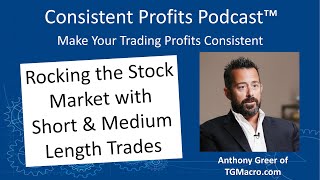
This is a YouTube video titled "Rocking the Stock Market with Short & Medium Length Trades – Anthony Greer – Episode 067" published in June 2024. It features a podcast conversation hosted by Brian McAboy interviewing Tony Greer of TG Macro. They discuss trading strategies, market perspectives, the impact of elections on markets, AI's influence on trading, and Tony's business including his newsletter and upcoming podcast. The content is an in-depth trading and market analysis discussion between two experienced traders.
Hello and welcome to the Consistent Profits Podcast brought to you by Inside out trading and Brian McAvoy. Where the focus is on consistency, because when you have the consistent part down, profits become easy. Well, welcome, everybody, to the Consistent Profits podcast is brought to you by Inside out trading and Brian McAvoy. That would be me. Today, I'm excited to be interviewing Tony Greer of TG Macro. And he's just kind of a pretty cool guy, pretty sharp. You can see his cool office that he's got his in trading room that he's working in there. They've got all kinds of stuff going on. Tony, how you doing today, man? Thanks for taking time for this.
Not at all. I'm doing great. I'm enjoying the, the markets and yeah, man, I'm pretty comfortable here at the TG Macro hq.
There we go. There we go. So, so when we first connected here a minute ago, you're looking at a big spike. What you got going on?
Yeah, well, I'm actually kind of trading the semiconductor space at the moment and in Nvidia and stuff like that. So this is just a random uranium chart that is also up there. But I'm kind of just keeping an eye on some of the stuff that I'm in right now.
Gotcha. Gotcha. Well, let's see. It's been. Oh, wow. Probably almost a year since, since we had you on the show.
Yeah.
At least.
Right? It's been a while.
Yeah. Yeah. I think yours was episode 30, and we're rolling up on. We're in the mid-60s right now, so. Yeah, it's, it's, it's been a spell.
Very cool. Congratulations. It's a good run.
Yeah. Thanks, man. Yeah, trying, trying to stay after it. It's, it's an interesting ride, but I get to talk to cool people like you, so it works out all right.
That's cool.
Help. Yeah. Well, just so for those of you, for, for our listeners who aren't familiar with you, give us a quick background on, on what, what you trade and what you do and what. A little bit on TG Macro.
Yeah, sure. So I, I, I'll, I'll kind of give you the encapsulated bio. I spent the first 10 years of my career as a commodity trader, the next 10 years of my career as a equity salesman, and morphed that into starting my own company, which is based on a newsletter publication. As I've been writing about markets since I was a commodity trader, and then kind of formalized an email that I wrote to people as a sales Trader in Equities and launched my own publication called the Morning Navigator on Election the day before election day in 2016 with the. Yeah, with the bet on that Trump was going to win the election and the world was going to go batshit crazy. And here we are. So I'm, I guess I'm seven volumes into writing the Navigator. The business is growing, knock on wood. And I keep a live, you know, live real time P L of the positions that I'm trading in the Navigator and kind of people appreciate that and appreciate, you know, timestamping yourself to risk and managing it right in front of them. And so that's the kind of lessons that I'm trying to teach in the newsletter. And like I said, business is good so far and I spend the most of the day sitting here staring at the screens, trading the markets, to be quite honest with you.
All right, there you go. Yeah, there you go. If it's fun, it's a good way to spend the day, right?
It can be fun, it can be agony. It can be, it's always, it's always a little bit of something that's exciting, that's for sure.
Oh yeah, oh yeah, well, very cool. Well, yeah, and thanks for catching us up. Like I said, you know, we got, we got some listeners, you know, I've seen when you were on before, others, you know, you're new to. So now as far as your, you said first 10 years commodity trading and so, you know, you still trade commodities though, right?
Yeah, I'm mostly an equity trader now, to be quite honest with you. I mean I trade everything on most of my stuff on ETFs and I, I do really, really love the stock market. You know, it's, it's a little bit. While I do have commodity positions, it's not like commodity trading like I did when I was at Gold Sachs running the Goldman Sachs commodities index, for example, you know, where you're in and out of 22 commodities and 22 commodity spreads. And that's, that's real active commodity trading to me. So, yeah, I speculate in commodities, but most actively trade stocks, if that's fair.
Yeah, fair enough. Well, so I gotta ask though, what, why, why the preference for stocks especially if you had like, you know, some years, obviously successful trading in the commodities, why switch to stocks? And I asked. It's a little bit of a loaded question, I'll tell you that right up front, but I want to get your, get your perspective on the two, two instrument groups to trade.
Yeah, you know, I'm more, I'M more interested in kind of investing in commodities kind of thing where, you know, if I see gold, you know, where you like gold and everybody's got a chunk of gold on in some way, shape or form, and I kind of hold that. And you know, on occasion I'm into the oil trade, which, you know, when, when, when there's something really good going on in oil and you can jump in and it's going to move more than, you know, a couple of bu.
Day.
When there's, you know, when there's a real event going on, I'll trade that. But the reality is, is that the markets that provide the most liquidity and volatility for me and really, really a high level of comfort zone is the stock market. You know, as, as years have gone on, I mean, I manage risk in the commodity space and like I said, I'll still put positions on that are commodity related. And, and I like to trade things with commodity tailwinds. You know, when, you know, you can pick a stock like a miner that's going to probably trade with a commodity E and P company or something like that, that's likely to trade with oil and gas. You know, there's always edges to exploit there. I just love stocks.
Huh? Well, so like I told you, it's a little bit of a loaded question because I, I know that there are some people that, you know, their view of the stock market is that it's really almost a confidence game with stocks because, you know, a stock, it just really is only worth what level of confidence people have in it, whereas other instruments and such, like commodities, at least there's some real world, you know, supply and demand that influences it greatly or you know, like real estate investing and stuff like that. But I mean, with, with stocks like we saw, you know, back in 2008 where there were, you know, super huge companies that literally went to zero, like almost overnight. So what, what is it you like about stocks in that kind of a context?
I love the S and P bull market that we're in. And, and, and I love it because it's kind of like an observable bull market that we've been in since my, for my entire life, you know, and I've been in touch with markets since I was really little. My dad was a trader and I knew what bids and offers were by the time I was in junior high. So I guess it's that, you know, I can point to the fact, you know, you can say that the stock market is only, you know, worth what, what people are be willing to pay for it. And I'd argue that they're willing to pay consecutively more every single year for it. So that's something that I really like to be a part of, you know, and, and that's something, you know, there, there's, of course there's downdrafts and this and that, but the average rate of return in equities is like 11% over the last like 30 years. So, you know, if you want to jump in and try to be short that at the precise moment that there's a crash or something, then, then that's probably a good strategy if you're that good at it. But for the most part, the S and P, I don't understand people that want to be short the S and P. It's built to, to win. Right. It's big to have, it's big. It's built to have the biggest, strongest and most profitable stocks in it and kick out the lesser of those. So just with that setup right there, people that bet against it are starting from a losing position, you know.
Okay, yeah, fair enough.
Yeah.
And that, that is a good perspective, especially with the s and P500 because yeah, it is by design meant to be strong.
Right. I, I, I feel like that's, yeah, that, that, that's, they kind of hand you that, that little advantage when you step into the S and P trading ring. Like, hey guys, this is built to go up just, just so you know, over the last 30 years, it only ever goes up. Right. Like, so let's just start you off with a little bit, let's start you off with a little head start there. So that's it, that, that's very helpful for me. I like knowing that it goes up all the time. It's a comfortable ring to be in.
Yeah, fair enough, fair enough. And that does make more sense than just, you know, trading individual stocks. You know, that may or may not be influenced by various factors. So. Yeah, all right, that, that definitely has some good merit to it. Now you mentioned that you started started thing right before the elections in 2016, so the last four years. Yeah. Like you noted. Yeah. Things have been a little crazy and here we are in an election year again. So what's your, what's your position on things now? What do you, what do you foresee as far as like the rest of this year in the years to come?
Oh my God. I think first of all, there's a non zero profit, there's a non zero potential chance that Trump wins the 2020 election. Before we get to 2024. Right. There's so much, I mean, I doubt that they'll overturn the result, but we're learning about so much fraud that took place now and we're learning about all my, oh my God, the COVID up of the Hunter Biden laptop and the 51 heads of state. So, like, I'm literally poised for anything, right. Going into this election year. I'm poised for, you know, a Trump landslide. I'm poised for another stolen election. I'm poised for like, absolutely. I'm poised for another pandemic, another bioweapon. It could be anything. Right. And, and that's not conspiratorial. If we were talking last year, some of that might have been a little conspiratorial. Like a little. But I think by now, I don't think it is. So, you know, I don't know, I don't want to get too far off of the point of the question, but I think that it's really, really fascinating that the market might be pricing in a little bit of a Trump victory with, with the Fed, the way that it won't go down. You know, maybe, maybe it's pricing in the behavior that it had when he was in office. And I'm not, I'm not necessarily saying that that made him a good president or not, but he certainly was good for the markets. Right. He like the idea of cutting regulation and keeping taxes to a sort of minimum and still spending your freaking lips off. You mean. That's bullish for stocks, you know, and so maybe the market is, is anticipating a little bit of that. But I, I love the way that it all plays into the story and into the narrative. I really do.
Oh, yeah, yeah. And well, you know, as far as running off the, the beaten path or, you know, away from the question, it's like. No, it, actually, I consider it a very valid question.
Yeah.
Because depending on the general market sentiment and, and expectation of what's going to happen in November, every elect, every, every time the elections roll around. This is a valid question. It's just gotten more interesting over the last couple of elections.
Yeah, totally. It really has. You know, and you can't even make a case that Biden's necessarily been bad for the market. Right. I mean, the market's been up during the Biden administration. If you're, if you're a bull, you're, you're happy as a pig in, you know, you've got the AI craze going on in the background. You've got you know, inflation off of the highs. Tom, you've got the Fed probably not under a lot of pressure to do much. If I'm reading it right, like, right. It's not like the Fed's under pressure to cut rates or they're under pressure to raise rate there. The Fed's kind of like we're kind of fielding the data and everything seems cool. Bond market looks okay. Yield curve is not dramatically changing. Like we're in a comfort zone. We're in a very much a Goldilocks period of the treasury market for stocks. So that's one of the reasons that I can stay bullish.
Now, do you see that continuing through the elections or do you see as we get closer and closer, the likelihood of something really rocking the boat happening?
Man. Yeah, I do. You know, like, you never know. You know, you can't, you can't predict an event. But, you know, it certainly seems like the heat is going to get turned up on the American landscape again heading into the election, you know, and I don't want this to be a political podcast because it's about markets and stuff and I don't want to go there unless you want to. But yeah, I do. You know, I'm, I, I will stick with that view that, that I think that this can continue, especially because I feel like rates are really range bound and I feel like the technology tailwinds are really strong. So I, I don't, you know, I remember the dot com bubble and one of the things that I remember about it was, you know, you heard about all of these things coming into play in 95, 96, 97, right? Like New music, you know, new music players, new hardware, new iPhone, like all this stuff, whatever it was, like that stuff started playing out and it wasn't until everybody was using it that we found the top. You know what I mean? Like, and so that's why I don't feel like AI like people want to say it's priced into the market and I'll say maybe it's priced into some stock prices. But I don't think that it's priced into the narrative yet where we're like one AI collaboration headline from AI stocks going up 50% again from last sale. So that's how it was during the dot com bubble. And I feel like that's the way now where I don't think any, I mean, I won't say anybody, but market people seem like they're in a little bit in touch with AI and ChatGPT and some of the corporate world. But I don't think any of the retail world is really very much in touch with it. And so until I see it become way more ubiquitous, like, I can stay with this narrative of those stocks going up and to the right for, for some period of time now. I mean, you know, that blockbuster Nvidia earnings that set the thing off was, you know, only a year ago now. Right. I mean, it's only, we're only not even a year into that earnings period where they really separated themselves from the pack. And so, I mean, I don't know why that has to stop within, you know, just one year's period of time when we've seen tech, you know, go on a run for four or five years at a time before it runs into bubble territory anyway. So that's just kind of my take.
Oh yeah, no, and that, that's good perspective. I, I definitely appreciate it. The. Well, speaking of landscapes and that kind of stuff, whenever I see something like what we've witnessed a few times over the years, I mean, you went back to like the dot com bubble. And I mean that's, that's a good example. But you know, there are certain times where, and I like to use the example of the product life cycle where like if there's some revolutionary new product, my favorite example is like plastic 2 liter bottles. That was, that was a disruptive thing because plastics, all of a sudden we're entering into a very large market sector, a lot of money there, new technology that could be applied in a lot of different places. And it was really cool because I actually, when I got out of school, I went to work for one of the companies, it was making plastic bottles. And I, I got in there when there had already, they'd been around for a little bit. There were still a lot of new players entering the space, still a little bit of the wild west. But over the first six months I was with the company, it was cool because I got to sit in on the monthly plant manager meetings for the company I was with. And we're watching, you know, margins kind of erode. A lot of players dropping out, some, you know, some buyouts going on and some consolidation going on and looking at pricing changes, margin changes, that kind of stuff. And for the first time, and we'd gone along for a while and we hit this one month and we actually had a plant losing money, which was like crazy because when I first started with the company, it's like, man, all the plants are just making money hand over fist. Make all the mistakes you want. Didn't matter.
Yeah.
And. And so I'm sitting there at this one meeting, and it's like, man, you know, it's like the plants are struggling now. And I remember when we took. When we took a break for lunch, it's like, I remember. I remember this. And I went back to my office, and I still happen to have one of my binders from school. And we had this one instructor who'd worked out in the. In the real world. This is mechanical engineering. But he worked. He'd worked out in the real world for a while, and this one day he talked about the product life cycle and, and how the various. The nature of, you know, a given industry or whatever, if there's a cycle that it goes through, and there are certain things and events and circumstances that come up as you go through that cycle. And so I found a binder, and I'm flipping through it. It's like, that's the page. That's the one page. And I'm looking at it and it's like, okay, here's all the stuff I've been hearing. We've been riding up, riding up the cycle. You know, margins keep going up and volumes keep going up, and, hey, we're hitting the top of the cycle. And now margins are getting thin and, you know, players dropping out. And I'm like, this is exactly where we're at. I grabbed my boss and I'm like, check this out. And I show him. And it's like, no kidding, That's. Yes, that's exactly where we're at. And so for the next six months, we got to watch the rest of the curve play out. And it was just cool as crap. And so now anytime I see something like what we saw with the, you know, the.com back in the 90s and stuff, and there's software companies and everybody's entering a space, and a lot of companies, you know, it's like our. Our business plan is, you know, grow the company, get bought by Microsoft in two years and stuff like that. And it was just, you know, crazy times. But then it settled down and the consolidation, all that kind of stuff. So I got to watch the cycle go through that. And now we're starting to see the same thing with AI. It's like, yeah, we've got this disruptive technology, and there's going to be a lot of, you know, wild stuff going on. It's like, cool. I'm just waiting to go ahead and watch the curve play out again because watch it with other, other technologies along the way, and it's really cool. But the nice thing about it is it kind of gives you some insights as far as what's going to happen with the markets in general and the way the market behaves in response to new things coming along maybe. And so what you were just talking about, that's like, yeah, yeah, this is very cool, especially with AI because it is, it's one where it's still in its early stages, but it's still showing some of the similar traits and it's just, you know, really cool. Well, it's kind of like when, you know, when the, the expert advisors and bots and algorithmic trading came out, those similar, similar curve, you know, got to watch it happen through that. And now with AI, it's, it's a new technology. But this is, this is one that's going to be affecting everything. Not just, you know, certain areas. It's like this is going to be hitting everywhere. So, yeah, how it, how it affects the markets and trading as individuals and that kind of stuff, it's like, yeah, we got some potentially cool times ahead of us here.
Yeah, that's for sure. So that's for sure.
In addition, in addition to it being an election year, so yeah, we might have some, some crazy towns over the next couple years coming up just because all these different, like powerful influencing factors.
So yeah, yeah, for sure. It is interesting time for the markets.
Yeah. Well now that said, with TG Macro, you know, you're, you're, you're helping traders refresh my memory as far as, you know, what, what kind of services and products you guys provide there and what you, you know, what you've got on the horizon coming up. If you got any stuff, if you got any new things coming up, especially, you know, with like, like stuff we've been talking about things potentially on the horizon.
Yeah, we're. So my main product, you know, my, my business is really simple. I have a publication business and a consulting business. So my publication business is the morning navigator that I write three times a week, Monday, Wednesday and Friday, and have a really great growing subscriber base to that. I charge 800 a year for the note, but I keep a running view matrix in the back where I timestamp my trade ideas and run an actual trade percentage point P L. So people like that very much. And then the consulting side of my business, I speak directly with home offices and portfolio managers and risk managers about the markets or their portfolio and things like that. So those are the two main revenue sides of the business. And I would say that's really what I'm focusing on. I'm start. I'm about to start a podcast with a friend of mine and I don't want to give it away yet. So we're going to. Because we're going to announce it next week, but I'm excited about that. And that's going to be a weekly publication, you know, for at least a year. Like, we're really going to sink our teeth into it and talk about markets and where the trades are. And he's got a really good following, too, so I think that that'll be really exciting and doing things like that. You know, I'm going to be doing some more video where I do some more market briefings and things like that. So I'm trying to kind of expand, you know, my kind of sales funnel and ways to be able to reach people for free to get them to be interested in subscribing to the Note. So that's kind of how I'm set up right now.
Very cool. Very cool. Little side note, and I'll let it. I'll edit this out. This ep, this conversation is probably going to be airing week after next anyway.
Oh, okay.
So you may have already done your announcement by the time this, by the time this airs.
We're right there. We're gonna be right on. We're gonna be right on it because we're gonna, we're just gonna announce it with the first one when we publish it, and that's right around when we're gonna publish the first one. So I'm just gonna, I'm just gonna leave it out for now.
Okay. All right, fair enough.
Yeah.
All right. Like I said, I'll edit this out, but yeah. Okay. Well, so cool that you got a new podcast going on. Now. Is this going to be a weekly podcast, bi monthly?
Yeah, we're. Every week we're going to go toe to toe about markets, you know, and, and markets that we agree on and disagree on. And we have a big overlap in our following. So I think that'll be really, really cool to exploit. And we're gonna have some really great guests on as well. So it's gonna be a fun show. It'll be all. All about a really serious traders podcast. And I think it's got. I think there's a niche for it out there. I really do.
Yeah. Cool. Now, are you guys going to be, largely speaking to, you know, what's happening now in the markets, or is it going to be a blend of, you know, what's happening now, but also Some more evergreen kind of stuff.
We're going to talk about the markets and talk our book. You know, I mean, I'm going to be talking about the views that I have and the positions that I have on that are, you know, going well or not. And you know, about what J. You know, we, we're very good about having opposing viewpoints and discussing it. Like, we'll get on. Yeah, we'll get on the phone. We've been able to get on the phone for years and be like, what do you think of the S P here? And you know, I'll be like, I'm bullish. You'll say, I'm bearish. And we'll go toe to toe and be like, why do you think that and what do you think about this? And so we're really, we have a really functioning mechanism of airing markets out. And I think that like turning that towards the public will be a really powerful thing, believe it or not. Yeah. Because we get it, we get it sorted out and we'll, we'll arrive at a conclusion and God forbid our views line up. I mean, when our views line up, I triple my bets.
You know, when I was just say, yeah, yeah, same thing when you guys, if you're starting off opposing, but if you're coming to the same conclusion, it's like, yeah, that's probably going to be pretty strong.
Yeah. So we have, you know, we have some. So hopefully there'll be some alchemy like that. But otherwise I really, I, I really enjoy, I really do enjoy writing the newsletter and you know, basically publishing three times a week. I've got a really, really viral subscriber base, like the most. Yep, sounds good. The other, the, the last product that I wanted to mention that I started about a year and a half ago was the TG Macro Slack Channel, which is where I have. That is the next level of subscriber base up from the newsletter. And I have about 150 people in the Slack channel talking about things across seven market topic channels. And we, we go at it all day and all night. So it's really, it's really, it's really an excellent product. People get a really good view of. I mean people have told me that, you know, I both made them and saved them a lot of money by like narrating my intraday views and markets and things like that. So it's been really fulfilling and that that community just, just gets tighter and tighter and tighter because I send the note out every day and then we basically, you know, we talk about things in Slack all day long. And so it's very, I wanted to give people more access to me and more access to my ideas and I wanted to get access to a bigger audience. And so I've got some really, really sharp traders in there and portfolio managers and things like that. So that's, you know, that's the whole business right there. That, that takes up my whole day from managing that to writing the newsletter and talking to clients. That's about all I got.
Very good. Now as far as the trades that you guys are going to be talking about, you're just taking pretty much with, with intraday trading, right? Not, not swing trading?
No, no, I'm. I mean I would say I'm a position trader where you know, yeah, I may get stopped out in the same day that I put something on. I mean you never know. But, but I'm usually have a timeframe that goes from like two days to two weeks and if I get something right and time it right, I've had positions on for five years where I just never get stopped out and so kind of just run with the trend and that turns into, you know, a little bit more of a longer term trade slash investment. But I'm a big proponent of trailing stop losses. And every once in a while you catch a live one and you catch a trend that just keeps going and you can raise your stop loss all you want and the trend stays your friend. And, and those are the trades that event that ultimately you're hunting down. Right. Is, is the ones that look right for two weeks and they wind up being right for two years. Those are the ones that wind up making a whole ton of money for you. So those are the ones that you're kind of actively hunting down and trying to keep the holes in the boat from springing leaks and stuff like that, you know.
There you go.
Yeah, cool. Yeah.
So, so you usually work on like the what, the hourly chart, daily chart, weeklies or what?
I look at everything, man. I mean I had the same six 30 minute charts up in front of me that I've been looking at for 30 years now. Exactly the same setup. Great way to follow the markets is to have the asset classes laid out right in front of you on short term charts. And this way you can see all the price movements that are relative with each other. And kind of as soon as I flip my screens on in the morning and I see these six charts, I know exactly what's going on in the world. So that's really, really helpful. So in terms of charting. I mean, you know, I'm also looking at longer term trends. I, I like looking at one to five year daily charts. I'm a big moving average surfer and things like that. You know, I'll try to find things in a bull trend and get in on the moving averages and kind of try to surf them higher. Nothing fancy, just blocking and tackling. Tactical trading.
There you go. Cool.
Yeah, cool.
Well, for everybody that's listening, if you like what Tony's got to share here, definitely, you know, make sure you swing by with the TGMicro.com right? Yep. And you know, go ahead and engage him if, like I said, you know, if you're looking for good help, you want somebody who's obviously a cool guy, obviously sharp, doing well with it and wants to be helpful to other people. Yeah, definitely don't, don't just listen to this and say, yeah, you know, that was cool and then let it pass without doing anything is going to connect with Tony. And so your site now you're also, you said you got your podcast coming up and so yeah, a lot of cool stuff going on. But yeah, you know, also I applaud you guys, you know, everybody listening for, you know, taking time out of your day to listen to the podcast and you know, become better traders and not just, you know, chase strategies, but actually up your game. And uh, yeah, Tony, again, thanks for taking time for this, man. It's been awesome. It's good to catch up with you again. Cool that you got good stuff coming going on and cool to hear your perspectives. He's. Yeah, you're a little, a little snark some things which I totally like and I'm, I'm the same way. So. Yeah, yeah, very cool.
Yeah, man, we're having fun with it. I really appreciate it. I love being a returned guest on here, Brian. So thanks for having me. And, and anytime you want me back on, I'd love to.
Yeah, very cool. Yeah, excellent. Well, we'll do that. And everybody, let's go and wrap things up. If you enjoyed the podcast, make sure to subscribe, share with your friends and give us a like down below and we'll see you on the next episode of the Consistent Profits podcast. Cheers. Thank you for joining us today on the Consistent Profits podcast brought to you by Inside Out Trading. Make sure to swing by InsideOutTrading.com and pick up your free copy of break the cycle, 10 things you can do to stop reinforcing the past and get your trading on the right track. If you enjoyed the show make sure to subscribe on your favorite channel, and we'll see you on the next episode. Cheers.









