Sage Advice from a Veteran Trader – Ali Crooks – Episode 061
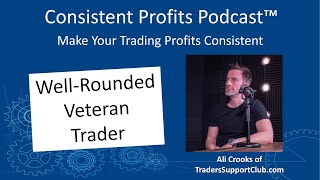
Ali Crooks, a veteran trader and coach, talks about building consistency and mindset for long-term trading success. He discusses his trading journey, psychology, and the Traders Support Club he runs to help others develop practical skills.
Hello and welcome to the Consistent Profits podcast brought to you by Inside out trading and Brian McAvoy, where the focus.
Is on consistency because when you have.
The consistent part down, profits become easy.
Hello, everybody, and welcome to another episode of the Consistent Profits podcast. This is Brian McAvoy with Inside Out Trading. And today I'm excited to be interviewing Ali Crooks. He's been trading for quite a while and helping traders and he runs traders support.com. welcome, Ali, and glad you're here today. Thanks for taking the time, man.
Thanks for having me on, Brian. I appreciate it.
Now, you have been trading for a while and I know that in your history, at least over the last several years, you've really been focusing on helping other traders. But how did you get started with trading and everything anyway?
Great question. It, it feels, it feels a long while ago now. It's back in, back in the early, early 2000s back when you, you'll, you'll remember dial up and, and, oh yeah, and yeah, dial up and partial fills on trades and you wait for another 10 minutes for the rest of your order to get filled. So that's, that's when I first got involved. So I, I think sometimes I'm a bit of a dinosaur and I say to say to people I work with, you don't know how lucky you got it with, you know, know, fast Internet and you know, Phil's feels that happen in seconds. So.
Oh, yeah.
Oh, it's a long while ago. I, I, it wasn't, it wasn't. I, I know I could, I could go into a lot of detail, but I think the important thing, if you listen this is I, I was one of these people that didn't have a passion for trading. When I first, first looked at it, I, I wanted to get away from business. I'd had a very successful initial business started when I was young. Sold that after three years and thought I was going to be the next Richard Branson. My second business fell flat on its face and the response at the time was my business partner had remortgaged three times and he was, he was out and his wife, I was 40, 50, I can't remember the exact amount. It was enough about probably nearer 50 grand, £50,000 in debt. So I was at the point where I didn't want employees, I didn't want a business. And I felt, I felt very negative towards being, being in business because I, you know, I had the big high and then the big low and during, during that time I'd been part of investment club And I, I'm sure you've got them over there in the States is that, you know, people get together like 20 people will get together once a month and spend three hours deciding which one stock they're going to buy. And for me, a young age and very, a very gung ho, I was like this, this isn't for me. And one of the guys there, he actually, he actually traded. So whilst we'd be sitting there bored to tears where everyone was making their case for Microsoft instead of this company I'd be sort of watching what he was doing. So he'd use those Sunday meets and he'd be going through his charts and, and I first got involved with options so that's how I started out. But it went, it went very wrong because I opted, I basically thought well options are the way options look how much money you can make from options. Forgetting that trade direction is still important. You know you can't just get yourself out of, out of a hole just because you bought, I bought a call option. You know, it doesn't, it's not, it's not foolproof. So I bought into the leverage and it, it didn't work out very well. And back then you didn't have all these online courses. The first training I did was in Las Vegas so I had to come, I had to fly over to Las Vegas bearing in mind in debt. I'm not actually making a success of this but I remember at the time, even though I was working a dead end job, I was working six, six in the morning till one in the afternoon, getting home and getting home in time for the US session. So that's, that's what I used to do. So I worked a, you know, a rubbish job just to be able to do this. And even then I, I, I still wasn't in love with it. I was in love with what I thought trading would give me which is, you know, a life where I didn't have a boss, didn't have the, the responsibilities and I was very skewed. I was looking at all of, and not thinking about the downsides where yes, you have all this time and freedom but you don't have connection, it's solely down to you. And at that point in the journey I was just, I just want to be successful and I thought if I can just make enough money in one month to pay the equivalent of my rent and bills that would be my first tick in the box of success. So that was my, and again it was a foolish goal really because what would happen is As I would get closer to this, this arbitrary goal of back then £500 because I was in a tiny one bedroom flat and that just about covered my, covered my outgoings, I would make poor decisions. So you know, I get close to it and I'd start thinking about the goal and then I would edge into trades too quickly or you know, jump out or just be, just be there. And this, this goal tormented me. But I think back then I was very, I was very dogged and very goal orientated and I was like, I need to achieve this. And, and actually if I'd had somebody around me back then that would have been able to sit there and go, it's great, you've got great determination, you've got great focus. But this goal of, arbitrary goal of hitting your month's, month's wages, that's not gonna, you're not, you're not necessarily gonna do it the month after or the month after. You should be focusing on being a good trader and executing correctly. But my, my sort of determination just kept me going. And, and, and then what I realized over time, I read a couple of trading psychology books, the Discipline Trader, Mark Douglas. I realized that there was, with what I'd learned in sports, I'd been good at sport as a kid, I'd been captain of various teams and I could see the correlations in terms of, you know, being able to perform your best but still not get the outcome you want. So slowly I started to think, okay, this is, that, this, this is huge correlation between the two. It's not just, it's not just brute force, determination and guts that's going to make you a successful trader. You need, you need humility, you need, you need vigilance, you need calmness. There's all these other things that I was essentially ignoring. So I built this up and I eventually, eventually got a, I actually got a mentor. It wasn't in the same way that you would mentor students now with zoom and, or somebody coming, you know, to you because back then most of the, the trading education was US based. It wasn't big in the, in, in the UK at that point. So I worked with this guy. I remember it was on a voiceover IP connection. There was no screen so you'd wait for it to come in. But actually it was really good because he was very calm. He was from Louisiana, he had a very, he had a low tone to his voice which was the opposite of me who is like quite upbeat. Gun Ho. And he would, he'd calm me, calm me down and Actually, when you would talk about a position that you were going to trade, having to describe it because we had no, no zoom with a screen, you were literally talking out your trading idea. It was actually really good because it was like you were talking to four or five other people and they weren't there to say, I think that's rubbish, you shouldn't do this, or that's great, it was just, okay, if you're going to take this position in the S and P, what are your reasons for it? What's your target, what's your stop? And it was great because it got you to verbalize out loud what it is you were going to do. And that really helped me. And for me that was great because I started to see some consistency and then I was able to get to a point where I didn't need to do the, didn't need to do the job full time. So I moved it down to part time. I was really lucky because the guy at the factory let me work Sundays and let me. On Sundays. You got paid double, you got to pay double shift. So you get twice the money for, for one shift. So I ended up doing about 4 to 5 shifts, but only in a part time way. So again, I was able to just build my account because I wasn't at the point where I could. I was making enough to be able to extract my money on a monthly basis. And I think this is, this is something a lot of traders are so keen to do is they want to get to the point where they can live off their trading. And often, in my experience, they're probably a little bit too soon. I mean, there's a whole other discussion about prop firms and everything else, but you know, we didn't have all of those, you know, you had to build your capital up. So it was a long journey for me to get to the point where I didn't need anything else, just purely my trading I did. I traded full time with no other income for about nine months, probably a bit longer actually. Nine, nine, 10 months. And then I was fortunate enough to meet my partner at the time. She worked in sales, so she had a good job. We came together so there were two incomes coming into the fam, into the, into the household. But what I found really interesting is I got quite bored. And she, as a sales director, she was getting flown over to Luxembourg sales conferences in Vienna and she'd come back on a Friday and she'd be like, what have you done? I'm like, well, I've been at the gym and Play some trades. And after about two years of that I started getting itchy feet and I got into education purely by chance. Somebody I knew through a friend said, there's a guy in London looking for people that want to do some weekend work. Training, training, groups of people. And I went down to this audition and they got me to stand there and talk about myself and talk about my trading. And then I got a call saying, yes, we'd like you to come in and do weekend trainings. And it, at that point it was perfect for me because I was day trading for most of the week and then two weekends a month within a do. So it's Friday, Saturday, Sunday, I would go out and I train a group of people, come back. So for me it was perfect because it took a little bit of the pressure off of trading, having to pay the bills. It was nice because there was, I was back, I was out. I was able to compound my trading account more because they were, was my partner's income. There was an income I was getting from doing some speaking and I really enjoyed it. It wasn't, it wasn't something that I planned out or said, right, this is what I want to go, I want to go and educate people. But I always say to people, be careful what you wish for because it's school. I wanted to be a teacher, but I looked at how much my teachers earned and went, ah, but I want to earn more money. So I, I always loved being part, being able to teach and I used to help out a lot of the sports clubs and coach and teach kids, but I never went down that route because I wanted to earn lots of money. So I've always had this unknown, almost this battle going on inside me saying, I want to, I want to help, but I also want to earn money. And I say, you know, be careful what you wish for. Fast forward 10 or 12 years and you know, I'm fortunate enough to get to do both and, and trader support club again, that came around very randomly. I was in a position where I was working for a training company and I sat there and said to them, look, I'm sitting with these guys for three days teaching them the basics. Really, I was essentially teaching them the basics and they would then go on to a further training that either I would teach or somebody else would teach. Problem was that training was three or four months down the line and when they walk back into the room, they'd forgotten everything that they learned. On those three days, very few of them had gone away and, you know, and pushed on because they, they weren't at that point. So I said to this training company, look, why don't I put a, an online portal together is essentially a load of videos. Just helping these guys to be able to do small things. Not to get them to, you know, zero to hero, but just get out there and put some of the things they've learned into practice. And I created this online portal for them. And then that company got into trouble, financial trouble, and they owed me a fair bit of money. So I did a deal with them and said, look, I'll, I'll cut the bill in half that you owe me and, but you give me the rights to take this portal and I can, I can use it and anybody can join. It's not just your students. And that's how Trader Support Club came along. And this, this portal was there, I, I, I rebranded it and then people just started tagging and following me and it grew organically. And it's still not a, it's not a big train. I'm not one of these big training organizations because I don't, I don't need to be or want to be. I get a real buzz out of working with people closely, probably like you. I, it's nice to go and speak and talk for, you know, two hours in front of a big group. But what I really enjoy is being at the cold face with people and working with somebody in month two and then seeing where they are in month six. Because the way I do things is I will, I will be heavily into the trader psychology, but my belief is trader psychology or trading psychology is number one. But you've got to have all the pillars in place. It's no good having high resilience if your strategy is poor and your risk management is poor. Your resilience will only last for so long. If you're risking 5%, 5% at, you know, a round trip, it's sooner or later I say to students, I say, if I was risking 5% a trade, I would have poor trading psychology. So you've got to have the whole, you've got to have the whole remit. I always think of it like a table and I think of each, each, each pillar. So your analysis, be it fundamentals or technicals, your next pillar or leg is risk on that table. Your next pillar is data, your ability to analyze your, your own trades and your, your journaling and then mindset in its own right and having a, an ability to perform at a high level. Take one of those legs away, the table will probably stay there but put any pressure on it. Losing run, winning run. I'm, I see this a lot, I see a lot of traders actually they're at their most vulnerable, almost nervous. Not necessarily when they've had three or four losers because they've, I've psychologically prepared them for that. But when they have a big winning run they can often be just as fragile especially if it's the first time they've been through it. So I'm a big believer in that, that that table needs all, all the legs in place. But I think fundamentally psychology is key.
Yeah, well from a psychology standpoint I love asking because you know trading psychology there are a lot of different perspectives out there and it can cover a lot of ground. So when you're talking trading psychology what do you generally, what's your perspective on trading psychology? Just general your take on it.
That's a, that's a really good question. Not one I think I've been been asked for me it's, I would say I'm, I'm, I'm, I'm the coach psychologist on, on the ground as in I haven't got a degree in psychology, I did sports psychology so I understand, I think performance and when you've done 10 or 15,000 hours of live trader training slash coaching in a trading room, you'd almost have to be, you'd have to be pretty stupid not to see certain patterns. I think if I was to sum it up I would say it's three things. It's attributes versus skills as a, as a kind of umbrella. So what I see a lot is a lot of traders will try and solve a psychological issue. So let's say fear of loss, they'll try and solve that with a technical solution. So they don't deal with the fact that no matter what strategy they've got, if they hit a losing run they crumble or they are less confident. But what they think is if I get this next indicator or this next strategy that thing will solve the psychology. So I see this all the time, I say it all the time. There's too many trader looking for a technical solution to what is more of a psychological problem. But to answer your question directly I'd say a lot of it is understanding their personality. So personality styles are very big. Are you, are you more driver orientated? So are you, are you, I mean everyone likes to win but are you really about winning? Is that, what, is that what gives you, that's what boosts your ego. So are you, are you fast paced driver orientated? Are you Somebody who's more expressive. You, you like the idea. I see this. A lot of people like the idea of trading, but actually they're people, people, they like to be around people and the, the trading thing. They like markets go quiet, they cause trouble, they get bored, they, they're not as vigilant, they lose their focus. And then the other side of it, you've got the slower paced, more analytical types. So the engineers, the accountants, great with data, great with understanding systems, processes, but can struggle sometimes when the losing run happens and they're not being right, they're not right. So I always look at it that way. And then you've got the amiables down at the bottom who are very good at following a system. I'll tell them what to do, they'll do it, but they lack the confidence in, in themselves. So I look at it a little bit like a quadrant and every single personality style is a strength at some point in your journey, but it can also be a weakness. So for me, when I, when I was in that spell of trying and failing, I was all about, well, you've got to be in it to win it. You've got to be trading, you've got to be, you've got to be pressing the button. I was very, very driver orientated. But if you, if you asked me to submit my trade results or my coach had asked me to submit my trade results, I wouldn't have filled in my spreadsheet, I wouldn't have done the journaling. I was always, I'd always get round to that side of it. So I think a lot of the time a trader is, there'll be an area that they're disowning and it's often that area, if they would put a little bit more attention on that, that they would see their, an uptick in their, in their, in their performance because they're, that people tend to go to the area that they feel most comfortable in. I went to the area of placing trades, being in the market, being there, got to be in it to win it because that was comfortable for me. Being aggressive, being, trying to be dominant but trying to be successful. But what was uncomfortable for me was sitting down and journaling exactly what I was doing, keeping a note, a log of each trade, measuring the, you know, the R value, the win rate, the, you know, the, the max exit. I could have had the, you know, all of the, all the data that we collect as I get my traders to collect. When I started out, I just wasn't interested in that or I knew it was important but I, I was, I'll get round to it, I'll do it later. So I was avoiding that bit. So if, I think, I think if traders took a, a more rounded view of their, their personality and how it can be a strength and a weakness and where it's showing up positively for them and where it may be showing up negatively, I think, I think that would be a useful thing. And that's what I do with my guys. I try and get them to, to increase their self awareness and really think about their attributes. You know, you can say what are the key attributes? Resilience, discipline. But no trader wakes up in the morning and goes, do you know what I'm going to do today? I'm just going to mess it all up. Every trader wakes up every single day with the intention of being disciplined. Whether they end up at the end of the day fulfilling that is another, is another matter. So I sometimes think intention isn't enough. They've got to look at why maybe they're dis, what are they, what are their trigger points, are they, are they naturally an overtrader when, when the pendulum swings to an extreme or they, an under trader. So a lot of the time I, I get my guys to say, okay, you're on a winning run, do you, do you loosen up and start risking too much? Or when you're on a winning run, do you tighten up and want to hold on to the profits you've got, Think about how you're feeling in those moments that will give you a, that will give you a marker as to whether you're more of a under trader, over trader, fear based trader, breed based trader and I think knowing yourself is very important.
Yeah, well, speaking of strengths and weaknesses, I mean there, there are different philosophies on that. I mean, you know, like, like you said, you know, do you generally lean toward, you know, focus on your weaknesses so that you have a better, well, you know, well roundedness or better balance overall or do you also maybe lean just again from your sports background to don't, don't, you know, put so much energy into your weaknesses but go ahead and build on your strengths and play to your strengths?
Great question. I think for me it depends where you are in, you know, if I hadn't focused on the weakness of my lack of data collection and journaling, I don't know, I may still be in the same cycle of making the same mistakes because there was a lack of self awareness. So in that scenario for me I would say the fact That I, I wouldn't necessarily say it was my weakness. I was, I focused on the thing that I was, I was trying, I was avoiding. I think it's a balance. I, I think that where, where focusing in your strengths is very important, is thinking about also the situation and environment you're in. So a lot, I see a lot of people come to me, they go, they want to be a day trader. And my first question is, why? Well, because I can make more money. I'm like, well, how do you know that? You know, the stats will tell you the complete opposite. The more, more the higher percentage of day traders failed and swing. I bet you started as Trader Alley. I'm like, but you're not the same person as me. You're not at the same point in your life. And you, you've got necessarily the same. So it doesn't mean it was, it doesn't mean it's the right thing for you to do. So I think in that scenario, looking at, looking at your environment, looking at your goals and, and focusing on where your strengths would lie is very important. As in if you know that focus is a real issue and you know, you know you've got, you're distracted or you've, you've got two, two kids running around at home. Is day trading. Are you playing to your strengths by being a day trader? Would you be better off focusing on swing trading even though your friend told you that day trading is the way to, the way to go, Right?
Yeah, well, yeah. And it's funny. Well, now, one thing you mentioned early on that I think also because you're talking about attributes, I've talked to, you know, a number of people on the podcast and quite a few of them will say to be a successful trader, especially long term, you really do need to have a passion for it. But like you said, you know, when you first got into it, that wasn't there and it was just because it was a way to make money. And a lot of people get into trading just because they're running away from the job. They hate the job and the job life. So it's not like they're running to trading because they love trading and just looking at it as a way to make money. So what are your thoughts or advice for people who maybe they're in that position? They're not necessarily running toward trading because they, you know, they, they, you know, they got hooked on it. It's like, yeah, that's what I want to do, but they're just running away from something and they don't really have the passion for it. So what, what's your advice for somebody that's in that situation where, yeah, maybe they're already trading, maybe even already a little bit successful, but it's just not something that really fires them up. What's your thought?
What are your thoughts on that? I would say find, find a way to get excited or passionate about it because I'm in complete agreement. I find myself at my trading desk looking, if I can't trade, I'm, it makes me more unhappy than when I can trade. So I, I, I'm the same. I'm like, I don't see a day where I won't trade because I, I just love the game, I love the challenge and I think if you don't fall in love with it, I agree it's going to be very hard to continue it. How if you're in that position and you don't, I think it's just look at, look at, look at all of the benefits it gives you and then, but really look at those in detail. Like look at, find ways to fall in love with it because I think, I totally agree. If you're not in that position. Longevity is hard because the inevitable drawdowns, the inevitable quiet periods, the inevitable, okay year versus a great year that's, that's coming regardless of skill. So it's, it's a, it's a bit of a blunt answer, but find a way to fall in love with it because I think if you don't fall in love with the process of trading, as I call it, the game, it's going to be very hard to maintain that because certainly what's interesting is when I get around my trader friends who are traders, there's never any talk about money. It's all about, oh, I was in this trade and this happened, or what you, what's your views on this? And it's never how much money did you make versus how much. That's not, it's not, it's not about that. And whereas you talk to somebody who's been in the game a year, they, like you said they might be being a bit profitable. That's very well, can I, how long till I can do a prop firm challenge? How much money is realistic? How much do you think I can make? And if I've got this much and I'm like, it's all external. So I think it's really work on finding and acknowledging the internal reasons why you're there. And I think a lot of traders, it's a Sink or swim, they get to a point where like me, I was like, I'm, I'm, I've now falling in love with the game. I'm now falling in love with the, the internal challenge because that's all it is. There's nothing there. It's just lines on lines on a screen. It's, it's, can I, can I keep doing this dance and getting better at this dance each month? Because I see it as a dance so I don't see it as a fight. And I think a lot of traders, they see it as a fight, they're fighting the market and that will, that will wear you down energy wise. And I think one of the most important attributes to have as a trader is have some a sense of humor towards the market. You know, the amount of times you think you, you know it's going to go your way. So you got to, yeah, you got to fall in love with the game I think and, and that will be different for different people. But I'm in complete agreement with your, your other guests that yeah, long term, if you don't, if you don't, if you don't have a passion for it, it's very hard to, to maintain it.
You ever run across somebody where it's just plain, you can tell by talking to them that really trading just isn't for them. What, what do you, what do you say to them?
I'm the, I'm like the annoying sort of five year old nephew or son that just, I just asked the question why. So I just keep saying okay, so okay, so why are you doing it? Because I want to make money. Why trading? Well, I can do it from home. Yeah, but why not drop shipping? You know, I, I will, I will keep pushing to see, you know, as if they, to try and get them to realize, okay, well, hang on a minute, why am I doing this? But I see a lot of people who stick it out past that kind of year, 18 month period that did come in for the money. They do start to, they do start to fall in, in love with it. But I think, and it's not to blow my own trumpet, but I think that's because a lot of the time I try when I'm working with people to get them to do that. It's the traders that are out there on their own that are, you know, just doing it for the money. The greed is, the greed is, you know, the greed is at that high level that I think they're going to struggle long term because that's, that's energy sapping. And I think with trading, you've got to, you've got to get your, you've got to be in a, in a balanced place. You can't be, you can't be pushing and pushing your energy out and being constantly aggravated by your P and L. You, it'll, it'll drain you over a, you know, 5, 10, 15 year period. You've got to be able to dance with it, you got to better, you got to better move with it and roll with it. And part of that is not being consumed by the end goal, but in the same breath. Those measurements are important. Nobody got in it as a charity, we, we all got in it to make money. But you have to be able to let that, you have to better park that friend of mine says you put that, you put that on the shelf and then you carry on, carry on doing what you need to do.
Well, speaking of, you know, the, you know, staying after it, what do you consider, like, if somebody is brand new to trading, what do you consider a reasonable length of time for them to expect to have to just, you know, work at it before realizing, you know, the gratification of what do you consider a reasonable time frame?
Yeah, I put into three phases. So I say you've got your, you've got your main learning phase, which I think can be anywhere from, I would say anywhere from. If they're brand new, it can be anywhere from three to nine months. And that is purely down to how much time they've got, how much focus they've got. You know, if you've got, you've got somebody in their early 20s, just come out of university, they haven't got a, they haven't got a plan yet, they're sat at home, they've got nine hours a day, they can pick up the skills, the technical analysis, the everything else fairly quickly. But if you've got a single mom, two kids, and she's got a determination, she's got one hour a night. So I sort of say that that initial learning period, I call it a learning hump, that's where it's, it's everything, it's psychology, it's risk, it's, it's terminology, it's all this stuff that they've got to, they've got to consume and break down and understand. And then you've got the second phase, which is where you apply it. So I always say the phase one is interpretation. So that's, it can be three months, nine months, depends on the person. Then you've Got implementation, which is implementing everything. And then you've got, I think, again, that can be, depending on if you're a day trader, that you can have a, you know, a very short implementation period to start seeing how you execute. But again, if you're a swing trader and you're averaging one trade, one trade a week, that's gonna, that's gonna extrapolate out probably another three months. And then you've got what I call realization where you start to then be able to see, how are you, how are you actually performing? You know, are you, are you sticking to your rules? You are you, where are your weak points? Where are your strengths? And then you've got personalization. So I see it as four phases. And the personalization phase is when you start feeling confident in your approach. You can execute correctly. You, your, your exposure to winners and losers. You've been through a couple of winning and losing periods. You, you've seen how your discipline and your emotions go. So I say it's anywhere from, I would say anywhere from a year up to two years. And I know that seems like a long time, but the competency and the results can come before that. But I'm talking about the trader who's like, right, I'm there now. I'm, I'm, I can, I can do this for the rest of my life. So I would say anywhere from, yeah, about nine months up to two years. And the reason I say that is it's so dependent on how much time that person has. And I don't like to be the person that says you can do it in three months. And I give that person false hope because they've got an hour a day and they're just, they're just not getting through enough exposure. They're going to be the ones that's going to take them longer. But the people who come and see me, who've got 10, 15 hours a day, that timeframe can come down quite a lot.
Yeah, 10, 15 hours a day.
I get a few. Yeah, I get the young crowd. You've got, you know, they've got all the time and, and, and, and all that and all the focus, but it doesn't necessarily mean they're going to be better. You know that sometimes, sometimes in those early days, being in front of your screens too much is the issue. They spent too much time in front of the screens.
No, that's why I chuckled. Yeah, I've run across a few where it's like, there is no life other than trading. And it's like, you need to mix it up a little bit.
I'm in complete agreement standpoint. Yeah. I, I know one guy and it's, and he, and he got close to a mental breakdown just because he just became obsessed. He got, got in a really bad way. He would, he would sit in front of his screens from 6 till 6 in the morning till 9. He would, he would, you know, relationships. He started, he stopped going out, he stopped seeing friends. He just, he just consumed by it and he came through it and he's, he's still a very good trader and he actually, he actually helps me a little bit now with some of the students because it's, I think it's good for them to see that actually, that level of, that level of focus is not actually helpful. That's where the, you've passed being productive and effective and you're just, you're just, you're just doing yourself, doing yourself hard well now.
So when, when people come to traders support.com your site, what, what kind of, what kind of offerings do you have? Do you have like courses, one on one coaching? Yeah. How do you help traders? What's it like?
So I try and I, so we, we have a, I have a philosophy where whichever program you go for you, you will get some form of direct feedback. So there will be some. I don't have a, I don't have a single program that you can buy and just, just go through it. So we have, we have a, we have a, what we call a kickstart program which is for brand new traders or traders that are a bit lost. They, you know, they've over consumed it on YouTube, they've got information coming at them and it's a four week program and it, and it takes, it takes them right down to the basics. And I do it on purpose. So even the traders that have got experience, I want to see how they, how they execute simple technical analysis, simple risk management. Because often it's the guys that have been in the game a year that have consumed so much information. They know a lot but they can't necessarily deliver it. And the nice thing about that, that program is it's relatively low cost. But once a week I will go through, I do it, I do a live Q A and I go through everybody's homework. So the idea is you submit homework each week for four weeks, I go through it and then at the end of that you're equipped with simple strategies, simple analysis. So if you're new you can go away and execute that. Or if you've got Experience, you've got something that you know that works. It's not, it's not basics that I don't do, it's exactly the, exactly what I do. And then if you want more time with me, I've got a group coaching program where we have 16 hours a week of live analysis or Q&As or coaching that go on or I've got a one to one mentoring program as well. So. But the way I like to set it up is I like people to go through the basic one because then they, then they learn more about how we do things and then they're better prepared if they want the other of the two elements. And I set it up in a way as it's, it's primarily the, the two are higher levels, are primarily subscription orientated because I've had people that need me for four months they go and do their own thing and then a year down the line something's not clicking, something's not working and they can come back. So the nice thing there is that they're not in a situation where you know there's a lot of these trainings out there where they charge, you know, they charge 20, $20,000 for three months, the clock's ticking and then at the end of the three months if they need to go again, they've got to pay it again. And I'm not saying that's wrong but I've just got a slightly different approach which is you, you, you essentially have a subscription model at that level so you can tap in and out with me. And the nice thing is it's, it's fairly limited. So the group coaching program is limited to 120 members and the one to one program is limited to 30 members. So it's nice that those, so people know that they're not, they're not one of 500 in that, in that group coaching environment and they're not going to be able to get some interaction with me or Martin or a couple of the guys that help me out. So it's, that's the way I've set it up. So it's, it's a smaller process, it's a little bit more intimate but it means that trader can really get under, I can get under their skin, they can get under their own skin and really, really, really get clear on how they're, how they're operating in the markets.
Very cool. And, and your site again it's Traders, Traders Support Club.
So traders support club.com yes. So it's just got a Club on the end. So we've, we've kept, it's a bit like we, it does what it says. We're, we're a club that supports traders. So it's just a simple name. But yeah, we've been, I've been running a trading room since 2011. You know, we, we track our trades. So any, I don't, I never tell people where to buy and sell. But we will do the analysis, we will come up with the short list and, and I'm very transparent about the trades I'm in. I've got my own, my own fund that is audited as well. So that's something I did in the last four years. So I try and bring that element of transparency. People see the trades I'm in and the nice thing I think the community say especially in the early days is if they're in a trade knowing that I'm in it as well or a group of people are in it. But what I'm very big on is not, not like a forum where Joe will ask Mike, well what do you think about this? And what do you think about this? Or I'm doing this. It's very much, look, this is the process. You can sit on my shoulder, you can see what I do, but when it comes to you making that call, you've got to make that call. So when somebody says to me, Ali, what do you think about a short on the S P or whatever the particular setup is? I just hit the ball back into their court and say, well, okay Chris, what do you think about it? Why are you looking at that trade? Because I want to, I want to know what they're thinking and their reasoning before I then just go, yeah, I think it's great because that's to me, coaching is about making sure you empower that person. You don't just simply tell them what you think and they can follow along.
Gotcha. Very cool, very cool. Well, this has been really helpful, man. This is, and it sounds like you got a good, good program you got going on over there. Trade support club. And so, so if somebody does want to connect with you, that's probably the best place to go.
Yeah, just, just Google Trader Support Club. It'll come up. Then if you want to drop an email in as well, you, there's a contact form. It may take me a little while, but I reply to every single trader orientated email. So if you're asking a question what about our training or about a particular method, I make a point of getting back to everyone. Yeah, I'm on Tick Tock as well so you can find me at Alastair Crooks on Tick Tock and Instagram Ali Crooks official. So I'll make sure you've got those links. But yeah, yeah, I'm not great on dms. I'm old school. So if you want, if you want, you want to hear from me, best thing to do is send in an email. They all get tracked and, and my, my PA makes sure I reply to everybody. But with, yeah, I'm not great on replying to DMS on social. So the best way is to drop, drop us an email and, and we'll get back to anyone.
Very good, very good. Well, again, thanks for taking the time with this and everybody who's, who's listening today, you know, if, if you like what, what got here and you know, it sounds like, you know, resonates with you and you know what you want to do with your trading, definitely, you know, reach out and connect with him and act on what you, you know, what you learned here today. Don't just sit there and keep it, you know, settling for the same old results if they're not what you want. So but at the same, and at the same time, you know, I applaud you for taking time out of your day to, you know, learn and grow it and develop as a trader, not just keep, you know, chasing the latest magic strategies and all that kind of stuff. So very good for that. And of course, you know, if you enjoyed the episode, make sure you subscribe and you know, so Ali, any, you know, famous last words for our listeners today?
I think I would say what I always tell this to traders is try and expand your space and time horizon. If you find yourself focusing on the result of this week, expand it out to the month. If you're worrying about the result for the month, expand it out to the quarter is take the, take the long, take the longer term view. The traders that take the longer term view, not necessarily their positions but how they operate and what they're looking for will tend to, tend to stick at it a lot longer.
Yeah, yeah, good advice. Well, it's also just a less stressful way to operate. So. Yeah, good advice, good advice. Well, again, thanks for, for taking the time for this today and I appreciate you being here and we're going to wrap things up. So, you know, hope everybody will, you know, come back again and listen to the Consistent Profits podcast. Talk to you soon. Cheers.
Thank you, Brian. Thanks for having me on.
Thank you for joining us today on the Consistent Profits podcast brought to you by Inside Out Trading. Make sure to swing by InsideOutTrading.com and pick up your free copy of break the cycle, 10 things you can do to stop reinforcing the past and get your trading on the right track. If you enjoyed the show, make sure to subscribe on your favorite channel and we'll see you on the next episode. Cheers.









