Trading as Your Business - 20 minute presentation
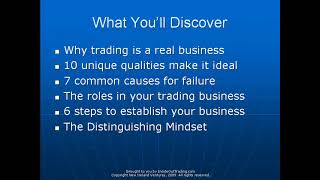
This is a YouTube video titled "Trading as Your Business - 20 minute presentation" created in May 2023. The content is a detailed educational presentation by Brian McAvoy from Inside Out Trading, explaining why trading should be treated as a real business. It covers the unique qualities of trading, common causes of failure, the various roles a trader assumes, and the six steps to establish a trading business, emphasizing the importance of mindset and proper planning for success.
Hi, this is Brian McAvoy with Inside Out Trading. And welcome to the Trading as yous Business presentation. Prepare yourself for the most eye opening information about trading that you will ever run across. Now make sure you pay attention all the way through. Now, of course, since we're talking about trading, I do have to include this disclaimer. As you know, trading involves substantial financial risk. This presentation is for education purposes only and is not intended to induce anyone to initiate any investment or trade. Your trading results are entirely your responsibility. Now what you'll discover in this presentation is why trading is a real business. The 10 unique qualities that make it an ideal business, the seven common causes for failure, the roles in your trading business, the six steps to establish your business, and most importantly, the distinguishing mindset that really separates the winners from the losers. So let's get started. Now there are several worthwhile trading wisdoms such as always trade with a system that suits your style or your personality. Never trade with scared money. But the one that I found that far and away is the most important one to attend to is to treat your trading as a business. Now why do I say that? Because it is a business. Now why do I say it's a business? Well, it is definitely not just a way to make money. And here's proof. Look around you. You've got computer, table, desk, chair, walls, floors, ceiling, doors, all sorts of stuff all around you. Now every single thing you see that you've purchased somewhere represents not only a number of businesses but also a number of industries. And every single one of those businesses exists because somebody saw a demand for a product or service and a way to make money. Every single one of them. Here's the question. Yes? What is a business? Well, business is any ongoing activity engaged for profit, period. It doesn't matter if you've got a lemonade stand out on the corner, if you deliver newspapers, if you've got a car dealership, if you're investing in real estate on a regular basis, if you got a brick and mortar business, anything that is an ongoing activity engaged for profit is a business. Now business is also. All businesses involve risk and all businesses do have certain requirements for success. Now trading really is an ideal business because it is unique in many regards. And these qualities, these aspects about trading that make it unique really are your advantages and the reasons that the odds should very much be in your favor. Now, why trading is an ideal business, let's take a look at them. The first reason, of course here is the low barriers to entry. You can get started in trading with A few hundred or a few thousand dollars and get started right away. That's excellent. Any other business is going to take a lot of money and quite a bit of time to get the business established. Not in trading. Next reason. Proven models are readily available almost all other industries. Whoever is successful, they're going to closely guard their secrets. So as far as knowing what their business model is, it's not easy to get to. But in trading, no readily available. In trading, you also have 100% control if you recognize it, because you have no dependencies on employees or vendors or even customers. That's cool. You control everything that happens in your business and it gives you 100% control. Trading is also infinitely scalable. You can start off again with a few hundred or a few thousand dollars and you can scale that clear up to a 100 million dollar business without having to add buildings or staff or additional resources. Wonderful aspect about trading. You also have a very wide range of involvement to choose from. It can be a completely passive activity for you where you just fund a managed account and have somebody else trade your money for you. Just check in with them once in a while. Or you can be a round the clock forex trader looking at 1 minute and 5 minute charts and it just totally fills your life and anything in between. So you have your choice for your involvement. That's very cool. Now, why trading is ideal. Even more reasons here. Yes, you're not geographically limited. You can trade from home, you can travel the world. Hey, you're not stuck. It's not location, location, location like any other business. No, you're not limited at all. This one is even. One of the best things about it is brakes do not hurt you or your business. In any other business where you're the owner operator of the business, if you take a break for a week or a month or six months, it's going to hurt your business if it doesn't kill it. But in trading, you can take breaks. You can take as many as you want, you can take them as often as you want for as long as you want, and you come right back to it and the markets will welcome you back as if you'd never left. And that's wonderful from a business aspect. In trading, unlike other businesses, you can also test things in the real world with zero risk. With any other business, if you've got a notion you want to try something to make more money, you can only test it in theory without risking any money. But in trading, no. You can test things in a demo account or you can back Test them and find out if it works in the real world, not just in theory. That's cool. Now, you also have tremendous flexibility with trading in any other business, if you have a chosen business model, if you want to change that, it's very expensive and it's going to take some time to change how you're fundamentally doing business. But with trading now, you've got tremendous flexibility. You can change anytime you want, it doesn't cost you anything, and you can make the changes happen right away. You're not locked into a way of doing business. Very cool. Now this last item here. Wonderful. The more the merrier. Any other business, if more people enter that industry, it creates more competition and reduces. Reduces your opportunities, makes it more difficult to make money in trading. The opposite is true. The more people that enter trading, that adds liquidity, that creates more opportunities for you because now there are more people to be on the other end of your trades. That is so cool. Anyway, these reasons are really tremendous advantages for you. Now, while trading is unique, it does still have similarities to all other reliable businesses. See all reliable businesses. Reliable being the key operator word there. They have these following requirements. First of all, they do require some planning. Businesses don't just kind of happen together. It takes planning. It also takes organization. How can you have consistent, reliable profits from anything that's disorganized? That just kind of goes without saying. Systemization is also key for consistency, but also efficiency and profitability. Of course, with any business, you do have to have financial controls. You can't just be going wild with things. And since it's an ongoing activity, that means it's an operation. And it does require management. All reliable businesses require all of these things. Now there's another similarity, and not too many people have paid attention to this. I'm the only one that I know of that's been bringing this up. If you look in any business book that talks about business in general, just about every single one of them will sooner or later. Bring up the statistic that 90% of all new businesses fail in in the first few years. Of course, you've heard this statistic. 90% of all new traders fail in the first year or so. Why do you suppose that is? Well, let's take a look at the common causes of failure for businesses and see how that pairs up with why traders fail. Well, when businesses fail, it's usually for a lack of one or more of these things. It's lack of startup capital, lack of experience, the owner lack, lacking the experience running a business, lack of industry experience. Lack of experience, starting a business. See, starting a business and running an established business, those are entirely different activities and require different skill sets. Lack of a business plan, this is huge. I'm a business consultant and I've run across a number of businesses that have been established for quite a while, eight, 10, 12 years. And the owners, when I first talk to them, I'll ask them certain questions. Do you have a business plan? I say, no. And the reason that they're talking to me is because they're working their tails off. They're not making enough money and they're just struggling along. Business plan is usually one of the most common causes in a big one. And of course, time to profitability. Time to profitability is crucial because you have to get the business where it sustains itself as quickly as possible, otherwise you're having to support it the entire time. You know what I'm talking about. Anyway, these are the common causes of failure in business. But wow, what do you know? Looks like the same reasons that traders fail. Yeah, isn't that wild? If you look at it, though, there's really one underlying culprit behind all of these, and it's called the Peter Principle. Now, the Peter Principle was published back in 1968 by Dr. Peter, who was commissioned to examine US businesses because. Because US businesses were suffering a lot of problems, functional problems made it very hard for them to be competitive in the new global marketplace. And if you look in the book, it says, in any hierarchical organization, a person will rise to their level of incompetence and remain there. Now, so what does that mean? Well, it means that a person in any company, so long as they're doing a great job, upper management would know, say, hey, Joe Blow's doing such a great job, let's promote him. And they would keep promoting him until he hit that point where, wow, you know, yeah, he's not doing so hot now. So he would stay there, just kind of stuck where he's not functioning very well. But he's not going to get promoted anymore either, because now he's not doing such a great job. Well, that represented a big problem for the companies because its effect was. And this was the observed phenomena that the Peter Principle explains. It was observed that in US businesses there was a lot of bad decision making going on, just generally poor management, and there was tons of efficiency and waste and lost profits. And the Peter Prince will explain a lot of why that was happening. Now, the lesson that came out of all this, though, was, first of all, the erroneous assumption that Just because somebody's been doing great in the past, that they'll continue to do great in the future. That was the assumption. Well, what they found was when you just keep promoting somebody just because they're doing great where they are now, and you throw them into a new job, now they're having to train themselves. And that almost always results in failure. That was the big lesson out of it. And the problem is when a person is thrown into a position that they're not properly prepared for and they have to train themselves, they'll encounter obstacles that really usually remain in their way of succeeding and excelling for years, if not indefinitely. And what the companies learned was, rather than just promote somebody because they're doing great, was to stop and assess them, take a look at their character traits and their aptitude and their current skill set, and see if they're ready for the new job. And if they're not, you train them first, then you promote them. Oh, and that made all the difference in the world. Now, so how does this relate to you? Well, when you made the decision to become a trader, you promoted yourself to a whole bunch of new positions, not just one. You didn't just go from being what you were before to being a trader. No, there were many new positions. And unfortunately, there was no one there to apply the lesson learned from the Peter Principle book for you. The. There was no one there, safeguarding you, making sure you were ready for it. Now, let's take a look at the roles you now have. Now that you understand, yes, trading is a real business. Let's take a look and you'll see what I'm talking about. You all of a sudden put on a whole bunch of new hats. The very first one, actually, before you even started trading, you were an investor or venture capitalist. You were somebody that had money. You wanted to put it to work for you, to make more money, generate some income and some wealth. But anybody with money has hundreds of opportunities. So that also immediately threw you into the role of planner, researcher, and analyst, because you had to explore all these different options and see what they're about and analyze which was the best way to go. Now, you also, of course, promoted yourself into the role of owner and business manager, because this is a regular activity engaged for profit. It is a business, and. And you're the manager of it. Now, risk management is a role that actually started back while you were a venture capitalist. It's an ongoing role in running the business, and of course, it's an active part of being the trader. So risk management Is a role. It's a really broad one, covers a lot of areas. And of course, you know, with the trader, that's the person placing the trades every day. But you also promoted yourself into the role of bookkeeper because you have to close the books of the business. Tend to the books. Same thing with the budget. Establishing a budget and following it, and of course, tax preparation on a periodic basis. You stepped into the role of quality. Quality is a huge part of business, not just products and services, but the business itself. And that's what Japanese automotive makers really have taught the rest of the world, is integrating quality throughout the company. Company, not just in the products, really is key to profitability, but also in this one, this last one I listed last because it really is one of the most important when it comes to trading systems. You know that you have hundreds of choices of what system to use. So you stepped into the role of a trading system analyst because you have to be able to look at a given system and analyze it and understand its meaning, merits, its strengths, profit, potential, weaknesses, inherent drawdown, all that kind of stuff. You have to be able to evaluate a trading system and know if it's worth trading before you go throwing money in the markets with it. So this is a key role anyway. You've stepped into a whole bunch of new roles. And the importance of recognizing these is they all contribute to the success of the business. Unfortunately, most people only focus on the role role of the trader. Again, they're just saying, I just want to make a lot of money. And so they just spend all their time trading. Neglecting these other roles has a tremendously high price. As a result, the business usually just struggles along and often just dies. And that's really too bad. Now, as far as building a solid business, organizing a business is a process. There are several steps involved and there's a specific process progression to the process, each of which requires knowledge and specific skills. So let's take a look at these. Step one is to set direction for the company. This is where you get your guiding decision points. Unfortunately, this is usually never done again. A lot of people are saying, I just want to be able to quit my job. I just want to make a lot of money. That's not a guiding decision point, unfortunately, because this isn't in place. This really causes a lot of grief and loss, a lot of wasted time from the lack of focus. Wasted time, wasted money. Now, step two is to assess. Remember we were talking about the Peter Principle? This is it in action. If you don't assess to make sure that person is ready for the new jobs and prepare them for it. The obstacles that they encounter will remain there often for years, many years. Now the problem is a lot of these obstacles that a person run in or traders run into, they're mistaken for psychology, trading psychology. But that's the wrong place to be looking because the problems stem from a person trying to train themselves. Trading is a skill based business and when you don't have the skills, you're going to have psychological issues or seemingly psychological issues. Now step three is again to ensure the core skills. You got to have a proper foundation to be able to do a job and do it well no matter what the job is. Unfortunately, most traders jump straight to basically intermediate level trading and that presents many functional obstacles and it also creates learning obstacles which only compounds the problem. Now step four is to analyze and confirm a business model in trading. Essentially that's your strategy and your trading system that you've chosen. But you need to be able to analyze and confirm, confirm that it works. Unfortunately, most people just go through the trial and error route, which is extremely expensive. But taking this step right here, it ensures the financial viability of the strategy. And from a business perspective, this one is absolutely essential. Step five. Now, if the other matters are taken care of, this is when you go in and organize your operation. This is really necessary for consistency. You've got to get organized and systemized. If you look at any large organization like the military and the admired corporations, they've done these things, they get themselves organized, they establish best practices and standard operating procedures and they get everybody's roles well defined. So that's step five. Build the operation. Step six. This is where you bring together the business plan. This provides the structure and the framework for you to operate in. And it also is the decision guide and your action plan on how you're going to get from where you are now to where you want to be. This must include a financial forecast. In order for it to be a real business plan and get any kind of security and comfort with it, it has to have the financial forecast. Without it, you're not going to have any security in it. So that's the big deal. Now the business plan really is critical for any business to succeed. But it's especially true in trading. The biggest benefits of having it are the time to profitability is minimized. Again, you want to get the business where it's sustaining itself as quickly as possible. But the business plan also really is where you get the high odds of success and real peace of mind that what you've got going on really is likely to work. Now again, the high cost of neglect for traders, what usually winds up happening is emotional trading. They don't have the skill sets, they're not organized, they don't have focus, they don't have a plan. And so they're sitting there trying to make money in these kind of conditions. And yet it's almost impossible not to have your emotions constantly hammered on you. Now as a result of that, most people don't keep their profits. If they make any sooner or later you wind up handing them back to the markets. You already know what I'm talking about anyway. The sad result is years of struggle, frustration and yes, anguish. Anguish is the right word because it really is. It's anguish. I mean, when trading is going sour, it just makes life crap. The saddest thing about it is with neglecting these roles and making a proper business is that eventually your business is going to suffer the eventual financial death. And that bites. Now what you just saw in these six steps is the steps for building both a business and a business plan. You can see, yes, it does follow a very specific and logical progression. I didn't make this up. This has been around since I was born. It's been proven in the real world for centuries. This is the way to do it. Now why don't they happen though? It seems pretty self evident. Well, most people don't even know to consider them. A lot of that is the way trading is presented to people. Another problem is people will hear treats trading as a business, but they don't understand the importance of it, how vital it really is. Of course a lot of people don't know how. If you've never started or run a business before, you've never seen a business plan, how the heck are you going to write one? It can be very difficult. Now a lot of it also really comes down simply to the mindset that you brought to trading in the first place. See, there is a very distinguishing mindset. Don't be offended with what I'm going to share with you because we've all been here. Let's just take a look at it with the opportunity seeker. That's pretty much anybody that's in the get rich quick mindset. I want my freedom from my job. I hate working for somebody else. I want to be free. I'm just looking for that opportunity. That's an opportunity seeker. And it's easy for them to get sucked into the get rich quick stuff. An entrepreneur though understands, hey, anything that I'm going to be doing on a regular basis for profit is a business. And so I'm going to organize and systemize a business out of it. Now, the lifestyle rewards because entrepreneurs build assets, they build businesses, things that are reliable and consistent. And that's why most real entrepreneurs enjoy six, seven, sometimes eight figure income streams. Most of all, they have reliability in what they're doing, they enjoy the consistency and most importantly of all, they have the security because they're going about it in a proper manner. Now, in building your business, as you know, it doesn't happen overnight. Nobody's going to build a six, seven or eight figure business overnight. It just doesn't happen. It requires skills and knowledge, of course, and it requires that a person be serious and mature about it and, and of course very dedicated to it. Now, in wrapping all this up, of course, yes, there is more to it than most realize and neglect does have a huge penalty. Entrepreneurial traders I found in my experience, since I've been helping other people over the last few years, yes, entrepreneurial traders with a business mindset, yes, they are the ones who usually succeed and opportunity seekers, they're the ones who usually fail. Now, knowing what you do now, make sure that you build your business the right way. Now, this presentation has been like the 10,000 foot view. Obviously the scope of actually doing it is way beyond that of the short presentation that you've seen. To discover how to actually do it, click the link below.









