Trading As Your Business - Episode 050 with Brian McAboy
This is a YouTube video titled "Trading As Your Business - Episode 050 with Brian McAboy" published in February 2024. It features Brian McAboy delivering a detailed solo presentation on treating trading as a business. The content covers the mindset, planning, and organizational aspects necessary for consistent profitability in trading, emphasizing the importance of a business approach to trading for long-term success and reliability.
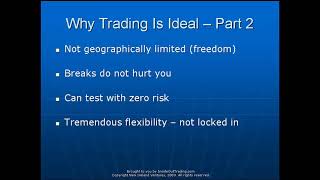
Hello and welcome to the Consistent Profits podcast brought to you by Inside out trading and Brian McAvoy, where the focus is on consistency because when you have the consistent part down, profits become easy. Hi, Brian McAvoy here. This week we're going to take another little turn on things. Mix it up a little bit. Instead of an interview I really wanted to share with you. I've been in a kind of a business mode lately. You know, trading is a business mode. So that's what I'd like to share with you today is a presentation that I did a while back where I'm talking about trading as a business and the different considerations that go with that. The benefits of, you know, treating your trading as a business, the cost, the different things that go into it. And so it's a really good presentation, runs about a half an hour. I think you'll enjoy it. I'm sure you'll get some good benefit out of it. So I hope you enjoy the podcast this week and here's the presentation on trading as your business. Talk to you soon. Cheers. Welcome to trading as your business. This is presented by Brian McAvoy, that's me with Inside Out Trading. Now prepare yourself for some of the most eye opening information and you do need to make sure that you pay attention all the way through. We're going to be covering a lot of different information today. You'll see what I'm talking about here in just a quick second. I'll give you a summary before we get started. Now, one thing I guarantee you is how you look at trading will never be the same after today. You're going to get a whole different perspective on it. Now, since we're talking about trading, I do need to include this disclaimer. As you know, trading involves substantial financial risk. This presentation is for education purposes only and is not intended to induce anyone to initiate any investment or trade. Your trading results are entirely your responsibility. Now, why do you need to know this stuff as far as trading as your business? Well, first of all, you haven't been told the truth, at least not the whole truth. Probably a good portion of the information that you've gotten about trading and how to trade successfully has been incorrect or incomplete at best. Without the key puzzle pieces, the odds really are very severely against you. Now, once you understand these things that I'm going to share with you today, you can turn the odds to your favor and know this isn't hype or bs. This is a truth. This is how you turn the odds in your favor. Now, what you're going to discover today and why you want to stick around and pay attention all the way through. First of all, you're going to learn out why trading is a real business. The 10 unique qualities that make it ideal. 7 common profit killers. 6 inherent obstacles that all traders face. 5 requirements for reliability. And reliability really is a key item there. To make money is one thing. You want to be able to make money reliably where you can relax and have some security in that money. You're also going to learn the distinguishing mindset. Really, truly what the distinguishing mindset is between winners and losers. Yes, this is really important for you to understand where most traders go wrong and what to do instead. Now, let's get started. See, there are several worthwhile trading wisdoms, like trade with a system that suits your personality. Don't trade with scared money. But the one that stands head and shoulders above the rest being important is treat your trading as a business. Why? Because it is a business. Now, how can I say that? Why do I say trading is a business? Well, it's not just a way to make money. A lot of people look at trading and they're like, no, it's not a real business. I don't have a store down the street or a factory or anything like that. But really, seriously, just look around you. The computer that you're, you know, we're communicating through the chair that you're sitting in, the table or desk that your computer is sitting on, the room that you're sitting in, the windows, doors, walls, paint, carpet, your clothes, everything around you represents at least one business, probably a number of businesses in a number of industries. Every single thing that you see around you represents a whole bunch of businesses. Now, every single one of those products and businesses exist because somebody saw an opportunity for profit. They saw demand there. They saw that they could make money at it. So they started doing it. And they were making whatever it is or providing whatever service it is in that regard, they're no different from trading. Trading, it's an opportunity for profit and you're going to get into the business. You're still a little skeptical. All right, there's money to be made. But really, what makes it a business? Business versus just a way to make money. Well, let's take a look at that question. What is a business? Well, a business is any ongoing activity engaged for profit. Really, any ongoing activity, whether it's a lemonade stand out on a corner or you've got a car dealership or an accounting firm or an investment firm or anything that you're doing on a regular basis for profit is a business. Now just to illustrate, even the government recognizes this. If you buy a house, you're not a real estate investor. If you're buying and selling several houses a year for profit, you're in the business of real estate. Same thing with cars, same thing with securities, like we're talking about with trading. So anything that you're doing on a regular basis and it's an ongoing activity, that's a business. Now all businesses also involve risk and all businesses have certain requirements for it to be successful. Trading really is very cool. Let's take a look at some of the reasons that it's unique in many regards. And really, if you think about it from a business perspective, these qualities really are your advantages and reasons why the odds should be in your favor. If you pay attention to treating your trading as a business like we talked about. Okay, let's look at some of these things that make trading unique and are your advantages. Well, first of all, you have very low barriers to entry. If you've got a couple thousand bucks and you want to start trading today, you can. It's not like you've got to go get a four year or eight year degree, put up a building and all this kind of stuff. You got money, you can start trading immediately. And it doesn't take a ton of capital either. It's not like you've got to have several million dollars to get started in trading. You can get started trading with a couple hundred, a couple thousand bucks. That's cool. There are proven models readily available. There are. Unlike other businesses, where the really successful companies closely guard their competitive advantage of business model. No, in trading, there are proven models all over the place. Well published too. In trading, unlike other businesses, you have 100% control over what goes on in your business. Other businesses, all of the businesses involve other people. You have employees or vendors or customers. In trading. No, it's just you and the markets. That's cool. Trading is infinitely scalable. You can start off small, a few thousand bucks, ten thousand bucks, twenty thousand bucks, and you can scale it up to hundreds of millions of dollars without having to put up another building, move to another location, add staff or add capital. No, you can scale it up as much as you want. That's cool. Wide range of involvement. It can be everything from completely passive, where you deposit your money into a managed account and have somebody else trade your money for you and you just check in once in a while and see how the account is going to everything to forex trading, where you can trade around the clock and almost every day of the week. You can be absolutely insanely involved in it or hardly at all. That's cool. More reasons you're not geographically limited. You can trade traveling the world if you want to. That's really cool. You're not locked into a physical location, a certain locality to be successful. You can take breaks anytime you want. And it doesn't hurt your business with any other business, since it depends on other people and particularly customers. If you want to take three months or six months or year off and just step away from your business, it'll kill your business or at least substantially hurt it. Not with this one, with trading, no. You can take breaks anytime you want and the markets will welcome you as though you had never left. Now this one here. As far as testing with zero risk, this is really cool. Trading is the only business I know of where you can test things in the real world and find out if they work. If you've got an idea, an indicator or strategy or set of rules, whatever, you can test it in the real world to see if it works. Any other business, you can only theorize or get a little sampling. If you want to test it in the real world to see if it works, you've got to invest some time and money trading. Tremendous flexibility with any other business. If you want to change substantially how you're doing business, it's going to be some investment of time and resources to make that change. With trading. No, if you are, say you're a long term end of day position trader now and tomorrow you want to be a day trader, hey, go for it and you can. There's nothing holding you back. That's cool. You're not locked in now. This last advantage is really cool. But anyway, the more the merrier. Any other industry, more people come into that industry, that means more competition for you, means it's tougher to make a profit with trading. No more people that enter trading. That adds liquidity to the markets. Means there's more people that are able to take your trades when you want to put them out there. That is cool. So these things, these are 10 huge advantages from a business perspective to make trading really just a great business. Now, it is unique in many regards, but it still has similarities to other businesses. What am I talking about? Well, all reliable businesses, keyword reliable require the following Planning, good planning. I mean good business, a long term reliable income stream and source of wealth generation. It doesn't happen by accident. It requires some planning. It also requires organization. How can you Expect consistent performance and profits out of anything that's not organized. Same thing with systemization. You want consistency, repeatability. That's where you get the reliability from. That's where your systemization comes into play. As well as adding to the profitability and efficiency of the operation, good businesses also always have to have reasonable financial controls in place to make sure we're sticking to our plan and all that kind of stuff. Since it's an ongoing operation, ongoing activity does require management. Now this is fine. Don't be intimidated. These are common. Think about any good business that you know of. It has these qualities and that's what makes it a good business and very reliable. Now another similarity that trading has with other businesses, and this is really important here, if you look in any book just in general business, you'll see a statistic there and that's that 90% of all new businesses will fail within the first two to five years. That's been around truth for a very long time. Oh, well, that sounds a lot like the old statistic. That's been around for a very long time. 90% of all new traders will fail in the first very short period, six months to a couple years. Why do you suppose that is? Well, there are seven common profit killers that you'll find are common between the two. Let's take a look at some of these common profit killers. Things that kill businesses and kill trading businesses. Businesses. Well, frequent changes in direction. For one, you're doing things one day this week. Have you ever worked someplace where today we're doing it this way and next month. Oh, no. Whole change of direction. No. And with trading like I was talking about, there's some traders they can't get settled down. They're jumping from one trading system or strategy to another. They'll be end of day trading with one system one day. And next week they're trying to day trade maybe with a scalping system the next. So yeah, the frequent changes in direction definitely hurts your profitability. Poor decision making, that's very commonplace and unfortunately a big deal in business and in trading. Poor management in general. You've seen this and probably experienced it yourself. Inefficiency, short term thinking, oh my God, this is just a huge profit killer. Businesses will do things for the sake of profit today and tomorrow it's costing them big time. Lack of financial controls, again, you've probably experienced this in jobs that you've had where the company's throwing all kinds of money into something and it's just stupid and they really shouldn't have been Doing it in the first place. Last but not least, inconsistent performance. It's going to hurt any business. Bottom line. Now, why do these things happen? Well, back in the 60s, US businesses were suffering a lot from the list that we just looked at, and it was causing some problems, particularly with global competition. And this group was commissioned to study and see what's going on. Why are all these things happening, particularly the poor management, bad decision making and inefficiencies. And the result of the study was a book called the Peter Principle. And in short, it says that in any large hierarchical organization, a person will rise to their level of incompetence and remain there. That's the Peter Principle as it was stated in the book. Okay, but what does that mean? It basically means that in any organization, a person is going to keep getting promoted until they hit a level where, hey, now, they're not doing so great and then they're going to be stuck there. They're not going to get promoted anymore. That's what it means. In short, the reason for that is as a person moves up and their jobs change as they move up, those different jobs require different skill sets. Really, who can this affect? It can affect anybody. Used to be an engineer, and I would see it where I was on an engineering staff and there was one guy who was a really excellent engineer and he got promoted to be a supervisor over another group of engineers. Horrible. Because he didn't have the managerial skill set that he needed. He was a great engineer, but not when it came to managing other people. This is true regardless of the job or the environment. Like I said, different jobs require different skills. Just because you're good at one thing doesn't mean you're going to be good at something totally different. Different. So the lesson that was learned out of the peter principle for U.S. businesses, and this was really valuable, was first of all just promoting somebody because they're doing well and expecting them to continue to do well. That past equal the future is a bad assumption. That's an erroneous assumption. Without guidance and training, what's going to happen is you throw somebody into a new job where it has a whole different skill set and you don't give them any guidance or training, they're going to have a very poor foundation and their performance is likely to suffer unless they are just so blooming good that they can overcome that. And the problem is with this, the obstacles that they run into, not having the guidance or the training, those obstacles that are affecting their performance, they're going to stay there for years. So the big lesson out of all this was before you promote somebody to perform an assessment and make sure that they have the personality first of all for the new job, just the general temperament for it and then the aptitude for it, then the skill set. Then if they meet all that cool, you go ahead and promote them. If they don't have the skill set, well, you train them first and then you promote them. That makes all the difference in the world. How does all this relate to you? Well, when you made the decision to become a trader, you effectively started your own business operation and you promoted yourself to many new positions, several of which you probably didn't have any experience or training for. And there was nobody there to apply the lessons from the Peter principle for you. Now what roles are you talking about? What new jobs are you talking about? Well, let's take a look at them. Before you even actually started into trading, you were an investor and a venture capitalist. You decided that you didn't want to just have your money sitting in a mutual fund or some long term stock or some CD somewhere. You wanted to invest it and put it to work for you, generating a nice either wealth generation or nice income, but something more substantial than just real passive investment. So you are an investor and a venture capitalist. Once you chose to go into business for yourself, which you did, and it's an activity, not just an investment. Trading is so now you also had to become a planner and a researcher and an analyst. And once you got started, hey, now you're the owner and a business manager of your trading business. Of course, risk management. That's something that before you even chose trading was something that you had to assess, hopefully and on a day to day basis. Traders are risk managers. Now there are other new roles. Yes, there's a bunch of them. Of course you're the trader, but you're also the bookkeeper. You're running a business now. You have to keep your books, file your taxes, all that kind of stuff. Quality, this one's huge. Most people don't realize, but yes, quality is a part of every business, whether you want it to be or not. It's the there because you're always wanting to improve things. When things go wrong, you need to fix them. That's the role of quality. Then of course this one, Trading system analyst. Once you chose to get into trading, you needed to take a look at the various methodologies and systems that are available, analyze them and decide, hey, is this worth getting into? This is a crucial job that a lot of traders really don't Realize that they have, don't attend to it very well. Anyway, the importance of recognizing all these roles is all of them contribute to the success of a business. Most unfortunately only focus on the role of the trader. They're just busy trading. I'll talk to people and they're like, I just want to make lots of money. And they're just busy trading. They neglect the others and unfortunately pay a very high price for that neglect. Usually that price is continued disappointment, frustration and lack of profits that goes on for months, oftentimes years. That's a high price. Now where most go wrong is first of all, like I said, they're viewing trading simply as a way to make money. They're not looking at it as a business operation. They're not, I just want to make lots of money. And that's what I hear out of them. They're not viewing it as an ongoing business pursuit. That's very short term thinking. They're not thinking of it as a long term. I want to. Consistent wealth generation and income generation. No, they're not looking at it that way. So they grossly underestimate what it takes to have that long term consistent profit. Now, of course with trading, part of the problem is it sounds simple enough at first. It really does. The commercials of course don't help. You've seen them. Oh yeah, they got the little toddler up there on the screen. Oh look, I just placed a trade. It's so easy and even a baby can do it. Sure place in trades. Yeah, everybody can click a mouse. My cat can click a mouse or my dog. That doesn't mean that they're making money now. People jump into it, underestimating what it takes. Then they wonder. They just jump in. Then they wonder why it's so tough. Why is it so hard to make money? They of course blow out their account or they just continue to struggle for years. And it's really a shame. The problem is, yeah, it sounds simple enough at first. I mean trading itself, it's not that difficult. Buy low, sell high, or vice versa. If you're dealing in the future, you sell it high before you buy it low. Okay, yeah, it sounds really simple. And a lot of people get hooked into trading with the lure of easy money. They're not told the whole story story. If they're looking for a long term source of income and wealth generation, then they need to look at it as a business. Because long term consistent income and wealth generation only comes from a true business if it is an ongoing regular activity. Now, a reliable business doesn't just happen by accident or it doesn't just fall together. It doesn't. And it doesn't happen overnight. It does require skills and knowledge and a serious, mature and dedicated person to make it happen. These are just simple facts. Now remember the requirements that we talked about. All reliable businesses require planning, organizing, systemizing, implementing of financial controls and managing. They do. Now again, when most people enter trading, they're coming from a job or an occupation where these things are new tasks for them if they've not had any preparation for it. So they're working from very limited knowledge and they're trying to learn on the fly, so to speak. Just like they're getting thrown into a job. They haven't been prepared for it, they haven't been trained, they haven't really been given the expectations of what the job requires. And they're trying to learn as they go without any guidance or training. And the worst of it is half the time, actually more than half, they don't even know the questions to ask. So you've experienced it and you're witnessing the Peter Principle in action. Really. Peter Principle is like how not to build a business. Building a business in many regards is like building a house. You don't just grab some boards and start nailing them together thinking, hey, the house will just. You can figure it out as you go. No, if you do that, there's going to be a whole lot of undoing and redoing that goes on and that makes for considerable waste of time and money. Now the distinguishing mindset really, that separates the winners and the losers, those that can build a decent, reliable business in a short period of time or a reasonable period of time, is this. Don't be offended because I've been in both of these. Don't feel bad. This sounds like if you can relate to this, don't feel bad. We've all been there at some point. It's just part of the maturing process as you become a trader. A lot of people when they first get into trading, they're an opportunity seeker. They're getting sucked in with the old get rich quick mentality, the lure of easy money. And they're looking into trading because they're fed up with their current job. They want a change in lifestyle, they want to stop what they're doing now. They're looking for an alternative. Yeah, here's trading looks easy enough, the money's good. Yeah, let's jump on it. They're running away from an unpleasant life and they're just jumping on the opportunity for money, but the difference and the whole difference in the mindset. Now if you, if you look up the word entrepreneur in the dictionary, it says that an entrepreneur is a person who organizes and systemizes a business undertaking, assuming the risk for the sake of the profits. Now the key distinguishing thing there is they're organizing and systemizing a business undertaking. An opportunity seeker is willing to risk to make some money, but they're an opportunity seeker. Most, like I said with traders, they don't understand it's a business. So they just jump into it thinking, hey, if I can just get to making money, everything else will come together. No, an entrepreneur understands that. No, I've got to get it organized and I need to systemize things. I need to treat it properly as a business. Now, in building a solid business, there is a particular process to build a business and there's a specific progression to the process. Like I said, you don't just grab boards and start nailing them together thinking everything will fall in place. There are several stages involved and each stage requires knowledge, a process and specific skills. Now the inherent obstacles for most traders is the lack of experience, training or guidance when it comes to creating a business plan, building the business on paper, actually starting up a profitable business, growing a profitable business, and maintaining a profitable business. See, each of these stages here have different knowledge sets and skill sets and processes to go with them. I've worked for guys who are great at starting up businesses. They were new plant startups guys would just be great at. But you put them into a mature facility where everybody's been there for five years and everything's all smoothed out, they struggle vice versa. Same thing with even the simple act of creating a business plan. I know tons of small business owners that have not been able to sit down and write a business plan. And that's why they're calling me, is to help them write their business plan because it requires specific skills and knowledge to do it right. The business plan really the reason to focus here, it is absolutely critical, it really is for any business to succeed and in a reasonable period of time, you got to have a business plan. This is especially true in trading. The biggest benefits, first of all, time to profitability. By putting it together, building it on paper first, before you ever start throwing money into it, you shorten your time to profitability dramatically. That's why venture capital firms and angel investors and banks, if you don't have a business plan, they won't give you a penny because this is a make or break part of the deal. If you don't have a plan. Who cares how lucrative your idea is? You've got to have the plan in place to show how you're going to make it happen. Now, once you have a plan, like I said, it shortens your time to profitability. You put the odds severely in your favor, very strongly in your favor. Because now, like I said, you've already built it on paper and you get a great piece of mind from this. You're not just sitting there hoping that things are going to work out, hoping that you're going to get profitable in a reasonable period of time, hoping that you're going to make it next month, next year and five years from now. All that hoping goes away because now you know you've given yourself something really tangible and solid to work from. Now, mistakes commonly made by traders again, underestimating what it takes, just in general, they're thinking, hey, I'm going to change my lifestyle, I'm going to quit my job and I'm going to go trade for a living. No, that's where you're underestimating what it takes. If you want to have reliability and security. No, you've got to treat it like a business. Starting up without a business plan, this is another huge mistake. Without the business plan skipping that really makes things so hard. Another mistake is just thinking that everything will just fall into place for those consistent long term profits. It doesn't work that way, not in the real world. The biggest one, I can't stress it enough, failing to get the help needed to do it right the first time in trading and in any other business, there's just too much money that can be lost too quickly. To think that you can just keep trying this and trying that and trying this and to trying that. It's too expensive and it takes too long. Now again, there are high costs for neglecting doing it properly. First of all, emotional trading, I hear it from people all the time, oh, if I could just be more disciplined, everything would be fine. No, your emotions were hammering you because you haven't given yourself a stable point and some security of treating it like a business. Of course you're going to feel a lot of anxiety and be open to a lot of emotional problems and other things that seem psychological and discipline related. They're not. It's because your trading lacks the structure of a business. You haven't gotten it organized yet. Now the other price that's paid is, yeah, I know a lot of traders, man, they've done well and they'll go through these cycles. They'll run up for three to six months and they'll just be rocking and tearing it up, triple their account. And then bam, they give it all back and then they do it all over again and they just are on this endless vicious cycle. So yeah, they make money, they just can't keep it. Ah, that sucks. Now, the big price, the high cost of neglect without getting your business organized as a business and doing it right. Yeah, years, not just weeks or months, we're talking years of struggle, frustration and anguish really is the right word for it. And unfortunately, eventually, yes, comes the eventual financial death where you just plain have to come close up shop because the stress gets so high, your subconscious is saying, hey, if we don't stop this, the stress is just going to kill us. So we're going to end the stress by blowing out your account. Bam. And you're done. Now what to do instead? Well, first of all, really honestly, treat your trading as your business, a real business, not just being serious about it, but treat it like a business. Get help to do it right. That's the smart thing. Don't just go along, invest in yourself and your business. Anybody who's serious about. If you're talking about trading providing a new lifestyle for you and a whole different lifestyle, a new life for you and your family, you want to make sure that you do it right. So invest in yourself and your business and make sure that you do it properly. If you get help, it really is the best use of your time and your resources. The advantages you gain by treating your trading as business. Approaching it this way, first of all, it makes your life easy. The stress can go down because now you're getting the guidance. You're getting the knowledge, the process and the skills and the actions that you need to take to do things properly. This is your fastest, surest and most sensible way to consistent profits that I know of. Best of all, really, it eliminates tons of waste. If you're tired of jumping from one system to the next, if you're tired of running around in circles, this is a great way to help eliminate that waste. Now again, the other thing, the confidence that you get from having a solid plan, that's well thought through. The confidence is great. Another thing, just from a general lifestyle, if you want to call it that, is the security from knowing how to start a business. Because you're going to learn the process of how to properly plan and start up a business. That is extremely cool. Now the other thing, yes, with a business plan, which is one thing that you, that you'll have walking away from the program is you'll have a working business plan. That plan gives you clear direction. No more jumping around from this to that and back again or running around in circles. That's cool. Again, having structure to your trading, that itself is going to lend consistency and efficiency. And that means more time for you. Now, instead of taking 50 hours a week or however much time you're putting into your trading now, you'll be able to reduce that. That frees up your time and that is cool. That's wonderful. Now the lifestyle rewards for people who choose to be entrepreneurs and not opportunity seekers. Entrepreneurs build businesses, they build assets. And that's what you want to do. Because, see, when you get good at building businesses and acquiring and creating assets, that's when you really can start looking at six and seven figure income streams. That really is cool. Again, when you know how to do this, when you've gone through the training and you've acquired the skill set and the knowledge and the process, that's when you really can enjoy reliability in what you've got going on for making your living and the consistency and the security that goes with it. That is really cool. Now to wrap things up here again with trading. There is much more to it than most people realize when they first get into trading. You know, that's true. And neglect has a huge penalty. If you want to just sit there and ignore it and play the na na na na na na. I don't see the hard work over here. It's not that tough if you do it right. It's just a matter of going ahead and stepping up to the plate and saying, hey, I really do want the lifestyle. I'm going to do what it takes. If you don't, that's got a huge penalty to it. But what I've found in my years in trading and working with other traders helping people is the entrepreneurial traders, the ones who approach it like a business, treat it like a business, they're the ones who succeed. You really put the odds in your favor. This is Brian McAvoy with Inside Out Trading. Cheers. Thank you for joining us today on the Consistent Profits podcast brought to you by Inside Out Trading. Make sure to swing by Inside Out Trading and pick up your copy of the Proven formula for consistent monthly profits. If you enjoyed the show, make sure to subscribe on your favorite channel and we'll see you on the next episode. Cheers.









