Trading Reflections, Stoicism and the Journey – Matt Carver – Episode 057
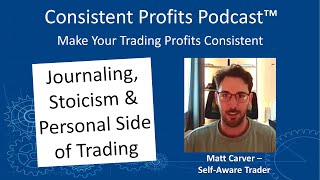
This is a YouTube video titled "Trading Reflections, Stoicism and the Journey – Matt Carver – Episode 057" published in March 2024. It features a conversational interview hosted by Brian McAboy with Matt Carver, an individual trader from the UK. The discussion covers Matt's trading journey, his transition from stocks to Forex and crypto, the importance of journaling, self-awareness, stoic philosophy, and personal development as key factors in trading success. The conversation also touches on the psychological and spiritual aspects of trading and life improvement.
Hello and welcome to the Consistent Profits podcast brought to you by Inside out trading and Brian McAvoy, where the focus is on consistency because when you have the consistent part down, profits become easy. Hello, everybody, this is Brian McAvoy with Inside Out Trading. And welcome to another episode of the Consistent Profits podcast. Today I'm really excited to be interviewing Matt Carver. He's an individual trader, lives in the UK and he actually happens to be a. A former coaching client of mine and he's tearing it up in, in the, in the markets. And thanks for. Hey, Matt, thanks for taking the time and being here with us today.
Thanks having me, mate. I'm looking forward to it. It's my first venture into the video world for a very long time. First time on camera as well. So, yeah, sorry to your viewers if it's a little bit clunky, but yeah, looking forward to getting into it, man.
No, you got, you got, you got your, your office well set up there. We've talked about your change in decoration and upgrade and everything. Yeah, it looks good, man. So, yeah, well, so everybody knows. I mean, if you're probably not familiar with that, maybe you'll remember from Twitter. But yeah, like, like you just said, he's, you know, I've been doing a video, but I wanted to have him on today because he's got a really good story. He's, he's got a good experience that I think a lot of, lot of, A lot of you will be able to relate to and you can learn from his experience and some of the things that he's done to, you know, get his trading really well in hand and, you know, just a lot of good practices, things that, you know, lessons that he's learned and, and also it's encouraging because, you know, he's had his struggles and he's been able to overcome them and he's still in the game. So let's go and jump into it. Again, Matt, thanks for being here today. So let's go ahead and start off at the beginning. I mean, how, how did you get started in trading? What were you doing before trading? And how do you. How'd you get started?
First time I heard about it, I was actually working a sales job. I was about 19 years old. I used to door to door sales. It was all commission only. And after about six months, one of the lads I used to work with, he got into trading. It was all stock market, right? This was back in 2009, so the barrier to entry was really high in trading back then. But he came from A decent family. He had a fair bit of cash behind him and I think his parents were kind of dabbling into the stock market a little bit. So he used to come into work and say they'd made X amount of money. And obviously being a young guy, like, okay, I need to get a little slice of this, what's going on? And I used to track the footsie back then and you kind of did a mental mass of I put 100 quid in yesterday, today it's going to be worth this much. And it kind of spiraled from there. I got interested in it initially from the financial crash in 2007, 2008, because you kind of look at it and think, how do this, how do these people make all this money? How can I get a bit of that? But like I said back then, it was, it wasn't really easy to get into, but it was enough of a seed in my head that I kind of always wanted to make it grow somehow, but I just didn't know how to. So parked it for a few years. And then I met someone through a mutual friend late or mid to late 2013 and he said he'd been trading for about six months and I kind of like, oh, that, that seed in the back of my head was a bit like, ah, hello, it's time to grow here, so start talking about it again. Was into stocks, which I don't touch anymore. I probably had about six months foray into that. I placed my first trade at the beginning of 2014 with a pharmaceutical company whose name I can't remember, but he'd kind of seen that with the stock market and forgive me if I get this wrong, but certainly back then when the earnings for the year came out, they would come out at a certain time of the day before the market was always impossible to position yourself because it gap up with this pharmaceutical company. However, they were releasing their earnings four hours after the open. So we tracked it from each quarter of the previous year. So we'd seen like it made 100 points after every earnings report each quarter. Now it was like the yearly report and okay, well I'm going to put a grand in and if it does what it did last time, I'm going to walk away with about 15 grand in the next couple of hours. And the earnings came out, we put, we had the money in and if it started off with, oh, the president's going to change, the company president's leaving and it just immediately tanked. Took out my position, took out his position and then they came out of all the good news. And it rallied like from the open. It rallied about 200 points that day without us on board. So that burned. That hurt. But it was money I could afford to lose, but it was baptism of fire, so to speak. And from that point on, I kind of looked into stocks and realized that you had to put a lot more energy and time into following things like news reports and earnings and all this kind of stuff. And it just wasn't me. Didn't really suit my personality. So kind of again, parked it for a few months he was doing his thing, and then I'd say early 2015, he started mentioning Forex to me. And although you get the news announcements in Forex and everything, I didn't have to sit there and worry about, you know, there was, there was one particular trade I took in the stock market. It was for EasyJet, which is, you know, for flights, and something to do with like one of the. The nuts and bolts that they'd used for their planes had been used in some Asian, some Asian aviation company, and there was a problem with it. And because those nuts and bolts affected one of the planes, it put easy jets, like little things like that. I just didn't really. Couldn't stand top of that. It was too much, so lost interest in it. With Forex, I didn't have to worry about that.
Well, well, actually, it's funny, I mean that you bring all this up because one of, one of the things that I find hilarious about the stock market, I mean, I know it's like an institution that's been around forever and it's cool and how it came to be is cool, but with stocks. Yeah. My aversion to it, and I don't mean to, you know, hurt anybody's feelings that like stocks, but it's all a confidence game.
Yeah.
You know, somebody can leave the company, it's some little piece of news can leak, and all of a sudden the value of that company can just bottom out and it's just disappear. Or on the flip side of it, somebody can do something stupid and all of a sudden, bam, you know, it doubles. For real. Good reason. It's all just what everybody thinks. And so with Forex, well, Forex is a lot more immune to that. But not totally immune. Anyway. Go ahead.
Yeah, I think it's the correlation between different things in the same sector. But yeah, it was just. I'm not really a numbers guy. I don't sit there crunching data and all that kind of stuff, which I think is you need for the stock market and you need to be aware of different policies that may affect stocks. And it just wasn't for me. I mean, obviously there is an element of. A huge element of the fundamentals and news that drive the Forex markets. But I found it easier to be able to just dip in and out of the market compared to the stock market. It just seemed to set my personality a little bit more. But I started probably mid to late 2015 looking at forex a little bit more. I spent a long time on the demo charts. Just my brain works as I need to figure this out before I put money into it. I don't want to be a gambler. I want to get. Build a system. I want to build some sort of idea of what the hell I'm doing before I put money into it. And it made me really, it made me a really good technical analyst, but it didn't make me a great trader from that point. I started making a bit of money in 2017. It wasn't consistent, but, you know, and it wasn't a huge amount of money, but it was proof of concept that I could do it, that I could translate some of these technical analysis skills into actually making money off of them. And the market was completely different back then, a lot more volatile. And then end of 2017, crypto happened. So at the time I was working for one of the big counsel firms in London and I was doing graphic design documents. And obviously bitcoin is built on the blockchain. And I've heard of Bitcoin back in 2013, 2014 from some like rogue websites and forums that I used to be on. But I just thought it was when you sort of see a certain group of people online talking about something like drop shipping, drop shipping is one of them where people get in and you know, you have to kind of get in from the mid, like right from the beginning and then you can make the money. I looked at bitcoin a bit like that. But when I was working on some of these documents for this county fell and they're in the top four. So it was a big deal. I've seen a lot more blockchain this, blockchain that Internet of things. And I thought, okay, maybe there's actually something to this. So I started looking into bitcoin a lot more and I managed to run it up from it was about £4,000 up to, I think it was the high about £16,000, which is $20,000. But I became a bag holder. It was my first time experiencing a bottle So I rode it up, thought I was a king and then it like dropped back down and here I am, like pretty much where I started. But it was a good, it was a good lesson. And seeing the cycles play out a lot quicker in that market kind of gives you an overall idea of the legacy markets and how they move. So at that point, 2018, I wasn't focusing on Forex as much because the crypto markets were going pretty mental. Moved on to social media to start meeting some new traders and ended up building a little bit of following there. Couple of guys approached me, we made an education group and that was. That lasted probably about 18 months to two years, went very well and it took up a lot of my time, but it was good for the pocket. But it wasn't necessarily good for my trading because it took so much of my energy and time. You know, people were paying us a decent amount of money and I thought because they're paying that money, you know, it needs that dedication of time. But it made my own trading stuff right from that. However, people were looking at what I was doing. So we used to give trade calls and, you know, typical sort of education group stuff and some guys that were kind of a little bit more switched on and said to me, you know, your trade calls, have you ever thought about dropping the time frame and maybe improving your risk reward? Because I used to go in with quite high stop losses. So it kind of again planted a little seed in my head. And I thought when people started taking my trades, but they were taking them with tight stop losses on the lower time frames, which I didn't have the energy or the time for. They were making more money off of my own trade. So I kind of thought, hang on a second. So once that group had closed again, this was, this is like 2021 or late 2020, the crypto market started booming again. And I just kind of thought, right, you know what, I'm sick of social media. I had a bit of PTSD from running this group and checking my messages like 24 7. So I just kind of eliminate myself from social media. Got off of everything. I knew that I had to do something a little bit different to what I was doing before because I used to trade the hourly and the four hourly time frame on Forex. And that was great when I had my corporate job and it was great when I had my education group because it allowed me to do other things during the day whilst having stuff in the background. But then I found myself sitting at home during the lockdowns by Myself trading the charts. And if you're looking at the charts every hour rather than like every five minutes or something, just kind of a little bit bored, don't know what to do, leads to over trading. The markets aren't moving as much. So beginning of 2022, I mean 2021 was a bit of a blur. I spent a lot of it going out getting drunk and making up for lost time from lockdowns and stuff like that. So 2022, I kind of knuckled down hardcore and said to myself that I really needed to get this sorted. I needed to, you know, this was my, this is my passion. There was something there. There was like I said, the seed had been plant from a couple of guys in my old group that said, you know, look about looking to get into the lower time frame. So I did and that started a really difficult journey. And I trade the 1 minute chart now exclusively for my entries. And with that you need a lot of patience, you need a lot of discipline. So from the beginning of 2022 up to this point, and it's an ongoing journey, I've just focused on building myself and my personality around being a disciplined enough person to trade the one minute chart effectively. And you know, trading is essentially, in my opinion, your trading results reflect your life. They are literally a representation of your mindset. So if I've got an erratic lifestyle, which I had in 2021, for example, my trading results are going to be erratic. But also with trading they will highlight all of your, it will highlight all of your personality defects and anything that's wrong with you that you've built up over your lifetime and the habits you've got, it will show them to you. It's like a catalyst for self improvement. So as I was, I used to just mark levels on the hourly 4 hourly time frame set pending order on them and just let what be will be. With the one minute chart, it's a little bit different. Sometimes I get in 30 seconds later I'm stopped out and punching that wall behind me and like throwing my mouse out the room and all this kind of stuff. And then when you kind of look at you sober up a little bit and you go, what is why that's not the, the type of person I want to be. So I've got a lot into spirituality, stoic philosophy as you know, journaling, meditating, all this kind of thing. And really past two years just being totally knuckling down to improve that. It led to self sabotaging loops where I have a couple of really Good months. It make me overconfident and then I would self sabotage and lose a lot of the gains that I'd made. And obviously I got. I've probably done that three or four times over the course of the year and I got fed up with it and I was at a real low point. And then I'd obviously seen you on Etienne's podcast and needed to sharpen up my processes because I think there was a lot of. There was a lot of stuff there. It was a good sort of foundation, but it needed leveling out, it needed to be. I need a bit of consistency with it. And since that little. However long it was, two months that we went through all of the processes and sharpening everything, it's just been. I've been green every month except for December, but I didn't. I mean, it's December. If I'd said at any point in the year I'm gonna have a red month, I knew it would be December. But yeah, I've been green every month since May last year. So it's going well. I've been back on social media for a few months, speaking to other traders again, building sort of my own personal brand and that's kind of where I am now. I'm. I've lost. I. I have my own trading account, my own personal trading account for forex and for crypto. I'm also trading the funded accounts and funded websites and everything. That's kind of big at the moment. I had six figures of funding last year and I lost that with my forex funds. They all sound the same, these names of these companies, so I think they closed in September. I lost all my accounts and I went through the process with a few other companies later on last year. And since the beginning of this year, my goal was to get six figures of funding by the end of Q1, which I'm basically almost there now. I've got 50k in funding across two accounts and then I've got. There's two, two phase twos going on for another 50k each. So hopefully by the end of this month I'll be sitting there with six figures of funding again, which is my goal. And then for the rest of the year it's just going to be about scaling up with those and yeah, that's kind of where I'm at now.
Cool. Cool. Well, that was, that was a good telling of your story. That was, that was excellent. A couple of things I wanted to revisit just to bring them to everybody's attention. I know one Thing I noticed when we were working together that, that you mentioned, that has served you really well. I noticed that you were really good about journaling stuff. Not just your trades, but you kept a personal journal and you've been doing that for a long time. And, and my son does that to my youngest son. He's. He's always been good about journaling and just having the record of your thoughts and your experiences and stuff and the lessons that you're learning that you can go back and reflect on it and occasionally going back and you know, reading through them and everything. You, you know, it would come up when we were, you know, we're working together that, yeah. You know, you're looking through your notes and occasionally, you know, you'd hold it up to the screen. You like, see, that's like. But yeah, that's huge. Just the taking time to go ahead and record what's going on with you and then, you know, review it later. And like, like. And well, like we thought, like we talked about on several occasions the stoic practices. That's like the main thing in the stoic practices is. Yes. Take time to reflect on your life and your day and just, you know, have that self examination which like I said, you've. I've been very impressed. You've done very with this. And I'd say it served you well too though.
100. Yeah, it's. It's something that I'd say to absolutely everyone that I come across. My friends, traders, like just literally anyone that is suffering with something mentally. And I think we all are these days. I think we always, like humans always do anyway. I mean, with spirit philosophy, you go back thousands of years, you've got the Emperor of Rome and Marcus Aurelius, and he's writing to himself in his journal every single day. And you kind of think, well, we're still the same now as we were back then, but we probably dialed up the craziness of the Internet. But it's like a conversation with yourself. And if you haven't got people in your life that, I mean, everyone's always centered on their own issues anyway. But if you haven't, you won't, you won't find someone in life who's as interested in your life as you. So writing in a journal every day, it doesn't matter what it is. It could be when I speak to traders, it's like, oh, you should journal your. You should just journal. And they always think, oh yeah, I'll journal my trades. And I think about my trades. I'm like, no, like journal what's going on in your brain because no one else is asking you about these things. And perhaps sometimes you're embarrassed about some of the things or feelings that you're having, but they're, they're staying stored up inside you. And if you don't release that, it's going to show up in your trading, obviously, but it's also going to show up in behaviors and habits and interactions in your life. You know, you could. Something could have happened to you. I don't know, let's say a couple of days ago, you might have lost a little bit of money on something or you've got a bit of bad news. If you don't process that, you're going to be grumpy. You're going to be a nice person to be around unless you process that somehow. Unless you get that energy out. And I find journaling every single day just gets out. It doesn't matter where. I would. I'll journal about my trades and how things have gone over the day. I'd also say things like, I had a good gym session today. My diet wasn't that great, so I'll make sure tomorrow it's going to be good. Like little things like this, they stay conscious in your brain. So the next time, you know, one of the things I am is strict with my diet and sometimes I'll be, you know, I'll relapse because I like sugar and there's a lot of nice bakeries around near me. And if I've had a particularly bad day on in that aspect, I will write it down at night and say, okay, tomorrow, I need to make sure it's sorted out the next day. If I'm thinking, oh, go and get a chocolate bar or something. But, oh, no, I remember I said yesterday, I'm not going to do that. It could be little things like that. It could be, you know, I've. I've had a lot of family and childhood things to process, and that's been at the forefront of my mind for the past couple of years. There's something that needed resolving. Little things like that I don't particularly want to talk about with people. One, because they probably wouldn't be interested. Two, because they wouldn't be able to give me the right advice. But three, it's a very personal thing. And I find just getting that out on paper for my own reviewing it just. It just kind of makes you go, ah, it's out and it's been processed. And I can, I can put that aside. Now. And it allows space for more things to come into your brain. So I make it. I make it a daily habit for that reason, even if it's not. Even if I had a really, really good day and there's no drama to talk about, there's nothing that needs processing. It might just be a paragraph that I write. So I had a really good day today. I saw some friends, whatever the case may be. But it's something that I recommend to literally everyone. And people think, well, what's the right way to do it? There is no right or wrong way to do it. It's just whatever's in your head, just let it flow. And I got one of my mates to start doing it. Same, same sort of practice every single night. And he said the first night that he had done it, I think you wrote about three or four pages out and felt better immediately. So when it comes to just your life or trading, like, journaling is probably one of the biggest life hacks to improve yourself, in my opinion.
Oh, yeah. Well, a couple of things that I like about it in particular is. Well, first of all, if you're wanting to improve any aspect of your life, you have to pay attention to it.
Yeah.
Because there's so much that we go through in a given day, especially in today's modern age with all the noise from the Internet and just the busy world that we live in, it's so easy to go into subconscious mode. And so it's like we're just kind of operating and doing things throughout the day and we're not consciously aware of a whole lot of that's going on and what we're doing. And just in the, in the journaling and reviewing stuff, you, like, step back and look at, at things externally so you're paying attention to it. And like, for me, yeah, like, you know, you talk about, like with your diet. When I started tracking my macros and recording them every day, recording everything I ate and the, the, you know, the, the calories, the fat, carbs and protein content of what I was eating, my diet just naturally improved. And I found that, you know, my cravings when I went to go eat and stuff like that I would eat less instead of just eating habitually. Now I'm kind of paying attention to it. And it didn't take long, though. After a while I didn't have to track it anymore because it's like I've gotten, yeah, I got my eating habits in order and. But one thing, and this I really love, matter of fact, I have it as part of my default tabs that open up when. When I open my browser. I'm gonna do a real quick screen share just for grins because this speaks definitely to what we're talking about. But it's this article that says the critical part of success you're most likely to too busy for. And what she's talking about in this article is self reflection.
Yeah.
Taking time to review your day and of course, you know, refuse reviews. The, you know, the. The stoics bringing up Marcus Aurelius and stuff like that. But yeah, it's like what that's one of the biggest success secrets is just taking time every day to reflect on what you have going on and step back and look at it from a different perspective. Instead of being caught up inside it, you step outside of it and look back, look at it. So, yeah, I mean, I love this article and I keep it there for a regular reminder.
Yeah, 100. Particularly with like food to track your food. I noticed if I. It sounds really, really like OCD and kind of autistic levels of discipline. But like, if you're writing, I've got note notes on the, on my phone where if I just write egg on toast in the morning, 300 calories or something like that, and if I make sure that I record every single meal that I've had throughout the day to hit a certain calorie target and I don't go over it, I stick to it. But if I don't, suddenly I'll forget, oh, I might have had something else. And so I had the eggs and I might have had like another little chocolate bar or like something. Or the yogurt or whatever the case is, but that skips my brain. And then I go with my calories because I haven't tracked it. But I mean, I just find having it there in front of you, it does make you more conscious of it. But with, with the journaling as well, it's. It's really important, I think, just to get everything out of your brain onto the paper just so you don't have to have it in your head. But it also serves as a. As a good purpose to reflect on it at a certain point in time. So every call, at the end of every quarter, I'll go back and look at everything I've written. And one of the key things that I realized about myself, probably, I mean, it was last year or the year before, is that I'm quite a positive person. I try to always see the good and everything, but there's a. There's a Thin line between being positive and being deluded. And I would write something like, and particularly with trading, because you just cannot control anything in trading. So if I had goals, for example, like, I'm nowhere near my goals, but it'll be all right. Oh, I'll get there. And you know, it's going to be fine. And then six months down the line, if you're writing the same thing, which I was, I was going to be fine. It's going to be fine. I took stuff that I'm going, what, what am I talking about here, man? Like, I sounded deluded. And it kind of sobered me up and really made me realize, Holden, what could I be doing more that I'm not doing in this period? And I've got all of this. I've literally got everything I'm doing on paper in an Excel sheet. And I can say, well, in the same way that you would tweak any system, whether it's trading, whether it's coding, whereas anything, you can tweak parts of your life, and if you've got that data there to say, well, this bit, this isn't working for me. Two hours of TV time or YouTube time a day where you kind of convince yourself, I'm learning something because I'm watching educational stuff. But is that really, like, it's going in, but is it really, you know, like actually serving your life but you actually acting on that? And I wasn't. So it's good to see where you work, particularly if you're, if you're struggling. And I think most, most traders are, and most people are in life as well, it's really easy to miss the small little wins along the way. Whereas if you're going back and you're able to literally see who you were a year ago, six months ago. And the thing is, with self improvement, and a lot of people were on the sort of 1% improvement a day mentality these days, thanks to the Atomic Habits book, which I recommend to everyone. If you're doing literally something every single day to improve your mind and your body, it stacks up over time. You just kind of go, you need to be able to look at a reference point and say to yourself, oh, well, I was here at this point in time and I'm now here at this point in time. Oh, there's, there's literally, I can see the difference. Without that collection of data, journaling, whatever the case is, you've got nothing to compare it to. So you don't really see and feel those improvements. So that's Another really important thing about it, which I quite like is just going back and seeing the goals that I had, problems that I was facing and for example, you know, like this time last year when I came to you and I was suffering a little bit with self sabotage and my trading. If I go back to my journal, I can see it's full of angst, it's full of bit of despair and there's hope and there's a load of things collected in that that were on my head, in my head every single day. If I look at a journal entry from last week, it's night and day. So that's another really important part of it. But I think with the data collection and whatever it is, and particularly like trade journals as well, where people collect, you know, they, they write down what, what trades they took every single day and they've got screenshots and all this. If you're not reviewing that, then what's the point of doing it? You know, you've got to be able to reflect on something, get the data from something in order to improve going forward. But excuse me, without that reference point to actually go back to, then this is kind of a pointless endeavor.
Oh yeah, well, one, one thing that you've paid attention to with yourself and it's, it might sound a little cyclic here but, and, and I picked up on like from the first time we talked about one thing that served you very well is you do maintain a good self awareness which for trading and for life in general, that's a really good trait to have. And it's not just a trade, it's a habit though you've made it a habit where, yeah, you're acting on it, but you've always maintained a really good self awareness. Every time we talked I could sense that about you. I mean of course the journaling, that's the self awareness in action, but you've just always maintained a real good self awareness. You know, when we'd be talking about, you know, what was going on with you since we had spoken last, you're, you weren't just going through your day, you were paying attention and paying especially paying attention to what was going on with you. Which like I said, for, for traders it's an absolute must. Some of the traders, they get going on automatic and then they wonder why they're struggling five years later with the same, it's like because you weren't paying attention, you were asleep, you got it, you got to stay aware. So yeah, that's always been a really good trade of yours. And it's good that you do, you do share it with people because I know you like talking about it as well, whether you're, you know, the stoic practices and the philosophies and journaling and all that stuff. So, yeah, yeah, that's awesome.
I don't actually know where it comes from. That's the thing. If someone said to me how to become so more self aware, I don't know is the answer. The only thing you can do is read, I think. Read. I mean, everything in history is recorded pretty much, and everyone. Your struggles are not unique. Your attitude towards your struggles will be unique. And I think just accepting the fact that nobody is really that special in the grand scheme of things, you know, we're on this planet for such a short amount of time and everyone kind of acts as if they're the greatest thing in the world when they have a little bit of success. And that's a, it's a real, it's a real problem with trading is that as soon as someone starts making a little bit of money, they think they're going to be the next big thing. And one of the quotes that I like is from Tom Dante, Trader Dante. And it's something like, everyone thinks that they're one trade away from being something special, whereas I realize I'm one trade away from being a C word. I don't know if this is a podcast I can swear on, but when it comes to self awareness, it's realizing that, you know, you, everything that you do is going to affect everyone else around you and everyone is experiencing a different reality. So the people that you meet have their own emotions they're going through. And although you may think you've got bigger problems than that person, you know, you could be running a business with 200 people, you could have three different properties. You've got a wife and kids and you've got all these issues and you look at someone who's, you know, depressed because their car won't start and they can't, like all these kind of like everything's relative. I think building the self awareness is, I don't know, it's a difficult one. And you're right is everyone needs it, but it's kind of, I think the only thing, the only way you can build it is getting experiences and learning from others. And the first thing, first step to do that is accepting that you don't really know much. And I think we live in a day and age where literally anyone can go onto social media on any platform and put out their opinions on something and have people interact with them as if those, those words carry weight. And I think that's a really dangerous thing because it inflates people's sense of self worth. Almost automatic. So I try to make sure that with journaling, with meditating, with reading, it kind of makes me think about other people in this world and not just myself. And I don't know, it's a really. It's a really difficult subject. And as I said, it's. It's something that. It's not like you get to an end destination. It's just. It's constantly evolving. It's a constant journey. To keep it at a high level is to stay conscious through the art of looking at data. And that data is mostly myself. That makes sense.
Oh, yeah. Well, I think part of it really, it comes from. It comes from, you know, what you're concerned with. And here's what I'm talking about. I remember reading a long time ago, this book was about Carlos Castanata, a mystic from, you know, fame back in the 60s and 70s. But one of the things I remember when I was reading it, he was talking about how the ego is this false construct that we have. And people put so much energy into defending the ego and this Persona that we think of ourselves as. And the true mystics, the spiritual warriors, they would. What do you call it, as far as they would. It'll come to me in a second. But anyway, they had it as daily practice to review their entire day and let go of any times that they were like, defending the ego and what other people thought of them because they wanted to get rid of all that. They don't want to carry that. That energy around. They wanted to keep that energy for spiritual energy, for doing their magic and stuff. But he said, if you think about it as human beings, we're just assemblage. A human being is really just an assemblage point of perception. And so if you're worried about yourself and the ego, the, you know, other people see and they're thinking of you, if that's what you're worried about, you're going to be going through the day largely unconscious. But if you're paying attention and it's like, wait a minute, no, this is like the real me and my life and my experience. And I'm not worried about everybody's perception, but I'm just worried about what I have going on and what I'm doing. That's where it really comes from. It's kind of like, you Know, what are you actually worrying about? Are you worried about what other people think of you? Are you worried about what you actually have going on and your effect on the world? And I think a lot of that's where. Where it starts is. Because as we've been talking, I've been thinking, and just different images and scenarios have been coming in my mind. And it's like. I think that really has a lot to do with. It is. It's like, yeah, what do you really. What do you concern yourself with? Are you worried about it? Yeah, go ahead.
I was gonna say that. I think that just to touch on that, I agree. It's. We live in a world now as well, where a lot of people are sucked into their phones. Like, wherever you go now, we've got people hunched over looking at their phones. I think a part of self awareness is understanding that you spend literally every single second of your life with yourself. And it was either Senica or Epictetus. They said something like, if you go away, if you go traveling, that's great. You can. You know, people go traveling to escape their problems, but you're still with yourself when you go away. So whatever's in your head is going to. Is going to follow you. There's a lot of stuff that I got into. There was a really good book called the Untethered Soul by Michael Singer. There was another book by Deepak Chopra. I can't remember the name of it. But essentially we've got this voice in our head. You know, we can. We can look at something and there'll be, like, a subconscious thought will pop up, and that would be the ego. Because basically, our body is a collection of everything in our past. But if you ask yourself, who am I? I am Matt, I am Brian. Like, whoever, like. But it's not really who you are. There's. There's something deeper within us. What Deepak Chopra had said was in Sanskrit. This is something that really stuck with me. In Sanskrit, the word yoga is. I've forgotten it. I've got it written down. But essentially, there's a reality outside your head, and there's a reality inside your head. And you need to match what's going on outside your head to what's going on inside your head, not the other way around. And most people in this world are trying to impress upon the world what is going on in their heads. So particularly on the trading markets, whatever you think is possible and whatever you think is not possible is going to be true. So, for example, you might have something that's trending in your head. You might think, I need to wait for this to pull back. It's never going to keep just going up and up. Eventually you might get in and it might retrace and you might think, oh, I fucked it up. I need to, I need. Sorry for swearing. It's never. Of course, of course. As soon as I get in, it does this. You don't believe in that possibility. You get into something and it just, it continues and continues and continues and makes you loads of money. It's a real. So it's a weird one with trading in that sense, but in terms of the self awareness and understanding that there's a. There's something that's watching all of your emotions build. And those kind of things come from spiritual practices. Reading a lot of religious texts as well, reading some of the teachings from religious leaders, it is all connected. They all, they're all talking the same language about the same thing and it links to trading. So. So well. So when I started really taking it seriously a couple of years ago, getting into spirituality and understanding that it's not about the technical analysis, it's not about, you know, just, you know, volume indicators and all this kind of stuff or whatever people may think and taking trade calls is all about the reality that's going on inside your head and kind of just seeing things for what they are. But you can't see things what they are unless you practice that particular art, not just in trading, but everywhere in life. I'm trying to think of an example of where you can do that in life. But I think when, when, when you think a particular thing can't happen in the world and it happens, like Covid was a great example. No one thought something of that scale could happen. It kind of makes you see reality a little bit different and kind of accept that you're not in control. But we all want to be in control. Ego wants to be in control. But daily practices of some sort of self awareness, like I said, like journaling, meditating, I'd always come back to that is because it, sorry, is the way to, you know, freeing yourself from that kind of haze of not being conscious or lucid.
Yeah, yeah, big time. Well, we've covered a lot of ground and it's been really cool. And actually, if you, if you're game for it, I'd love to have you on. We could maybe dig a little deeper into some of this stuff. As far as conversation, I do, I do want to kind of bring it on back to trading though, because I know one Things that we had talked about in the last year was how you're wanting to go ahead and, and get back into, you know, online and, you know, sharing what you've learned with other traders and, and get your presence back out there. So what, what do you have coming up? What do you have on the horizon?
Well, I started again on Twitter X a couple of months ago, just getting familiar with being back on social media. It's kind of weird, you know, because I had so much time to myself. I had literally no one I was talking to except for a couple of mates from my personal life who were into trading. And it's been really strange and positive getting social feedback from other traders. It's been really interesting. I've been really enjoying that. I'm going on holiday in a couple of weeks to the Philippines for a couple of weeks and then when I get back, I'm going to venture onto YouTube, doing some vlogging and just kind of sharing my journey, my own thoughts. I mean, I've tried to speak a little bit about where my mindset is on this podcast today, but there's a whole bunch of thoughts in my head that just kind of needs unscrambling and, and just put out there in a way that makes more sense to me. So I'm going to start a vlog soon. I think the problem with social media these days for trading is that there's a lot of lappers and there's a lot of untrue stuff that people present to try and market to others. And I think, I mean, trading's such a difficult game and we spoke about this in the past, but these online funded programs, slash, you know, they call themselves prop firms but they're not really prop firms. They put out their stats. So there's obviously that really cliched saying of 90 of traders lose 90 of their money in the first 90 days. Well, these, these funded programs are actually showing the success rate is less than 1%. So you have a two step program. So it'll be one step to pass the first stage of the challenge to move to the second round and then you pass the second round to get your live account. Like less than 1% of people are doing that and then going a step further to get a payout is even less and then getting that second payout is even less. So you're looking at, I don't, I don't know what exact figures are and I haven't looked at them for a while, but you're looking at, let's say less than 1% of people are actually making money in trading consistently. I mean, there's a real gamification of these, these firms now. So people are, and I think they're wising up to it from what I'm seeing. But a lot of people are not really exposed to the true nature of trading. It's like, well, I can put a couple of hundred quid into this firm and if I pass, they're going to give me 10, 20, 50, 100, 200,000 of capital that I can trade, so I might as well just go high risk. And it's almost. It's just basically gambling. It's essentially glorified gambling at this point. And a lot of people don't have that knowledge or exposure to trading a personal account and what it takes to build that up over time and, you know, remaining consistent with risk management. So kind of content I want to put out there is going to be more catered towards people that are, you know, in the grind every single day, every single week, as opposed to what you're getting these days, is a lot of guys who, I mean, they will, they will fake screenshots. You know, one of the big things that people used to do was sign up to their own brokerage and then. And then fake like, like account games and all this, build followers and then sell a course. And that's a lot easier to do than it is to trade, which is why more people do that than trade. But I kind of want to show the actual journey because I think there's a lot of people that actually are turning to trading these days. You know, Barrett entry is basically none. You know, you can open a lot. Like when I first started trading, you needed to. And this is like 2009. I think the minimum account size you, you could get was a deposit, 25 grand. And then slowly over the years, it goes like 10 grand, then it's 5 grand, and now it's like 50, and then it's like nothing. You can put anything you want into it or you can sign up to these funded firms. So a lot more people have got accessibility to it, and I think a lot more people were actually looking at it as something they want to do. But there's so much out there these days that I just kind of want to add a voice of, well, hold on. This is what it's actually like. And these are the things you probably actually have to go through if you want to make it. Of course, there is a gamification to it that I enjoy as well. I do enjoy using these Prop firms. But in terms of like the mindset required, the discipline required, it's not, it's not what is portrayed as, oh, I can get onto the beach and I can trade on my phone and I've got a Lambo and I've got my Rolex and I've got the hot babe and everything like that. It's not like that at all, you know, and at least they're not doing.
The baby commercials like E Trade did years ago.
You remember those, which is that, sorry.
The, the baby commercials where they had, they had the little toddler, he's like 2 years old and he'd be like standing up in his crib with his phone and it's, you know, yeah, trading so easy, even a baby can do it. Those commercials, and they were hilarious, but that was the whole message was, yeah, it's so easy, a baby can do it.
Yeah, that makes sense. Yeah. And you know, the thing is like even going around London on the underground, but they've got adverts for trading everywhere. You've got copy trading systems, you can go on to social media, you can go to Twitter and you can find like 100 guys selling the course. I mean, the thing is, for me it's, and again, I learned this the very hard way in a lot of years of pain, was that technical analysis is a part of trading, but it isn't all of trading. And it. See it, it's sort of put on some new traders that as long as you can nail levels and you can draw the right things, you can make money, but it's not like that at all. So, yeah, I kind of want to add my voice as a, as someone that actually trades on a consistent basis and what steps I took to, to get to where I am and kind of be the person that I needed to hear from. You know, there's a, there's a few guys that I sort of paid attention to last year on various podcasts and Twitter and stuff, which when you hear their experiences of real time trading stories and the things and the perils that they had to go through and overcome, it's more inspiring than seeing some like 22 year old dude that's saying like, oh yeah, I got, I've got my Lambo and this is how you do it as well. Sign up to my course. So, yeah, I just want to kind of keep building that brand on Twitter. We'll go on to YouTube and Instagram in the coming months and yeah, just see where it goes. But I want to be trader first. Social media Second always.
Yeah. Yeah. Well, one of the, one of the things that you and I have talked about and you alluded to a little bit here, especially with the percentages and I'm only bringing it up because to me it's like probably the most important thing about trading if you want to pursue it, with the, the high failure rate with prop firms and, and the historic high failure failure rate with trading in general. Anyway, the main thing is, is recognizing that this is a, a skill based occupation. It's not one where like, like you're talking about, you know, it's gambling. Yeah, you're gambling if you don't know what you're doing and you don't know what the outcome's going to be because you haven't developed the skills and you, you're going into it and it's like, yeah, the outcome is unknown, but if what you, what you've done and part of you, you've done intentionally, part of you've had to because of the hard knocks that you've, you've taken along the way. But it's like if you, the main thing like with prop firms, what they're looking for is they just want people to show up. And the people that do get the pats are the ones who show up and, and they have the skill, they've taken the time to learn how to do this and do it properly. Those, they're the ones who get the payouts. It's everybody who's wanting to game the system and just look for that easy money but not treat it with the proper respect. They're the people that are just losing money and never, never get there. And so you, like I said, you've been a really good example though because you've, you've been more serious about it. I mean, of course, you know, you've gone through your different phases and stuff, but you've always pursued, you know, taking it seriously and doing it properly and not just always looking for a shortcut.
I mean, there's certainly been periods in my career where I've looked for shortcuts, believe me, and they never, ever work. They just, you deviate from your path for three, four months and then you end up back where you were, you know. Oh, the reason I did that is because I was looking for an excuse not to do the hard work. I think, you know, the, the comparison with like high performance athletes and in sports is, it sounds a little bit cliche, but it is, it is true, you know, that the person that kicks a ball into a football goal A thousand times will have way more experience of technique and understanding than someone that's trying 50 different things. And in trading, a lot of people, because there's so much noise out there, they will try one thing. Then when it doesn't work, and I've been guilty of this myself, which is how I know it's true, after a month, not even a month, you might try something for a couple of weeks and it doesn't work yourself. So you'll see someone else doing something, you'll try to emulate that person, not knowing whether that person is actually successful or not. But when that person's stuff doesn't work for you, you'll go somewhere else. And there have been times where. And it comes to trusting and believing in yourself. And again, that's something that comes with self awareness, with discipline and trying and challenging yourself. Not necessarily in trading. One of the things that I do is make sure that I'm doing something which I don't want to do every single day. One of them is doing cold plunge, one of them is doing a plank. I absolutely hate doing the planks. And I realized with that, even that is like a mental game I start. And it was part of my sort of say it's like an autistic level of data collection. Like, I got obsessed with it, but on my phone, literally every day last year, I recorded my time for how much I could plank and started off the year about 1 minute 20, 1 minute 30. And at the end of the year, my best was six minutes. But as I sort of, as I, as I progressed through the year, I realized that it was, it was completely mental game. Like, obviously there is a physical side to it, but when it comes to pushing a little bit further, there's, there's a, there's a muscle inside your brain that kind of goes, oh, hold on, I can do a little bit more. So when you get up to, you know, it might, let's say running as well, because a lot of people find that a bit more relatable. But you can run two kilometers and then you kind of go, I've done my two kilometers. But something in your brain will go, actually, I can get, I can squeeze out another half. And then you, you do that extra half and go, oh, what else am I capable of? So you get to the two and a half next time and you go, maybe I can push it a little bit further. And you might only get to 2.6, 2.7, but you're learning to push yourself in different ways. And that is a way of building confidence for yourself. But in terms of, like, the sports analogies as well with trading, if there's one thing I could go back and do, it would be, you know, if I could go back two years, three years, and just say to myself, one thing, to just stick with one thing and refine the hell out of it. Because if you're looking elsewhere online, the minute you doubt something, the minute you. You think that what you're doing doesn't work, you're gonna. You. It's not gonna work because you've already. You've already made up. You know, you made up the result in your head already. But if you just stick with something and it may not work, but through the process of refinement, you can see why it doesn't work. And one of the key things that I did was I learned one of my strategies wasn't the greatest. It was. It was good. And I think this is the. This is the. The real temptation with trading. And majority of traders will experience this. They will have a strategy that works enough of the time to keep them interested in doing it. And you have to kind of go in and realize, like, look at the parts that don't work and do something different. And you will only get to that point if you just stick with the same thing over and over and over again and stay in your own lane. And the way to stay in your own lane with that is committing to that project yourself and learning to build trust in yourself.
Yeah. Yeah. That's huge. Yeah.
Cool. I think that's what a lot of people lack these days. And again, from my own experience, I can say that with quite a lot of assurance.
Yeah, Very cool. Matt, this has been fun, man. This has been awesome. I appreciate, again, I appreciate you. You being game for this. I know when we first talked about it, you were. You were a little. I don't know if I'm ready yet or not, but I'm glad, but I'm glad you did, man.
This.
I think it's been worthwhile. And hopefully, you know, everybody that's listening today, you know, I hope. I hope you, you know, got some good stuff out of this. Matt's a really good guy. I've known him for almost a year now. When we first got together, yeah, he was. He was a little on shaky ground. We're able to get him back on his feet, and he's just. He's a good guy. He's. He's been at this a long time. He's dedicated, but he's also proof that it can work and you can get there. It is going to be a journey. Enjoy the journey, even the rough parts, just recognize that it's like, yeah, okay, this is a, you know, growth opportunity. You know, there's something to learn here, but I can come out of this better and. And, you know, enjoy the journey. So as far as, you know, taking time out of the day, again, everybody that's listening, I applaud that you do that. And it's good that, you know, you are focusing on taking time to, you know, learn and grow and develop as a trader, not just chase strategies and stuff. So, you know, good call taking time out of your day for this. I appreciate it, Matt, again, thanks for being here. I'd love to have you back on sometime. We'll continue the conversation and your journey as you get back on social media and with your vlog and everything.
So thanks for having me, man. Yeah. So sorry if it's a little bit out there and a little bit discombobulated, but hopefully it made sense to people listening.
Oh, yeah, no, this stuff, you were talking about it and it's all. I mean, I could relate to almost everything you're saying. So, yeah, this is. This is totally worthwhile. Like I said, you've had a good journey. It's been really cool and appreciate you sharing it, man. So it can be a little sometimes uncomfortable to share the journey, but, hey, it's. We're all human, right?
Yeah. Yeah, I agree. Thank you, brother. Appreciate having me on.
Yeah. Well, let's go and wrap it up. And everybody, if you enjoyed this, go ahead and subscribe to the podcast. Swing by InsideOutTrading.com if you'd like some help with your trading, and we'll see you on the next episode. Take care. Thank you for joining us today on the consistent profits podcast brought to you by Inside Out Trading. Make sure to swing by InsideOutTrading.com and pick up your free copy of break the cycle, 10 things you can do to stop reinforcing the past and get your trading on the right track. If you enjoyed the show, make sure to subscribe on your favorite channel and we'll see you on the next episode. Cheers.









