Whole Brain Trading Expert - Zvi Benyamini – Episode 070
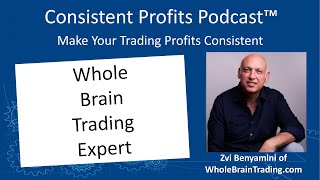
This is a YouTube video titled "Whole Brain Trading Expert - Zvi Benyamini – Episode 070" published in August 2024. It features a podcast-style interview hosted by Brian McAboy, who converses with Zvi Benyamini, a trading coach from Israel. The discussion centers on trading psychology, mindset, and systematic approaches to improve trading performance. Brian McAboy leads the conversation, exploring topics such as the psychological challenges traders face, the importance of competence and confidence, and how to overcome self-sabotage and internal conflicts to achieve consistent profits.
Hello and welcome to the Consistent Profits podcast brought to you by Inside out trading and Brian McAvoy. Where the focus is on consistency, because when you have the consistent part down, profits become easy.
Hello, everybody, and welcome to another episode of the Consistent Profits podcast brought to you by Inside out trading and Brian McAvoy. That would be me. Today. I'm really excited to be interviewing Zvi Benjamini from Israel. He is help. He focuses solely on helping traders with his business, whole brain trading. And we're gonna just go ahead and jump into it and I get it. I want to get to know you just a little bit. So how'd you get started with trading? What?
What?
I mean, of all the, like, thousands of things you could have, you know, gotten into, how do you wind up in the trading space?
Hi, Brian. Well, how did I wind up in the trading space? Probably about 20 years ago, I was in, I, I was in engineering management at the time. Ran across. The only thing I knew about money was probably putting money in CDs in the bank. Ran across trading almost by accident and investing and the whole thing, everything looked the same. Some guy came in on a lecture with, showing us charts. That's easy enough. I can do that, right?
Yep.
A few years later, I'm still convincing myself that I can do that. But, but, yeah, that was pretty much the start of it. It was pretty quick to realize that it's not as easy as it looks. So I had to really kind of learn how to do it. I was, yeah, it was pretty early on that I realized I want to do this seriously.
Oh, that's good.
Yeah.
I remember after the first, after my first serious technical analysis course, at the end of the course, I came up to the instructor. Back then, the instructors were physical courses in the classroom. I came up to the instructor and I'm like, okay, how do I turn this into something serious? Great course. But, but now what do I do as well? If you want to be serious, you got to learn this from somebody who actually knows what he's doing and, and, and, and got to really get into it. Oh, yeah, it's not going to happen if you're kind of, you know, okay, I learned a few things and I picked up from here and I picked up from there, and that's where it kind of started. It was, you know, serious seminars, the serious books, the serious teachers and, and mentoring and yeah, after a few years, and I was, I was doing okay, but, but, but I was working with a mentor at that time, and I was doing okay on the lessons. And, and every charity showed me I could read.
Yeah.
And every situation he gave me, I could trade reasonably well. With one problem. The account wasn't making any money. Other than that, everything was great. And, and I was okay. David, why am I not making any money? And he says, I don't know, you're doing everything right. Could it be psychological? But I can't help you with that.
Huh.
Which is where I started figuring out that, you know, there's more to this than reading the charts.
Oh yeah, true. Yeah. And it's funny you mentioned that you, you know, you're in engineering prior to trading. So many engineers get caught up in a trading and just like you said, it's like, you know, as in, I mean, because engineers generally are above average intelligence wise. You look at trading. Yeah, I get it. I can do that. It's like the, the, the trap of, of being above average intelligence is. Yeah. You look at just something like trading, say, sure, I can do that. It's like, no, you're underestimating the challenger, dude.
Yeah. Yeah. We tend to think that charts have anything to do with math and, and they really don't. Unlike any other chart we've ever seen before. And yeah, we bring a lot of habits from engineering that don't necessarily work now.
So what did you get started with trading? Were you trading stocks or futures or.
I was trading stocks.
Okay.
Mostly swing trading at the time.
Okay.
Swing traded for a few years. I tried to go full time, took a year off of, took a year off of work, try to go full time. Made the mistake that everybody does when they try going full time, which means I'm on the clock every minute I'm not trading, I'm wasting. And if I can trade forex in the morning, US stocks in the afternoon and, and, and I might as well be doing that. And I would start my day at 8am, finish it at 11:30, trade seven different systems simultaneously on seven different time frames and get caught in my own feet and fumble.
Oh yeah. Oh yeah.
I was literally losing on day trading everything that I was making on my swing trading account. But it was the same accounts. I didn't really notice. I felt break even.
Yeah.
But funny. And, and, and it took, it took a while. Plus a painful going back to work for another few years before I tried going full time again to really kind of, okay, this is what you need to be doing. You may learn other things on the side, but don't mix the money. Kind of. It's okay to risk a thousand dollars of trade on on your swing account. But please don't do that on your day trading because you don't know what you're doing.
Oh yeah.
Well now, so you touched on it already and of course we got it. We got to get here because I think we're on the same page with a couple of our perspectives on it. You said, you know, you did realize after a while it's more than just reading charts. There's a psychological aspect to it. So what's your perspective on. On. Because you know, the psychology of trading. Everybody loves throwing the term around.
Yeah.
But can mean very different things depending on who you're talking to. So when somebody says trading psychology, what does that mean to you?
I think most people look for trading psychology in the wrong place.
Okay, what do you mean by that?
They, they, they find themselves struggling with emotion and stress and, and fear and all of that in real time execution. And they focus and, and they think that's the psych, that's the key in psychology.
Yeah.
But it really isn't the key to trading psychology. And I, I can use an analogy from, from basketball. You know, if Steph Curry has to shoot the last shot of the game and he's open and he needs to focus. He has all the skill. He can do that a hundred times over. But now it's all down to psychology. Can you keep your focus? You've practiced every day for years, Zillions of times. All that's left is execution psychology. But if I were to have to shoot that shot, I'm not good enough. I don't know how to take it. My, my probabilities are terrible. And, and, and of course I'm going to be stressed because I'm not skilled enough. Why am I not skilled enough? Because I didn't get up in 6am every day to practice and shoot a thousand shots a day. So I didn't do the, my psychology didn't bring me to the point where I take it professionally enough and I'm skilled enough and I know exactly what I'm doing, that all that's left is execution. Trading psychology is more about trader mindset than about execution stress for most retail traders.
Okay. So, so again I gotta, I gotta hitch up on the words because they can be so subjective. Because I, I think I know what you're talking about when you, when you say mindset. But I know there are a lot of other people when you say mindset to them they got a different take on what mindset means. What do you think when you say mindset?
What do you mean mindset means I am approaching this professionally. I am putting in the work that I need to work. I'm working systematically. I want a system, I want to know its numbers. I want to know if it's wrong so I can stop doing it and do something else. I build the skill. I, I want a journal because I want to know what's going on. I want to be the very best that I can be. Not just theoretically, but I'm actually doing what needs to be done. Oh, it's just like a diet. I want to lose ten pounds. Yeah. But I also want to eat ice cream. So it's, it's not going to work together. What do you want more? And mindset is really about I wanting to do and actually doing the things that you need to do to become a good trader. And if you do that, execution becomes a lot easier.
Oh yeah.
Almost every time that I work with a trader and, and they have an execution problem. They have a problem with exits. They, they keep getting stressed. As soon as the straight starts moving. Okay, what's going to prompt you to exit? The answer is usually this and maybe that and maybe not that, but maybe not that and maybe, maybe if they had it.
Sometimes this.
Yeah, sometimes this. But something. Sometimes I kind of feel my way through outreach. Oh yeah, which of course you're stressed because you're now improvising under pressure, under fire, with real money on the line. Oh yeah, of course you're going to be stressed. That's normal. You're not supposed to fix that. You're supposed to be stressed. That stress is telling you you don't know what you're doing, man.
You know, it's funny, you've mentioned that a couple of times already. And I remember years ago and there's a very famous guy in the trading space, in the trading psychology space in particular, and, and he's got a lot of bestseller books and stuff out. Anyway, he and I got on the phone and it was pretty cool. I was, I was kind of just starting out and. But you know, I was going to ask him. It's like, so, you know, what's, what's your take on, you know, the whole thing, the whole bit. And he's like, well, you know, traders, you know, if they're struggling, they just, they've got these deep psychological issues. You know, deep rooted beliefs are usually subconscious and, you know, it might take a year or two to, you know, work through them all, flesh them all out. And I'm like, no, I totally disagree. And he's like, oh, no, this is. This is what it is. And I'm like, no, Most of the people I've talked to, they're. They're okay. They're not all screwed up. They just don't know what they're doing. And. And he's like, oh, no, no, no, that's not it. It's psychological. I'm like, no, because, you know, if. If most people, if you take them and you throw them into something, they don't know how to do it. And it takes skill. Yeah. They're gonna stress. It's going to be rough and it's going to be emotional, but if they know what they're doing, not a big deal. And it's like, oh, no, no. It's like, I know. It's funny because we got in this argument, neither of us would concede the other's point. I'm like, whatever, dude. We cut off the phone. And I'm like, yeah, okay. But no, I. I agree with you. Yeah. The psych. Most of the psychology comes from a state of competence and confidence.
Exactly. Exactly.
So, yeah, if. If you address that, you're addressing the cause, the stress and the emotions come from the lack of competence and confidence.
Exactly. Now, now it. It gets worse because there's so much talk about trading psychology that it's almost normalized, that it's okay. Everybody struggles with this, so it's okay that I'm struggling with it. There's no red flag here. Screaming, you don't know what you're doing, man.
Stop.
It's just stressed. You'll work your way through it. And then you see people posting questions like, okay, this. Some guy posting a post on a forum saying, okay, this is the first time I blew my accounts because everybody around him is blowing accounts. And I answer the guy and I said, no, this is the last time you ever go near to blowing an account. See the difference in how that makes you act differently now? Like, I was stressed because I wasn't sure where to exit. Okay. How do I become sure where to exit so I never need to stress out. Instead of taking all these things as signals to be proactive and figure it out so it doesn't ever happen again. It's just part of the game and it's normal. And everybody kind of. Yeah, yeah, you know, everybody struggle with this, and let's tell each other war stories on what stresses us out and how fearful we are about missing out.
Oh, yeah. Well, one of the biggest disservices people do is in the forums or on, you know, Podcasts or whatever. And they say, oh, no. Trading, it's going to be emotional and it's going to be stressful. That's just how it is. It's like, what a huge disservice. Because that's not true.
Yeah, yeah. If somebody would have told me, no, all this stress is because you don't know what you're doing. Fix your system. Go do more work, more systematic work on your system. Set your rules more clearly. Have a clear exit, have a clear entry. Have a clear rule for the exact timing. Do all of that instead. It was okay. Work through the psychology that sends you on a wild goose chase.
Oh, yeah, yeah.
Just learn how to control your emotions.
That's exactly. Control your emotions. You're human. We can't control them. Or even worse, trade without emotions.
Oh, yeah.
Like we're supposed to be a robot. Had a client once that. That was very. He would tilt like crazy and I would ask him, okay, what do you want? Instead of tilting like crazy? He said, I want to trade without emotion. I go like, really? You really want to spend your day without feeling anything? No, but that's what I'm supposed to. That's what everybody says. Which bring us to the. Which brings us to the next goose chase in trading psychology, which is copying other people's words of wisdom. The entire industry of trading mindsets is based on the idea that there is an absolute objective trading mindset that great traders possess. And if you copy them and you listen to their words of wisdom and you try to apply that, you're going to think like them, when in fact it's the other way around. The entire issue of trading psychology and trading mindset and trading stresses and everything is about you. Not about that north theoretical north star that somebody else drew for you, but how they feel it's about you. Where are you right now? Why are you stressed? Four people are going to be stressed when. When they try to enter a trade for four different reasons because they have four different gaps in their system. Or four different. Or. Or one of them's trading too big for his size and another one's trading too small for his size. Another one's trading an entry that he got off YouTube but he doesn't trust. Each one has a different reason and another one just got burned three times and second guesses his entire system. So it's really about kind of, okay, don't show me the summit and say, put some guru on the summit and say, okay, this is how I think. Look at that trader that's trying to climb right now is in the middle of the rock and he's not sure which hand to move next. And instead of teaching them theory, go and see where it. Where are you right now? What are you struggling with? What's running in your mind right now, which is different from anybody else. Okay, where's the next place to put the next hand now? Where's the next place to put your foot? Now? How do you climb from where you are? Trading psychology is about working on you, not about reading somebody else. Now reading somebody else. You can read all the trading books in the world and you're much more educated, but you're still stressed on all your traits because you didn't change anything in the way you're approaching it. You may want to, but you didn't.
Right.
For that, you need to kind of do something.
Yeah.
You got to do something. Yeah. You can't just consume information. That doesn't change.
Exactly. It's not about consuming information. It's about both personal work and system work. You got to do them both.
Yeah.
And, and if you do them, then you move forward, and if you don't do them, then you're educated. It's like learning more indicators and more systems and more. Now you learn more trading psychology. It's the same thing. You're not, you're not going to be a better trader.
True.
You just know more strategies.
Exactly. You know more strategies. Now I know more strategies about, about trading psychology too. That doesn't help me either. You need to master the one that you're actually trading.
Oh.
And you need to master the psychology and the mind and the thought patterns that run in your mind when you're actually trading and work on those.
Yeah. Yeah. Very cool.
Well, so, so you got into trading a while back. You said it was like 20 years ago. About how long ago did you start helping other traders?
A few years ago.
Okay.
I started a few years ago. At first it was, it was really, you know, the classic teaching and, and, and, or mentoring with, you know, I'll show you how to trade. And, and, and at some point I, I realized that the many people that have been trading for a while, they've been trading for a few years. They, they got the grasp on the basics, they got the grasp on system on, on, on a few trading methods. They know what they think they're supposed to be doing, but they're stuck. You know, we expect this kind of, this kind of progress and on trading on our trading chart. And actually we go like this and then we kind of get Stuck. And we think we're going to break through that. But that breakout can take years or happen never.
Oh yeah.
And, and, and, and that's the frustration that starts building up with traders that are traded 2, 3, 5, 7, 10 years and haven't made it. And they realize that the last thing they need is another teacher right now. What they do need is to figure out what's going on. Like why am I not making money is the question. Or why am I spiraling down and tilting or.
Well, yeah, well the question is what am I missing?
Exactly. What am I missing?
Because, yeah, and it's like, you know, because I'm sure you've done it where you're talking to somebody like you said, three, four, five years and they think they know pretty much all there is to know about trading and being a trader and they're not asking the right question. It's like I think I know all this stuff. What am I missing? Because I'm obviously missing something. I have all this knowledge but, but it's still not working. So what am I missing?
Usually if you run with a trader through a single trade, bar by bar, you know everything they don't know. Just, just for the questions that they start hesitating on and, and, and, and there's a lot of holes in, in, in the system usually. Also, also a lot of times there are mindset issues which are not about trading psychology. They're about the bigger picture of where trading fits in your life. You know, we all want to separate that trading psychology from our everyday life.
Right.
I'm going to be a very organized trader. Yeah. Where else in your life are you organized? Ah, nowhere. But I want my trading to be organized. It's not going to happen. If, if, if, if, if you're, if you're looking for that excitement, if you're looking for that rec, These are, that are real trading psychology issues that will mess everything up. Because if somebody's there for the excitement, they're going to do a lot of things and avoid doing a lot of things that they should be doing because it ruins the excitement.
Sure.
And that's, and until you pick up that, pick up on those self sabotaging situations and self sabotage is a lot more common than we think think everybody self sabotages a bunch of stuff in their lives, including trading. But, but it's not specific to trading and, and, and, and figuring out where I'm self sabotaging myself and figuring that out and stopping, doing, stopping that will all of a sudden allow them to do what you want them to do, which is get to work on your freaking system. But they couldn't until now. Yeah, because there was that inner conflict in them that wanted something else more. And as soon as you don't want that something else more, now I'm available to be open to set the rules and write them down and count the numbers and drop the setups that aren't working because I'm not there for the action anymore and I'm not there to show, show my parents that I did well or something came out of me or, or whatever.
You nailed a big one a second ago when you said identifying internal conflicts, that's huge because yeah, that, that can keep people on a self sabotage cycle forever. If they don't identify what their internal conflicts are, that conflict never goes away and it just stays there and keeps kicking at your feet. And yeah, that's huge. So it is now when, when you're working with traders. So what's, what's it like when somebody comes to work with you? Is that, I mean, is that kind of where you focus? Like I said, what's it like when somebody comes to work with you?
Well, usually they come in some level of despair and, and frustration and oh yeah, they've had about just about enough of this stuff.
There's close to quitting, right?
Not necessarily this close to quitting, but very usually after a very painful period or event that made them realize that they can't continue doing what they were doing and expect the same results.
There you go.
They need to do something else, but they don't know what.
Okay.
And first of all, it's really about identifying where their, where their real problems are. Are they system problems? And if so, there's usually a mindset issue. Why are you trading without a system not knowing what you're doing? Like I would not be on the NBA court because I'm not good enough and I would not try out for the NBA team because I'm not good enough. Why are you guys trading money without the rules? Ah, because I think I can do it because I trust my intelligence, because I want to have fun and I'm in a hurry to make money because I don't. If I don't make 100% the next three years, then my entire life is not going to go the way I want it for whatever reason. I don't have time to waste right now on this because I need to make money quickly for whatever reason. We need to, we need to figure that reason out. We need to put it out in the open. Many times, you know, people aren't even aware of those.
True.
There's, there's a lot of drivers that drive our actions. We're not even aware of.
Sure.
And then once they were aware of those, okay, let's look them in the eye, figure out the grown up solution to how we, we, we move forward.
All the context there.
Yeah, because, because, because, because, you know, really those are the conflicts. You know, it's, it, it's just like dieting. You want to lose 10 pounds, but you like ice cream. You want to lose 10 pounds, but if you lost 10 pounds, then all of a sudden, I don't know, I'd start exercising and you know, I don't want exercise really. So, so, so I'll just stay like this for whatever thing is holding you back. And most people have an idea, but it's usually the wrong idea of what's really holding them back. And only after you start digging, you find the real things. And once you remove those, you look them in the eye, you find the solution to both sides of the conflict that everything can move forward with. That's when people are able to move forward. You know, discipline is really about conflict. It's not about gritting it out. Discipline is a lot easier if you want to do what you need to do.
Oh yeah, true.
If, if you see how it serves your biggest purposes. If, however, you have different purposes, which it doesn't serve or it even conflicts with, discipline is going to be a tug of war against something that you're not even sure what you're tugging against, but you're not going to win. Yeah, you can't get up at 5am and go running unless you care enough to. I don't care what it costs me. I need to do this. And then you just do it. Then there's no discipline issue. It's just the normal decision for, for what's so important to you. I mean, David Goggins stories, you know, he wanted to be Navy seal.
Yeah.
He wanted to be a Navy SEAL so bad that he was willing to do whatever it needed to take.
Well, just, just to kind of balance things a little here. Because like you, I've had this conversation with a number of people. It doesn't have, it doesn't have to be that you have this overwhelming motivation. You just have to have enough to get you past the resistance. So even if you're not like crazy fired up. Yeah, I just gotta do it. As long as it's enough to get you to do it, that's good enough.
Yeah.
The point is the resistance. If the resistance is big.
Yeah.
You need a lot.
Yeah.
If the resistance is something that you're just not aware of and once you look it in the eye, you say that's kind of stupid. I mean, I accept that. That's what I'm thinking. But I don't want to, I don't want that to stop me. The resistance dissolves. And the moment the resistance dissolves, you need a lot less force to go through it.
True. Well.
And then once you actually get in motion, if you can get even a little bit of momentum, that's huge.
Yeah, it gets, it gets easier once you start moving.
Yeah.
You know, get a few days where your trades are all straight A's when you're all. Every trade was by the rules. Just, just get a few days where that's your only goal. Every trade was by my rules. Take two different trades that day, three trades that day. Every trade was by my rule. Do that for a week and the wheels start turning.
All right.
Make that your goal and just do that for a week. And then, you know, like you said, things start getting in motion. You start gaining momentum.
Oh, yeah.
But, but, but you need to start turning the wheels at some point.
Sure.
Well, so, so when coming some. Somebody comes to work with you, that's kind of your starting point is just find out what the problem is and getting, getting some momentum in the right direction.
Yeah, well, yeah, it starts with getting momentum, finding the problem, getting momentum in the right direction. Sometimes all they need is, is, is. Is really a point in the right direction and a few, and a few steps to get the wheels turning. Sometimes it's, it's, it's about a little deeper work because the conflict isn't obvious. It's there. But, but, but it's not obvious. And, and, and the person will usually, you know, self sabbath. Usually with self sabotages of all sorts, you're usually not aware of why you're self sabotaging.
Yeah.
And you got to figure that out.
True.
And there, and there's the tools to do that and the processes to do that. But, but it's. Then it's really about, you know, doing a little work and figuring out where that is and then removing that conflict and removing that resistance and then you're able to do. Back to square one. Okay, how do we get the world, the wheels turning in the right direction and start gaining momentum? And sometimes it's huge gaps or critical gaps in the system where it's normal to be stressed because you're not competent and once you notice that. Okay. Then homework goes in that direction.
Well, so one thing I noticed. Yeah. On your site, maybe I missed it.
But.
I mean you've got, you know, your process and we'll just go over real quick or if you want to explain these on your page on your webpage says, you know, process consists of four key steps. Trading review, mental exploration, solution design and market validation. And so is that like the general process that you use with most, most people?
Yeah, it's, it, it's a general process but it's, it's, it's, it looks very, very different on different traders.
Okay.
Because depending on what you find out when you start exploring, you're going to go in very different, down very different paths. More technical, more psychological, more action driven or more figuring out deeper what the problem is or going to do homework on your system. Some people it, it'll take around, some people it'll take five rounds.
Gotcha.
And, and, and, and how mixed are the things together? Because system and, and, and mindset are really, you know, related. It's not like they're two separate things.
Oh yeah.
They're pretty much one projective projection of the other. I mean I used to have that problem. I would, I would get off trades too early. I would wait for these huge setups and then take them at the first.
Pop.
Because I was unable to sit through a trend and sit through the now that mindset issue. How I would feel when I see trends going down and which, which was psychological view the way I view trends, the way I view drawdowns in my mind was projected into the system. I built a complete rationalization around that. I had very strict rules on how I get off of the first trade. I was following my rules. The walls were stupid because the rules were fear driven.
Oh yeah.
Rather than the good thing to do.
Yeah. Oh yeah.
And like you said, a lot of traders are really, really good at rationalizing.
Yeah, we rationalize discretion. What we really want is to avoid rules and have as much freedom to be more active. But we call it discretion.
Oh yeah.
And judgment. Rationalize fear of entry as, as, as, as waiting for that perfect setup and being very diligent on, on the entry rules. And we're creating rules that have no validity, but we create them because they make us feel better and avoid those things that are harder for us. And when you start seeing those connections and when you release one of those because those, those are huge barriers.
Oh yeah.
That one could have helped me at that, at that level forever.
Yeah.
Until I broke through that one. All of a sudden all my winners were two, three times bigger without changing probabilities or anything. Just my winners got three times bigger.
Oh yeah.
So when you release something like that or you, or you have a hard time adding because you're, you can't wrap your head around the idea that you might give back the profit that you already have. So you avoid adding, but you're, you're avoiding adding not because the math tells you it's bad, it's a bad idea. You're avoiding adding because your stomach tells you it's a bad idea and you're afraid. But once you learn how to do that and you work through the mental side of being okay with adding, you can now incorporate it into your system. Boom. Every good trade is twice as big.
Okay.
All of a sudden your numbers change without really doing anything just because you're, you removed that fear.
Okay.
So identifying the fears that are hidden inside your rules can be huge jumps in performance.
Oh yeah, indeed.
Well, that's pretty cool. So. And yeah, I noticed, yeah, the other thing I noticed it's kind of different about you is. Yeah, you know, you're, you seem pretty flexible in, in what you do. You said like, you know, some people, it's just others it's like five, maybe more. Yeah, you seem to be pretty flexible and able to, you know, adapt what you're doing to each person's situation.
That's pretty cool.
So now if, if anybody's curious and we're going to wrap this up here pretty soon, but if anybody's curious, you want to find out more about what these got going on, go to wholebraintrading.com that's, that's his website and that's where you can find out about, you know, more about him and how he works and his process and you can even go ahead and book a one on one call with him, a 15 minute little discovery call, you know, so you can find out, you know, you can find out about him, he can find out about you. Make sure it'd be a good fit to work together. But whole brain trading and you've had this site up for a while. It's a good looking site. You present things well. It's nice and clear and concise that you're in Israel. So what, what, what time zone are you in?
I'm about, this is seven hours ahead of Eastern time.
Okay. Okay.
But I have worked with people from, from California to Australia and, and in the middle. And in the middle. So, so yeah, that we can always get Around.
Cool. Cool.
Well, this has been really, really a good conversation and worthwhile and function. You got any final words of wisdom for, for our listeners today?
Final words of wisdom. This always takes me back to okay, why do they need my words of wisdom? Just, just look at yourself and, and, and really see what the real problem is. Because it usually is something different than what you would like it to be because that's as easiest. Okay, most people know what the big problem is. Just ask yourself on that behavior.
What.
Am I gaining from this? Or what does this help me avoid? That I really don't want to do and I really don't want to accept and I really don't want to admit. Yeah, if you just ask these two questions and do that honestly enough, even ask, you know, have somebody ask you that question that you trust and then you have to really have to answer them, then you're gonna find out that there are things that you need to do that you're not doing right now and it's going to become obvious to you that you need to do them and then you just need to do them because it's not gonna, these things do not fix themselves. That's the important thing. Traders will get stuck for years, many years in the same cycle, making the same mistake patterns over and over and over again with a new system and the new system and the new system.
True, true.
If you see that you have a trading mistake, mistake pattern, it is not going to go away until you look it in the eye and decide what do I need to change so this mistake never happens again, not even once?
Well, yeah, I mean you're touching on something that I love to, to preach and that is if you've been stuck for a while, you got to understand that you are your own limitation. And so you need to get some outside perspective because you don't know what you don't know. You can't see what you can't see. And so being able to hop on a call with somebody like you, that can be that outside perspective that says, yeah, hey, this is what you've been not seeing. And so now we can, we can now we see it, now we can address it. And that can be massively helpful. So yeah, for everybody listening, like I said, you know, if what we're talking about today and what Z is talking about, if it resonates with you, swing by his site and you know, go and book a call with him, I think it would be absolutely worth your while. And the main thing is don't stay stuck. That's the main thing. Act, act on what you find it out today. Don't just say, yeah, that was, you know, that was fun and it was interesting and then keep doing the same thing. If you want your trading to be better, do something about it.
Yeah.
So. So V, thank you again for taking the time today and you know, I really appreciate been a real fun conversation. Hopefully it's, you know, been worthwhile for everybody and all the listeners, you know, applaud you for taking time out of your day to, you know, focus on yourself, learn how to, you know, be a better trader and develop and not just chase more indicators and strategies. So yeah, sweet. Thanks again.
Thanks for the invite.
Oh yeah, yeah. Been great Chad. Love to have you on again sometime. And everybody make sure you know, if you like this share with your friends, subscribe to the channel or the podcast. We'll see on the next episode of the Consistent Profits podcast.
Cheers. Bye Bye.
Thank you for joining us today on the Consistent Profits podcast brought to you by Inside Out Trading. Make sure to swing by InsideOutTrading.com and pick up your free copy of break the cycle 10 things you can do to stop reinforcing the past and get your trading on the right track. If you enjoyed the show, make sure to subscribe on your favorite channel and we'll see you on the next episode.
Cheers.









