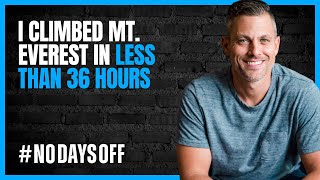
Brian Gubernick climbed 29,029 feet in 24 hours at the 29029 endurance event with his wife and friends. He learned that consistent effort beats talent, showing up matters more than being the fastest, and valleys make peaks sweeter. His decision test: how will you feel about this tomorrow?
Chapters
Thank you for joining me today. It's Brian Gubernick, and welcome to the No Days Off podcast, where we believe that every single day brings a new opportunity to get better. Today is a very special day. It is our 100th episode. So thank you all who have been with me from the start of this podcast journey. I so appreciate the support, the listens, the shares, the feedback I've been getting on the phone or via text. I really, really appreciate it. Thank you for being part of the movement. I believe in this so much, and I, and I hope that we're making differences in our listeners' lives. So thank you very much. 100th episode. So here we go today. I want to talk about a recent experience I just had at an event called 29029, which is put on by a friend of mine, Colin O'Brady, a guy I've become closer with over the past year. His partner, Jesse Itzler, both of these guys will be appearing at Built How, a big event that we have coming up in September. You want to check it out, builthow.com. But just at their 29029 event, And what is that event? You've got to scale a mountain, walk up a mountain, hike a mountain to the equivalent of 29,029 feet, which is the height of the elevation of Mount Everest. So my event was at Snow Basin. They're held at different mountains around the nation, ski towns or ski resorts. And everyone's a little bit different, but everybody is climbing at least 29,000 feet. So I had to trek up Snow Basin 13 times, and you've got to complete that within a 36-hour timeframe. So you have 36 hours to climb 29,029 feet. My wife Ellie joined me, as did my friends Eric and Julie and Jay, and we all completed the journey. We all completed the event. And that's the, that's the game. That's what you're trying to do. Just complete it. It's not a race per se. Well, while I may have raced it a little bit, It's not a race. Everybody wins if you get it done. There was about a 52% completion rate. So of the 300 or so people that showed, 150 made it. But the other 150 that did not make it, they had a heck of a journey themselves, and I'm sure they learned a ton. What I want to share though are the things that I had— I guess I learned on the mountain, or the things that I was thinking about while hiking. So for me, I went 24 hours straight. Objective being get it done, uh, I guess as quickly as possible, but I wanted to go wire to wire. So I started at 6:00 AM. I finished the next day at 6:00 AM. Here were the things that were on my mind. First, this was not a speed event. This was not necessarily a time of a talent event. What it was though, was time on task, one foot in front of the other, over and over and over again. And I know many of us have heard that time on task trumps talent. And I'll tell you, for me, my experience, I did finish this event. I was the second person to complete it, which, you know, I was not nearly the fastest moving. And again, it wasn't a race. So I definitely could have been beaten by others if in fact they wanted to do the same thing that I did, which was never stop. See, most people went to sleep for 2, 3, 4, 5 hours and rested up and then completed on day 2. I just kept going. And it doesn't make me special, but I'm just saying what it demonstrated was that my ability to stay on task trumped those that were technically superior to me in terms of speed and ability to hike. So my time on task paid off, and that was on my mind. It was very interesting to kind of see that play out in, in a physical event. Like this in business, in relationships, in health. Time on task, being consistent, one foot in front of the other, is going to trump inconsistent talent every day of the week. The next thing for me, no matter what shape you're in physically, mentally, you just got to do the work. See, I saw everybody out there competing, and I saw many people tap out that probably could have kept going, should have kept going. I saw other people that I never thought could make it actually finish the event, maybe at the 36th hour, but they finished it. And at the end of the day, all you had to do was show up and do the work. Yes, you've got to get through the pain. Yes, you got to get through the mental lows because everybody went through them. But you gotta do the work. You just gotta do the work. There's no substitute for just doing the work. Next thing that came to mind for me, Colin O'Brady. I talked about him many episodes back. I talked about the limitless, uh, the possible, the possible mindset, he calls it limitless mindset. And what Colin talks around, he talks around lots of different cool things, but one thing he always says is in order to have tens, you got to have some ones. Meaning that in order to have the highest highs, sometimes you got to go through the lowest of lows. And I'll tell you, for me, going through that night, I was incredibly nauseous. I didn't feel great. My mind was not always in the perfect spot. And I had a lot of ones, a lot of low lows. But I'll tell you what, when I completed at 6 AM the next day, 5:53 AM exactly, I had an amazingly high 10, and I know that 10 existed because of the 1s. So in life, in business, sometimes you got to go through those, through those valleys to get to those peaks. And I'll tell you what, when you get to the mountaintop, physically and mentally, it is a lot sweeter when you've had a few different challenges, trials, tribulations throughout that journey. The last thing that I took away from the mountain that was on my mind, I was oftentimes asking myself with different decisions I had to make, especially do I want to stay out all night or do I, do I want, do I want to, uh, do I want to turn in? I kept asking myself, how will I feel about this tomorrow? Whatever decision I make, how am I going to feel about this tomorrow? Meaning, will I be happy with this decision tomorrow when the emotion is settled, when I physically settle down, or would I— will I be disappointed in myself? Will I have regret? And I'll tell you, for me, with respect to pushing through the night, when I asked myself, you know, because I thought a couple times, maybe I should just rest, maybe I should just, you know, it's okay, right? Like, I'm still gonna have a great experience. And I kept asking myself, well, if I do that, how am I gonna feel about my decision tomorrow? And the answer was not great. I'm not going to feel good about it. I'm going to be disappointed. My goal was to go all night. And so I kept going. So I think a lot of decisions in life and business and relationships, I think a lot of times if we slow down and think, gosh, how am I going to feel about this tomorrow or next week or next month? Am I going to be happy about this decision or am I going to be regretting this decision? I think it could serve as a really, really good guide. So that's all I have for you guys today. I think a lot of things to think around there. How do those, how do those concepts apply to your life? How does, how does, uh, thinking about how you're going to feel about this tomorrow, how does time on task, how does having ones in order to get to tens and just doing the work, how does that apply in your world? That would be the focusing question for me. Where could I apply this? But thank you all for joining me on the 100th episode. That's the end of it. That's all I have. Remember, every single day brings a new opportunity to get better. So let's get after it.