
Ep 336 | The 3 Keys to Building a Successful Partnership
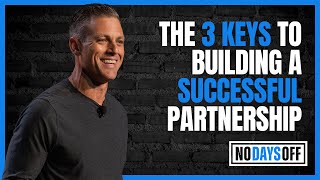
Brian Gubernick shares three keys to successful partnerships: transparent financial and goal alignment, crystal-clear expectations and roles with performance metrics, and structured scheduled communication. He shows how these principles apply to business deals, marriages, and friendships alike.
Chapters
Thank you for joining me today. It's Brian Gubernick, and welcome to the No Days Off podcast, where we believe that every single day brings a new opportunity to get better. Today I want to talk a little bit about partnerships. Specifically, I want to chat around the 3 keys to building a successful partnership. Here's the reality. We all are engaged in some form of partnership in business or in personal. Partnerships are just a, a part of life, right? Like, if you do this, play this life game long enough and this business game long enough, odds are you will find yourself engaged in some sort of partnership. And there are ways to really screw up that partnership, and there are ways to thrive. I want to talk about the 3 keys that I believe exist based on my own personal experience. And I wanna tell a story about how I learned these 3 keys and how they've been applied. So about, I don't know, probably 11, 12 years ago, there was an individual in my world, someone that had become a very close business friend, and we had concluded it's time to get into a business partnership. It just made sense for the both of us, at least we believed it to be. Making sense. And so we both shared the same mentor at the time, and I think I was sharing with my mentor, hey, so-and-so and I are going to get in partnership, and he says, hey, before you do that, I want to meet with you guys. And I said, cool, that'd be great. So not too long after that, we fly out to Austin and we meet with this individual, and he sits us both down and he says to us, gentlemen, I want you to both log into your computers and I want you to pull up your respective net worth statements. You know what you're worth, your assets, your liabilities. I want you to pull it up. So we both open our computers, we both pull up our net worth statements, and he said, great, now I want you to exchange computers. And we both looked at him like, you know, was he crazy? He said, no, I want you— you're both going to exchange. Oh, and by the way, here's my net worth statement just so I'm playing the game too. And sure enough, you know, we begrudgingly both handed off our computers to one another and spent the next 5 or 10 minutes really analyzing or reviewing each other's net worth statements. And it was incredibly awkward and uncomfortable, but it was enlightening. And it was very interesting because our mentor then said, this is great, because key number one to any great partnership is going to be building that partnership from a very clear, transparent, foundational understanding of one another. In other words, what you have, Brian, and what you have, you know, Partner B, you know, that what you guys are having and maintaining and wanting to build, lack of understanding where one another is coming from is actually jeopardizing your ability to start your partnership off on the right foot. What I want you both to do is take the hardest thing off the table, which is your money, and I want you to financially undress and get that awkwardness out of the way. And now we can have a real conversation around what a partnership looks like. So key number 1, my takeaway: you don't all have to exchange your net worth statements, but we've got to have a foundational understanding or knowledge as to where one another's stands beyond just your business interests. In other words, what's driving you? What's driving you financially? What got you here, you know, from, from where you started to where you are now? Where do you want to go next? What does money mean to you? What is life? What do you want to achieve in life? Who's important to you? Bottom line, what I'm trying to get at is we focus solely on business interests sometimes, and we don't understand what is personally motivating a person. And therefore, we're negotiating a partnership or even operating in a partnership without an understanding of the whole person. Yet we want to have a, you know, arguably the most important relationship, that partner who has the greatest impact on our financial future. We're letting that person hold the reins to something so damn important, but we're not even— we don't even know them all that well. So key number 1 to building a successful partnership start that partnership off with an incredibly firm understanding, a transparent understanding around not just their business interests, but what impacts them or influences them personally, intrinsically. What are their long-term, what's their long-term goals and vision? After this exercise, our mentor then says to us, great, now I wanna have a conversation around what I would say is The second key to building a successful partnership: expectations. We're going to get very clear around, Brian, what you expect of your partner in terms of his role and his responsibilities and his performance. And Brian, what should be expected of you in terms of your role and responsibilities and performance? See, in a lot of partnerships Resentment brews, and sometimes that resentment kills the entire partnership. And why does resentment come up, come about? It's because of a misunderstanding between what I thought you were going to do, what I thought my partner was going to do, and what my partner actually did or didn't do. In other words, there's a disconnect between what I thought was going to happen and what they thought should happen. So, let's address that head-on right now. Let's get really clear around expectations, roles, responsibilities for one another. Spell it out, attach numbers to it, metrics to it, make the measurement rather objective versus subjective, meaning that you either won or lost based on the— based on an actual number that we're measuring, and it's not based on a feeling, a subjective analysis. Furthermore, one partner is always going to be outperforming the other. No two partners are going to be contributing equally at all times. Knowing that that in fact is going to occur, let's discuss, let's describe exactly what's going to happen when one person's doing more than the other. See, again, resentment comes about when that happens. So knowing that that's going to happen because it's just natural, let's take it off the table right now by discussing what we're going to do when it occurs. So key number 2 to building a successful partnership is getting super clear around expectations for one another, as well as what is to occur when one of us is doing more than the other based on objective measurement, because it's going to happen. Any great partnership, even Charlie and Warren, had times where one of those partners was doing a lot more than the other. And sure, there's tremendous respect between those partners. Uh, there is an understanding that, you know, both are gonna ultimately, over the course of time, honor their end of the bargain. But there were times, I'm sure, when Charlie felt like he was doing a little bit more, or Warren felt like he was doing a little bit more. And my guess is that those two individuals, you know, reconciled that in one way or another. I mean, I don't know the specifics, but Warren is worth a considerable amount more than Charlie. You know, Warren's interest in Berkshire Hathaway was more. So, I mean, there was, there was different motivation. There was different motivation for that, but I'm just calling it out. After we discussed expectations, our mentor then moved to the third key. He said, key number 3 to building a successful partnership is communication. Now that goes without saying. But he went even further. He said, here's what I mean by communication. How are we going to talk to one another? What is our language? What is our cadence? What's the frequency of our conversation? What's the structure? What's the agenda? Bottom line, communication has to be scheduled, coordinated, defined. And oftentimes a lot of partners, it's rather haphazard. It's anything but defined. So our mentor had said key number 3 is to get super clear, very clear around how we're going to communicate, when we're going to communicate, what great communication looks like, and then we're going to anchor to committing to it. We're going to marry ourselves to this communication schedule. So the 3 keys, to restate them, number 1, start from an equal playing field and understanding, a clear transparent understanding as to what not— not just what motivates us business-wise, but what's motivating us beyond that. Let me know. I want to know the skeletons in your closet. I want you to know the skeletons in mine. If we're going to be married in business, let's address that. Number 2, let's get super clear around expectations for one another, and let's make certain that we understand what happens when one person is doing a little bit more than the other. And then number 3, let's get clear around how we're going to communicate. The language we're going to use, the timing, the cadence, the frequency of those meetings. Are they— are you calling me every night? Am I texting you every morning? Are we meeting every Monday? It doesn't really matter to me as long as it's defined and we honor it. Now, the interesting thing about these 3 keys, I'm talking about it from a business perspective today, but as you can imagine, I'm sure many of you already went here with this, This very much applies in your personal world as well. Think about your, your personal relationships. Let's say your significant other, your spouse. Number one, before you guys got into a deeper relationship, you probably had to have a much clearer understanding beyond just that first or second date type of knowledge. You wanted to know what motivated them, what drove them. If they wanted a family, it was how many kids, why do you want that kind of family, how do you want to raise the kids, You know, there's so many types of conversations to be had. So we've got to start off from the same, you know, from, from the same foundation and have a transparent, clear understanding of one another before we could build even further. Next, we've got to have expectations. I want you to know what you could expect of me as your spouse or your significant other, and I want to know what I can expect of you. Now, you may not speak about it in a, as in, as an objective a manner as I'm describing right now. But it goes without saying that when your relationship is really flying high, odds are you guys are pretty closely aligned with respect to expectations for one another. And the opposite of that is likely happening if your relationship is not really, you know, doing all that well. Lastly, communication. I don't think I have to go too deep into this as it pertains to significant others, but clear communication, how we're going to communicate, the cadence in which we do it, the manner in which we do it, the timing, all of these things. When you're, when you're nailing that, when you're knocking that out of the park, odds are you're having a really great relationship. And when you're missing the mark in terms of communication, frankly, when you're not communicating at all, I think we all could probably guess how that might feel, or maybe even living it right now. So if you want to change the trajectory of any relationship, any partnership, business or personal, I want you to look at these 3 variables. Did we start off from the same, from a, from a sound foundation? Do we have expectations for one another and are we clear? Can we describe them perfectly in the same manner? And lastly, are we communicating at a high level? The focusing question for you today, look at your partnerships or your future partnerships. How does this, how do these 3 keys apply? Where have you seen that you've had a lot of success in these 3 variables in the past? And where have you seen opportunity for improvement? I think we could all get better every single day. I mean, that's what the No Days Off movement's all about. So today, let's get better at our partnerships. That's all I have for you today. The No Days Off podcast. Thank you so much for listening. And remember, every single day brings a new opportunity to get better. So let's get after it.
More from Brian











Ep 755 | Mack Newton's Words of Wisdom - "You Are Only as Big as Your Self-Concept" (REPLAY)