
Ep 338 | A Conversation with Matthew Dicks
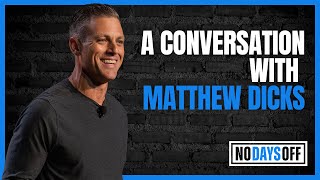
Matthew Dicks went from elementary teacher and wedding DJ to a 30-time storytelling champion. He records one story-worthy moment daily through
Chapters
What's going on? It's Brian Gubernick with the No Days Off Podcast. Thank you so much for joining us. Today we are actually going to be doing something a little bit different than we historically do. As you know, if you're part of the No Days Off Nation, you've been listening to 300+ episodes with us, you know that I normally run episodes, call it 5 to 12 minutes in length. We do a deep dive on a— I guess it's not too deep a dive, but we dive into one topic and that's what we talk about. Well, we're gonna do something a little bit different. Uh, periodically I'm gonna run a longer form interview with someone that I think we could all learn something from. So I'm going to run the interview and then the days after that we'll do it, we'll do a deeper dive into maybe certain things that were said by the individual I was interviewing. So we're gonna run with this format. We'll see how it goes. I think it'll be really well received. And I'll tell you what, I've got someone here today that, uh, I think he's got a few words of wisdom to share with our audience. Matthew Dix, I'd like to welcome you to the No Days Off podcast.
It is my pleasure to be here. Thank you.
So Matthew, uh, if you wouldn't mind I'll tell everyone how we met, but I'd like you to start off by telling us a little bit about who you are, where you're from, what you're up to, why we have the opportunity to speak today.
That's a tricky question. Well, I'm in Connecticut. That's an easy one. I'm from Massachusetts, migrated to Connecticut to chase a girl. She did not become my wife, but I managed to find my wife in the wilds of Connecticut. During the day, during the school year at least, I'm an elementary school teacher. For the last 25 years, I've been teaching little kids how to read, write, and do math. So that's often what I think of as my primary job because it's actually a place I have to be on certain days at certain times. When I'm not teaching, I'm an author. I've published 6 novels and now 3 books of nonfiction. So I do a great deal of writing. I'm also a storyteller. I perform on stages around the world. I do stand-up comedy. I deliver speeches and graduation addresses and convocations and all these kinds of things as well. And then weirdly through that process, I became a teacher of what was initially just storytelling, teaching people how to tell stories. And then the business world found me and I pushed back at first and said, "No, I don't do that. I just teach people how to tell stories." But nowadays I work with Fortune 100 companies and Olympic athletes and the FBI, the clergy, nonprofits, teaching strategy and branding and marketing and advertising and sales, all of the things that it turns out storytelling actually can apply to all of these things in a way that I didn't understand a decade ago when I started working with companies, but now I understand that something as simple as looking at a the strategy for a slide deck, storytelling either is going to be applied to that and it's going to come out as something engaging and interesting or it's not going to be applied and it's just going to look like everything else. So I've discovered whatever you're doing, I can help you with storytelling just about.
Well, that's kind of how we came to meet in that just a couple weeks ago, I'm running alongside my partner Ben the Metrics Masterminds that if you've been listening to No Days Off, you've probably heard about before. And, uh, Ben and I months prior had been discussing like, you know, what do our people need to learn? You know, what, what could they benefit from? And, and, and Ben had said we all need to become better storytellers. We need to better tell our personal story, the story of our business. We, you know, most of the people we're working with are these hard-charging entrepreneurs, many in sales businesses, we need to better explain or better tell a variety of stories. We use them all throughout. And, and so we went on this, this journey to find the best storytellers out there. And, and Matt, I came across your Storyworthy book, and it's called Storyworthy. If you're listening, this is a good one to buy. Uh, I read this book and I'm like The Metrics people got to read this. They're going to love it. They're going to love this book. I think you absolutely crushed it with this book. And I'm going to read some of your other books, but this Storyworthy book, which is about how to tell stories, was a game changer. And so you flew out and you spent a couple hours, a couple hours with my people. And we were so appreciative of all that we learned from you with your book Storyworthy, but with your presentation, it's awesome.
Thank you. It was a, it was a great time. And I really enjoyed your folks. They were a lively bunch.
So, yes, they most certainly are. So let me ask you, let's just start there. Storytelling, like, this is a loaded question. But how does, how does one become, I don't want to say become a storyteller, but for you, this journey, like, how did it become one built around storytelling to where not only are you just a good storyteller around your friends and family, but you go on to win, I don't know, 30-plus storytelling championships. And now it's morphed into this massive career around helping big companies understand. How does that happen? How does one get into that particular space?
Well, you know, it happened really by accident. I mean, I was writing first, you know, writing novels initially and lots of other sort of magazine articles and things like that. And my friends, they heard about this organization, The Moth, you know, live storytelling on stages in New York City at the time, and I live about 2 hours away. And they told me, go tell stories in New York, go to The Moth and compete against those other storytellers. They said, you've had the worst life of anyone we know, you'll have great stories to tell, which is not a nice thing to say to your friend. And my life has been pretty fantastic, so I don't know what the hell they're talking about. But, you know, I planned on going to New York and tell one story on one stage and then I'd check that box off and move on with my life. I got there and I eventually got on that stage and told my story and I won that first StorySlam. But the moment I was standing on that stage and telling people something about my life, and I've always known that the stories that I should be telling are the ones that are sort of my moments of embarrassment, shame, and failure. Those are the ones that people tend to be drawn to. So I was telling one of those stories that night. I just knew the moment I began speaking into that microphone, I'd found a place that I belonged. I used to tell people I got lucky. I stumbled upon something in my mid-30s that I was uncommonly good at just by luck. Then one day my wife heard me say that and she said, "Is that really what you think? You were just born as a storyteller?" I said, "Well, I don't know. I didn't get any training." She said, like, basically, you're an idiot. She said, first of all, you've been teaching for like 2 decades. You have the worst audience in the world, which is 10-year-old kids sitting in front of you every day. And she knows how I teach, which is basically I just tell the kids stories to get them to listen to me, and while they're listening to me, I trick them into learning long division. So I've been telling stories to kids forever. And then she said, you're also a wedding DJ. So for about 25 years, I was DJing weddings. She said, you stand in front of 200 people every Saturday, speak extemporaneously They're all like basically half drunk and you figure out a way to like hold their attention and get them to do what you want to do. And then she said, you've been, you've been writing and reading all your life. You know, she reminded me that like when I was 10, I was writing to Spielberg to complain about a scene in the movie E.T. and how it was flawed and how it sort of like broke the movie a little bit. She's like, when you were 10, you were analyzing movies. And when you were 17, you started writing. And I have not missed a day of writing since I was 17 years old. She said, "You don't think all of that sort of came together that night at the Moth when you won that slam? You don't think you've been sort of like unknowingly in training for all that time?" And I thought, "Oh, I think she might be right." So yeah, I think she's probably right, but I didn't recognize it at the time. It's one of those things where you're sort of getting ready for a moment in your life that you don't realize is coming. And I got lucky.
This is so good because when you visited us a couple of weeks ago, you were just giving a presentation around tactical storytelling. Storytelling, I didn't get to ask you these questions. So I'm so glad to hear, uh, your answers and what we're about to cover. Because one thing, one thing on my mind, and you kind of touched on it, I wanted to know, were you, were you always like this? Were you a natural storyteller? Did you have this gift of gab? Did you, did you find yourself, you know, at a party or at the dinner table and kind of the mic was in your hand? Not, not the literal mic, but, but Were you that guy? Was that always you?
I was, and it was mostly though because I grew up in a— I grew up in a home where like everyone was sort of a private contractor. You know, my parents were sort of like in their separate corners, and we would occasionally come together in the middle of the house for meals and then disperse. You know, no one ever looked at my report card. I got kicked out when I was 17, and you know, I've been on my own ever since. And so I didn't have a lot of adult attention growing up. And what I wanted desperately was attention as a kid. And I discovered the way to get attention was to tell stories. And I quickly realized the stories that would actually get people to listen to me were the stories about the time I messed something up, the time I screwed up, the time I did something stupid. And so that came— that combined with comedy too. So I instantly— or not instantly, but I eventually discovered that if I'm funny and I tell stories, I can get people to look at me, because right now no one is paying any attention to me whatsoever. I think it was simply out of an act of desperation as a kid to get people to pay attention to me that I started telling stories. I think everyone thinks they're a good listener, and I think almost no one is a good listener. I think one of the things I did early on was I really started paying attention in a strategic way to how language worked. So that if I heard someone make someone else laugh, I remember as a kid I would say to myself, "What did they do?" And I would track it back and say, "Oh, they started by saying this and then they flipped it and that's what made everyone laugh. So can I flip things like that too?" When I was a kid and I was watching Saturday Night Live, I would ask myself, "What made that skit funny?" And I remember there was a night when I went, "Oh, exaggeration is funny. All they did was exaggerate something that already exists in the world. They just made it bigger and louder and that was funny." funny. Can I exaggerate things in my life to make it bigger and funnier? And so by paying attention to the stories that had impact on people and paying attention to the way humor worked, I was able to sort of figure out how to do things that other people weren't as good at, probably because they didn't need to be, because their parents were at their baseball games and they were at their track meets and they were at their band competitions. So they weren't like desperate like I was.
Man, I am fascinated by— because you kind of mentioned this in the book too, you learned a lot of stuff when you were a younger guy, like, like as a younger kid, like you were very— I don't know if it was intuitive or you observed. There are just some things like the way you describe it now and the way you described it in the book. I remember thinking to myself, man, I wasn't thinking about, you know, the things that Matthew's describing here. I wasn't thinking about it. If here's what makes a funny story or here. And it sounds like maybe that was just out of necessity. Given the environment that you were in.
Yeah, I, I think if I plopped you on a desert island all by yourself, you'd learn how to fish eventually, right? If you have to find a way to kill a fish in order to survive, in a year you're going to be like one of the best fishermen that ever existed on the planet, just out of necessity, you know. And so I think there's probably a lot of ways I could have gotten attention. I, I could have robbed the liquor store and that would have gotten me attention. I could have started setting fires in my school, that would have been effective as well. For whatever reason, I decided to use language in order to get the attention that I wanted, which is fortunate for me. I didn't sort of stray down one of those other paths. But yeah, I think it was out of necessity that I started to figure out what people were doing and really paying attention in a way that I just think, if you don't need to pay attention, you probably are not paying attention. Hmm.
So this is gonna take a bit of a turn, but I can't help but ask, right? Like, you're a parent now. You want to build, you know, your kids in a certain way, resilience, you know, you want them to be resilient, you want them to learn like you did, or maybe like, maybe not like you did. So how does this apply now to, to how you parent, right? Like, your kids, I think, I'm fairly certain, are being brought up in a different way than you were brought up, yet you still want them to learn the things maybe you've learned, or in, in some way. So how is this, how has this impacted your parenting? How can I as a parent make sure that my kids are given this opportunity without, you know, my word, not yours, but neglecting or not paying attention to them.
Right. It is the lifelong struggle I have. You know, when I was 22, I was robbed at gunpoint, and a gun was put to my head and the trigger was pulled several times. And it resulted in a lifetime probably now of PTSD. It was, it was debilitating and awful and torturous and It was terrible, and I wouldn't wish it upon another human being ever in the world, and yet I would never take it away from my life because at the age of 23, everything changed in my life. I have been, in the words of my wife, relentless ever since that moment because of what happened to me, because I really believed I was going to die. I find myself all the time thinking, I want my kids to have that sense that time is precious and that relentless feeling of— We must do the things we love as often as possible, but I don't want someone putting a gun to their head and pulling the trigger on them. So it's a real struggle as a parent. I, I think the thing that I do consciously, and my wife does it too, is we just try to make the world, um, as sort of as difficult as, as can be appropriate, let's say. We try to provide friction for them. So When my son went through a Little League season of losing all 17 games, 0-17, I actually was really excited and happy because I think he learned more from that season than the season that he made it to the championship game. He learned how to lose and I watched him go from, "It's painful to lose," to, "I'm sick of losing and I'm not going to lose anymore," to, "Oh my God, this is just hilarious how much we're losing." We're just gonna have to like enjoy this in any way we possibly can. And he came out of that season just stronger as a result. You know, I have a 15-year-old and a 12-year-old. Neither one owns a phone. My daughter says she's the only one in high school who doesn't own a phone. That is a way of me creating friction in her life, which means I'm not going to afford you the luxury that all those other teenagers have, but I'm gonna make sure that you feel loved and supported, and I'm gonna help you in other ways. You know, my son just went to Washington, D.C. with the Scouts, 5 days in D.C., and they asked for chaperones, and I could have chaperoned, and I told my wife, I want to chaperone, I want to take that trip with him, but I'm not gonna because if I go with him, it's going to be too easy for him. I want him to go with the Scoutmasters who he doesn't know very well but who I trust and love and think are wonderful men. I want him to like have to go far away from the family and not be able to get in touch with us and learn what that is like. So I deprived myself the opportunity, understanding it's going to make it more difficult for him, but knowing that in the long run he's going to grow. So I'm constantly looking for sort of those opportunities so they don't feel neglected, you know, and they don't feel like they're not being taken care of, but that they understand that we're not going to make it easy either. We're not sort of like clearing all paths. I want them to have to like clear some brush on their own. So I'm trying to do that as much as I can, but it is a eternal struggle for me.
It is a struggle. I, I, I, I love though, um, a lot— I like a lot about you, but one thing I love about you is, is the way you're parenting. You know, side note, like, you and I were supposed to have a call before the Metrix event. You may remember you had to, you had to cancel it and reschedule because your son had a baseball game. And I loved that because I'm like, you know, here he is, he's got this call with someone he's run— who's running an event And without hesitation, you're like, listen, I'm not missing my son's game, which made me love you even more. Then at our event that like the day of our event was also the day after the release of your newest book. And I think, and I may butcher this story, but you had some things coming up for that book release that I was talking to you about how you rescheduled them because, well, your son had another, had the championship game or it had got rained out and moved. So while you're creating friction, I also know you're an incredibly loving father and husband. So I just, I just want to make sure we recognize that. It's very cool.
Yes, I, I'm, I'm on the sidelines all the time cheering them on. But, you know, when my son gets hit by a pitch, I'm not running onto the field to make sure he's okay. Like, there's a coach there, there's an umpire there. I'm sitting back here. I'm sure he's fine. And if he's not, they're gonna let me know, you know. So I'm just trying to let them be in the world in a way that they sort of learn some independence. And they understand that like, there's a, there's a, there's a safety net that you can fall into, but you got to fall a ways before the net's gonna catch you. You know, I'm not like right over your ass. I am well below. I'm gonna let you fall a long way before I catch you.
So I want to go back to something you had mentioned, right? Because I think in becoming a great storyteller, one of the things you've got to, you've got to be able to do is become a great listener as well. And you mentioned listening. I want to ask you, as someone that, that, you know, really is, is the top of storytelling, you mentioned listening. How do I become a great listener? Maybe what makes for a great listener, and what action steps can I take to be better at, say, active listening?
Right. So I'm gonna take away the word active listening because I can't actually find a definition for that that makes any sense to me.
Okay, fair enough.
As far as I can tell, active listening means there's nothing inside your ears while someone is talking to you, right?
Okay, sounds good.
So the word I use is strategic listening, which is to say when someone is telling me something, I'm listening to what they're saying, meaning I'm focused I'm looking at them and I am listening to them. But at the same time, I am constantly asking myself, what are they really saying? What are they actually trying to tell me? And how can I respond to them in a way that allows them to know they're being heard? I think when we strategically listen, we're trying to figure out what is the understory, sort of like what is lying underneath the thing they're actually telling us. Because most of the time when people are telling us something, There are things that they are not saying, and those things that they don't say are often the most important things that are trying to be said. When we respond to someone, the best way for them to know that they're being heard is to sort of identify what that possible understory is and then say something that's productive, which means we're not going to just parrot what they said by content matching. They told us a story about their son's baseball game, so I'm going to tell a story about my son's baseball game. That does not express empathy. That does not express understanding. That just says, "I heard the content that you spoke and now I will speak similar content." That doesn't get any depth of relationship. So strategic listening means you're actually saying to yourself while they're speaking, "What are they really trying to say to me? How are they really feeling? What is their wish from this conversation if they could actually speak it, if they dared to have the vulnerability and courage to say, here's what I'm really trying to say. I'm trying to figure out what that is, and then respond in a way that means something to them. Hmm.
So, in order to do that, I'm going to assume though, not only do you have to be a strategic listener, you probably have to ask some good questions as well. One thing I think I've observed from you, like I've heard you, I watched you interact with people at my event, and I was listening to you. And I listened to some of the things you were asking of some of our members. And you asked some pretty solid questions, which generate usually pretty solid answers. Is that just something you do naturally? Or have you really honed that skill asking better questions?
Well, I mean, part of it is you have to be curious about other people. And tragically, there's a lot of people who are just not very curious about other human beings. They're sort of more interested in themselves. So, Developing that sense of curiosity, and I think one of the best ways to develop it is to actually speak to people. Because once you discover that the world contains multitudes and every person has really fascinating things to say if you can get them to say it, that's a wonderful thing to happen. I love to talk to people on airplanes. When I sit down next to someone on an airplane, I actually hope that I can find a way to have a 7-hour conversation.
Rarely Which is crazy. Sorry to interject. I hope that nobody talks to me on an airplane. So I feel bad now.
Yeah. Well, no, everyone feels the way you do. And I think it's the result of bad conversations. I think we end up at some point in our lives sitting next to someone who ruins our plane ride. And then we decide everyone's going to ruin our plane ride, mostly because people are interested in talking about themselves rather than asking questions. And so it is true, there's better questions than others. One of my favorite questions is, "Don't tell me what you do for a living. Tell me how you landed in the position that you're in today. How did you get to that job? I don't care what you do, but it's the journey I'm more interested in." And people light up and they really go— and it forces them to reflect in a really fascinating way. I've watched people cry. I watched this woman cry because when I said, "How did you get into the job that you're in today?" She said, "Well, my brother worked in the company, so then I got a job in the company." And I said, "Oh, is it something you really were dying to do and your brother paved the way for you?" And then she got a little teary and she said, "Actually, I never ever dreamed of doing what I do today and I don't actually want to do it today." She said, "I never realized the only reason I'm doing the job I do today is because my brother started doing it first." It was one of those moments where she was like, damn, this has never occurred to me before.
Nobody had ever asked her before, I guess.
Right, because everyone says, what do you do for a living? And they go, oh, that's interesting, as opposed to really looking for a story. Questions that elicit stories are always more interesting than questions that elicit facts. Asking someone what they do for a living is just asking for a fact. Saying, "How did you get somewhere?" is asking for a story. So, the more you can ask for stories, the more people have an opportunity to share with you and the more you have an opportunity to figure out why they're interesting or what is interesting about them.
I love it. So, now we're talking a little bit about stories, right? So, I don't even know how to ask this one, right? You've written books on the subject. So, for me to just say, "How do I become a better storyteller?" I feel like that's unfair. But in the limited time we have, together, Matt, I wanted to ask you, you know, in terms of storytelling, if we were going to take something tactical from this conversation today, something I listen and I go back to my office and I'm leading my people, or I go on a sales appointment, what should I be thinking about so that whatever message I'm trying to convey today is more effective in the way that I'm doing it? What comes to mind for you?
Well, I always tell people that the person who has the most stories to tell tends to be the best storyteller. Finding more stories is the first key to being an excellent storyteller. Otherwise, you're going to be like that uncle at Thanksgiving who tells the same 3 stories every single year. We're also most effective as storytellers and communicators when we can speak in metaphor, when we can compare 2 things. The easiest way to get someone to understand something is to take that complex thing we're trying to describe or that foreign thing or that thing that they're not familiar with and compare it to something that is eminently familiar. And we do that through storytelling. We do that by having a story that relates to every other thing in the world. So the more stories we have, the more we have an ability to take a concept and then explain it through story. So, you know, I talk about Homework for Life, which is a process.
Yeah, please, please talk about that. Because I think it's that for me, That was one of my most valuable takeaways from the book and from the day that you were teaching. So please dive into Homework for Life. Sure.
I think it's the most important thing I teach. I teach kids how to work hard and be kind, and I still think Homework for Life is more important. It's basically the idea that we have more stories in our lives than we ever see. When we do see them, we often allow them to pass by us unnoticed and unrecorded. Homework for Life was my attempt to become a storyteller who had more stories to tell. And so I gave myself this homework assignment first about 15 years ago in an attempt to just become someone who had something to say at all times. And so what I do every single day is I sit down and I ask myself, what's the most story-worthy moment that took place over the course of this day, even if nothing actually happened that would be worth telling a story of. I force myself to find something and then I write it down. Not the whole story because that's crazy. I mean, I write novels and I still think that writing down a story from your life every day is ridiculous. I also, I believe in habits. I want to create a habit. If you were asked to write a story every day, 500 words, you'd miss days. I don't want you to ever miss a day because we don't miss days because every day is worth living. And because it's worth living, something happens over the course of the day that's worth remembering. And so I use an Excel spreadsheet. It's just one cell across the screen. I write down what my Homework for Life moment is in that cell. So 4 or 5 sentences that essentially capture a moment from the day. And I do that every day. And over time, what I discovered was my goal of finding one moment per day was a ridiculous goal because now I average 7.8 moments per day. Meaning every single day 7.8 things happen that I think are worthy of holding onto and possibly telling a story about someday. And it's not because back in 2015 when I was finding one moment per day, my life was any less interesting. It was just as interesting in 2015. I just hadn't refined the lens yet for storytelling. I wasn't finding the stories that I can now see and find today. And I'm not a unicorn. Thousands of people all over the world do Homework for Life now. And they all report the same thing, that the longer you do it, the more you see. And the more you see, the more stories you end up having to tell. So it's really— it's changed my life. And it certainly changed the lives of many, many people who are doing it on a regular basis.
Now, you know, I don't know why I hadn't thought of this before. It seems so obvious. But with this podcast, you know, I'm putting out an episode every single day. And people ask me, um, you know, how do you keep coming up with, or where do you get these subjects? And the reality is, and what's, what my aha is, I've been doing Homework for Life just with podcast topics. And to your point, I used to come up with like one topic a day, but today I have 5, 6, 7 a day just because my mind is like a tune. Like, I'm, my head is constantly on a swivel in terms of like observing what's going on. What conversations I'm having, what conversations others are having. And I think in my head, that might be a good topic, that may be a great topic. And if you looked at my phone, if I was to show you my phone, my, my apps are my— I'm sorry, my Notes app is just littered with subjects. And anytime I go to record, I just flip through it and say, okay, this looks like a good one to talk around today. Let me do a little bit more research. So it's funny that you say that. I never thought of that until right now. But same thing goes with, with podcast topics or most anything for that matter if you, if you alert yourself to it, right?
I've been blogging every single day of my life for the last 20 years without missing a day. I'm coming up on my 20th anniversary. People say, how could you possibly find something to write about every single day for 20 consecutive years? And I say, well, I'm just constantly monitoring the world around me, the things people say, the thoughts that filter through my mind, the memories that I have that I think are worth sharing with people. You know, it's not a blog that sort of is targeting one thing. It's essentially, if you read it, you learn about what makes me tick. But 25,000 people a day, for some reason, want to read about what makes me tick. I don't even really write it for them as much as I write it for myself. You know, my daughter reads it, and she's gone back 20 years, and she loves it. She says, like, Dad, I can't believe when you and Mom first started dating, you thought this about Mom. But that record exists now in the world. And you're right, it's just the idea of we're going to be attuned to our lives, to the things we encounter, the things we interact with, and that gives us topics to speak about, or we're going to keep plowing through life. You know, the, the best reason to do Homework for Life though, the one I sort of— has nothing to do with storytelling but has everything to do with humanity. If I asked you to tell me about as many days as you can remember, let's say in the year 2022, just a couple years ago. Most people can probably get maybe 100 days. They can probably, if I give them enough time, remember 100 days from 2022. That means we've reduced 365 days to 100 days. So when people say time flies, it doesn't really fly. They just choose to forget most of the time that they experience. They don't account for it in any meaningful way. and therefore time flies for them because a year is converted into a third of a year. I find 7.8 moments per day, which means I'm turning a year into 28,000 days. And I can tell you, the time does not fly by for me. It creeps by. My daughter's 15. She feels 15. I have never met a parent that doesn't say, "Oh, my kid— your kids grow up so fast that it just goes— it flies by." I don't have the heart to tell them, "It doesn't. You just didn't pay attention." You just let your kid live through the age of 4. And if you ask someone, "What do you remember from your child's 4th year of life?" They might have 9 things they can remember from the entire year of their child's life, which means they've just reduced it to 9 days. And that's why time flies because we just choose to forget the days. I don't, and therefore time doesn't fly for me. And it can be for anyone. I'm not a unicorn. Anyone can do this.
It's so— that's so good. It's such a valuable lesson. I'm thinking here, like, if you said, Brian, tell me, you know, what was going on with your daughter Avery when she was 4, you know what I would do? I'd pull up my phone and my pictures, and I'd go back to those pictures, and they'd serve as the reminder for those 9 days that you just mentioned, or the 12, or the 17, whatever the case may be. It wouldn't be 365. And so, those are triggers. So, it begs the question, how do I create more of those reminders?
Right. Yeah. And so, for me, homework for life is when my son or daughter say something to me that I think is interesting, hilarious, profound, unbelievable, it's an entry in my homework for life. So, I have thousands of entries of my kids saying things to me. Now, you know, as a parent, your kids say crazy things all the time, things you never want to forget. And then most parents just choose to forget. They just choose to not actually take a moment and write down that crazy thing their kid said. And so then when they're 18, they can't believe how quickly time has flown by. And it's just because they forgot everything that happened.
It's so good. It's so good that, that alone, we should hear that and start taking action. Don't feel bad about the fact that you've missed it. You're now aware and moving forward, you could, you could change that.
Yeah, don't do that. I've had people who— I had a woman recently, she was like in her 80s. And I was talking about Homework for Life, and she said, well, I'm 82, you know, I— there's no reason for me to start now. And I said, well, if that's the case, do you want me to just go get a pillow? We can end it right now. I can just put a pill— if it's not worth remembering today, we might as well just kill you now and finish you off, you know. It was so crazy to me that she would think that the next 10 days she was living were worthless and not worth remembering just because she was 82. Like, you start at the moment you think about starting. You know, for me, I hate the fact that I had to come up with this idea. I keep thinking like, why didn't someone tell me when I was 10? Because I teach my 10-year-olds this skill, and I have 10-year-olds who are today 25 years old, and they write to me and say, Mr. Dix, I have at least one memory from every single day of my middle and high school life. Do you know how valuable that is for me? They're like, I can't believe I got so lucky to be in your class and have you teach this to me. And my thought is always, why didn't someone teach me this? Right? Why did I have to come up with it myself?
So good. So, the action items for everybody, start doing this yourself, Homework for Life, but also teach some of the younger people in your world, your kids or whoever that may be, to start doing it. Because I'll tell you what, I have some like notes or random things from middle school and high school that I see. Now, granted, that was 30 years ago. It's hilarious and it's emotional and it's all these things, man. I wish I had more of it. So good. So I want to pivot a little bit to your business or this, this career outside of, of teaching 5th graders. Uh, you, you took a big risk in my opinion. Maybe it didn't feel risky to you, but when you start going down a different path, um, I think there's some risk there. There's, there's potential failure and all the things that go along with that. I'm curious, you seem like a very confident guy. You've always been confident in your abilities. Did you ever have a lack of confidence or an insecurity when you began building this storytelling business?
I didn't have a lack of confidence. I mean, my wife would tell you, "Matt has never lacked for confidence." I think when you grow up sort of on your own to a great degree, and I was the eldest of 5, sort of trying to keep my brothers and sisters alive, I've never not felt like I can't get it done if I need to get it done, which is great and sometimes a curse, as my wife will say. Sometimes his confidence is not necessary in all situations. The thing I was lacking confidence in, which is crazy today, is when I started working with big companies, Fortune 500 companies, I often didn't tell them I was an elementary school teacher because I thought that would make me seem limited in my ability to work with them. I didn't tell them that I had owned a DJ business, that I was a wedding DJ for 25 years and owned that business and operated it and was very successful in doing it. I never told them that for 10 years I managed McDonald's restaurants from the age of 16 to about 26 until I got myself through college. It turns out that those 3 things, eventually my closer clients, the ones I've been working with for a long time, those stories eventually come out once I sort of I earned their trust and I feel safe with them. Those are the stories that mean the most to all of my business clients. The fact that I built a business that was successful really means a lot to them, even if it was in my mind, "Well, it's just a wedding DJ business." They're like, "No, any business that you built and was successful and top of your game, that's tremendous." And the fact that I'm an elementary school teacher, every single client I have loves that. I was working with someone today from the World Bank. And they want me to come to Sri Lanka in September. And they said, "But we know you can't because you're teaching. And we totally love that about you and would never want to take you away from your students." And I hear that and I go, how stupid was I not to feel like I could speak about that at some point? How crazy was that? And the McDonald's part is the craziest one of all because so often I start working with a C-suite person or a VP on storytelling. And over time, it becomes sort of coaching on leadership and on management. And it's because as a McDonald's manager, I got some of the best management training that exists, I think, in the world today. You find someone who can run a McDonald's restaurant, 60 to 80 people who are all being paid minimum wage, half of whom can't speak English, no one who really wants to be there but has to be motivated to be there— that's the hardest thing I've ever done in my life. And The fact that I did that is astounding to these VPs and C-suite people because what happens to them is they often get elevated to a position but never receive any management training. So they find themselves in these positions where they don't actually know how to delegate effectively, conflict resolution, all of these things. I end up coaching them on those topics. They all understand that it's because he ran a McDonald's restaurant for 10 years that he's able to help me in my giant technology company. And none of those things made sense to me at first, and I lacked confidence in all of those areas. And it was my clients that eventually showed me that those experiences have enormous value for them and for me.
Oh, I couldn't agree more with your clients. I would say before we engaged, I think the thing that, aside from the fact that you're a master storyteller, when I heard about your upbringing, when I heard about you being a schoolteacher and managing McDonald's, like that drew me closer to you or wanted me to be in business with you more so than— so it's fascinating for me to hear you say that because it, it kind of in my mind I think, gosh, how many things in our past are we maybe hesitant to share, but maybe those things could actually be the greatest reason someone wants to engage with us.
Yeah, it was a good lesson for me, and I don't hold anything back anymore. I always just thought they made me seem lesser. Than these corporate people I was working with. But part of it was too, as you start to work in the corporate world, you just realize, "Oh, they're just people." I used to think of them as like, "Oh no, I'm going to speak to the vice president of a technology company that you've probably already touched 3 times today." But then I discover, "Oh, well, she's actually divorced and looking for a date," or like, "Her kid just screwed something up in the other room." They're just normal people who happen to be in a position that causes them to have more responsibility than they probably can ever manage on their own, which is why they need folks like me to sort of help them a little bit. But they're just people. And the more I work with folks, the more I realize that.
Yeah, some really good takeaways there. I want to talk to you about failure. Not that you've ever had any, and we're going to dig into that. But again, the No Days Off Nation, like the people listening to our podcast every day, they're entrepreneurs, they're, they're growing, uh, they're pushing, they're trying to have a, a good deal of success. And of course, with that, you fall on your face from time to time. I'd like to talk with you a little bit about failure, maybe some failures or failure you've had, and more specifically, how you, how you dealt with that, how you overcame that.
Well, you know, early in my publishing career, I, I published my first book, a novel, which did very well. And then I wrote my second novel and sold it, and then this thing happened where your editor gets moved to a new— another part of the company, and you get assigned a new editor in the midst of your book. It's called having your book orphaned. It's a disaster for an author because it means the new editor has no financial obligation to that book. They didn't choose it, they didn't buy it, they're just basically now just ushering it forward. And if that second book doesn't do well, oftentimes your publishing career is over. My second book did not do well for that reason. I was assigned an editor who had no financial responsibility for it, and she really didn't do much with it. The book is my least successful book I ever wrote. That was terrible, and that meant I needed to find a new publisher. I wrote a third book, and no one in publishing wanted my third novel. I spent a year writing a book that no one wanted. In the middle of all this, we were having babies, my wife and I, and she's a teacher, but we had decided she was going to stay home with the kids and I was going to combine my teaching salary and my writing money, and that would get us by. That would really just get us by. I wasn't consulting at the time. I wasn't doing any of this. When the third book didn't sell, we basically didn't have enough money anymore. We remember those days. We remember that year of being genuinely afraid, me thinking like, "How many jobs am I going to have to cobble together here?" We were never going to run out of food, we were never going to lose our home, but I might be working 3 jobs at a time to make the ends meet. When no one wanted that book, that third book, I'll never forget the phone call I had with my agent. I took it just outside my classroom at the end of the day. I went outside and she said, "Listen, no one wants the book." I said, "Does that mean my publishing career is over because my second book didn't do well and no one wants the third?" And my agent said, "No, it just means you need to write the best book you will ever write in your entire life, and it needs to be the next book you write." And I remember, yeah, and I said, "Oh, really? That's all I have to do?" And she said, "Honestly, that's exactly what you have to do. You have to write the best book you'll ever write in your life, and that'll relaunch your career." And I loved that advice. I hated it in that singular moment, But what she did for me was she basically said, here is very specifically what you must do. She said, there's an enormously high bar. I'm going to tell you where it is, and I'm going to tell you, you have to clear it if you want to continue on this path. She didn't sugarcoat it. You know, she didn't, you know, give me a, give me a little, you know, you know, a piece of candy and say, here you go, you're going to be fine. You know, she really said, go and write the best damn book you can ever write in your life. And the third book— the third book I published, the fourth book I've ever written— it became an international bestseller. It became the best book I will ever write, probably. It sold more than all of my other books combined. It's published in 30 countries. And maybe I was inspired to write that book, but I suspect that what really happened was someone told me what I needed to do. She was very specific about it. She didn't sugarcoat it in any way. And I went out and did what I had to do if I wanted to maintain this career.
Wow. Why did you respond, or why do you believe you responded so positively? Whereas I think many would have been intimidated and said, forget it, I'm not writing another book. What, what is it about you that, that had you kind of run at it as opposed to away from it?
That's interesting the way you describe that, because I always tell people I run at the things that I'm afraid of most. I always think that's a an extremely valuable thing. I started doing stand-up comedy because I told people it was too scary. And as soon as those words came out of my mouth, "It's too scary to do stand-up comedy," I went, "Ah, damn. Now I have to do it." And that's literally what I did. 3 nights later, I was on a stand-up comedy stage attempting to be a stand-up for the first time in my life. So running at things you're afraid of, the signal that you're afraid of something is probably the signal that that is the next area you need to conquer. But conquering new realms can be really terrifying. I think that the reason I responded so well to my agent was because the way she framed it, she said, "If you want to have this career as a writer and an author, which I know you want to have, here is what you have to do." There were no other alternatives. She wasn't like, "There's a side door that you can take. There's an alternative route." She's like, "If you want this career, this is what you have to do." It was a straight line. There was no other way to get around it. I was also certainly lucky in that nothing has ever really seemed hard for me in my life since I had that experience. I was robbed at gunpoint, the trigger was pulled. I was arrested and tried for a crime I did not commit, and I became homeless. That was all within the span of 18 months. I'm homeless, I can't feed myself. I'm awaiting trial for a crime I didn't commit. I spend some time in jail for a crime I didn't commit. And then I'm horrifically and torturously robbed at gunpoint. Ever since that 18-month period, nothing has seemed very hard for me, you know. And it's a— again, it's a blessing and a curse because it makes my wife crazy sometimes because she wants me to sometimes worry about something that she is worried about. And in my mind, I'm always thinking, this is actually not a problem. In 3 weeks, we won't even be thinking about this anymore. So I just place my mindset as 3 weeks from now. I just say, "Well, if it's not going to bother me in 3 weeks, I'm just going to pretend that it's 3 weeks from now and not let it bother me now because that's not going to help me. It's not productive to worry about things." So when my agent said, "If you want this writing career, this is what you have to do," I honestly think in my mind, I thought, "Well, if it doesn't happen, I still published 2 books, which is more than I ever thought I'd publish in my life." and they still exist in the world. And maybe I'll go write for magazines, you know, or maybe she's wrong. You know, all of those things that didn't feel life or death, because I had already experienced life or death. And this was not life or death.
You had built a muscle, the muscle to running at the obstacle, right? Like, I, it makes me think about Ryan Holiday's book, The Obstacle Is the Way. And, and he's essentially saying, like, whatever stands in front of you is in fact the way. You've got to run at it, and you're living proof of that.
Yes, I really— I'm always looking for the next thing that sort of makes me nervous, makes me frightened. And even if it's like— my daughter right now is in Vermont. She's in Vermont for 3 and a half weeks at a summer camp. You know, 3 and a half weeks is a long time for my daughter to be away.
How old is your daughter now?
15.
15. Okay.
Yeah, and she has autism. She's very, um, she's a very high-functioning autistic person, she would tell you. And she is. You wouldn't know right away that she has autism. If you spent a couple hours with her, you'd be like, okay, this kid is quirky, right? But you don't know it right away. But the idea that we sent her away for 3 and a half weeks, I did not like that idea because I was frightened about it. Frightened about it. And as soon as I said to myself, I'm frightened about it, then I was like, oh, we have to send her. If I'm afraid, that just means that like This is a challenge that I have to overcome because she was ready to go. It was like me as a parent being afraid to send her away. But as soon as I recognized that it was fear, I thought, "Well, I don't have a choice anymore. Now I have to send her because that's the next obstacle I have to run at, which is let my children spread their wings in a way that doesn't necessarily make me comfortable but is good for them." Wow.
Yeah, that is so good. It is so good. And, and, you know, it's funny, I'm sitting here thinking, my daughter, uh, my, my 11-year-old just got back from a week at camp, no phones allowed. Uh, they would occasionally post pictures as like proof of life. And I remember my wife and I talking about her going away, and she's never been away from, from us like that. And us deciding like, it would not only be great for her, it's going to be good for us as well, just because she's growing up. It's time for that. It's time for that.
Yeah. Yeah. I mean, obviously, there are some fears we want to avoid. Poison ivy, nuclear war, everything in between those two things, those are avoidable, and we should be afraid of both of those things. They both suck. But most of our fears tend to just be the things that we probably should be doing but are making excuses not to do.
So I'm going to ask you a question that's a little out there. Um, I'm going to borrow it from Lewis Howes, who's a podcaster that I, that I really, really like. He does more than podcasting, entrepreneur. Uh, and I heard him ask this question before, and I thought it'd be a good one to ask you. I'm so curious to hear this response. So Lewis, the way he frames this up, he says, imagine you can live for hundreds of years. And you get to accomplish anything and everything you want in your life. The stories, businesses, success, philanthropy, whatever it is, it all comes true. But in this hypothetical scenario, uh, you have to take all of this content with you. So this interview today is gone, your books are gone, everything you've done is gone, anything you put out in the world, it's all— it's all dis— it all disappears. So no one has access to your content anymore. So It sounds crazy, it sounds terrible, but on the final day you get to leave behind 3 lessons. And this is all we get from Matthew Dix, this— these 3 lessons. And Lewis called it, I think, the 3 truths. What would be those 3 lessons or those 3 truths? What comes to mind for you?
Well, the first one is that The bravest people in the world are the ones who are willing to be themselves even when the world is rejecting who they are. And that's essentially the idea that non-conformity is something that all of us probably have inside of us, but few of us really rarely exhibit in the world because we are constantly being pressured by the world to fit into a box that probably doesn't quite fit us. And that the people we should be inspired by are the weirdos who are choosing to be themselves when the rest of us think they're weirdos. So look for the weirdos and be inspired by the things they do when they have the full knowledge that no one really wants them doing those things that they do. So that would be one.
It's really good. It is really good. Look for the weirdos. One thing we say here all the time is one of the keys to success is getting weird, being weird, because what is weird? Doing things different than the status quo. And if you want different results, you got to do some different things, you got to behave a bit differently. So I love, I love that message.
Yeah, that's exactly true. That's exactly— that's a more concise way of saying what I just said. The second one, I guess it sort of fits along these lines, but It's a little different. I don't think anyone really believes me about this, but it's 100% true. No one is paying attention to what you are doing to the degree you ever believe it. And the sooner you can stop caring what other people think about you, the happier, the more productive, the more successful you're going to be. Now, that is a double-edged sword because to a great and perhaps tragic degree, I genuinely don't care what other people think of me. And my wife says it is a double-sided sword. She will say it is his absolute superpower, but there are moments when it definitely creates problems for him. And that is true. There are moments when I walk into places, and because I don't care what anyone thinks about me, I am like tragically underdressed in a way that like might not be helpful to me in that moment. You know, and I don't care, but my wife points out like, it might not have been great for your career to walk into that space dressed the way you wanted rather than the way that was expected. And I say, I don't care. And she's like, I know you don't care, but it is a little problematic sometimes. But I think in general, the less you care about what other people think of you, the better off you're going to be. I think that people nod, like you're nodding right now as I say that, and yet I don't think people really actually believe it. I think they say that sounds right, but they never really act as if it's true. And I think if you can find the capacity and, I don't know, the wisdom to, to believe it's true, I think you're going to be a happier person. So stop, stop caring.
It's— I think it's hard, right? It's, it's really hard in today's environment. I think more so than ever before because of— we're in this age of social media and, you know, the ability to connect with people. So I think it's probably hard. I actually don't think I struggle with this too much. I don't care too much what everybody thinks, but I am in a business that trades on reputation and image. So it is kind of a double-edged sword, to your point. Um, on one hand, I want to not care, and on the other hand, I know that that image and reputation is, is part of part of what drives revenue for me. So it's really a tricky thing, but I hear you loud and clear.
Yeah, it's tricky, I acknowledge. But I also think that if I'm sitting in a room full of people and we're all dressed one way and a guy walks in dressed the way he wants to look or the way that's comfortable for him, I cannot help but think, that's the guy. That's the guy I want to know. That's the guy who is living the righteous life. He's probably more successful than all of us. And I always point that out to my wife and she says, "I'm not sure if anyone thinks that except for you. I think when the guy walks in with the leather jacket and the jeans and everyone else is wearing a tuxedo, I'm not sure if everyone's thinking, 'That's the guy.'" She's like, "I know you are thinking that, but I don't think other people are thinking that." Yeah. So that's two. So for me, the third one is you should be optimistic at all times. I teach this to my students. There's optimists and pessimists, and anyone who says they're a realist, they're just a pessimist in disguise. You're on one end of the spectrum. There's no realists. What I point out to my students is if we choose optimism, if there's an event coming up in a week and it's going to be bad or good, a certain number of people will assume it's going to be bad and they will live the week feeling like the moment that is coming is going to be bad. Let's say there's an election coming up. And you want one candidate to win, right? And you're worried about the state of affairs if the other candidate wins. You can choose to be pessimistic and think things are going to go wrong, the wrong candidate's going to win, the world is going to come to an end. And you can spend months thinking that way, and that means you've just caused yourself 5 months of suffering. And then you land in the point of suffering where maybe that candidate does win, the wrong candidate, and you're exactly where you thought you were going to be. The optimist says it's going to turn out just fine, and for 5 months you get to live a peaceful, blissful, happy period. Now, if it doesn't work out in the end and the wrong candidate wins, well, that means your suffering begins there and not prior to the moment, right? I think a lot of people are pessimists and they suffer up until the moment that the tragedy happens. And they suffer longer than the optimist. They do get to say, "I told you so," right? They get to look at the optimist and say, "See, I told you so. We were right. It didn't turn out well." But there's not much value in "I told you so" if the optimist got to spend 5 months of blissful, you know, thinking everything was going to be rosy. So I tell my students and I tell my friends all the time, assume that the best things are going to happen. Just assume that it's going to turn out fine. And if it doesn't, deal with it at the moment it doesn't turn out fine. Don't deal with it prior to, prior to that moment, because you're just making yourself suffer more than you need to. And people do that, I think, every single day, all the damn time.
You think it's just a choice? You think it should just be like, I'm going to choose to be an optimist around this? Or is there more to it than that?
Well, I don't know. For me, it's a choice because I— there are moments when I can find myself like dipping into pessimism. When I start to think, "Oh, this is not going to turn out well," and I say to myself, "No, actually, you know what? Historically, things seem to work out okay in the end. The moral bend of justice, morality tends to bend in a just way even though it bends slowly. We did win World War II. We haven't destroyed ourselves with nuclear weapons yet. The world isn't underwater yet." I just think that's what I do to myself. When I start to dip into pessimism, I say, "Well, there's a lot of great things that are happening right now." In the year 2020, none of us were in the same room with each other and we never thought we would shake hands again. We thought elbow bumping was going to be the thing. 4 short years later, I was in a room with you last week filled with 200 people and I shook probably 50 hands and hugged 13 people. We never would have been able to imagine that in 2020. Whenever I'm feeling pessimistic, I just say to myself, well, look where we are now and look where we were 4 years ago. Why would I not be optimistic? Things seem to work out most of the time. I do think it's a choice to a certain degree. It's that framing of the past and the present and choosing to look to the light rather than the dark.
It's really, really great. That's a really great share. Well, we're nearing the end of our time together. Let me ask you, Matt, before we go, How can our audience, how can the No Days Off Nation support you? How can we get behind the thing? How can we learn more about what you have going on as well as, you know, buy some of the books and things like that? How do we best support you?
Well, I have a new book out, Stories Sell, which is probably better for your audience. Storyworthy is a great book and they should probably buy at least 12 copies each, but that was a book that was written to teach people how to tell stories, not really businesses. And so what happened was the business world found the book and became enamored with it. And I'm thrilled. It's been— it's nearly my bestseller now. But I always felt like it was a round peg being fit into a square hole. Business people were making it work for them. Good for you. So Stories Sell, which is the book that came out just recently, is the book specifically designed for folks who are looking to be better leaders, better salespeople, better marketers, better branders, that kind of a thing. So not only will it help me, but I suspect it would be very helpful to your audience, that book in particular. So they can look for that book wherever they get books. If they want to come find me at matthewdicks.com. And if you want storytelling in particular, if you go to storyworthy.com, that's a place where I've built a business with a partner where we create courses and lots and lots of free content. There's a free academy where you can sort of go through a storytelling course online with me. Learn how to become a better storyteller. So there's lots of content that I'm pushing out into the world to try to help people become better storytellers. Like I told your people, I get brought into Arizona to speak to your folks for business, but I always think I'm sort of an undercover storyteller who's really sneaking into these rooms and offering business and sales and leadership advice. But really what I'm trying to do is just make people better human beings by teaching them how to tell stories. To themselves, because we're the most important audience for any story we ever tell, is first us, and then tell stories to their loved ones, their friends, their communities. I'm happy when my storytelling instruction helps them sell more things or build their businesses or grow their wealth, but I'm even more happy when they go home and they tell better stories to their kids or tell a better story on a first date to get a second date or tell a better story at church to connect to the person sitting in the pew next to them. Those are the things I hope.
The most. Well, that's a heck of a mission, and, and I'll tell you, from my perspective, you are well on your way to, to fulfilling that, that mission. Uh, your time here today means a ton to me. Meeting with our people a few weeks ago, absolutely amazing. And I want to encourage all of our audience to go and learn more about Matt's books, his blog, his website, his training collateral. I know he's all over YouTube. I mean, find this guy. There's So much to learn beyond just the hour we spent together, but today was awesome, Matt. So thank you so much.
Thank you, really appreciate it.
And to the No Days Off Nation, thank you so much for joining us today. Do us all a favor, remember, every single day brings a new opportunity to get better. So let's get after it.
More from Brian











Ep 755 | Mack Newton's Words of Wisdom - "You Are Only as Big as Your Self-Concept" (REPLAY)