
Ep 339 | Active Listening There's No Such Thing But Strategic Listening...
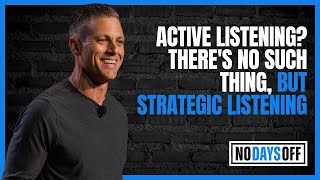
Brian Gubernick argues that "active listening" is too vague and proposes "strategic listening" instead, which means deliberately probing for someone's underlying intent and emotions. Matthew Dix's key question, "How did you land in this position?" transforms factual answers into emotionally resonant stories that deepen relationships and make you a better storyteller.
Chapters
Thank you for joining me today. It's Brian Gubernick, and welcome to the No Days Off podcast. We believe that every single day brings a new opportunity to get better. So I want to build upon yesterday's interview. Yesterday's podcast, we interviewed Matthew Dix, a, an amazing guy If you haven't listened to the episode, the interview, it's our first long-form interview we've ever done here at No Days Off. I talked to Matthew for, I don't know, about an hour. And I'll tell you, I learned so much. And I'm assuming if you listen to it, that interview, you learned quite a bit as well. And I wanna take the next few days to break down that interview into some bite-sized chunks, things that we can, kind of double down on, learn from, and implement in our world right away. There are so many things that Matthew shared. It was kind of tough to break it down, but I want to start with what first resonated with me from Matthew's interview. There were a couple words that Matthew used out the gate, early in the conversation, probably 10, 15 minutes into our conversation. Matthew used words like observation, desperation, and necessity. Observation, desperation, and necessity. And he used these words to discuss or really describe what drove him to be a better storyteller. First, he talked around observation. He said, and I quote, "I think that everyone thinks they're a good listener, And I think almost no one is a good listener. And so I think one of the things I did early on was I really started paying attention in a strategic way to how language worked. So that if I heard someone make someone else laugh, I remember as a kid, I'd say to myself, what did they do? And I would track it back. He went on further to say that he would look at what people did, not just, not just, you know, in observing in the real world, but he would say he watched Saturday Night Live and he would ask himself, what made that skit so funny? He says he remembers when one night he was watching Saturday Night Live and he saw them really exaggerate and exaggeration was funny. And so he learned that in order to be funny in this world, maybe exaggeration was a tactic. So that was the observation. Desperation, though, where did desperation play a role? He would talk about in his family, um, he was desperate for attention. He had described that he didn't play sports or he wasn't in the band. His family oftentimes seemed at odds with one another, and in order to be heard in a rather large family, he was desperate He sought a need to be heard. He was fascinated by figuring out different ways to be heard within his family. And then lastly, a word that he used that really resonated with me was this word necessity. He talked about out of necessity, he had to build certain skills. Again, he wasn't particularly athletic or he wasn't, necessarily the best at a number of things, but out of necessity, again, maybe a need to feel heard, he developed a skill. So I first observed or listened to Matthew speak, and I wrote down observation, desperation, and necessity. And what do you take away from that? Those three things are pretty amazing motivators. So for me, I started thinking in my world, where do I need to do a better job of just observing? Where can I create some degree of desperation? And where in my life have I seen a skill developed or a path chosen just out of sheer necessity? It was interesting to pick his brain and see what motivated him. But this led to really what I wanna talk about further today, which is this idea that active listening is not really something that exists. And as Matthew described, it's more about strategic listening. He actually stopped me when I was interviewing him, if you recall, or again, if you haven't listened to it, go back to it. Probably 20 minutes in, he said, I'm gonna take away the word active listening because I can't actually find a definition for that that makes any sense to me. See, I've always used the word active listening. You need to be a more active listener. But he said, you know, active listening, as far as he can tell, means there's nothing inside your ears while someone else is talking. Instead of things being active in terms of listening, he uses the word strategic listening, which is to say when someone is telling him something, he's listening to what they're saying, meaning that he's very, very focused. Now, he kind of went deeper into this. He said strategic listening It means you're actually saying to yourself, why is this person speaking? What are they really trying to say to me? How are they really feeling? What is their wish from this conversation? If they could actually speak it, if they dare to have the vulnerability and courage to say, here's what I'm really trying to say. That's what he's trying to figure out. What's going on? What they're talking about. And then he can respond in a way that means something to them. So he said, and I quote, "In order to do that, I'm going to assume not only do I have to be a strategic listener, you have to also ask some really good questions." And he touched on a couple of these great questions. One kind of path he took us down that I really liked, and that was this question where he was kind of describing, and we got to talking about airplane flights and how he loves to talk with people on flights. And I think I countered with, man, that is kind of my nightmare. I don't really want to talk to anybody on an airplane. And he said he feels bad for me. He said it's probably a result of a bad conversation. And he said that sitting next to someone, you know, with bad conversation ends up ruining the plane ride and the plane experience. But he says a lot of that just has to do with people's desire to be heard instead of asking great questions. So he says one of his favorite questions, instead of saying, tell me what you do for a living, he actually says, tell me how you landed in the position you're in today. Like, how did you get that job? So I don't care necessarily what you do, but the journey is what he was interested in. And he said when he asked this question, how did you get How did you land in this position? How did you get there? He says people light up and they really start to reflect in a fascinating way. He said he's had people cry. He told a story about a woman who cried because he asked her how she got into her job today, and she ultimately realized the only reason she's doing that job was because her brother worked for the company and she wanted to honor her brother. And he followed up that question with her. He said, 'Is that really something, that job, was that something you were dying to do?' And she had, you know, that's when she got teary-eyed. So he continued to build on that though. And instead of saying, 'What do you do for a living?' He said he would ask, you know, great questions to elicit stories that are more interesting when the questions really kind of elicit just facts. So he wants to hear stories, he doesn't want to just hear facts. So asking someone what they do for a living is just asking for a fact, saying, how did you get somewhere? But when you ask it at a deeper level, you end up getting a story. So the more you can ask for stories, the more people have an opportunity to share with you. Matthew believes that when you strategically listen and you could strategically ask better questions, it prompts people to tell stories, and stories are what in fact deepen relationships. Matthew believes that the person who has the most stories tends to be the best storyteller. So in preparation for conversation, that's what prompted him to become a better storyteller. So today's episode, you know, I talked about some of these key words that I observed from Matthew. Right, observation, being one, right? Necessity and desperation. How do you think about those words? How do they apply to your world? How do they create motivation? And then as it pertains to conversation or being a strategic listener, not an active listener, but a strategic listener, how do you under— understand? How do you ask questions such that you get to what they're really trying to tell you? See, active listening, by my definition after having this conversation with Matthew, is now just surface level. Strategic listening, though, is about asking deeper questions to understand what they're really trying to tell you, to kind of cut through all the noise and to understand what is the point you're really getting at. Get them to tell more stories is the key. So the takeaways for you today, again, those, those words, how do they motivate you? And secondly, how do you become a more strategic listener using Matt— Matthew's tactics, specifically the questions? That he brought, he brought to us during that interview. If you haven't listened to the interview though, go back to yesterday's episode and check it out. That's all I have for you today, the No Days Off Podcast. Thank you so much for listening, and remember, every single day brings a new opportunity to get better. So let's get it.
More from Brian











Ep 755 | Mack Newton's Words of Wisdom - "You Are Only as Big as Your Self-Concept" (REPLAY)