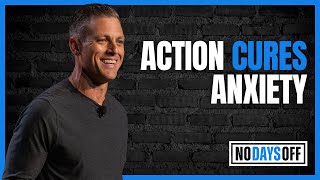
In this solo episode of the No Days Off podcast, host Brian Gubernick draws on more than two decades of entrepreneurial experience to argue that light, non‑clinical anxiety is not a problem to be avoided but a source of energy that can be harnessed through immediate action. He explains that anxiety stems from a perceived loss of control; taking even a tiny, concrete step restores control, releases trapped nervous energy, and prevents the feeling from becoming toxic. Gubernick illustrates the concept with a common scenario—a difficult conversation—showing how a series of micro‑actions (journaling, sending a brief text) can break the paralysis. He also offers a toolbox of quick‑fire tactics (stand up, change posture, move outside, write a note) for moments when the next step isn’t obvious, and he encourages listeners to re‑frame larger stressors (job loss, breakup) as calls to action rather than retreats. The episode ends with a reflective prompt asking listeners to identify where anxiety shows up in their lives, what they’ve done historically, and how they can apply the “action cures anxiety” principle today.
Chapters
Thank you for joining me today. It's Brian Gubernick, and welcome to the No Days Off podcast, where we believe that every single day brings a new opportunity to get better. As an entrepreneur for, I don't know, just over 20 years, I've had all of the ups and downs that have come along with that. I've had the highest highs, I've had the lowest lows, I've been on the journey like so many of you listening to the No Days Off podcast. See, I started my business career when I came out of college. I went into the corporate world and I spent a few years there. And while I left the corporate world, it wasn't all bad, right? It just wasn't the right path for me. But there were certain things about the corporate world that were not all that bad. Uh, there was a very defined path for growth, for opportunity. There was comfort in knowing what my day was going to look like from day to day. There was stability. There was stability, like, do my job and here's what, you know, the future kind of looks like. These were not terrible things. They just didn't fit the model that I wanted to run. They didn't fit me. But for the vast majority of the world, or at least in the United States, that is the path. And I applaud those that go down that, go down that journey. Now I went a different direction, like so many of you, and that was the direction of becoming a business owner, becoming an entrepreneur. And as much as I've loved it, right, you get to carve your own path, you get to, you know, drive when you want to drive towards something, you get to pivot, you know, you got— you have this flexibility and you get to build, you get to influence and impact others. All of these things are awesome. But on the other side of that, there are some downsides. And that's the stress. That's the overwhelm. That's the going to bed at night thinking about payroll and having to wake up in the morning and think about the exact same thing. I've had all of these emotions like so many of you. I have a lot of them still today. But probably the number one thing that I've experienced more throughout my 20-plus years than any other thing, any other emotion at least, is what I would call anxiety. Now, I'm not talking like clinical anxiety or depression. I don't mean that. And if you're feeling that way, if it's that overwhelming, it's something, you know, with respect to your mental health, today's episode is not about to solve your challenges. You deserve more professional help. But I'm talking about that lighter version of anxiety that so many of us know, not just entrepreneurs, but even in, you know, if you're running, uh, in, in a corporation, you know what I'm talking about, where you've got so much on your plate and you've got so much riding on the moves you make and you're on edge and maybe you even procrastinate a slight bit. I'm talking about that anxiety. Now, I don't necessarily think that anxiety is a bad thing. A light level of anxiety. I actually don't think stress is a terrible thing. I know that stress has prompted me into motion many, many times. I know that anxiety, you know, if properly channeled, builds energy and motivates me for— to push forward. Here's what I know about anxiety though, and this is what I want to really talk about. I know that the greatest cure The greatest cure for, for anxiety is action. Taking just one small action will reduce your anxiety and diminish these feelings that we're describing, these feelings of overwhelm. See, anxiety is rooted in a feeling of lack of control. If something important to us feels like it's beyond our control, even just a little bit, it actually prompts or activates anxiety. And as I mentioned, this is not a terrible thing. This is a, this is a good thing. Now some of you may be thinking, well, wait though, I thought anxiety is bad. I should probably avoid it. I should meditate. I should try to forget my worries. I should go on vacation. I don't want to feel bad. And I, I get it, don't get me wrong. Ongoing anxiety that's not, that's unaddressed is, is actually really bad for you. But I'm talking about when you first get those anxious feelings. I don't want you to avoid them. Avoidance trains you to see anxiety as something horrible or even unbearable, something you can't handle. But you can handle this anxiety. So instead of avoiding the anxiety, I want you to lean in and ask, what action can I take right now, however small, to gain at least some control over the thing that's making me anxious. Remember, anxiety, really, that feeling comes from a lack of control. So what I'm saying to you is, next time you feel anxiety, instead of avoiding it or trying to figure out a way to make it go away, I want you to lean in and I want you to ask, what action can I take? What small action can I take that gives me some degree of control over the thing that's in fact making me anxious. Let's say you've got a deadline to hit, or maybe you have to have a difficult conversation with a peer. Whatever it is, I guarantee you there's one small step you can take to address it. Let's talk about the difficult conversation, for example. We've all had scenarios where we knew we had to have a difficult conversation but we were stressed around it, we had some degree of anxiety around it. Maybe it's a family member, maybe it's a friend, maybe it's a peer at the office. When you think about reaching out to them, maybe it gives you some degree of anxiety, maybe you feel this anxiety. So instead of taking action, in the past, maybe you've done nothing about it, just hoping it would go away. But that anxiety doesn't go away, it just continues to nag at you. It builds. It can even become toxic. Now, you don't have to have that difficult conversation right now, but you can take a step in a direction. You can take a step in the right direction. You could send an email to yourself where you just vent, or you could journal around it about how angry you are. You're just, you know, getting it out of your system. That is a step. And once you do that, You'll put your thoughts into words, and now you maybe have some perspective. Now that you have some perspective, you could send that person a text. Hey, I'm thinking about you. I think we ought to chat sometime soon. Now, you might not get a response, and that doesn't matter because you're taking action. See, again, anxiety sometimes paralyzes us. Maybe it, maybe it makes, makes us freeze, or again, maybe we just try to avoid it. And what I'm trying to encourage everybody My experience, because I've gone down that path, I've avoided it and it didn't work out favorably for me. But when I look at it today and I'm like, why do I have this anxiety? Why do I feel this way? And most importantly, what step can I take at this very second that will move the ball forward? It may not solve for everything, but it gives me some element or degree of control. I think it's something that you might be able to start doing right now. See, anxiety, in my experience, is really kind of this, this weird, almost trapped energy. It's your body saying, do something. It's your body saying fight or flight or freeze, whatever it may be. Anxiety is like this primal call to action. And by the way, freezing, paralysis, isn't, isn't action. So anxiety is this form of energy, just like I'm describing here. And if it's trapped in the body, it can actually become toxic. Think about it. If you've had anxiety and you've let it fester, you've let it build, how do you feel? How do you physically feel? How do you sleep? How are you eating? If it's significant, you know, I mean, you know what I'm talking about. It is toxic. It does not feel good. You've got to release this energy. And I believe the way you do it, again, is by immediately taking some sort of positive action. Now, if you're not really sure what to do, like you don't know what that next step may be, maybe just for you personally, stand up, start moving, change your posture, get outside, like just get into motion. Don't be paralyzed. What's one small action you could take that will start to address this worry? Identify the action, don't overthink it, and just do it. Doesn't matter how small, doesn't matter if it hasn't even come close to solving the problem. Action releases this anxiety energy and you feel better. Now, what do you do about really big problems? Losing your job, maybe a, maybe a breakup or something super heavy like that. You're going to get anxious. That's, that's normal. Now the question you got to ask yourself is how are you interpreting this anxiety? Is it a call to action or a call to retreat? If you choose it as a call to retreat, you'll see anxiety as your enemy. However, the more you take some sort of action, the more you retrain your brain that anxiety is not really all that bad. So I don't know. I mean, again, we've got a lot of entrepreneurs here, and even if you're not owning your own business or building your own business you have entrepreneurial thoughts or a mindset, a growth mindset, that's why you're here. That's why you're part of the No Days Off Nation. That being said, you are absolutely experiencing anxiety in your professional world, but maybe you've got it in your personal world as well. So, the focusing question for you today is where is it showing up? What have you historically done to handle that anxiety? And what could you now do based on today's conversation? Which is to take action because action cures anxiety. That's all I have for you today. The No Days Off Podcast. Thank you so much for listening. And remember, every single day brings a new opportunity to get better. So let's get after it.