
Ep 384 | Brilliant Management Cannot Overcome Bad Economics
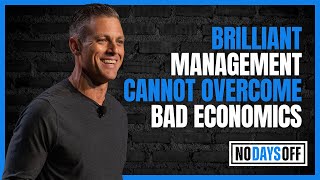
Warren Buffett says brilliant management can't save a business with bad economics. Brian Gubernick uses General Motors, BlackBerry, and Sears as examples of companies that failed despite strong potential, and Phil Jackson's Knicks to show why talent alone doesn't fix a broken system.
Chapters
Thank you for joining me today. It's Brian Gubernick, and welcome to the No Days Off podcast, where we believe that every single day brings a new opportunity to get better. I want to get into business today. We have a lot of entrepreneurs listening to this podcast, individuals looking to build big businesses or that already have big businesses and looking to get to the next level. At a minimum, if you're not building a business, you are probably thinking about different ways to get into the business space as an entrepreneur. So today's topic is a bit around business building and just being an entrepreneur in general. And like so many things we do here at No Days Off, we are once again going to turn to our buddy Warren Buffett, who's got a great quote that I want to dive a little deeper into and figure out how it in fact applies in our respective worlds. Warren once said, when a management with a reputation for brilliance tackles a business with a reputation for bad economics, it is the reputation of the business that remains intact. I'm gonna read that one more time. When a management with a reputation for brilliance tackles a business with a reputation for bad economics, It is the reputation of the business that remains intact. Warren said this quote, right? What he really meant is that no matter how talented or how skilled a leadership team is, a management team happens to be, they cannot overcome the inherent limitations of a terrible business model. They cannot overcome— a great management team, a great leadership team cannot overcome an industry with, say, poor economics or business fundamentals that are relatively weak, like low profit margins or insanely high competition or just generally poor market conditions. The best leadership, even the best leadership, is going to struggle to deliver strong results, consistent results, when the economics of the business are are just poor. So in essence, what Warren's saying here is that great management, while it, it can optimize operations, they can't make magic happen. They can't transform bad economics into good economics. They can make things maybe better, but if you've got a fundamentally poor business model or just bad business in general, it's really tough to lead your way out of that or manage your way out of that. Buffett, what he's doing here is really cautioning against overestimating the power of management in industries or in businesses that have financial or structural problems. So Warren Buffett's investment philosophy has been one where he says, hey, you got to have sound management or leadership in place. I mean, as you maybe know, and I know we just recently talked about this on a past episode when we, when we covered Warren Buffett's investment strategy, he's looking for great leadership teams. He's looking for continuity in leadership. He's looking for a track record of success. It's one reason he likes to buy companies that have, that have been family owned and operated where there's succession and, and it's just been consistency. That being said though, he's going to rank the economics of the business above the management of the business. Again, ideally he wants to see both of these things, but economics are tough to make up for regardless of leadership. So Warren's strategy again is to find these two, but he's going to look at the economics probably a bit more so than he's going to under— underanalyze, I should say, underwrite the leadership team itself. Now there's examples throughout business where you kind of see this quote in in action. One example would be GM, General Motors, and this was before its bailout in 2009. So before its bankruptcy, before the subsequent bailout, again, that was 2009, GM, General Motors, had a reputation for leadership, for strong leadership in the, in the auto industry. They were actually the, the model. They were being studied. There's books about GM's leadership. And GM, even though they had amazing management leadership, they faced a business that had really poor economics. Labor costs at this time, 2007, '08, '09, were extraordinarily high due to union contracts. Uh, operations were pretty inefficient. There was an over-reliance on what we call gas guzzlers, gas guzzling vehicles, and there was significant pension liabilities. Despite having arguably one of the best leadership and management teams out there, the company couldn't compete. It couldn't compete effectively with, with the leaner, more efficient companies like Toyota, like Toyota, who was in the same space. These challenges led to bankruptcy in 2008-9, and the company had to be bailed out. BlackBerry, who seems to be an example for everything, it's probably another good one here. Their management was highly regarded. The company was actually, you know, once a leader in the smartphone market. However, even though they had this great leadership team, the mobile phone industry evolved, and it was— there was bad economics in terms of market trends, and there was more competition from Apple and Android, and the customer base was declining. And even with their super talented leadership team, BlackBerry couldn't adapt. Couldn't adapt quickly enough to shift towards a different device, this touchscreen device, and an app ecosystem, which is what Apple was doing. And its management couldn't overcome this fundamental shift. And as a result, BlackBerry lost its market share, lost its market position. I mean, it's all but extinct. Companies like Sears, who maybe some of you have heard from or heard about before, maybe you have no idea who I'm talking about because they're not quite what they were, but Sears at one time was a retail giant and its CEO was one of the best out there. However, that CEO and that leadership team could not overcome a growing e-commerce market, this competition, and these changing consumer behaviors. And so Sears, their business model became outdated, their economics became poor. They had these large physical stores and they didn't have an ability to adapt to an online marketplace, marketplace. And this meant the company declined, ultimately leading to bankruptcy in 2018. Now, I got to thinking about this a bit more in that maybe this, this, this concept where you— where great management isn't going to overcome a bad economic model, maybe this concept applies in other places. And naturally, like I do in so many cases, I started thinking about sports. Let's take, uh, many of your sports fans. Let's take a guy like, um, Phil Jackson. 11 NBA championships with the Bulls and the Lakers. But in 2014, he took over the Knicks as their president. And from 2014 to 2017, despite his track record, despite his legendary status, the Knicks roster was a complete mess with bad contracts, bad players. And even Jackson's coaching philosophy, it's his, his triangle offense that he was known for, he wasn't able to turn this team around because it lacked talent, it lacked cohesion. So even with this crazy championship pedigree, the Knicks failed to improve and were at the bottom of the standings during Jackson's 3 or 4 years there. Bill Belichick, one of the greatest NFL coaches of all time, he struggled early in his career with the Browns from '91 to 1995. Even though he was known as like a brilliant tactician, and even though he later would have incredible success with the New England Patriots, he could not overcome the weak economics, the weak roster of the Browns, the poor front office decisions during that time. And after 5 seasons with his— with a terrible record, he was fired. And then he found his way to some better economics, a more talented roster in New England. And that's where his coaching brilliance really could translate into long-term success. Now, it's kind of interesting, but when he lost the economics in New England, in other words, his roster changed, so did that team's performance. And Bill found himself now out of a job. So you see this show up in a number of different places. I think it's pretty interesting. The core message here today though is that while leadership, great leadership teams, or great management is absolutely necessary to flourish and thrive, recognize that if you've got a bad model, bad economic model, poor margins, uh, no, no competitive advantage, you know, a struggling industry, even with the greatest leadership, you may not be able to overcome the odds stacked up against you in terms of your business model, your economics. So, I think the focusing question for you might be, where is this showing up in your world? And I'm not saying that you don't have to improve as a leader, or maybe if you're employing people and you have leaders over specific departments, whatever that may be, not saying we shouldn't increase our leadership lid. But I am saying we should probably take a step back and say, hey, is it my leader or do I just have a poor economic model. Now, use that word economic, you know, in a variety of different ways. Obviously, there's the business sense of the word, but just in, in the context that we're describing, I think it applies to the model itself, the business model, the department model, the sports team model, whatever it may be. Is your leadership really struggling, or is it simply the economics that just can't be overcome? I'm not one to ever say tap out. But I am one to take a step back and analyze all the data so that we can make better decisions. I think it's probably something for you to consider doing today. That's all I have for you today, the No Days Off Podcast. Thank you so much for listening, and remember, every single day brings a new opportunity to get one. So let's get after it.
More from Brian











Ep 755 | Mack Newton's Words of Wisdom - "You Are Only as Big as Your Self-Concept" (REPLAY)