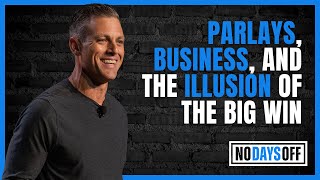
In this solo episode of the No Days Off podcast, host Brian Gubernick uses a recent Wall Street Journal story about sports betting parlays to illustrate why entrepreneurs and businesses often fail when they spread their focus across many high‑risk initiatives. He explains how a parlay works—combining multiple bets into one high‑payout wager that is mathematically stacked against the bettor—and shows that 60% of sportsbook revenue comes from these bets. Gubernick argues that the same logic applies to startups and other ventures that try to raise capital, launch products, expand markets, and hire simultaneously. He contrasts this “parlay” approach with a “moneyline” strategy: betting on a single, high‑probability opportunity, avoiding the “miracle mindset,” and minimizing reliance on uncontrollable variables. He cites the disciplined, incremental success models of coaches Nick Saban and Bill Belichick as examples of focusing on small, repeatable wins that compound over time. The episode concludes with a call to listeners to identify where they are making parlay‑style bets in their own lives and to shift toward focused, simple strategies.
Chapters
Thank you for joining me today. It's Brian Gubernick, and welcome to the No Days Off podcast, where we believe that every single day brings a new opportunity to get better. Just last week in the Wall Street Journal, there was an article on sports gambling. Now, I am drawn to the article in the Wall Street Journal because it's, it's on the front page, because I like to gamble on some sports with friends every now and again. I think it adds to the excitement, but I also like to learn a little bit more about the industry. And I, I start reading this article, and within the article it describes how DraftKings and FanDuel and these other big sport online sportsbooks have, have really, really been growing at an astronomical rate. And one of the reasons these companies are growing is because they found that there is a massive appetite for consumers to bet on what are called parlays. Some of you listening, you probably are very familiar with the concept of parlay, but many of you probably have no clue what I'm talking about. What is it? What is a parlay in sports betting? Whether you like betting or not, let's understand the concept here, okay? When you are playing a sports parlay, when you're betting a parlay, What you're essentially doing is taking a, a, an event and taking another event and taking another event and saying, if all of these events occur, then I win my bet. And the odds of winning the bet are relatively low, so the payout is actually really high. So for example, let's make believe that Uh, last weekend I was betting on the NFL, and I was betting on the Philadelphia Eagles to win their game. In addition to the Eagles winning the game, I bet that their quarterback Jalen Hurts was gonna pass for less than 250 yards during the game. I also bet that the total score and I'm just making this up was going to be less than 50 points between the two teams. And then lastly, I bet that their running back Saquon Barkley would run for more than 124 yards. So there are 4 bets I just described. All of them can be made individually, but in a parlay, what we're actually doing is saying all 4 of these scenarios are going to happen. and when they do, my $10 bet is gonna pay out $100. I'm just making up the odds, but that's the kind of crazy thing that could happen. I bet $5 or $10 or $20, and maybe I get a 3x, 4x, 5x, 10x return. Within the article in the Wall Street Journal, it actually told the story about a woman who had bet $5 on a 14 team parlay. She had to win all 14, uh, bets. And it told the story about how she had won 13 of the 14, and then on the 14th, the player that she had bet on fell apart and did not cover the bet that she had made, did not win the bet that she had made. And so while she won 13 out of 14 and she bet $5, she could have won $22,000 but did not because that last bet didn't hit. So parlays have kind of become the new lottery ticket in, in some degree. Now why the heck am I talking so much about parlays? I just want to— I want everybody to understand the, the, the concept, because sportsbooks right now, 60% of their revenue are coming from these parlays because people keep chasing the impossible odds. This begs the question, are we making the same mistakes in our business and our life? Par— parleys are pretty much mathematically set up for failure. The more variables, in this case bets, the lower the probability of success. And there's this illusion of the big win. People think hitting a parlay is going to change their lives, is going to change everything. But the odds are stacked against them. But they, they don't pay attention to the odds because they believe the upside to be so big. Now, so many entrepreneurs listening to the No Days Off Podcast are part of the No Days Off Nation. I want you to compare what I just described to business. So many think that adding more ideas, or adding more initiatives or taking risky bets are going to lead to success. And actually what really happens is it decreases the likelihood of success. It increases your chances of failure. This is the analogy to gambling. Parlays show so much promise and upside, but the odds are so stacked against you. And the same could be said in your business. The more ideas, the more initiatives, the more bets, that you're making that you think are going to lead to success, they just simply increase your chances of failure. Entrepreneurs, I think, and we're all guilty of this from time to time, we build these, these business parlays. We try to scale multiple things at one time. We try to launch several products or services simultaneously. We bet on multiple high-risk strategies. And then we wonder why it didn't work out. Instead, as we talk about so much here at No Days Off, instead maybe we ought to focus on one great opportunity. They stack up variables in one great opportunity, those that, those that focus. They stack up the variables on just that one thing. They don't need everything to go right on all of the outside variables. All the eggs are in one basket, and we stack those eggs in that one basket, and it makes for a much more simplified approach to success. An example of, you know, the kind of the chaos in, in, uh, parlay business— parlays, a real-world example in my opinion, is the, is the business startup. Any business startup is— has to raise some money while at the same time launch a new product or service, while at the same time expand into different markets, while at the same time hire rapidly. And you're, you're raising money, launching services or products, expanding in the markets, and hiring all at the same time. It really should be no surprise why so many businesses, and specifically startups, fail. There's too many moving parts, and as a result, there's a high failure rate. Instead, maybe we ought to take the Nick Saban or the Bill Belichick approach. What do those two individuals do? They win not by making big bets, but by stacking small, high-probability plays that all build on each other. So how do we go about avoiding this parlay trap in our business, in our life? I think one thing we can do is play the moneyline game. What do I mean by the moneyline game? In gambling, the moneyline bet is, is simple. You're just betting on the team to win, right? So, so the, the, the Eagles are playing the Chiefs coming up here in the Super Bowl. A moneyline bet would be saying the Eagles are going to win or the Chiefs are going to win. Forget about the odds, the spreads, all of the other variables I could possibly bet on. I am simply picking one side or the other. In gambling, that's known as a moneyline bet. Bet, just betting on a team to win. There's no extra variables. In business, this would be like betting on one great strategy at a time. So I think in order to avoid the parlay trap, number one, play the moneyline game. Number two, avoid the miracle mindset, let's call it. Instead of looking for that one big play, focus on consistent discipline Execution. Avoid the miracle mindset. And then lastly, in order to avoid this Parley trap, reduce dependence on the uncontrollables. Reduce dependence on uncontrollable factors. If success requires everything to go right, you're just not running a very smart business. You're actually gambling. I hope you heard me there. If success requires everything going right, You're not running a smart business, you're simply gambling. So reduce the dependence on uncontrollable factors. So bottom line, I think as we kind of wrap up this conversation today, the house always wins when you play parlays. Sure, you're going to hear a story about somebody that hit some multi-team huge parlay, and they're an out— they're outliers. In almost every case, the house always wins when you play parlays. How do I know that? Again, 60% of revenues of gambling companies are tied directly to parlays. It's not because people are winning. The house always wins when you play parlays. In business and in life, complexity kills. So keep it simple. Take these high probability shots and stack small wins that compound. That's how I believe you win over time. So my question for everybody here today, where in your business or your life are you making a parlay instead of a smart, focused bet? Where are you making a parlay in business or in life instead of the small, focused bet? And then of course, once you recognize where is that, where that's at, What are you going to do about it? That's all I have for you today, the No Days Off Podcast. Thank you so much for listening, and remember, every single day brings a new opportunity to get better. So let's get after it.