
Ep 499 | The 4 Steps to Unlocking the Power of Boredom
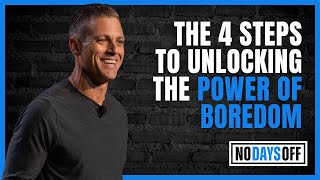
Brian Gubernick argues that boredom sparks creativity and problem-solving, but constant stimulation kills it. His best ideas come during low-stimulation moments like showering or driving. He outlines four steps: resist filling every empty moment, schedule dedicated time for nothing, let your mind wander, and turn boredom into a challenge.
Chapters
Thank you for joining me today. It's Brian Gubernick, and welcome to the No Days Off podcast, where we believe that every single day brings a new opportunity to get better. I have a question for you to start today's episode: when was the last time you were truly bored? When was the last time you were truly bored? No phone, no notifications, nothing going on. You're just sitting there. Most people seem to avoid boredom at all costs. We try to avoid boredom at all costs. What if I told you though, it's actually one of the most powerful tools for creativity, for focus, for self-improvement, for gratitude, for relationships? Would you believe me if I told you that boredom happens when our brains lack stimulation? And in today's world, we never ever, ever give ourselves a chance to experience it. When I was, when I was growing up, it seems like I had an awful lot of boredom going on. You know, that's kind of what you did with kids. You said, go out and play, go figure it out. And sometimes there wasn't a lot to do, and there just wasn't as much stimulation as there is in today's world. But in today's environment, it's actually pretty hard to be bored because of the phone and, and connectivity to the rest of the world and notifications, all these things. Boredom happens when our brains lack stimulation. But we never give ourselves a chance to experience it. I used to see boredom as wasted time until I realized it's where some of my best ideas and some of my best decisions actually come from. I've told a story here at No Days Off, one, you know, in an earlier episode, actually probably one of our first couple dozen, and I won't go too far into the details today, But I talk about a story of when I went to go visit a psychologist, a guy who was trying to help me kind of figure out different direction in my life. And I remember him saying to me, Brian, when do you get your best ideas? And I told him, I, you know, after he grilled me a little bit, I'm like, well, in the shower. He's like, great, where else? I'm like, well, when I'm driving. It's like, where else? I got— when I'm, when I'm out for a run. Where else? When I'm sitting on the beach doing nothing. Because what do all these things, what do these things all have in common? And as we got to chatting, the reality is every one of those things, my mind was at its calmest state. I was even on autopilot. Dare I say, I wasn't being stimulated and hence was bored. The second I kind of realized that I get my best ideas and I make my best decisions from these moments when my mind is at its calmest. And when I'm essentially bored was a game changer for me. It made me ask the question, how do I create more of that in my life, not less? There are lots of benefits, it goes without saying, to boredom if we allow ourselves to get there. Boredom fuels creativity. When your mind isn't occupied, it starts to wander. And that's, that's what happens to me in the shower and when I'm driving and when I'm running. When I'm driving, by the way, I'm still safe. I'm just saying, when I'm, when I'm going from point A to point B for the thousandth time, when your mind's not fully occupied, it starts to wander. And when your mind starts to wander, great ideas oftentimes emerge. Great ideas come about when we're doing nothing. I mean, how many times have you had a big thought or a breakthrough when you're in the shower or when you're, you know, doing nothing at all? I'm going to guess you probably had some of your best ideas. I'm going to guess, you know, you looked for a notepad or, or you look for something to write it down so as to not forget it. We've all had these experiences. Odds are your mind was at a pretty calm state. I think boredom helps you solve, solve problems, especially big problems. Stepping away from an issue, it allows that subconscious to, to keep working on it. Writers, entrepreneurs, people like in those fields oftentimes solve complex problems when they stop thinking so hard about those problems. Boredom helps us increase self-reflection. It forces us to confront our thoughts instead of escaping into distractions. Because if you're, if you're always busy, when do you ever have time to stop to ask Am I actually on the right path? So, I think we've got to look for more boredom in our lives as a result. Now, side note, I think our kids need to be bored more often too. I'm not going to get on a soapbox necessarily here, but I think we need to let kids be bored because it teaches kids to problem solve and be patient and be more creative. And when they're always, you know, when kids are always in these structured activities or they always have screen time, they never learn how to entertain themselves. When you and I were kids, we built forts, we made up games, we invented stories because, because we had to. So I think we've got to give kids space to be bored. Otherwise, we rob them of the ability to be resourceful, of the ability to, to use their imagination. So just a quick sidebar, I think we need to push our kids to be a bit more bored. It's not easy though. I mean, I promise you it's not easy. I live it in my house. I think there's 4 steps though. Let's get the crux of what— to the crux of what I want to talk about here. I think there's really 4 steps to using boredom to your advantage. I think there's 4 steps. Number 1, you know, the first step in using boredom to your advantage: I want you to resist the urge to fill every empty moment. I want to challenge you to not grab your phone during short moments of boredom. When you're waiting in line, when you're sitting at a red light, when you're between calls, when you're eating lunch, don't grab the phone. Resist the urge to fill every empty moment and just sit there and be bored. See what happens. So step 1 to using boredom to your advantage, resist the urge to fill every empty moment. Step 2, Schedule time for nothing. Schedule thinking time, like just time for nothing. And during that time, take walks, maybe with— without any music or without any podcasts, without anything that's stimulating your mind. Or in that scheduled block of time where you're doing nothing, sit in silence for 10 minutes and just see what thoughts come up. I'm not necessarily saying, uh, saying to meditate. No, I'm just saying sit there silent and see what, what comes up in your mind. Aim to be bored. So again, number 1, resist the urge to fill every empty moment. Number 2, schedule time for nothing. Number 3, let your mind wander. If you want to use boredom to your advantage, let your mind wander. Instead of seeing boredom as, as wasted time, use it as a trigger for reflection or as a trigger for brainstorming. So when you start to see your mind wander and you usually look to do something to stimulate your mind or bring it back, don't next time. Let's just let it go and let's see what happens. And then the finally, the fourth step to using boredom to your advantage, turn boredom into a challenge. Instead of reaching for distractions, I want you to ask, what can I create right now? What problem can I solve right now? What do I actually want to be doing right now? So turn boredom into a challenge. Don't reach for the distraction. Ask some questions. So real quick, the 4 steps that I think you could use to turn boredom into an advantage: resist the urge to fill every empty moment, schedule time for nothing, let your mind wander, and number 4, turn boredom into a challenge. So My challenge for you is to run through those 4 and try to leverage them today. The next time you feel bored, don't escape it. Just sit with it and let's see what happens. Because if you never allow yourself to be bored, I really truly believe you're missing out on creativity, clarity, and just overall deeper thinking. Remember, boredom isn't wasted time. I actually think if channeled properly, It's a secret tool. The question I have for you is, are you using it? Are you using it? Test it out today. Let me know what you think. That's all I have for you today, the No Days Off Podcast. Thank you so much for listening. And remember, every single day brings a new opportunity to get better. So let's get after it.
More from Brian











Ep 755 | Mack Newton's Words of Wisdom - "You Are Only as Big as Your Self-Concept" (REPLAY)