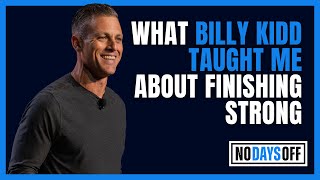
Brian Gubernick shares Olympic skier Billy Kidd's lesson: the last three turns of a ski run shape your memory and momentum for the next one. He applies this to business and life, arguing that how you finish meetings, calls, and projects determines how people perceive you and how you perform next. Coasting at the end reinforces mediocrity; finishing strong builds elite identity.
Chapters
Thank you for joining me today. It's Brian Gubernick, and welcome to the No Days Off podcast, where we believe that every single day brings a new opportunity to get better. I'd like to tell you about one of the more profound pieces of performance advice that I've ever come across. And it came from this guy wearing a cowboy hat on skis. That's right. This guy's name is actually Billy Kidd. Really true, that's his name, Billy Kidd. And what I learned from Billy in just one line actually changed the way I think about finishing that anything that's important, anything in life, in business, in athletics, whatever it may be, whether you're running a sales call or leading a team meeting or closing out a quarter, just wrapping up your day, I really think that this simple idea from Billy Kidd could be the difference between reinforcing greatness or reinforcing mediocrity. Let's talk about it. So first, who is Billy Kidd? Billy Kidd is actually a, a living legend in the world of skiing. He lives in Burlington, Vermont now, I think, and, uh, somewhat of a mysterious guy, but he was the first American man to win an Olympic medal in alpine skiing. He won a silver at the 1964 Winter Olympics, so just over 60 years ago. He was a world champion in slalom 2 years later, and he was known for his style, his smooth style, his elite technique. And yeah, he really wore this iconic cowboy hat when he was on the slopes. Beyond the medals though, Billy Kidd is actually known as a teacher. He was someone who could take a big concept and do a great job simplifying it down into an unforgettable idea. And this is one that I think he, he dropped this when I, when I read about it. It's one he had dropped on one of his students, and the phrase he said, or what he specifically stated, was to always remember the last 3 turns. Remember the last 3 turns. Now what, what the heck did he mean by that, and why should our No Days Off Nation care? Most skiers, or snowboarders, and I'm guessing many of you here ski, snowboard, whatever, most of us coast at the end of a run. We start to kind of relax. We even get a little lazy. Our form usually slips as we are getting down towards the end of the run and approaching the chairlift. Billy Kidd said those final 3 turns matter more than any other turn that you make while coming down the slopes, because those turns are the turns you take into your next run. In other words, if you finish sloppy, that's actually what your body remembers as it gets on the chairlift. If you finish sharp, that's what you begin to internalize. In other words, the end leaves a deeper imprint than the beginning. And I think he was answering this question, someone was asking him what's the most important turns in slalom or in downhill racing, and I think so many assume, well, it's the very start or it's somewhere in the middle or at least the final turn. And he had made the statement, nah, it's the, it's the 3 turns leading to the chairlift. Because again, if you finish sloppy, that's what your body starts to remember. If you've skied or snowboarded, you know, like, you kind of get a little lazy at the bottom, especially at the end of the day. Again, that is when the turns are most important. It's very true on the mountain, and I definitely think this concept is true in business. I want, I want you to think about— let's make this real— I want you to think about your last sales call or your last client presentation. Your last team meeting, or maybe your last business quarter. How did you finish? How did you finish that presentation or that sales call, that meeting, that quarter? Did you close with intention and clarity and energy, or did you maybe trail off a bit and ramble or apologize or wing it at the very end. Here's, here's the truth. If you believe in what Billy Kidd is saying, the last 5 minutes of a client conversation are often what determines whether that client, that prospect, is going to say yes. The last interaction with an employee is what shapes their motivation for the week. The final sprint of a quarter determines if you hit your numbers or spend the next one playing catch-up. I think Billy Kidd's lesson is pretty simple. Don't coast when it counts the most. I think finishing strong isn't just a sports thing. I think it's a, it's a business advantage because the end of anything, a project, a pitch, a week, it's where I think reputations can be made and momentum can be built and excellence can become muscle memory. I think what Billy was really teaching was you don't just practice how you perform, you perform how you finish. You don't just practice how you perform, you perform how you finish. The end matters because the end is what actually sticks with you. It's what reinforces identity. So if you are consistently finishing in a sloppy way or distracted or reactive, you're not just ending that particular rep, you're training yourself to tolerate less than your best. I think we have to flip that. Finish every single rep with intention. Finish your day with maybe a review. Finish your sales call with clarity. Finish your workout with form. Finish your week with really strong focus because how you finish is how you're remembered or how you're going to remember what you just went through. And it's going to reinforce who you actually are. So, some action steps for you. Let's make this a bit more tactical and let's apply this remember the last 3 turns concept to your life and to your business starting today. I want you to identify one area where you consistently are coasting at the end. Maybe it's the last few minutes of meetings. Maybe it's sales follow-up. Maybe it's your daily routine. Whatever it may be, we all are probably coasting at the end of something that's rather important in our world. I can tell you for me personally right now, I feel like I am coasting at the very end of my day. I mean, when I'm home at the end of my day, it's like I, I've justified kind of sitting on the couch and being numb for a little bit, and I could be doing so much better there. I think I'm ending distracted and sloppy, and if I ended the day with 5 pages read or something of greater benefit. It might start me off stronger the next day. So, going back to the exercise, I want you to identify one area you consistently coast at the end. And then number two, I want you to create a finish strong ritual, something that might become your standard. So, end every sales call by summarizing next steps, or end every day by reviewing your wins and your losses and your next day priorities, or end every week with a 15-minute strategic reset of some sort. Lastly, I want you to audit your energy. I want you to ask yourself, if someone only saw the way I finished, would they believe I'm elite? If someone only observed how you finish something, would they believe that you're the best of the best? If not, I think you know where the work actually begins. So Billy Kidd might have been talking about skiing, but what he was really saying— excellence isn't just how you start, it's how you finish. And those last 3 turns, they actually write the story. So this week, don't just show up strong, finish even stronger, because that chairlift in your world is coming, and what you carry into the next run is your momentum, is your everything. That's all I have for you today, the No Days Off Podcast. Thank you so much for listening, and remember, every single day brings a new opportunity to get better. So let's get after it.