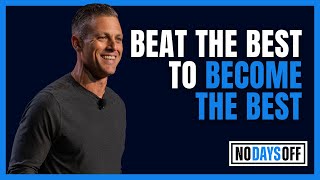
In this solo episode of the No Days Off podcast, host Brian Gubernick shares a personal story about his 13‑year‑old daughter Katie, who prefers entering smaller dance competitions where she can easily win. Brian uses this anecdote to illustrate a broader principle: true growth and lasting success come from seeking out the toughest competition rather than settling for easy victories. He argues that both individuals and businesses often choose “safe” arenas to guarantee short‑term wins, but this habit prevents the development of a “championship mindset.” To support his claim, Brian cites three corporate case studies—Nike, Lululemon, and Chipotle—each of which deliberately entered highly competitive markets dominated by established giants and succeeded by raising their standards, products, and brand experiences. He concludes with a concrete action item: identify areas where you’re opting for weaker competition and deliberately switch to a harder arena, surrounding yourself with peers who challenge you, thereby fostering continuous improvement and iconic, lasting success.
Chapters
Thank you for joining me today. It's Brian Gubernick, and welcome to the No Days Off podcast, where we believe that every single day brings a new opportunity to get better. I want to tell our No Days Off Nation a quick story about, about one of my kids, about Katie, who is my, my younger daughter, my 13-year-old. Katie recently told me that she wants to travel again this year for a, for a dance competition. Now last year I had the opportunity to take Katie to Chicago, just her and I, which was an awesome experience. We had a lot of fun and she did really well in that dance competition. So I asked her, you know, where do you want to go this time? And she gave me two cities. Both of these cities are pretty small markets in oddball parts of the country. In other words, they're not very big dance destinations. And I found that kind of strange. So I asked her a couple questions. And of course, slowly the truth started to come out. Those particular events, those two cities that she gave me, they would have much less competition. So she'd have a much better chance of placing and maybe even winning. And the path to the trophy would be easier. And that became a moment for us because I had to, of course, share with her something that I believe to be very fundamental. It may feel good to win. That's what I explained to her. It may feel good to win, but if you actually want to be the best, you have to beat the best. You don't lower the competition. Instead, you up your skill. You raise your skill. And I think I think it clicked with her, though I'm not certain just yet. But I think she at least understood what I was saying. I don't know if she accepted it, but she understood what I was saying. And I think that this situation we can relate to, and I think that message, I think it can click for all of us. Because kids are not the only ones who do this. Having the opportunity that I do to work with so many professionals, adults, I find that adults do this constantly as well. See, in, in, in business and in entrepreneurship, I see a lot of us pick smaller arenas because the odds of, of winning, however we define that, they feel safer. But I mean, I think we all know this, and we certainly talk about it here at No Days Off. Greatness doesn't usually live in safe. It lives in stretch. It lives in pressure. It lives in competition that scares you a little land. And I think that that's the real separator. There are so many great business examples of companies that chose competition, that chose what they perceived to be the harder path because they had grander aspirations. They didn't want to compete in a small arena. They wanted to, to beat the best and win at a really, really high level. They weren't content just being, you know, average or slightly above average. They went after the best. Nike is a great example of this. Nike chased the giants. When Nike began, Adidas and, and Puma dominated the sneaker world, the athletic world. Nike, Adidas, and Puma, they were the giants. Nike actually didn't try to avoid them. Nike didn't hunt for a small, uncompetitive niche. Nike went straight toward the biggest athletes. They went straight at the biggest stages. They, they went after the biggest leagues. Phil Knight, founder of Nike, said, "Icons aren't made by avoiding competition. They're made by outlasting it. They're made by persevering." See, Nike didn't shrink the arena. They grew into the arena. Another company that I was just looking up to get their whole story is Lululemon. Lululemon. They didn't go looking for the easy space in apparel. They didn't settle for building a small yoga-only brand or hiding in some sort of comfort category. They actually did the opposite. They went right after performance wear, which oddly enough was the category that, that Nike had owned for decades. So the giant I just talked about who went to find a different arena and beat the best, Lululemon went after them. No one thought a, a premium, uh, boutique-style athletic brand could possibly compete with Nike or with Under Armour at the time. But Lululemon didn't lower the competition. They raised their product. They raised their materials. They raised the entire brand experience and they earned their place on the top tier. Now today, Nike still technically leads, but Lululemon is one of the most profitable apparel companies on the planet. And they did it by stepping directly into the hardest possible arena, not the, not the easiest. They built greatness by competing at the highest level. The last example I have for today is, is Chipotle. Chipotle, they took on McDonald's in a pretty tough category. They entered that fast casual space, which is basically the, the bloodsport of food service. The margins are traditionally pretty low. The competition is insane. The consumer expectations are pretty darn high. And McDonald's, the biggest, most operationally efficient company in, in food, if not all of business, they had already perfected their model and they had done it globally. Chipotle could have played it safe. They could have stayed local, small, protected, but they didn't do that. Instead, they built a national brand around fresh, fast, customizable food and they took on the biggest player in the category. Not only did Chipotle survive, they became the category leader of modern fast casual, and they prompted McDonald's and everybody else to actually adapt. And they built a brand that people actually stand in line and line up for. They were not trying— Chipotle was not trying to find weaker competition. They were trying to build a product that was strong enough to win in the most competitive environment possible. To me, to me, I would define that as a championship mindset. That's what it looks like. So, you know, the core message I think here is this is the lesson that Katie needed, and it's a lesson I think that adults forget. Winning in a small arena might feel good, but it doesn't build champions. People lower the competition when they're afraid of being exposed. Companies lower the competition when they're afraid of being compared. Entrepreneurs lower the competition when they want guaranteed outcomes instead of earned outcomes. And those guaranteed outcomes are usually much, much, much smaller. Than the outcomes they'd earn if they went after it with a championship mindset. If you want to be iconic, if you want to build something that lasts many years, many decades, if you want to grow to your, your actual potential, I think you have to chase environments that force you to level up. Because champions, champions never pick easy opponents. They pick the opponents who tell the truth about where they stand. So your action item today, take an area of your business or your life where you've been choosing weaker, weaker competition. Maybe it's lower goals or easier markets or smaller tables or less demanding peers. And then flip it. Choose the harder arena. Choose the harder arena. Get around the people who challenge you. Compete where the bar, the bar is even higher. In other words, grow into the stage rather than shrink it. So as I told Katie, you don't grow by making that stage smaller. You grow by becoming the kind of person who can win on any stage. To me, that's the work, and that's what this whole No Days Off movement is all about. That's all I have for you today, the No Days Off podcast. Thank you so much for listening. And remember, every single day brings a new opportunity to get better. So let's get after it.