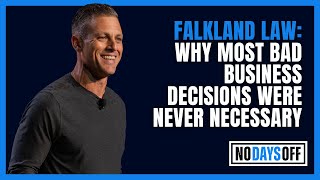
In this solo episode of the No Days Off podcast, host Brian Gubernick introduces the “Falkland Law,” an anti‑urgency principle for entrepreneurs that advises: if you don’t have to make a decision, don’t make one. He explains why many small‑business failures stem not from bad choices but from decisions that were never necessary. Gubernick outlines three psychological drivers of over‑deciding—discomfort with ambiguity, perceived external urgency, and identity‑based productivity bias. He illustrates the law with two concrete scenarios: premature hiring and reactive discounting, showing how early decisions lock in costly outcomes that waiting would have avoided. The episode then delineates when the law applies (reversible decisions, waiting yields more information, damage does not compound, urgency is external) and when it does not (cash‑flow crises, eroding trust, safety concerns, escalating problems). Finally, he gives listeners a practical exercise: list pressured decisions and answer three questions for each (what if I do nothing for 30 days? what information might appear if I wait? is the pressure real or just discomfort?) to decide whether to act now or wait. The episode closes with a reminder that decisive speed only wins when it improves outcomes, not merely to appear productive.
Chapters
Thank you for joining me today. It's Brian Gubernick, and welcome to the No Days Off podcast, where we believe that every single day brings a new opportunity to get better. Entrepreneurs pride themselves on decisiveness. I, I know I do. We are told to move fast. We're told to have bias toward action. We hear things like, "Indecision kills businesses." And you know what? A lot of times this is in fact true. But here's something that I think most small business owners only learn after they've had accumulated enough scar tissue. That's that a lot of bad outcomes don't come from bad decisions. They actually come from decisions that never needed to be made in the first place. And that's the core idea behind what's often called Falkland Law, the Falkland Law. If you don't have to make a decision, don't make one. That's Falkland Law. If you don't have to make a decision, don't make one. Now, this is not to be confused with procrastination. It's not to be confused with avoiding responsibility. It's about recognizing that forcing certainty too early often makes things worse, not better. This especially happens in small businesses where decisions have a tendency to ripple, ripple rather, rather quickly. Now, the Falkland Law is an anti-urgency rule. What it says is if a decision is not forced by cash flow or integrity or safety or compounding damage, then time is often your ally. Most entrepreneurs assume every open loop is a problem, and, and that's just not That's just not true. Now, I think about myself, I definitely have felt that way early in my career. But as I've progressed and I've had more years under my belt, what I recognize is time is one of the most effective variables to use. The anti-urgency rule that is the Falkland Law is incredibly beneficial. Some open loops are actually information gathering mechanisms. When you delay decisions, non-forced decisions, more data tends to show up. Problems start to clarify themselves. Options collapse, collapse naturally, and you're only left with what matters most. People reveal their true intentions. When you decide too early, it removes that sort of advantage. Now, entrepreneurs, small business owners, over-decide all of the time, and they do so for predictable reasons. The first reason they do it is because discomfort comes along with, with the ambiguity. There is discomfort that's created when things are ambiguous. Uncertainty feels like a problem. It may just be a phase, but it feels like a problem even when it's just a phase. The next reason we over-decide as small business owners, as entrepreneurs is that pressure sometimes masquerades as urgency. Emails, texts, people in your organization waiting for direction. It feels like leadership requires an answer right now. And so, this false urgency is created. The third reason I think we over-decide actually has to do with identity. Deciding, making decisions feels productive. Waiting feels unproductive, feels passive, even when we know waiting is the smarter move. So the result of this, decisions get made and they get made sometimes with partial information. They get made under emotional pressure and they get made to relieve discomfort instead of the real reason you would make a decision, which is to improve outcomes. This is how unnecessary decisions get locked in. Think about hiring and hiring decisions. In hiring, Falkland Law gets violated constantly. You're busy, the work is starting to pile up, you convince yourself any help is better than no help, and so you start to say things like, well, this candidate is good enough. Or this candidate's available now, or this candidate says the right things. And then you make a decision. And then 6 months later, no surprise, you're correcting mistakes, your team's getting frustrated, you're spending time, more time managing than you were before. The original problem wasn't lack of decisiveness. It was deciding when waiting would have, would have revealed the truth. If you had waited, good candidates might have shown up. Bad candidates, they might have faded, or at the very least, they would reveal themselves and you would have recognized they were bad. So waiting 30 days in this sort of scenario would have felt painful, painful, but making the decision actually cost far more. Another good example of, of Falkland Law, I think about pricing discounts and and revenue. Specifically, let's talk about pricing decisions under stress. Let's say sales are slow or cash gets tight. So instead of diagnosing lead quality or conversion, you know, points or sales behavior, follow-up issues, what we do is we end up deciding to discount or run a promo or bring our standards down, lower standards, so we could close more deals. And that decision trains customers to wait. It compresses our margins. It masks the real issues we're experiencing. The slowdown was information. The discount was a permanent decision. So waiting would have exposed the real constraint, but deciding locked in a much weaker position. Now, Faulkland Law applies in many cases, and it— there are cases where it does not in fact apply. Faulkland Law applies when the decision is reversible, when waiting provides more information, when damage compounds by waiting— I'm sorry, no damage compounds by waiting— and when urgency is external, it's not structural. So Falcon Law, taking your time in the sense that I'm describing it here, makes sense when you can reverse decision, when waiting likely gives you more info, where the damage does not compound if you wait, and where the ex— urgency is external, it's not structural. Now, it does not apply— and this is important— you can't apply it when cash flow is bleeding. You got to make a move faster. Where trust is breaking, you got to do something before it erodes, where safety is involved, or when a small problem is clearly starting to grow. Those are forced decisions. Everything else though, waiting is often the, the highest leverage move you have. So all that being said, what are your action steps for today? What can you do? I think here's how you go about using this concept Practically, I want you to write down the decisions that you feel pressure to make right now. The decisions you feel pressure to make right now, write them down. And then for each one of these decisions that you feel pressure to make right now, I want you to ask these 3 questions. Number 1, what happens if I do nothing for 30 days? What happens if I do nothing for 30 days? Number 2, what information might show up if I wait? And then number 3, is this pressure coming from reality or is it coming from discomfort? If nothing breaks by waiting, then just don't decide yet. You'll gain an upper hand if you wait. Entrepreneurs do not win by deciding fast. They win by deciding only when the decision actually improves the outcome. That's Falkland's Law. That's the Falkland Law. Used correctly, it saves time, money, and it certainly saves some regret. That's all I have for you today, the No Days Off Podcast. Thank you so much for listening, and remember, every single day brings a new opportunity to get better. So let's get after it. [MUSIC] [MUSIC]