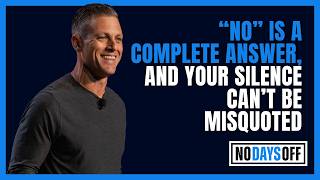
Brian Gubernick argues that saying "no" without explanation and using strategic silence gives you negotiation power. Each extra sentence you add creates openings for the other person. The real leverage comes from self-control: saying less, meaning more, and tolerating the discomfort of quiet.
Chapters
Thank you for joining me today. It's Brian Gubernick, and welcome to the No Days Off podcast, where we believe that every single day brings a new opportunity to get better. I think there are two sentences that every entrepreneur should internalize. The first: no is a complete answer. And the second, your silence can never be misquoted. I think that most people conceptually understand this, but I think very few leverage that knowledge. A lot of people struggle in negotiations and conflict and money conversations for a simple reason. They just talk too much. They explain, they justify, they try to sound reasonable, and in doing so, they start to give away a lot of leverage. So these two ideas, "No is a complete answer" and "Your silence can never be misquoted," these can dramatically change how the type of conversation I just described, how they go. And again, you probably conceptually understand it, but you've never actually deployed it. These are tools. You start leading conversations when you use tools like this instead of reacting to them. What do I mean when I say we default to explaining? What do I— what's actually happening in scenarios like that? When someone asks you to reduce your fee, or lower your compensation or bend on a standard or a boundary or agree to something you don't want to agree to, your natural instinct is to explain why. Explain your fee or your value or your standard and why it exists. And that instinct doesn't usually come from logic. It comes from discomfort. Silence feels really awkward. I mean, I'll tell you, for me, definitely had to develop this muscle. Short answers sometimes feel rude. Again, another muscle that I had to develop. Most of us were conditioned to believe that being clear requires being pretty verbose, and that's— I found that not to be true. Here's the reality. Every extra sentence you add becomes something the other person can negotiate against. In other words, you're not usually being helpful. You're maybe creating some openings. Now let's go to the first tool, the idea that no is a complete answer. When someone makes a request that you're not willing to meet, you are absolutely allowed to say no, and that's it. Or maybe you want to say, no, uh, that doesn't work for me. Or no, I'm not able to do that. Then you stop. That's it. You don't need to tell a story or create a defense or look for permission. I think when delivered properly, a clear no isn't aggressive. It's more informative. When people overexplain after saying no, what they're really signaling is some uncomfort or— uncomfort or uncertainty. When you have strong boundaries, they don't require justification. They actually require your conviction. Now, the second tool, which is really about strategic silence, it's— I think it's even harder for most people. Just, just being silent. Silence is uncomfortable, especially when the other person expects you to respond immediately. But silence does something that I think is pretty powerful. It shifts the pressure back to the person making the request. So when you stay quiet, they're going to keep talking, or at least start talking. When you stay quiet, they're likely to reveal more than they intended. Sometimes they even go about solving the problem for you. And the key insight here is that your silence can never be misquoted. What do I mean? Words can be taken out of context, right? But silence cannot. Silence insulates you. It protects you, especially when emotions are high or, or stakes are real. Now, where does this show up in real conversations? I think this matters when someone says something like, "Can you do it for less?" Or, "We were hoping you'd be flexible." Or, "That number is higher than we expected." Most of us rush to respond, but you don't have to. When someone says, "Can you do it for less?" You can say, "No, no, I can't." We were hoping you'd be flexible. No, I, I can't. That number is higher than we expected. Maybe in that scenario I just say nothing. And then you wait. And what happens next tells you everything. If they adjust their position, there was probably some room. If they push, they were testing. If they walk, Well, guess what? They probably weren't aligned anyway. None of that clarity happens if you fill the silence. Here's the deeper truth to all of this. Negotiation power doesn't come from clever language. You know, just recently we did an episode about Chris Voss and his strategies, and I don't see that as clever language at all. I see that again, you know, what I described in that episode just a couple episodes ago as tools, just as I'm describing here. Negotiation power doesn't come from language, clever language. It comes from self-control. The ability to say less and mean what you say and even let discomfort do some of the work, that's self-control. A calm no protects your standards, protects what it is you stand for. Silence protects your position. When you stop talking out of fear, I think you, you begin to start leading with a bit more intention. So this week, what I want to challenge you to do, you're going to find yourself in some sort of negotiation or difficult conversation. You know, these scenarios where you traditionally would do more talking. And instead, I want you to try this out. I want you to just say no and hold the line. I want you to be silent where appropriate and, and let it feel a little uncomfortable and watch how it works for you. I promise you that you start working on these sorts of things and you find yourself negotiating and leading a little bit differently and having more success is direct result. That's all I have for you today, the No Days Off Podcast. Thank you so much for listening, and remember, every single day brings a new opportunity to get better. So let's get after it.