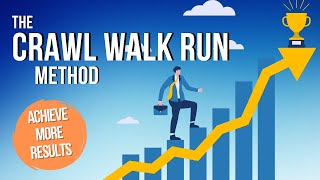
In this episode of the No Days Off podcast, host Brian Gubernick introduces the "crawl, walk, run" framework as a practical approach to achieving faster, sustainable results in both business and personal life. He begins by emphasizing the No Days Off philosophy of daily incremental improvement and warns against the common tendency to dive in too aggressively. Drawing on lessons from a mentor named Sam, Brian explains the three stages: Crawl – starting small with research, planning, or a minimum viable product; Walk – building on the foundation by scaling, expanding teams, or increasing marketing; Run – leveraging momentum for rapid growth and taking calculated risks. He highlights the dangers of overextension, such as costly mistakes and burnout. To illustrate the method, Brian shares a story from his experience running a CrossFit gym with partner Derek, where they used tiny dietary swaps (e.g., replacing fries with broccoli) to help clients develop sustainable habits, embodying the crawl stage before moving to larger changes. He concludes by urging listeners to reflect on whether their own resolutions are too aggressive, encouraging them to scale back, secure early wins, and progressively move through the crawl, walk, and run phases. The episode ends with a motivational reminder to seize daily opportunities for improvement.
Chapters
Thank you for joining me today. It's Brian Gubernick, and welcome to the No Days Off podcast, where we believe that every single day brings a new opportunity to get better. Let's get into today's topic. Today we're going to be discussing the crawl, walk, run to business and life. See, we're talking every single day about taking a no days off approach, meaning that we're taking action. We're going to read, we're going to learn, we're going to study with the idea, with the idea, with the focus being to get a little bit better at something every single day. However, I do know that when we take on that sort of project, that sort of thing, we may want to go all in. We may want to go all out. Frankly, we may take a jump that's too far. As opposed to implementing incrementally, which brings us to crawl, walk, run. See, uh, over the past few years I've been working with a guy who I've become pretty friendly with. His name's Sam, and Sam taught me an awful lot about business. He taught me how to slow down and instead of trying to accomplish everything in one single day, he said, we've got to phase this approach. We've got to incrementally attack this project. And therefore, Brian, we're going to leverage a crawl, walk, run strategy. So what does that mean? What is that all about? Crawl, walk, run is a business metaphor that really describes the stages of a project or a business venture. Basically means that you start slowly and you build up momentum over time rather than trying to do everything at once, like I have a tendency to do. So here's what each stage really means. Okay, so in the crawl stage, this is starting small. This is taking small steps. This is building momentum. It's about getting started. It's about laying a foundation for future growth. So this might, in business, this might be research. This might be writing a plan. This may even be testing some sort of minimum MVP, minimum viable product. Maybe it's just putting a toe in the water. Maybe it's your V1 if it's a business project. If it's a life project, maybe it's just, again, laying out the research, doing the analysis before you're making a full commitment on a direction. Now, when you shift from the crawl stage and move into the walk stage, what you're really saying is you've laid the foundation now and you're ready to start scaling. This might be expanding a product line or, or building a team, or investing in advertising, or just going deeper with this plan that you outlined in the crawl phase. Now we've moved into walk. The last stage is known as run. And this is when you've really, you know, you've got the foundation, it's time to take off. The business maybe is scaling or it's thriving, you're able to grow a bit more rapidly, you're able to capitalize on opportunities, you're able to take, some, some more risks, more calculated risks to continue to expand. Bottom line, this crawl, walk, run approach, its objective is to really help you not overextend yourself. And when you overextend yourself, when you commit to too much, when you do things before you actually planned, well, it can lead to some costly mistakes. So start small, build momentum, and gradually scale up. And as you're doing that, you're gaining experience and you're coming up with new resources, new education, new research that you can make smarter decisions around. So how does this apply now to No Days Off? Going back to what I was originally saying, we have a tendency to dive in and want to just take it all on. And I'm going to encourage you to slow down a little bit. Here's a good example, I think, and this goes back to my, my days running a gym. A CrossFit gym with a partner of mine, and we would have individuals come to the gym, and they'd work out so darn hard, and they'd be committed, but they wouldn't have the success that they desired. And what we found out was that they likely weren't having that success because while their workouts were strong, their diets, their food was off. So when we'd sit down with them, when my partner Derek would sit down with them, and he'd start devising a food plan, He would always say to them, somewhat joking but dead serious, rather than outlining an entire overhaul to their food plan, he'd say, "Here's what I want you to do. I want you to eat broccoli." And it would sound like a joke, but it wasn't. What was he really saying? He was saying, instead of having those fries on your plate today, how about we just swap it out for broccoli? Instead of having that cheese, or whatever it is that is deemed unhealthy that you shouldn't have in your diet. Why don't we just remove that and insert, in this case, broccoli or something else that would be a healthier replacement? See, the idea was we can't just go to the walk or even run, or the run phase. We've got to crawl. And crawl, when it comes to your food, is making a small incremental change. Make that change, implement it, create a new habit around it, and then layer on the next thing. So maybe after you add broccoli, maybe it's, you know, adding a new component to your diet. Maybe it's eating more fruits and vegetables and a little less grain and breads and things of that nature. But you're just creating a crawl, walk, run strategy. So the focusing question for you today, in all that you're implementing, all that you're doing with this No Days Off movement, are you moving a little too fast around certain things? I'm not trying to hold you back. I'm just saying, let's look in the mirror and, and do some analysis here. Are we making New Year's resolutions, which oftentimes fail? Meaning that, are we putting— are we, are we coming up with this grand plan that is going to be really difficult to implement? And could we revise it a little bit, maybe scale it back a bit, get some victories, get some wins, have some success, and then build? And move it into bigger phases like the walk and then eventually the run. So where in your life have you aimed to make changes that might be a little too aggressive and that if you scaled back, the likelihood of being success would be significantly greater? That's all I have for you today. Remember, No Days Off Podcast. Thank you so much for listening. Tell all your friends and peers about our podcast. And of course, remember, every single day brings a new opportunity to get better. So let's go get after it.