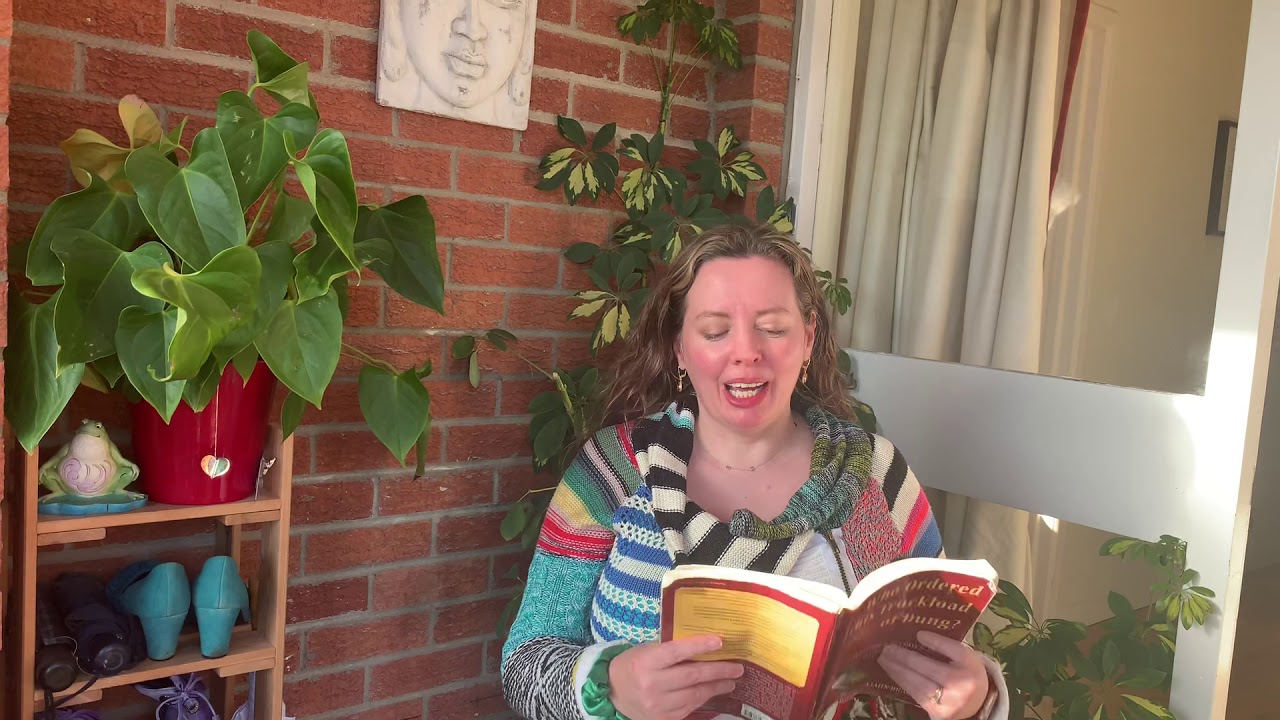
In this YouTube video Bridget reads the story "Two Bad Bricks" from Aijan Brown's Who Ordered This Truckload of Dung. She begins by explaining how a former student, Chris Fars, recommended the story, highlighting its relevance for perfectionists. Bridget then recounts her own experience building a monastery wall in 1983 after purchasing land with no resources. As a former theoretical physicist turned monk, she struggled to lay bricks perfectly, eventually completing a wall that contained two misaligned bricks. The abbot refused to let her demolish the wall. Later, a visitor pointed out that while the two bad bricks were visible, the 998 good bricks were also present, shifting Bridget's perspective to appreciate the overall structure. She extends this insight to relationships, mental health, and personal growth, arguing that focusing on a few flaws blinds us to the many strengths. Finally, a builder shares a commercial secret: mistakes are often marketed as unique features, reinforcing the idea that perceived flaws can become valuable assets. Bridget thanks her husband for filming and closes the story.
Chapters
Hello, it's Bridget back again with story number four from Who Ordered This Truckload of Dung by Aijan Brown, the wonderful Aijan Brown. So tonight's story is Two Bad Bricks. It's a really wonderful story. It's the first story in the book, and it was highlighted to me maybe about ten years ago by a young man who came to the class, Chris Fars. Hi, if you're watching, if you're out there, Chris. He came to the class for 6 weeks and then he signed up again for another 6 weeks and he brought his friend. And I was really surprised because he was a young guy. But there was one night I was looking for a story to read and I said, anyone recommend a story for tonight? And he said, yes, Two Bad Bricks. And I was so touched because that not only meant that he had went out and bought the book, but he'd actually read it as well. And this story had touched him and— That's amazing. Since then, I've read it quite a lot because it is a really wonderful story. It's really helpful if you're a perfectionist, and it's quite inspiring, and it helps us get things in perspective. And, um, yeah, I think you're gonna remember it. It's quite interesting, it's quite fun. It's also quite long, so settle back, sit down, and here we go with the story of The Two Bad Bricks. After we purchased the land for our monastery in 1983, we were broke. We were in debt. There were no buildings on the land, not even a shed. Those first few weeks we slept not on beds but on old doors we had bought cheaply from the salvage yard. We raised them on bricks at each corner to lift them off the ground. There were no mattresses, Of course, we were forest monks. The abbot had the best door, the flat door. My door was ribbed with a sizable hole in the center where the doorknob would have been. I joked that now I wouldn't need to get out of bed to go to the toilet. The cold truth was, however, that the wind would come up through that hole. I didn't sleep much those nights. We were poor monks who needed buildings. We couldn't afford to employ a builder. The materials were expensive enough, so I had to learn how to build, how to prepare the foundations, lay concrete and bricks, erect the roof, put in the plumbing, the whole lot. I had been a theoretical physicist and a high school teacher in lay life, not used to working with my hands. After a few years, I became quite skilled at building, even calling my crew the BBC, the Buddhist Building Company. But when I started, it was very difficult. It may look easy to lay a brick, a dollop of mortar underneath, a little tap here, a little tap there, but when I began laying bricks, I tapped one corner down to make it level, And another corner would go up, so I tapped that corner down and then the brick would move out of line. After I nudged it back into line, the first corner would be too high. Hey, you try it! Being a monk, I had patience and as much time as I needed. I made sure every single brick was perfect, no matter how long it took. Eventually, I completed my first brick wall and stood back to admire it. It was only then that I noticed— oh no, I'd missed 2 bricks. All the other bricks were nicely in line, but these 2 were inclined at an angle. They looked terrible. They spoiled the whole wall. They ruined it. But then the cement mortar was too hard for the bricks to be taken out. So I asked the abbot if I could knock the wall down and start over again, or even better, perhaps blow it up. I'd made a mess of it and I was very embarrassed. The abbot said no, the wall had to stay. When I showed our first visitors around our fledgling monastery, I always tried avoiding taking them past my brick wall. I hated anyone seeing it. Then one day, Some 3 or 4 months after I finished it, I was walking with a visitor and he saw the wall. That's a nice wall, he casually remarked. Sir, I replied in surprise, have you left your glasses in your car? Are you visually impaired? Can't you see that those 2 bad bricks spoil the whole wall? What he said next changed my whole view of that wall, of myself, and of many other aspects of life. He said, yes, I can see those 2 bad bricks, but I can see the 998 good bricks as well. I was stunned. For the first time in over 3 months, I could see other bricks in that wall apart from the 2 mistakes. Above, below, to the left, and to the right of the bad bricks, Were good bricks, perfect bricks. Moreover, the perfect bricks were many, many more than the 2 bad bricks. Before, my eyes would focus exclusively on my 2 mistakes. I was blind to everything else. That was why I couldn't bear looking at that wall or having others see it. That was why I wanted to destroy it. Now that I could see the good bricks, The wall didn't look so bad after all. It was, as the visitor had said, a nice brick wall. It's still there now, 20 years later, but I've forgotten exactly where those bad bricks are. I literally cannot see those mistakes anymore. How many people end a relationship or get divorced because all they can see in their partner are 2 bad bricks? How many of us become depressed or even contemplate suicide because all we can see in ourselves are 2 bad bricks? In truth, there are many, many more good bricks, perfect bricks, above, below, and to the left and to the right of the faults, but at times we just can't see them. Instead, every time we look, our eyes focus exclusively on on the mistakes. The mistakes are all we see. They're all we think there are, and so we want to destroy them. And sometimes, sadly, we do destroy a very nice wall. We've all got our 2 bad bricks, but the perfect bricks in each one of us are much, much more than the mistakes. Once we see this, Things aren't so bad. Not only can we live in peace with ourselves, inclusive of our faults, but we can also enjoy living with a partner. This is bad news for divorce lawyers, but good news for you. I've told this anecdote many times. After one occasion, a builder came up to me and told me a professional secret. We builders always make mistakes, he said. But we tell our clients that it is an original feature with no other house in the neighborhood like it. Then we charge them a couple of thousand dollars extra. So the unique features in your house probably started out as mistakes, in the same way that you might take to be mistakes in yourself. What you might take to be mistakes in yourself, in your partner, or in life in general, can become unique features enriching your time here once you stop focusing on them exclusively. Thank you, and thank you to my husband for filming. Thanks for hating. See us all tomorrow. Cheers.