Bryan Johnson Fireside Chat (Full Interview)
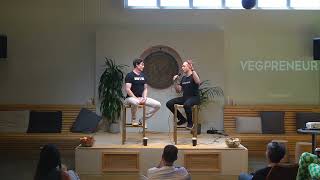
In this fireside chat, entrepreneur Bryan Johnson discusses the mental health challenges of founders, the philosophy behind his Blueprint "don't die" longevity program, and how he applies scientific rigor to health, nutrition, and protein intake. He explains Blueprint as an economic response to society’s increasing spending on extending life, describing a model that maps the human body’s 35 trillion cells to a single objective: reduce daily mortality. Johnson critiques grind culture, shares his approach to building plant‑based consumer products without triggering tribal debates, and outlines how to embrace haters as useful feedback. He explores AI’s role as a future custodian of knowledge, urging a shift from knowledge‑based work to embracing "not‑knowing" and aligning AI with human goals. Johnson connects these ideas to broader existential threats—climate change, nuclear risk, and AI alignment—arguing that personal health protocols can serve as a micro‑cosm for planetary alignment. He also reflects on his personal motivations, early influences from biographies, his investment focus on deep‑tech (synthetic biology, genomics, brain‑interface), and offers advice to younger entrepreneurs about seeking novel insights in the dark, rejecting grind culture, and preparing for AI‑driven societal transitions.
Chapters
All right, and now to today's speakers. He really doesn't need an introduction, so I just want to welcome up Brian Johnson today and thank you again for being here. Next slide.
Thank you.
How are you today?
Great. Are we sharing a mic?
Yeah, we're sharing.
Okay. Or, Mick, we have a mic. We don't.
Let's do a mic for the camera. Tyler, should we do a mic?
Okay.
Yeah, let's do the mic.
Oh, I see it's on there.
Okay. So thank you for being here today. We're gonna skip your story. I assume most people already know it. I'd love to talk about building companies today with you, specifically plant based ones, sustainable ones. From what I understand, you were pretty miserable when you were building up Braintree. Can you talk a little bit about, like, mental health and how founders can sort of approach building a company in a more healthy, sustainable way? You're doing it again now with Blueprint.
Yeah. How many are you all building companies? Everyone here? Yep.
Raise their hand.
Yep. So you're all mentally ill? A little bit. That's the truth, right? Yes. Yeah. It takes a certain kind of person to go about and do something crazy. Yeah. I guess my thoughts go to. So when I was 21 years old, I felt like I wanted to do something meaningful for the human race. Like, that was the thing that burned inside of me. And at that moment, I don't think I ever could have imagined how much pain I would endure to do that given thing. To make your way through entrepreneurship. And I wonder if many of you would feel the same way. That the amount of difficulty you've experienced in your life up until this point when you started far exceeds what you ever thought would be the case. And there's many moments where there's an overwhelming desire to quit. It's very hard to sometimes get up. Sometimes you feel crushed by reality. And so for me, it was. For some reason, I always had this burning inside of me. I don't even know what it was or where it came from. It just kept me going. And I suppose a relevant question for all of us is, what is our why? What is our source of energy? Because to me, that was the thing that made the make or break difference of whether I could get back up after getting knocked down. And if you, you know, I guess whys are not. They're not like universal truths. They're things we can make up sometimes. But to me, I guess I had a why that was sufficiently strong that, yeah, I got it. Allowed me to keep on getting back up when sometimes Entrepreneurship feels like you get dunked in water and just when you come up for air and you gasp, you get dunked again, sometimes before you even get a gasp of air. But, yeah, that was my experience. It's pretty tough, especially when things compound on top of each other. So one, I guess I feel you. I don't know where all of you are at in life, but definitely can map maybe some of the realities which you may be experiencing.
Can you explain why you're building Blueprint?
I guess if you know the value of human life has increased quite a bit over the past few centuries. It used to be the case that humans would die and it was okay. So maybe if you look at it through economics perspective, how much money did society spend to save a life 500 years ago? And how much money does society spend right now to save a life? Let's just talk about the United States. And so if you look at the infrastructure, like in this room, there's all kinds of infrastructure. Like this building was built to code. It passes standards. There's probably a smoke detector. It looks like there's. Are there water in case of a fire maybe?
I hope so.
We came in cars. A lot of us did that have seat belts and airbags. There's regulations on the roads. If you look at the societal infrastructure of how much we as a society pay for human life, it's very, very high. And if you think about it, I'll just draw a graph in the air. So y axis, X axis. So the amount of money spent on dye has been going up since the beginning of Homo sapiens. And so dye is like things like smoking and alcohol and violence and environmental toxins, like all the things that make us die. And I think that line is going to peak in the 2020s and then go down as a spend. And there's another line that basically starts beginning of Homo sapiens 200,000 years ago, and it goes up almost exponentially in don't die. So if you look at the amount of money this human race spends on don't die, it's climbing very, very fast. And that's all this infrastructure we have in place. And so blueprint is an observation of an economic trend of how much is society going to spend on don't die? And it's going to be exponential. And the hypothesis is that when AI makes progress and it starts doing a lot of fundamental things we do, our attention is going to be diverted and it will be basically around don't die. So blueprint is what we're trying to do is we said, I'm a collection of 35 trillion cells. I die a little bit every single day. And so can we figure out all the ways I die and then can we figure out how to make me die less every day? And so it's just been this methodical scientific process on how to die a little less every day.
Thank you. I'm trying to match your posture. That's very difficult. Can you talk about the protein craze that we're in? It seems like everybody seems to not be getting enough protein. What are your thoughts on protein and how do we maybe address it a little bit better?
My protein intake is 110 grams a day and it's adequate. I can do it on a vegan diet. And so what I've done is we are caloric restricted and vegan, and I do an hour a day in exercise and a lot of people don't think those things map to my body muscles. In the 99th percentile, my cardiovascular capacity is top 1.5% of 18 year olds. So a lot of people don't think you can be strong and fit and vegan and caloric restricted and 110 grams of protein and 100 biomarkers that are ideal. And so we've tried to show you can in fact, achieve ideal health with that approach.
How do we best educate the world on these facts?
That's what we've tried to do with Blueprint, is we all know that when you go out in the world and you're trying to find an opinion on a given thing, you're going to find an infinite number of opinions that all disagree. There's no consensus, and it's hard to reconcile how to discern what you should do. And so we've tried to do this with Blueprint, where we say, I say, tongue in cheek, that blueprint is the health protocol, best health protocol built in human history. Prove me wrong with your data. Because if you're out there and you're trying to navigate the complexity of health and wellness, we're basically saying, here's an answer for you. Here's all your meals, here's all your supplements, here's your exercise protocol, here's your sleep protocol. Just do that. You don't need to spend, you know, 10 hours a week reading books and listening to podcasts and taking your own notes, like, good luck with that kind of stuff. So we really have tried to squash complexity so that if somebody just wants the power laws of longevity, we're a safe place to show up. Because right now I've been through this myself. If you're out there on your own, it's impossible to figure out what's going on and you're just going to be whipsawed through everyone's opinions.
Why do you think the future is Nuts, lentils, berries, as opposed to, you know, foods made in a lab?
We really don't maintain any strong opinions about anything. We're kind of open minded to everything. Yeah, the what we tried to show is that when technology achieves a certain level of ability in society, we humans rush to adopt it. So we all use navigation, digital navigation. Most of us use AI chat tools, most of us use the Internet. Most of us use. So when technology crosses a certain threshold of usefulness, all of our moral and ethical qualms kind of just evaporate and we just adopt it ferociously because it allows us to achieve our objectives. And that's what I've tried to show with blueprint is that this algorithm of blueprint takes better care of me than I can myself. And it challenges all these fundamental ideas I have about being in a human. And so yeah, I think I'm open to this concept of an algorithm running me with any input, which helped me achieve biomarkers because I really want to play other games in existence other than deciding what to eat. Cool.
Can you talk a little bit about building a CPG company in 2024, specifically a plant based one? Are you using terms like plant based and vegan or how are you getting the word out?
We have avoided most of the triggering elements that get people to separate into tribes and go to war. We've chosen other battlefields that you all know this, that the moment you mention meat or plant based or vegan or something, you're in for a fight. It's a cage match. No one ever wins. Everyone just gets bloodied up. And so we have steered clear of those wars, trying to focus on other objectives of as a species, the only thing we care about is just not dying. It's like literally the only thing on our to do list. Everything else just kind of pales in comparison. And so don't die also includes taking care of the planet and taking care of other intelligent other things which are also intelligent.
How do you deal with the haters building a company? Obviously you deal with hate and then you especially do a lot of trolls come your way. How do you suggest people deal with that? And how do you stay asleep at night.
If you don't have haters? You want to dial it up. You really do want the energy of haters. They're fantastic. They bring so much energy and they offer great perspectives. And they're in. They stand up and they're engaged in the conversation. Love them, embrace them, have fun with them. A lot of people's ideas are that haters are to be avoided or to be annoyed at, be grateful. They are taking their time to hate you. It's a compliment. So if you don't have haters, dial it up.
We're going to leave some room for Q and A as well. So if you have any questions, start thinking about those. What advice do you have? Or let me ask you this question. If you weren't building blueprint right now, what else would you be building? And I know you're working on other projects, but what other opportunities do you see in the space that other people should be going after?
I guess I'll share with you what motivates me, and that may not be true for you, so I'll give this a go. My primary relationships with other people are those who live who are basically dead now. They're biographies I've read throughout history. And when I have a problem that I'm thinking through, I'll reference somebody in the past and I'll have a dialogue with them in my mind. And they're people that have done remarkable things throughout history. And I do the same thing with the 25th century. So I imagine existing in the 25th century and speaking to the. To whoever exists there and having that dialogue. And what I specifically don't do is try to talk to anybody who lives right now. Because, no offense, this is true for all of us. We live, we are, because we exist in this moment. We are blinded to this moment. We can't see it. And that's been true throughout history. And so for me, the game I find fun to play is what is invisible right now that very few can see. And if you're constantly consuming the opinions of other people, you're most likely to be inundated with the opinions and ideas of this moment. And it's going to block you from seeing interesting things. And so I've personally been working on this for 10 years, and this is where don't die came from. It sounds really simple, but it took me 10 years to come up with. And it's basically, if you pose this thought experiment, if the 25th century could whisper in our ears and they're looking at us from like a century long timescale, what is the one thing that Homo sapiens figure out in the early 21st century that allowed for intelligence to thrive in the galaxy. So when you think of that, when you do that thought experiment, 99.9% of all that happens washes away. It's insignificant. It doesn't matter. It's like all the political drama that's happening today, no one's going to remember ever. It just doesn't matter. The drama in our personal lives doesn't matter. It just all washes away. And so if you try to say what value survives the compression of a few hundred thousand, a few hundred years, you're focused to say, you're focused to apply that filter and say the majority of all your thoughts, actions, behaviors, cares, ideas don't matter. They're compressed with time in the same way that the 13th century is reduced to. Call it what, 500 books, 1,000 books, whatever, some small number. But the majority of what happened in that time is based, is gone. And so for me, I guess the value I try to offer each one of you is in whatever you're trying to do. Try to find novelty of thought and novelty of action and try to push out the noise of the things that people in this time and place are pressuring you to do, to conform with social norms. And there's just been. It's a pretty unique time that original thinkers can do amazing things and very quickly, unlike any other time before. So usually original thinkers get ostracized by society. They don't really have a shot. But the Internet and AI allows for breakout moments that haven't been present before. So that would be my. What I encourage you to do is. And it takes time to develop the skill.
What advice would you give your younger, younger self?
It would. Okay, so I was raised in this small religious community, and in that group, I was only basically invited to look at the light. So I could only see the elements that religious group wanted me to see. And then there was a clear line that said, things over here on the dark side, you can't look at, like, these are ideas you can't touch. There are bad things, they're evil things. They're going to make you go to a wrong place after this life. And so basically half of reality was blocked off for me because it was framed as evil. And since leaving that, I find that I actually hang out. I enjoy hanging out more in the darkness than I do in the light. And many of these ideas, for example, how do you find ideas that no one has, Oftentimes they're hiding in the dark because everyone else is looking in the light. So there's this funny story where it's not a story, but. So there's a gentleman on his hands and knees under a street lamp, and he's looking for something, and someone walks by and they're like, excuse me, can I help you? And he says, yeah, I'm just trying to find my keys. And he said, okay, where did you last see them? He said, well, over there. And he said, confused. Why are you looking for your keys under this light when you last saw your keys over there? He said, because the light's here. And so often we look for solutions where we can see light and the darkness has been a fruitful place. It's counterintuitive, but I would give myself the advice that many of life's joys and greatest insights will be found in the dark.
Are there any companies that you look towards or leaders in your space or beyond that you think are doing a really good job in setting a good precedent?
I go back to biographies as being my source of inspiration. The thing I admire most is how can one rise above their time and place and do things that are impossible to that generation and blind to that generation? That's, to me, what I find to be the most beautiful attribute of the human race.
What do you think today is the best use of AI for everyone in the room? Maybe we can focus on entrepreneurship.
I would say if you can properly project where it's going and situate yourself. The thing that's happening is we humans are the custodians of knowledge, which means we know stuff and we share knowing in many things. We pass on knowledge, and so as a species, we just share a knowledge base. And AI is going to become the custodian of knowledge because it's going to be better at knowing things than we are. It will know more things and be better at knowing those things than we are. Now, when that happens, our primary skill set is not going to be in knowing. Our primary skill set is going to be in not knowing. That is the most radical transition ever. So this is framed. I call this a first principle thinking versus zeroth principle thinking. So first principle thinking is what engineers talk about, where you identify things you know, and then you try to make the fewest assumptions possible and then step your way into a solution. So it's just like how we do knowledge mastery, zero principle thinking. You don't know anything. So Einstein's discovery of special relativity was a zeroth principle insight. You can't start with Newtonian physics and arrive at special theory of relativity. You had to pull it from another dimension the same is true with a vanishing point in Renaissance art. The same is true with the discovery of germs. So with AI, sure, you can use chat tools and like all the computational methodologies that are being used, but really, it's a fundamental shift on being human where we transition from knowing to not knowing. And it's building businesses and doing things in your life where you actively interact with. Embrace not knowing. Because I guess like the. The tangible thing here is AI progress is going to create existential dread for humans. When AI does something threatens our jobs, most people freak out and they say, I don't understand why I exist anymore. And if you're prepared for this transition, you're not surprised by it. You'll be in a better psychological state to build your business knowing that these things are happening. And so really, to me, it's like not being shut down with existential dread or psychological confusion. When this inevitable transition happens.
Do you think we as a species will be able to address the climate crisis? And how.
Yeah, this so blueprint is my effort of trying to actually physically be. Be the existential problems that we face as a species. So we have climate change, we have basically a question, will the Earth be sustainable? We have a question if we will annihilate ourselves with nukes or bioterror weapons or whatever. And we have a question whether AI will enable us to survive ourselves. And so if you take any one of those three existential problems, then any one of us in the room can say, you acknowledge the problem exists, but then the question is, what do you actually do about it? And that's a pretty powerless contemplation. And so I wanted to propose something where each one of us could actually be the problem and solve the problem independently. And so we did that by understanding me as a collection of 35 trillion cells and said, can we make my 35 trillion cells cooperate towards one objective, which is die? And so specifically, that means when 7pm me wants to eat a box of crackers, that is called goal misalignment, right? There's a version of me that wants to do something that increases disease and aging and death. And there's another version of me in the morning me which is like, no, I'm going to eat well and I'm going to exercise. I'm going to be the best, better version of myself. So that's a fracture of interest, it's a fracture of alignment. And that's what we have on the planet, where we're all chasing after different things and at least these big problems. So I Wanted to say, can I algorithmically get me on the same all my 35 trillion cells towards the same objective. And if you map that to planet Earth, it's the same thing. Replace my body with planet Earth. So instead of measuring me with all these different things, you measure planet Earth with millions of data points. You create a scientific protocol for how you maintain a healthy biosphere, coral reef, et cetera, et cetera. And then you implement the protocol and then humans deal with that protocol instead of right now we treat our personal bodies like we treat planet Earth like we're helplessly self destructive with our own bodies and with Earth. And so it's an identical relationship. And so then with AI, we basically, if you're familiar with these concepts, AI is all about goal alignment. It's like how do you get AI to not destroy existence, destroy us? And so you're goal aligning. And so I was trying to the goal alignment within me. So these ideas like a little esoteric but again I'm trying to be the AI alignment problem. I'm trying to be climate change. I'm trying to be how do you get all humans to cooperate in planet Earth? And so I'm basically trying to say how do we as a species not die across every existential threat we face? And so I know from an outsider's perspective, blueprint is about, you know, health and wellness. It's really about the existential crisis and existential threat and also the most magnificent opportunity we've ever had as a species on the cusp of baby of superintelligence. I love it.
Grand vision. Before we go to Q and A, what are you working on right now that you're excited about that you can share and then we'll open it up for questions.
Yeah. So the team, the blueprint team has this hypothesis that. Okay, I guess I do. I hope the blueprint team members do as well. AI is progressing so fast, it's creating existential crisis at regular intervals. So GPT4 did that and GPT5 is going to drop and other things. And when that happens, it's going to make inroads into our jobs, it's going to make inroads into what we do. And it's going to invite this question, why? Who are we? Like what's our identity? Do I have status? Do I have power? What's my game? I'm playing in life? And we're trying to drop don't die in as the guiding philosophy for the human race for the 21st century. And so it sounds far fetched because Typically, it takes quite some time for a new philosophy to run the world. But if there's crisis, sometimes decades go by and there's weeks of progress, and sometimes weeks go by and there's decades of progress. And I think that crisis is going to strike. And when we do, humans and all of our organizations and nation states are going to be asked these really basic questions about our existence. And I'm hoping that don't die can slip in there. So that's really where all my attention is. How. Because if you take the problems we have as a species right now and you go out in the world and say, okay, who has ideas or suggestions of what we should do, like capitalism or religions or communism or, like, who has any idea at all on what we do? No one does. Nobody has any answers on how you actually practically solve this stuff on a species level and with AI. And so, yeah, I'm hoping that we can slip that in and that it leads to the most spectacular existence ever.
Awesome. All right, let's open it up for some Q and A. If you want to shout your question, I'll repeat it.
Hi. Hi, Brian. I'm in the VP 5000. Thank you so much. I'm excited for that. Do you think that with all this corporate mindset, you think as a big CEO of owner of a company could, because of your experience, could using V blueprint, not have all the things that you had when you were a CEO of a company like Google decide the same deciding of, I'm gonna not eat, maybe for lunch because I have a meeting, or all the different problems that the entrepreneurs live when they're having that company?
Yeah.
Okay. I think you heard the question.
Yeah. Can entrepreneurs be healthy? Yeah, full stop. I think it's actually if we inspect the question underneath, there's an assumption that grind culture must be true for success to be achieved. So the assumption is you can't sleep well, you don't have time for exercise, that unless you're spending 16 to 18 hours a day working, you're somehow less than or you're going to be beat or. So those are the assumptions currently. And I think if we examine those assumptions, I don't think they're true. I think you could even go on the other extreme and say it's better that a person only works like six hours a day. I'm making this up. But it could easily be the case where you say a person that's well rested, well nourished, and in good shape is basically making better decisions than the impaired people who aren't sleeping. And so I think we have bought into the cultural norms and we think the world must be that way. I think it's just a fabrication and a mirage. I know. Personally, I think Braintree and Venmo would have been a much more valuable company if I would have had the clarity I do now that results from a healthy lifestyle. So I would basically call out Grind Culture as a false narrative.
Yes, Jim.
Brian, I applaud you on your prior business successes. You've done some amazing things and congratulations for that. And I love what you're doing with Blueprint as a model for the individual and for the planet as well. But Blueprint is a for profit company. What do you plan on doing with the money you've made?
The past?
The money you hope to make with Blueprint?
Yeah.
Blueprint is a for profit company. What do you plan to do with the money you make in Blueprint?
Yeah, I grew up poor. I didn't have any money to my name until I was 34 years old. My mom made my clothes for me when I went to school and I gambled my entire existence on making money through entrepreneurship. And I was willing to accept poverty level living to achieve that for my, you know, until age 34. And I got lucky. So I've never been one to find utility and money in buying a yacht or in having homes around the world. I've plowed all of my money straight into exactly what I said I would. So I put $100 million into an investment fund doing deep tech in synthetic biology, genomics, computational therapeutics. I did 65 million in a brain interface company trying to do neuroimaging for the masses and then Blueprint. So I've been true to my 21 year old self and money has not corrupted me, so I don't think it will. I'm pretty, I'm pretty dialed in on my life's objective and the fancies of money just are not even interesting to me.
Next question.
Hey, Brian, you know, there's a lot of industry that's kind of geared towards making us not feel at our best, you know, trying to make us sick, trying to help us die.
Yeah, big money back.
So you've obviously kind of accepted this fight. Do you feel like you've got people outside of the French team to work with you? And it's part two. Have you accepted or rejected Bismuth 213 for some reason?
The second one.
Yeah, the second 113. The concept being able to beat cancer free for a short period of time.
Oh, so the first question is, do you have any allies in what you're building and making people healthier? And then the second one is about.
It's a science question.
Science question. Okay, cool. Is Dr. Zollman here?
So, yeah, I'm unfamiliar either I didn't hear you or unfamiliar with the topic on the second question. So nothing there on the. Yeah. On the alignment. There's been an outpouring of support and interest in combining. And so I think I did blueprint for two years and then the Bloomberg article was written last January 25th and it just blew up. And Vance, he's the biographer of Elon Musk, he mentioned he's never in his life seen anything with this much energy underneath it. He's just blown away. And we've seen a little bit of that in the past 12 months. And I think that's just the initial reaction. I think there's a lot more unaccounted for energy on what's happening. And I think it maybe goes to this idea that we all feel like things are a little off. Like this idea that our institutions and societal norms are killing us doesn't quite make sense to it. And we kind of feel like we're helpless within these systems. The don't die, even though it's confusing to people and it's not like a very clear situation because it challenges everything you understand about reality. It has all kinds of latent energy behind it. So I'm very bullish that we've only seen a glimpse of the true energy behind this and that it's going to get a lot more rowdy and fun in a very short period of time. Because I think, again, I think that curve of the transition from once we hit an inflection point where there's more money spent per capita on don't die than die, it's just going to run. And so if you look at it, this is like where I love the beauty of trying to compress reality. If you just look at it through an economics perspective. Follow the money. Where's it going? And the dominant destination was dai. And now you've got emergent don't die, which is on the rise at a pretty rapid pace. And yeah, I think there's probably a tipping point here where as a species we move very hard into don't die. Because once we all want to play that game, there's that closed loop reinforcement happening. So I think it's going to go and go fast. Thank you.
It's 44. Do you want to take one more question?
Cool.
One last question.
James, thanks for being here, Appreciate it. So you're obviously very like driven and determined to do these things.
Right.
And you see more money being spent. A lot of that's being spent on.
Drugs like popping a pill or taking.
Surgeries and that type of thing. So how much is the blueprint taken? Because it's one thing tacking information, right?
Yeah.
If you, a lot of people know smoking is on or they do it any.
Right.
So how much is the transaction to information? How much is the different.
Yeah, this is I think my most controversial opinion. I think that so maybe said shortly, the human mind is on its way out. And if you look at the technologies that surround us, we humans adopt them ferociously when they help us achieve our objective, even if that means it, it steps on our free will. And so take a case for example, like Ozempic, let's just ignore the side effects of the potential side effects of that drug. If I can take a pill that basically turns off a part of my brain that wants to ravenously consume food, I'm willing people really want that outcome. And so when you really get down to the brass tactics of what will humans do to achieve their objective? The answer is almost anything. And immediately. And the technology around us is getting so much better, non invasive and invasive of helping us become better. Even in our cars, right. If you're swerving into a lane, your steering wheel may vibrate or the car may autocorrect. We have all this technology around us, building the scaffolding that increasingly allows us to, to basically play by the rules we want to play by. Now when that happens, we will look back at this time and place and probably feel sorry for people like us who live in this time and place, who are kind of all by ourselves trying to do what we really wanted to do, but just struggled. It's impossibly hard. And so the observation here is again this transition moment where it's a species where we're moving from Homo sapiens to Homo evolutus. And the version of Homo evolutus is we are built much more like our technology where it improves in a closed loop fashion and we focus on these much higher objectives versus now. Like for example, if you want to stop eating a treat at 10pm at night when your favorite show drops and you're stressed from the week, the chance of being able to succeed at that is very low and the chance of you repeating that same mistake is very high. So we're at this really weird form of intelligence that we can both discover the Laws of physics and quantum mechanics. And we also can't stop ourselves from eating the brownie. It's like this really weird intelligence that we are and we're correcting for the weaknesses we have and amplifying the good stuff we have. And so I think as a species that's where this launch point is. And so I think we'll have less reliance upon our own willpower and we'll be deeply integrated with the technology.
Just as a follow up, obviously some of the things you mentioned, like taking.
A pilgrim.
Is very easy but based on a motivational triad like seek pleasure.
Of what you pay.
Do you feel like you need some drug or some AI to impact that? Because people don't like exercise, you receive comfort. They don't really bring short term hard work.
I suppose if you, if you looked at it mathematically of how, what's the bell curve like for human discipline and willpower and the laws are probably very well established. It's probably just a mathematical representation of the species at any given moment. And so I don't think you're really going to change the nature of the human race. No one's going to create a self help program that's going to change the human race. It's just not going to move the needle. If you look at 8 billion people, the stats on that, on the bell curve are going to be identical. You may make small changes here and there, but not big ones. And so if you think about it from that level, from like a century level perspective, the don't die economic space is probably going to solve for our laziness. It's going to solve for inabilities to have willpower, it's going to solve for, you know, and maybe it will give us superhuman willpower or discipline, but we're definitely there. I mean I spent 10 years investing in the technologies that allow us to engineer the physical world. So for example, one of my investments, Ginkgo Bioworks, which does synthetic biology, you instead of chopping down a tree and then taking the pieces and building a house, you just design the seed to grow a tree. Or instead of planting rose plants and then squeezing them, pressing them for the rose oil, you just take a yeast and program the yeast to design the rose oil. And so we have our levers, we actually have the ability to engineer reality from the atom perspective, from the biological perspective and systems perspective. And when we have our hands on the admin of reality at the physical layers and digital, you basically have this play space that no one ever had. You're almost like Da Vinci with a sketchbook, you have no limitations. You can sketch it and it happens. And so I know I speak about these things in terms of like it's a 5, 10, 15 year time frame. So they're not, you can see beginnings of them now, but not entirely. But if on the timescale we're thinking about is a space species, it's basically now. And so I think that the interesting thing is making these observations because they're critical to our survival, that we need to be able to map out what the steps are going to be even though they aren't imminently available now. Otherwise we're just so blind to how we might structure ourselves as a species.
Thank you so much for joining us today. And thank you everyone who came out. Don't die. Thank you, Marvin, really appreciate it.
One more thing, you guys. I know that a lot of these answers are abstract and they're philosophical and they're not hyper specific. I would hope that the takeaway for you, and this is the advice I would give my younger self is that the biggest yields in your personal, personal lives and your professional lives are going to be novel insights you can generate. And so hopefully the tools I offer you today give you something to play with the idea of a zero principle insight. So discovering something that does, you know, that exists, but no one has ever identified to be, to have existed and to look in the dark and to realize that everything you look and see and bill is basically representations of dead people that still are alive right now. And so hopefully that's the value of the discussion today and unique in a way where you didn't hear the normal stuff you'd otherwise hear in a conversation about how to build businesses. So I hope it was useful. If I missed the mark, I would love to hear the feedback so I can improve.
We'll let you know. Thank you so much, really appreciate it.





