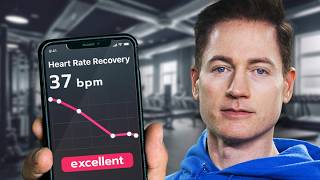
Bryan Johnson explains heart rate recovery, the drop in beats per minute after exercise, as a measure of cardiovascular health. A New England Journal of Medicine study of 2,000 people found low recovery linked to 400% higher mortality risk over six years. Johnson shares his own 37 bpm recovery and outlines three ways to improve it: 150 minutes of moderate exercise weekly, a fiber and protein-rich diet, and 7-8 hours of sleep.
Chapters
Today we are talking about heart rate recovery. This is where you exercise, you stop, and then one minute later you measure your heart rate. So for example, if your heart rate was 160 and after one minute it was 130, that would be a drop of 30 beats per minute. This is a significant marker of your cardiovascular and heart health. I did this recently and my HRR is 30, 37 beats per minute, which puts me in the 75th percentile for elite athletes and the 99th percentile for the general population. The reason why you want a high HRR is because a bad one is an indicator of bad things to come, including coronary artery disease, heart failure, hypertension, metabolic syndrome, diabetes and sleep apnea. A recent study in the New England Journal of medicine evaluated over 2000 participants with initial heart conditions. And those with low HRR had an all cause mortality risk 400% higher in a six year follow up. So it really is an important marker that foretells what's going to happen in the future, whether you are likely to live or die. All right, now, measuring your HRR is easy. You can do it at home. You do need a heart rate monitoring device on your body. But what you're going to do is you're going to exercise vigorously. You'll see where your heart rate is at, you'll stop immediately and then rest for one minute and you'll measure your heart rate again that 60 seconds after you subtract those two numbers and that's your HRR. So mine, for example, is 37. And here are two graphs. One is for elite athletes and the other is for a general population. You can see mine of 37 for young athletes is between the 90th and 95th percentile. All right, now let's talk about what you can do to improve your HRR. One is exercise to spend at least 150 minutes per week in moderate exercise and 75 in vigorous. So a general rule of thumb is moderate is if you can exercise and carry on a conversation. And vigorous means you're working hard enough where you can't speak anymore. Diet also plays a really important role. So have a lot of dietary fiber, have enough protein, have a balanced diet, try to avoid bad stuff. Generally vaping, smoking, junk food, have a clean diet. And three is sleep seven or eight hours a night. Maximize for four variables is time to fall asleep, time awake, and then REM and deep. If you want to check out this video, I've explained how I became the best sleeper in the entire world. You'll learn everything you need to know to become a professional sleeper and have the best mood of your life.