How To Live Longer And Healthier For Women
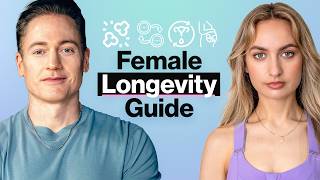
Kate Tolo adapts the Blueprint health protocol for women across different life stages, from premenopause through post-menopause. She breaks down how to track your cycle using apps or temperature, then adjust training, protein intake, and supplements accordingly. Three things work for all women: strength training, adequate protein with regular blood work, and pelvic-floor exercises.
Chapters
One of the most common questions I get at Blueprint is, does the protocol work for women? The answer is yes. We have a lot more in common than we do differences. For example, exercise is good for everybody. So is a good diet, and so is good sleep. There are four key areas which are unique to female needs. And to explain that is my colleague, Kate Tolo. She was the first person to do the full blueprint protocol after me. She's learned a lot doing this with me, and I've asked her if she can go through these areas with you.
Hi, I'm Kate. If you're a female and you're not training, eating, and recovering in line with your body's needs, you could be missing out. Your body follows rhythms that are predictable, and today we're gonna learn what those are. Most people don't realize that a woman follows a very predictable cycle, both in terms of their monthly flow, but also across an entire lifetime. So understanding those predictable patterns is really important because it gives you the insights in order to be able to optimize your performance, your recovery, and your longevity. So today we're going to find out exactly what to do. There are a few stages in a woman's life. The first one is premenopausal. This is from around puberty all the way through to age 42. That's what I'm in right now. This is where you're having regular cycles every month. From there you go into perimenopausal stage. Peri just means near menopause. This is roughly from age 42 to 50. These ages vary depending on the woman, but roughly that's when it happens. After that, you'll hit menopause around age 50, and then you'll transition into post menopause, and then you'll be in that life stage for the rest of your life. Pre menopause is marked by the start of your menstrual cycles. You'll know you'll hit perimenopausal when your cycles start to become irregular. So you might experience them monthly and then start to transition to once every two months, or it's just completely unpredictable. You'll hit menopause once it's been been 12 months since your last cycle. So if you go 13 months without one menstrual cycle, that means that you've hit menopause. After that, you won't have any more menstrual cycles. Now let's talk about how to optimize for each life stage. Okay, so let's talk about pre menopause. The thing to know here is that your cycle happens in two very distinct phases marked by ovulation in the middle. The first half is called follicular, and it means go hard, go fast, push your body more. The second half is luteal, and it means go slow, low, and prioritize recovery. Your cycle starts the first day of your period, which is great because it's very easy to know when that happens. So how do you know when you're transitioning from velicular into luteal? Well, that's ovulation. There are several ways that you can track have I ovulated? And is ovulation happening? The first is by counting the number of days since the first day of your period. The first day is day one. Count all the way through until you hit day 14 on average. That's when women ovulate. The reason that's the case is because your entire cycle, on average, is 28 days. And so ovulation happens smack bang in the middle. The second way you can do this is just by using tracking apps. I use one called flo. You can use anything that's available out there. They get really good at predicting when you're ovulating. Once you put in the data of I've had my period and here's how long my period lasts, you do that for a couple of months and it knows, okay, you're probably likely to ovulate around here. The third way that you can track ovulation is by tracking your basal body temperature. I do this every morning I wake up and I use an inner ear device to measure what is my temperature. You'll notice right after ovulation, your basal body temperature will increase by 1 degree Fahrenheit. That's a signal that your body has ovulated. The next very clear telltale sign is your cervical mucus. It changes very distinctly around your ovulation. It turns into this egg white consistency. Finally, the last way that you can track have I ovulated? Would be through hormonal tests. Now, this isn't free, but it is available. I actually do this myself. Every morning I wake up and I do a urine sample and I see where is my hormones at this time of the month. You'll see luteinizing hormone increases right around ovulation. Okay, so now let's talk about the different phases in premenopause and how to train and eat according to each. So let's start with follicular. This is where you want to push harder and go harder. It's the fast period. Of the period. So in this phase, you really want to push yourself, get your heart rate up and focus on high intensity cardio. Continue with strength training. This is really important because you want to maintain muscle and bone mass, especially as you head into the luteal phase. Next, you want to have 1.5 grams of protein per kilogram of body weight during this time period. For nutrition, you have better carb tolerance during this time period, so you have better insulin sensitivity, so you can have more carbs if you want to. And finally, for supplementation, take the blueprint stack and then continue with calcium and vitamin D to support bone health. Next, let's talk about the luteal phase, where you slow things down and you focus on recovery as you go into exercise. Focus on zone two. This is where your heart rate is at a point where you're not so exhausted that you can't maintain a conversation with someone. You also want to really prioritize strength training. Like I said, when your hormones fluctuate, especially estrogen, it puts you at risk of muscle atrophy and bone health deficiencies. So by focusing on strength training, you're maintaining and preventing against that. It's also why continuing calcium and vitamin D is really important during this time period. For nutrition. Lower your carb intake as your body isn't as efficient at processing carbs. For protein, you can increase to 2 grams per kilogram of body weight, again to maintain muscle mass. And finally, you can manage some of your symptoms that you might experience. So for sleep, you can take melatonin. For pms, you can take ashwagandha and rhodiola. And if you experience bloating, you can manage that through things like electrolytes. Okay, so let's talk about perimenopause, which is the transition between pre menopause and post menopause, essentially the time near menopause. And so the thing to know here is that your hormones are going through a lot of changes. So what you want to do is make sure you have good baseline before you head into this time period. You can do things like Dexa scans, checking your cholesterol and your blood pressure. I would also encourage you a wearable so that you know what your baseline sleep quality is like. Okay, so now you know where you're at with pre menopause. You're starting to transition into menopause. What do you do once you actually hit menopause? Let's talk about that. This is almost like a late luteal phase. So make sure you focus on strength training that maintains Bone health and muscle health. Next, make sure you keep your protein intake at 2 grams per kilogram of body weight. Continue to do high intensity interval training. Get your heart rate up, push yourself a little bit harder. Continue with the regular blueprint stack and you can add in things based on where you're at in life. So add in your ashwagandha, your rhodiola. Make sure you get your omega 3s for brain health and continue with calcium and vitamin D. So as you're going through all these hormonal changes, there are a couple of things that you want to watch out for. One is bone health. You can monitor this by getting a DEXA scan. Continue to get scans every so often so that you're monitoring. Am I experiencing some sort of decline? Two is cardiovascular health. Make sure you check your cholesterol and your heart health regularly. Three is improve against fall risk. And this is for both men and women as they get older by doing things like a one leg stand and maintaining good balance and good strength. Four is monitor for breast cancer. As your hormones fluctuate, it puts you at higher risk. So doing regular checkups is fantastic to prevent against this. And five, you might experience sleep disturbances. I highly encourage getting wearable. Sometimes it's hard to know, has my sleep actually changed? A wearable gives you objective data on your deep sleep REM and other sleep metrics so you can track is my sleep getting worse or better? Next, let's talk about pregnancy. If you become pregnant, it's really important to continue to exercise. A lot of pregnant women think it's not safe to exercise, when in fact the opposite is true. You want to maintain your body health by continuing to exercise. For brain health, for both the mother and the baby, omega 3F, folate and iron is all incredibly important. So make sure you supplement with that. There are some things that you should avoid. I'll put them on screen. Now, this actually doesn't mean that it's bad for you. What it means is that it's incredibly hard to test a lot of supplements against pregnant women. This is because we want to obviously take the safest route when testing ingredients. And so we have regulations here in this country and around the world to prevent against bad things happening to pregnant women. Okay, so now that we've covered the protocols, let's talk about what all women should know. Regardless of where they're at in their life stages, here are three simple things that everyone should note. The first is the importance of strength training. So instead of focusing on cardio and looking thin and some of these more aesthetic things. Make sure you focus on strength training. Even if you're currently not lifting any weights. Improving to once a week will make a dramatic improvement to your health overall. Increasing your protein and making sure you're getting enough protein each day will also help with this. Second is check your blood work, things like iron, especially when you're menstruating, and vitamin D, or will make sure that you're getting enough of the core nutrients to make sure you're maintaining bone and muscle mass. This is incredibly important. And third is pelvic floor exercises are important throughout the entire female cycle. This isn't just about pregnancy and retaining muscle mass in that way. It's because we have all these extra organs that put extra weight on our internal structure. And so you want to actually get ahead of this and start maintaining that muscle mass that you don't experience things like prolapse into the vaginal canal. So make sure you're getting pelvic floor exercises in. So there you have it. It's only a small glimpse of the female health spectrum. There's so much more to learn out there. And also, as a scientific community, there isn't enough research currently done on female health. So there's a long ways for us to go. But this is a really good starting point for anyone out there who wants to understand the basics of how to maintain good health throughout the entire female lifespan and also during different stages of life.





