In this conversational training session, Bryan Johnson invites Ben Patrick, known as the "Knees Over Toes Guy," to demonstrate and explain a series of knee‑centric exercises aimed at injury prevention, mobility, and longevity. The dialogue begins by challenging the long‑standing myth that the knee should never travel past the toes, showing Ben’s sled work where the knee is deliberately positioned over the toes. Ben emphasizes the value of backward movement—both on a sled and on a human‑powered backward treadmill—as a unique way to engage muscles correctly, reduce knee pain, and even wean users off painkillers. The session then shifts to strength‑through‑length training, featuring a full‑range split squat that stretches hip flexors while strengthening the front leg, with guidance on assistance, foot elevation, and progression. Next, Ben highlights a commonly neglected muscle group—the tibialis—explaining its role as the first line of defense against ankle, shin, and knee pain, and demonstrates a simple 25‑rep raise. He outlines a concise “mini‑protocol” combining backward sled/treadmill work, split squats, and tibialis raises, recommending every‑other‑day frequency, 5‑rep or 30‑second holds for split squats, and 25 tibialis reps. Throughout, personal anecdotes (Ben’s own pain‑killer recovery, Bryan’s improved stability) illustrate the practical impact. The conversation concludes with a motivational message that age is a mindset and that these exercises can meaningfully lower biological age and improve quality of life.
Chapters
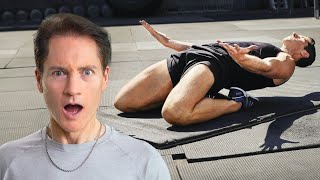
You want to see a full knee bend. And I'm not saying to try this. I'm just saying that this should not be possible from someone who was told their knee wouldn't fully bend again.
Wait a second. Wait a second.
Oh. Oh.
Today is a special treat. I'm here with my friend Ben Patrick, also known as knees over toes guy. Ben is somebody that I've turned to for injury prevention, flexibility, and training for longevity. Many of his exercises are included in my daily workout routine. Today, he's going to train with me, and I've asked him to trim, treat me as though I was brand new. Ben's going to walk you through the basics of how you can start thinking about having the strength and mobility you need to do everything you want physically in life.
So we're here with the sled. Brian's a champion, has a sled right in his home. I've coached a lot of people for longevity. Most of my success stories for the knee is people over the age of 50, and the foundation is sled. And we'll even look at replacements, and we'll look at why. So go ahead and belt up. We'll go forward, backward, nonstop, until you're cooked. So the first thing you're going to notice is that his knee is over his toes on every step. And the point of that is just that's a position we want to be strong in. And a big myth spread of no knees over toes. It started in the 70s because it was found that when the knee is over the toe, there's more pressure on the knee. I don't know what your finding is, but it seems like pressure is something we want to be able to handle.
We want to handle pressure.
Now he's going to go backward. Doing this, at least as much backward as forward makes it a potent knee health exercise. So there's not many things you can do where you get strengthening and cardio and healing at the same time. When you go backward, actually, you engage your muscles the way they're supposed to to protect the knee. It's been found in a study. When people with knee pain go forward, the muscles don't engage the way they do for people without knee pain. But when people with knee pain go backward, the muscles do then engage. So I actually used backward to get my way off painkillers. I was in a cycle of knee surgery, painkiller addiction. I worked my way backward. I sledded my way backwards off painkillers and never looked back. We do have one alternative. I'll have you hop on Here. So the idea of this came from. You go into your gym, you have the treadmill. You don't turn it on. You turn around, butt against the handle. We put some padding to make it more comfortable. Hop on here. I've got the resistance set, so it should be a nice medium amount of resistance. I think these kind of human powered treadmills are the future of treadmills because they're way cheaper and you have to work way harder. You now have. This is maybe the most potent knee rehab tool there is, is a human powered backward treadmill. A lot of people have gotten off painkillers by going for five to 10 minutes backward on their treadmill. Not turned on. It's definitely feeling it. Yeah. Now a teaching point on this one. Come get from an exact. Keep going, keep going. I know, I know, I love it. Come get a side angle, direct side angle. Here's your intention.
I like you as a coach.
Thank you. Here's your intention on this one. Toes behind knees. Every step, it's really going to make you push through those toes. Yep. You're already doing it naturally. How the knee is actually getting over the toe on every step, whether he realizes it or not. So you're getting stronger to protect yourself to then go downhill to handle those forward impacts in life. Then as you get stronger, you want to be reaching your toes behind your knees. Now you're in this position to handle life. So with this, you can build up to then being able to handle these forces in life but without the beating to try to get good at them. I've only been here maybe 60 seconds, and if I try to spin it faster, there's no limit to how much burn. I mean, the most bulletproof knees in the world could still get a healing effect.
Having seen you do that, I need to try that now.
All right, he's going to go for it.
Yeah.
How fast can you spin this sucker? And look, the future is. The future is metrics. How cool would it be to measure this? Like how much resistance, how much incline in time?
How's that? How's my form?
Killing it. Killing it. I'll bet a test on this would show growth hormone output would go through the roof.
That's good. I think you may have given me a new addiction.
Oh, good. Crushed part one. Now we're going into part two. What I've noticed is that when we're young, we got mobility. You ever see your babies, they've got mobility now. As we get older, we get strong, but as we keep getting older, we Lose the mobility and we lose the strength. So number two key for anti aging exercise is to find areas where you can train your strength through length in harmony. So now I'm going to challenge Brian to show me his full range of motion. Split squat.
Okay.
Just body weight.
All right, Ben, I'm a little nervous about this. I mean, you're the master. I've been working on this. How am I going to do?
Let's see. Outstanding. So he's aiming for a full squat on the front leg without the back knee touching the ground. So that's putting those hip flexors into a stretch position. So for counteracting like excess sitting, we almost all have too tight of hip flexors. Yes, good. So we're stretching here and we're strengthening the front leg through a full range of motion. We'll even get a look right here. Go down. So you're trying to cover the calves with the hamstrings. It's an intention while lengthening the back hip flexors. So it's two intentions going on at once. Your average stairwell is actually perfect for working on this because you have railings for assistance and then you have the steps. So the railings for assistance reduces the amount of strength that's needed to get into this position. This is actually how I had to start for my knees, so I had to assist myself. And you'll notice the mobility as you're stiffer, you have to elevate the front foot. So to be to be on flat ground, you really have to stretch out there. To have the back knee off the ground, you have assistance and you have front foot elevation. I think the backward is what got me off painkillers, but I think the strength through length is what kept me off painkillers for my knees and allowed me to never look back.
And Ben, for people who are trying this out for the first time, how many reps should they do? How frequently?
I don't advise daily. I think every other day is good. So in my zero program, we go every other day and we start where we do five reps on each side. You'll notice for the knee, the knee is going to have to be strong to get out of the bottom position. So controlling that knee is going to make it stronger, like performing reps. But for someone with a really bad back problem where they're trying to loosen up the hip flexors, you could actually just chill down here. So I would say either like start with a couple sets where you're either performing reps slowly five times or where you're just pausing down there for 30 seconds. All right, crush part one and two, part three. I'll just get right into a set. Is no weak links. So an example would be I was never made to train this muscle here under the knee. It's loaded. Every time you walk, particularly when you go downhill or when you go to jump, you have a ton of force through there. If you're now starting to exercise in your teens or twenties, or even if you're starting late in your thirties or forties and you're exercising, what happens the time you're 40, 50, 60, 70, as you're training everything in your body except right here. So this is the most common weak link because it never gets trained. If you go into a gym, they might even have calf machines, but they don't have tibialis machines. And this is your first line of defense against foot, ankle, shin, knee pain. So I'm going to coach you through a set of 25 reps. If it's too hard for someone, they can stand closer. You can even some people actually can't do this and flex. They could just do one side at a time and go back and forth. You could even take breaks. There's no such thing as too little. You can gradually build up and then you'll feel more stability in life. When you're walking now, you put the backward and the full range of motion work in and you have really a three part mini protocol right here with reverse sled or treadmill not turned on and full range of motion. Split, squat and tibialis race. So let's do this. Good. The quads stay flexed on this one because we're working with under the quads. Nice and down and flex. So it's like a reverse calf raise. It's not fancy. It's simplicity to be strong on the other side of the calf. You also notice that when you're going backward, the calves get a lot stronger. So this is like a finishing touch. I would feel okay with someone doing this mini protocol of about 10 minutes of backwards. 25 reps on the Tibialis and two sets on the split squat. Either going slowly for knee strength or pausing for pure flexibility for the lower back. Starting to feel some burn coming in.
Feeling the burn.
Nice. I'm going to coach even a bit more. Makes it a little bit tougher if the back is not on the wall. There you go. Putting your hands heel here will ensure. That's it. Keep going. Nice. When the back is against the wall, it actually takes off a little bit of the Weight. So it's a natural instinct to want to go back. And whenever someone's like, oh, I don't feel it working, I'm like, hold on a second and look how cool this is. Costs $0. Someone could do it while watching the rest of this video. You could go do your 25 tibialis raises.
Yeah, they definitely made a big difference. I never exercised my tibialis before I started following your protocol and it's made a huge difference in my overall stability. That's really what I would say. Whether I'm trying to improve my VO2 max or whether we're doing trail running, racing with the boys over the weekend or anything athletic. I just feel stable. And so these really have made a meaningful impact in my confidence that I can just do whatever I want physically and I'm up for it.
Heck yeah. I friggin love that. Makes my day. If he can do that in a few years. I had bad knees for like 10 years. I've partially, partially artificial kneecap on this side. I was told I wouldn't play sports again. I was told this knee wouldn't fully bend again. So if I could do something like, like that. Here's. Oh, I want to do that. You want to see a full knee bend. And I'm not saying to try this, I'm just saying that this should not be possible from someone who was told their knee wouldn't fully bend again.
Wait a second, wait a second.
Don't try it. That's how people get hurt, is by trying the stuff they see. But it's just to demonstrate. Full stretch all the way back. Amazing.
How'd you come up?
Well, I jumped. I jumped from this position and went onto the feet. Oh, oh, okay. Don't try that at home. Try the tibialis raises and the backward. But if you look at the positions we're in, all the work that we did made that able to be handled easier. Just like he can play with his kids, you know, who are in their teens. The average person your age, if they went and tried to compete all out, I see these people and they're like, oh, I tried to compete, blew out my Achilles, blew out my knee. This kind of stuff put in the work to prepare and then not only can you live longer, but even right now, your day to day competition be a lot more enjoyable. So like for me this is enjoyable. I don't have to worry about my knee.
Hopefully if you take something from this is no matter where, where you're at in life, no matter what your circumstances are. You can come back. You can be the person you want to be. Age is a number. It's a mindset. And as we're showing this blueprint, you can meaningfully impact your physical abilities, your biological age, and your speed of aging. Definitely within your control.