How Weak Are Your Bones? (Test & Fix)
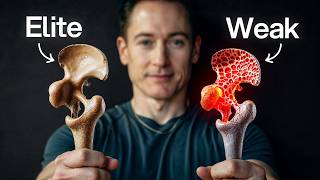
Bryan Johnson's bone density is higher than 99% of the population. He outlines a protocol combining resistance training, plyometrics, adequate protein (1.2-2.2 g/kg), minerals, vitamins D and K2, deep sleep, and stress management to build and maintain bone density, which peaks at 25-30 and declines after.
Chapters
The topic today is bones, and I'm going to start with telling you that mine are more dense than 99% of people. That one metric predicts I will live longer, I will move better, and I will stay independent for more time. I'm going to walk you through the exact details of what I do for elite level bone health. Having weak bones can trigger a chain reaction. You break a bone, you hurt yourself, you can't work out, you don't build muscle, that leads to less exercise, and it continues in abdominal effect. Your bones typically reach peak density between 25 and 30. After that, they begin to steadily decline. Now, sadly for women, they can lose up to 20% of bone middle density within years of menopause. Now, the goal is for every age to stay as close as you can to your peak. The first step is to know your baseline measurement. To do this, you can get a DEXA scan, which costs between 75 and $200. Now, when you get your report from your DEXA scan, you're going to get two numbers, a T score and a Z score. Your T score is going to compare your bone middle density to a peak 30 year old of the same sex. Now, your Z score compares you to those who are your same age, sex and body size. Now, if you are in your 20s or early 30s, you want to use this score as your peak score that you want to try to maintain throughout your entire life. Now, if your scan shows you don't have a great baseline score, don't be discouraged. You replace your skeleton every 10 years. So by applying the appropriate exercise, nutrition and other life habits like sleep, you can rebuild your bone density. So don't lose hope. In a big study of women over the age of 65, the women with stronger bones had a 51% reduced chance of death and had 30% fewer problems with walking. And for men between 65 and 76, even a small boost in bone health made them 23% less likely to die over the next eight years. Strong bones stops the vicious cycle before it begins. The first pillar of bone health is nutrition. When you're thinking about bone density, think about building a skyscraper. Collagen, an important type of protein, is the still rebar, the framework that gives the structure its shape and tensile strength. You'll want to be sure you're getting enough protein somewhere in the range between 1.2 grams and 2.2 grams per per kilogram of body weight. Now, that depends upon your activity levels and where you're at in life. But somewhere in that range, minerals are the concrete. Once the collagen scaffold is in place, minerals such as calcium, phosphorus, magnesium and boron are deposited to fortify the structure. Without this, your skeleton would be flexible but fragile. It's like rebar without the cement. Vitamin D and K are the workers and tools. Vitamin D helps absorb the calcium and direct it towards the site, while vitamin K2 activates the proteins that bind calcium into the collagen matrix. Without them, the materials sit idle and the project stalls. You also want to avoid the following excess sodium, excessive phosphoric acid from soda and chronic high alcohol intake. This can negatively affect your ability to absorb and hold on to the calcium intake. I put all of these ingredients into the blueprint stack, which was meant for whole body health and specifically bone health. For example, Longevity Mix includes a third of your calcium, calcium and magnesium requirements and also 2.5 grams of creatine, which is also good for bone health. Blueprint essential capsules and soft gels are also packed with the key vitamins and minerals you need for strong bone health. Okay, now you have all the raw materials. Now your bones are not going to become strong unless placed under stress. Now there's many ways to increase bone strength. One ways is to add weight to your exercises. This is the most efficacious, natural, non pharma way to increase bone health. Now this makes intuitive sense. A loss of load leads to bone mineral loss. For example, astronauts in microgravity can lose up to 1 to 1.5% of their bone density per month, which is 10 times faster than what you'd experience on earth. There are four types of exercises that are particularly good for increasing bone health. They are resistance training, plyometrics, weight bearing, cardio and power training. It's best to include a variety of these exercises into your daily routine. That's because each one of these exercises uniquely strengthens your bones in its own way. Alright. First let's talk about resistance training, which include things like squats, deadlifts and lunges. All of these exercises will load several major bones at the same time. Consider doing these things roughly two to three times per week. Plyometrics are also great. These are things like jumping and hopping. You could do this in your warmup routine and also do it four to seven times per week. You could also do things within your cardio routine, including stair climbing. Wear a weighted vest as you're walking or hiking. Power training is also great. These are fast, powerful movements. These are like medicine ball throws, kettlebell swings and box step ups. Try incorporating these things. Two times per week for roughly 20 to 30 minutes. Now, if you're a beginner on the first week, incorporate one of these into your protocol. Then slowly build up the frequency and the weights and the reps. That is the progressive overload you want to see to increase your bone strength. Now, if you're older or at risk for osteoporosis, begin with body weight exercises and then work into the more sophisticated movements and weights with a trainer. A substantial amount of your bone remodeling happens when you're sleeping. Studies have shown that those who are chronically sleep deprived have lower bone mineral density. During deep sleep, your body releases growth hormone, which supports many tissue repair processes and bone health. Now stress, on the other hand, is good when you're doing exercise related stress. But stress in life and your mind, that's a different story. You don't want that. Long term stress will raise your cortisol. It does things like reduces calcium absorption in the gut. Now over time, this can lead to bone health loss if not countered with nutrition and exercise and proper sleep positively. You can also use blueprint, rhodiola and ashwagandha to stabilize mood. Now if you see the pattern here in all these videos, it's the same things. Prioritize high quality sleep exercise every single day. Even if it's a 20 to 30 minute brisk walk, having a nutritious diet, these things help hormones, bone strength, lower your speed of aging, all the above. But what you see here is these markers like bone health breed out whole body health. So the goal is to have life systems that take care of your entire body. Hey Scott, now that we've talked about bones, can we talk about boners? Yeah. Yeah, we can, you guys. To learn more, check out my only fans.





