3:52
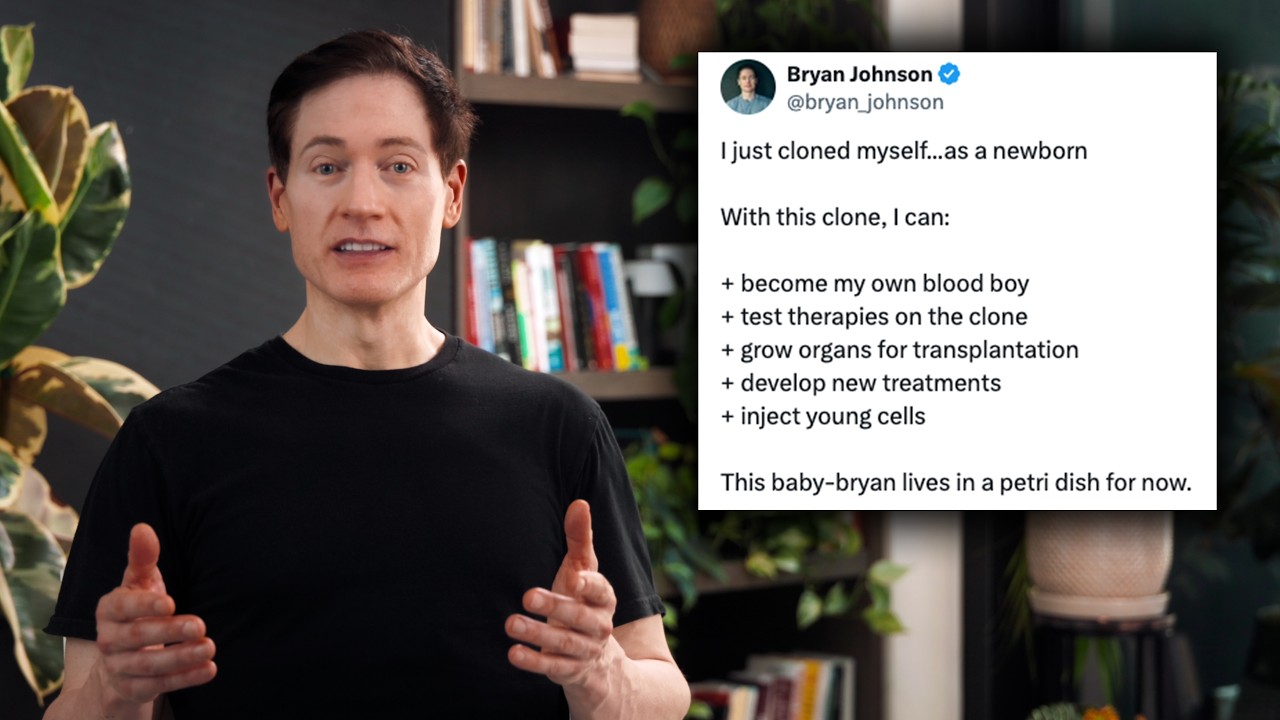
Bryan Johnson claims he cloned himself as a newborn baby, then extracted its blood and harvested its organs. Two commentators discuss why this alleged method is ethically alarming.
Bryan Johnson claims he cloned himself as a newborn baby, then extracted its blood and harvested its organs. Two commentators discuss why this alleged method is ethically alarming.
Bryan Johnson just officially announced he cloned himself as a newborn baby.
All right, biohacker Bryan Johnson claims that he has cloned himself.
And the way he's going to do it is by creating a baby version of himself and like a vampire, sucking the blood out of it, cutting up, harvesting all of the organs and sacrificing the baby's life. This seems like a bad idea.
Hey friends, this week I did one of the coolest things I have done in my entire life. I took my 48-year-old cells and reverse them to zero, back to an embryonic-like state. These baby Bryans sit in a dish. Now, to be clear, this is not an embryo. This is my cells in a dish that have had their epigenetic age gone to zero. Now, this is interesting because this follows the diagnosis. And honestly, getting diagnosed with an incurable disease is one of the best things that's ever happened to me. Before this, this happened, My project was primarily on how to keep the body in pristine health, therapies, protocols, sleep, diet, nutrition. Since I got the diagnosis and since Kate got her diagnosis with endometriosis, the project has shifted overnight. And we've been sprinting the past few weeks learning what can somebody do with, you know, when they're diagnosed with the disease. And we are now shifting our efforts from the basics of longevity to to focusing more on disease resolution, with Kate and I being the first customers. So let me explain to you what we did. So I had a blood draw of 125 milliliters. We then took my cells, we separated the cells, and then we applied Yamanaka factors to it. This reverses the epigenetic age to zero, which then makes them into an embryonic-like state. This makes the cells induced pluripotent stem cells. This means these stem cells can differentiate into any kind of cell, which means I now have the raw material. So for example, with my autoimmune gastritis, my stomach is eating itself, or my stomach lining thins. These cells could theoretically be applied to rebuild my stomach lining. Or if I have something wrong with my kidney or my liver, my heart, lungs, any kind of body part, these cells can differentiate into those cell types. I now have the raw material to rebuild myself. Now, the technology I used to create these induced pluripotent stem cells was really expensive. The good news is this technology can scale. As with all things, the more volume we have, the faster that cost curve is going to drop. And so I'm going to try and bring this technology to the world and lower that cost curve so that everybody can get their induced pluripotent stem cells created. So the takeaway is that we're now at a point where you can take your own cells, take them to zero from an epigenetic standpoint. They can then be differentiated into any kind of cell type of your body. So you now have the ability to rebuild and repair your body. We're now at an age where AI and biotech allows people, individuals, to solve their own disease. Now, the people who did this were very, you know, they had resources, they were technology aware. So we're trying to take the basic principles of what they've done and then make this broadly accessible. And so what is amazing now is when somebody gets diagnosed with something, it used to be the case where you'd say like, "Well, good luck." Now you can actually stare down the disease and be like, "You know what? I might have a shot here." The good news is the technology is scalable. It will allow us to bring the cost down over time so that Ideally, in, in society, everybody would have access to this raw material to repair and rebuild their bodies.





