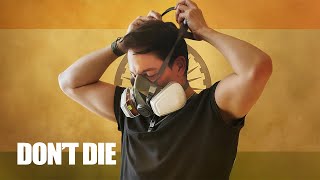
In this interview, tech entrepreneur and longevity advocate Bryan Johnson discusses his first visit to India, focusing on the country's severe air pollution. He reports PM2.5 levels exceeding ten times safe limits, describing acute symptoms such as burning eyes, sore throat, and lung irritation, and warns of broader health risks including neurological dysfunction, asthma, and systemic damage. The poor air quality forced him to cut a podcast recording short and prompted his team to rely on portable air filters and monitoring devices throughout a multi‑day media blitz (three podcasts, a press event, and a dinner). Johnson connects this environmental crisis to his broader mission with the "Don't Die" clinic and his longevity blueprint, arguing that improving air quality is as vital as curing disease. He reflects on humanity’s innate drive to survive, the need for societal shift toward health as a norm, and the role of criticism and community support in driving change. The conversation blends personal anecdote, health science, advocacy, and philosophical musings about mortality and collective action.
Chapters
You don't live under a rock.
You have most likely heard of him.
He's an American tech entrepreneur and an anti aging fanatic. Brian Johnson.
One of our biggest concerns coming to India is the air quality. I think they have right now the worst air quality in the entire world. And it's interesting that nobody is wearing a mask. The effects are so far ranging in terms of effects on children and their growth. And it's so multifaceted that it's hard to even comprehend the seriousness of it. We want to get many people of the country to be talking about these ideas and do so in five days. I haven't slept in a long time. Poorly rested. But also I was very concerned about the air quality here. Like, it's awful. It's like in the middle of a fire. I almost didn't come, like we were gonna call the trip off. A week ago I was told that this hotel had air quality, like filters in each room in the hotel. It was like, definitely like it was a thing. Everyone was like, they were aware of it. And that's not the case. Only here for a couple days. But these people here live with this every single day. Really puts it in perspective.
Brian, welcome to India for the first time. What is the one thing you're looking at more than anything in India right now?
Air quality.
How bad is it?
I can't really see you over there.
So what does that mean? So what is the number right now?
The PM 2.5 over 10x. What is reasonable? What is appropriate?
So what is it doing to me?
It can create neurological dysfunction. It can cause asthma, it can cause lung irritation. It just, it's whole body damage. Is it okay if I put a mask on? Yeah. Yeah.
Okay.
Is that okay? Ah, thanks. Yes.
Recently, Brian Johnson was in India. Then he went on a podcast, but he cut the conversation short. He walked out of the podcast recording midway because of the air. My team's telling me you want to like, go.
I'm so sorry. You just can't do this.
Ryan had to leave. I'm actually surprised that the air quality affected him that much. Our bodies have acclimatized, you know, our bodies have adjusted. The body has compromised to an extent where it does not feel like we are facing any issues, but in reality, we are.
Through the conversation, I could hear you fad and like, your throat, like, my throat's sore. Yep. The pollution is just not a big deal to them. And the setting was basically outdoor, so it's like full on pollution. We just like cut the conversation off in Like a middle of the flow. But it's very stressful, you guys. There's a lot of things in the world that are trying to kill us. For example, last week I spoke. We're all sore in the throat. Our eyes are watering, our eyes are burning. Like, you can just feel and taste the pollution. It's really intense. For context, we have this app that basically shows what the air quality is like in Mumbai, and it is just one step below being dangerously hazardous. The Don't Die clinic in California is immaculate. Water and air and food. So coming here is like the absolute opposite. And so we were trying to figure out, can we be here in India and talk about don't die and blueprint and still limit the amount of damage that's done? And so we have a air quality device here. So this is really comforting to know that the conditions in this room and all of our rooms are actually okay. We're doing three podcasts, one press event, and one dinner in one go. So it's just a blitz.
Today on our show, we have Brian Johnson. So sorry about the air quality. You have ignited a very interesting thought in me that this is not normal.
Oh, yeah. My eyes burn, my throat burns, my lungs burn. It's so bad.
I was wondering whether you are missing some other good things in life by concentrating so much on longevity. I think you are fighting against nature, and I don't know why.
I'm going through the emotional reconciliation process, going through all the mourning of people not leaving totally satisfied. It's upset. All right, we finished four podcasts, one social media shoot. Now we have a dinner. You know what? I messed this up. We've done so many things today, I can't even think straight. The most universal human experience in WAND is that none of us want to die right now. Like, look at the biomass on all of Earth with plants, animals, and humans, all of it. The number one metabolic objective is nothing wants to die right now.
Brian, I see you are traveling with your air monitoring device here.
We carried an air filter with us everywhere we went. We set it up in the place we were at to clean the air. Improving air quality in India is better than curing cancer. This was an honor because I genuinely believe that you're at that brink of.
Actually creating a practical change in human society.
And I don't know how many human.
Beings in the current world population can.
Say that it is absolutely insane that we would do anything to compromise our existence.
One day we look back at it and probably think of it as a human right violation. But we just do not. We continue living. Nobody thinks we'll move out of Mumbai or Delhi for that matter.
Hey guys. Alright roll. Let's.
A lot of bad things in the world, but I like it. It's the only one we have.
It's the only one we have. And I like this life.
And I think I have enough control in my life to do good things.
The most important thing is like having the support structure. You guys have each other is amazing. So thanks for having us on. This is such a fun conversation with you guys. Thank you for doing this. There's strength and community. It takes a teeny percent of the society to go in a different direction. Yeah. How you doing? Good to see you. To then shift all of society. And I think we're right there on the cusp of shift where like health is going to be the norm. And so if we can do this and plant this as a community, it'll be much easier for all of us.
Brian's on an adventure. He understands that people are not going to just eat up this idea of don't die. Very simply, he needs the haters to pass the message on. And in the same way, when you're making choices in life, you need the critics. The criticism, in a sense, is a validation of the idea that this is going to work. It's such an interesting way to look at yourself in the present. You go outside into the future and look in. What does it mean for humanity as a whole? Now that's something you have to think about. What happens if your father or your mother, your kids or you don't die?