What’s It Like Being My Dad? | Netflix Q&A
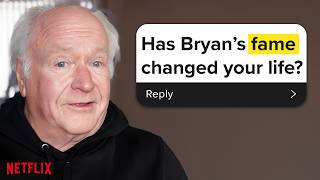
A father discusses his reluctant involvement in a documentary about his son Brian, a tech millionaire and longevity advocate. He credits Brian's Blueprint regimen with reversing his own cognitive decline and describes his 4 a.m. wake-ups and strict health protocol. He reflects on their relationship, his aggressive personality, and how Brian's fame has changed his life.
Chapters
How do you feel about being part of a documentary that millions of people might see?
I'm very, very uneasy. I just. I want to go down in record. The only reason I did it is because Brian asked me to do it. I have no dog in this hunt except my son. It's not of interest how I'm dealing with my life. That's not remarkable. So I guess very uneasy because I'm not comfortable, except that I am. Brian Zay, number one fan, what has.
Your experience been like making the documentary?
My experience in making the documentary has so significant. It was the impetus for me to look closely at my relationship with Brian. I can't hide the fact he had to have in his mind that my involvement would be an accelerator of that discussion. It became clear in the filming that it was and it has been. And then to have caring producers like you today who are friendly and encouraging, it's been unbelievable. I have reached a softer level than I've ever experienced in life. You know, I've been willing to take a chance to say publicly what I've said to Brian and to. And to do what I did to try and mend and further our relationship.
What is your favorite memory from Brian's childhood?
Him crawling to the bed with me and that. Just spooning perfectly those five minutes.
What's a piece of advice that you gave Brian that you're most proud of?
Thank you for asking that. I really think that I gave him great guidance from an early age on. I would like to think that I'm somewhat responsible for his entrepreneurship. We don't work for anyone. If we're in a situation where you're paying me an hourly wage. Just an hourly wage. Just know you don't own me, you don't have me. I love that. I like to think that that guttural reaction that he has to working for someone else comes for me. I'd also like to think that. That he's loving and he can say all the right things in a relationship, you know, on a date, in a setting, but he doesn't give his heart. It's tough to get Brian's heart. Not before the divorce or anything, any trauma in our life. I think. I think that that's something that he got from me is, you know, courtesy gets courtesy, respect gets respect, and attention gets attention, you know, to some respect. That in every relationship there's responsibility, even if it's a father and a son.
What age is that?
5, 6.
What do you do for work?
I work with attorneys in the legal field, putting cases Together.
What is a typical day for you?
I get up at 4 in the morning. I. I spend an hour doing my blueprint protocol. I make my drink. I usually have a cup of coffee. I do my pills, I just enjoy. I get in that framework and then I'm off to the gym. I'm usually there right when they open at 5 and I work out for an hour and a half and then I come back and the endorphins are firing. I mean, I'm doing the Mick Jagger moves in the driveway and that's a great state of mind to go down and start work at that time of the morning. I try and do my creative. If I'm looking at theories, looking for approaches, that's the time.
What does your day off usually look like?
It's miserable. I don't have days off. If I were to summarize what my offs are, it would be Sunday. Because on Sunday here in where I live, the gym's closed and my morning is not the same without that physical exertion. And so it's just really. Sundays are just trying to maintain, but there's nothing good about them. I don't start out right.
What do you feel like was the shift to help you feel that?
The major shift for me is coming from loss. If you didn't know that about me, my mental abilities, that's my identity. It is hard for me to even contemplate not having my mental abilities, being able to, you know, in my world, look at a problem and solve it. And when Brian came upon the scene for me, I was experiencing loss. I tell the story of writing a brief and literally wrote a page, page and a half, and then just stop, as I usually do, just to go back. And it was gibberish. Now, I mean gibberish, not just like typos or misspelling, but how did I go? A page and a half of typing and as gibberish. Now that scared the hell out of me. And so when he intervened, I saw instant progress and being able to get that agility back. Plus physically not having an ache. I've just been really blessed with the regimen that Brian has prescribed meeting my needs. I don't have arthritic changes. My fingers are nimble. I don't have problems with my knees. Everything is solid.
What's one thing people would be surprised to learn about you?
Well, I'm weird and I'm crazy and I'm really, really aggressive, overly so. I've always thought that was my trait. I think people would be surprised that like Right now, there's somebody behind that asshole. There really is that. I can lower the voice. I can lower the intensity.
How do you feel like your relationship with Brian has evolved over the years?
It has so many chapters. I guess I am in a position where I summarize. It is Brian is a small boy, where he was when his mom and I got divorced. We're joined at the hip. You know, I have five children, and of course, I have siblings, and I've lived life from my perspective. I've never seen a stronger bond between a father and a son. I know how I felt about him, and he reciprocated it. You know that when a child, one of five, can find his way through the mess and give dad the hug he needs or whatever, then there was a period, a long period of loss when I was trying to navigate separation and divorce and visits and being involved in their life that I now see was just like nailing him in the hands with a. And in the feet over and over again, not doing anything right. The situation didn't do me right. It was so frustrating. I ceased. You know, that's. That's why I could say, I want. I'll be there Saturday morning. But it wasn't laziness, slothfulness, or bad habits that kept me from going. It was the pain. And so after that, we've had such a. A great bond that we kind of ignored it. We ignored all of that. When I did have problems, he'd know exactly how to call me or write me and just encourage me, not be judgmental at all. That's where it went. And I tried to be there from him, like, you know, raw power. But of course, the elephant in the room never got addressed. It was really with blueprint and really this project that Brian got the. I don't want to say guts, but just got the vision that now was the time he put it in my face, made sure that I felt everything that he was feeling, and then I was free to express to him what it was like for me. So, yeah, we. We had some very, very powerful. Some of the most powerful personal experiences I've had is me seeing into his soul and feeling like he saw me for the first time. That this is not an aimless, lack of character guy. This is a guy who has all kinds of life skills, and he was using every one that he could, but simply couldn't navigate it. Right now I'd say that I love him to death, and I would say he loves me to death, but we're still evolving. It's amazing to me how many folds there are in a personal relationship. And with us, there are a lot of scars back there. And even though I think that he knows, listen, I die on the sword for him, and I think he knows that. But I think he measures out affection. I think that still he's testing the water. And I'm sure of that when he gives me his heart, when he says that intimate thing to me, he wants to know it's intimate, personal, and it better count.
What piece of advice has Brian given you?
I wouldn't really say it's a piece of advice. It's almost like a mantra. It's like there's one theme that is on top of all of his action, and that is, dad, you're a great guy and you can do it. And then he knows all the little things to say, not being judgmental. It's just like he's saying, you have it. I know you have it.
What is a dad family tradition that you and Brian still share?
None. None. None of it. I don't want any of it. Hell no.
Do you wish there were a tradition?
No. No family traditions. You know, we, like Brian, lives it day to day. The only family tradition we have is we don't have tradition. Birthdays don't mean anything to us. Christmas doesn't mean anything to us. And that's not to say we're hostile or have no feelings. It's just the only thing that matters is where you're at and what's going on. No one's gonna holiday and tell me how to act. And that's clearly with Brian. You're not going to put him in a setting where you're going to tell him how to act, how to respond, how to role play, you know, through Thanksgiving or a holiday or anything else.
What are your thoughts on don't die.
In preparing for this, I thought about that and it's so complicated because my son, who I have this very complicated past, this is his life. And so there's that level. There's being around a guy who is really trying to change the world, change the world on a personal basis, you know, awestruck. But I'm not Brian. And my job is not to convince you or anybody else to do something. It's not to be judgmental about your life at all. So I would say blueprint. Just from Rich's standpoint, it changed my life. It was at the right place at the right time, and I still credit it every day with what I do. But I'm not saying it as an advocate or a salesman or anything else. It's just God's gift at a particular time that saved me.
Where do you think that the whole don't die movement is heading? Where do you think it will end.
Up as to where don't die is going to end up? Your judgment is probably as good, if not better than mine because mine is clouded with the fact my son is. Is involved. But everything that I look at from an analytical side and a personal side, it is the way all I have to do is, after I talk to Brian, is look at a fast food restaurant is go to the store and just say, you know, we all know sugar's bad. We all know what's bad for us. And that's the only offering between here and a mile. So, you know, I think, I think waking people up to that is going to be huge. I think Brian being the spearhead of a clean food area, where we get clean food, we know what we're getting, pharmaceuticals and supplements, we know what we're getting, it'll change the world.
Do you feel like Brian's fame or wealth has changed your own daily life?
As far as Brian's wealth, yeah, it's. You know, my friends and associates know who Brian is, and it's interesting to see how that slightly affects our relationship. And I get recognized. I nearly faint every time it happens. I have been in airports. I can tell you the weird places I have been across the country and they will recognize me. When I went with Brian to first Don't Die conference in San Francisco and it was amazing to me, essentially, for the two days we were there constantly, people would pick me out of the crowd and engage me. It was amazing to me.
What is your perspective on Brian's lifestyle as a tech millionaire?
My perception or what my reaction is to him with money? Let's say that I am amazed even for me. I mean, I've never seen money like Brian has. I mean, no, but I'd like to think that the times when I've had money, I've known that it's just money. It doesn't change who I am. It doesn't enhance your anatomy at all. Believe it or not, but what I have been flabbergasted with is his reaction to it. For the years first years after, after he soul Braintree to paypal, he wore T shirts, Levi's. You would not know that he was a guy with a dollar in the room and how he treated people. You know, to this day, I have never seen him take even a millionaire Let alone, you know, billionaire type of attitude to people. He doesn't dismiss anyone. I've never seen it. Even now when there are hundreds of people every time that are just clinging on him. He'll work himself through that crowd. And I just don't understand it other than he just is a great guy. A great guy.
How do you navigate being part of a family in the public eye?
How I navigate things in the public eye is I don't care. The one thing I can tell you. Can you tell how much my life has changed? Of going from that position where you thought you're on death's door and even more important, living, but living like in a way that you cannot even comprehend, not being able to do anything that you like. I am high, as they say on life, you know, with my story, with everything. If it resonates with you and you feel good or something, that's great. But you don't need me and I don't need you. I don't change my life. I do the same stupid things right now. And I do them in public. I do them anywhere. You're not going to change me. There's no notoriety or whatever that changes really has any effect on the decisions I make.
What's one area of Brian's work that you wish more people understood?
The one area of Brian's work that I wish people understood is the importance of him being the test dummy. He is not like, I don't want to use any names because I'm not smart enough, but he's not like other people in the field that just out of air will say, if you do this, it means this or you do that, it will mean that or, right, Just go to the tv, right? Oh, take this, take that, and you're going to get this result to that result. That is smoke and mirrors. I mean, that is right out of the old carnivals. What Brian does is if he wants to know if vitamin K works, he has a blood test. He sees what his vitamin K is before the intervention, he sees what it is afterwards. You do not get that anywhere, nowhere. And I wish people would appreciate what he's doing in putting himself on the table to that. And I wish people would appreciate the significance of it. When he has this longevity mix, when he has his. The veggie meal, the nutty pudding. Yet people knew that this is not Betty Crocker, you know, at the bake stand. This is the result of now years and thousands of tests to make sure everything he's given you will actually have an effect on you. Wouldn't that be great if you could go buy a vitamin C, a vitamin K, a vitamin B and you actually knew when you took it it had a measurable amount in it that it was not so polluted with what it had that it wasn't going to give you result, wouldn't that be great? That's what Brian does and I wish more people would appreciate it.
What was your initial reaction when Brian invited you to try Blueprint?
It was like a guy being offered a pint of blood that had just lost three pints on the sidewalk. It meant nothing to me other than at least someone saw me and was willing to intervene. If you haven't appreciated, from what I've said, I was desperate because the mind is everything to me. And then when you're in trouble, what happens when you can't trust your mind? As I'm trying to say, do I go to the hospital for stroke protocol? Your mind is the problem. You're not exactly the best person in the room to be making those decisions. I needed somebody to come in and say, you're off, you're off the track. I'm going to tell you what to do. And he told me what to do, right down to the details that are ridiculous. Get up. Don't talk to me from the bed.
What advice would you give to someone considering starting blueprint?
You're going to be surprised with this answer. I don't think right now I would give anyone any, any advice, even on that level, because you could tell for me, I am poisoned by expectation of others. I'm poisoned by the expectation of our society of what is a good life or not a good life. The only thing I think that I don't want that is not directed to you is whatever your life is right now is fine. I'm able to construct this umbrella with my life. I would think anybody can do it. I'm so poisoned by that that even though blueprint has saved me, I don't want to advocate, I just don't want to be seen as the guy telling you what to do.
What are your vices?
Too many to name. I've got vices out the door. My advice is they don't have names for. But I'll tell you this, pushing the edge, which I clearly do, is because I feel empowered to push the edge that, like I say, coming from a position of loss, you're willing to go an extra mile walking. You're willing to test the waters with things because you know there's a little bit of invincibility There's a little bit of this. I've got plenty to go. So that's kind of a very interesting thing that I fight that. It's like, when do you let off the gas? When do you not power into some experiment with life or some edge of life that probably in the long run is not a good thing. One thing I should note about that I don't think that there's anything that's inherently bad or inherently good other than bad food and all of that. I'm talking about pursuits. You know, right now, I'm willing to look at a lot of things. And sometimes that's good, sometimes it isn't.
Who is the funnier one, you or Brian?
Definitely me. He definitely me. He needs to take funny lessons from me, like I am. I'm hysterical 24 7, and he has to work on a joke.
What is your guilty pleasure snack?
Okay, my guilty pleasure snack is not a snack. It's food from my childhood where a mom made bread, hot bread coming out of the oven. Oh, my gosh. Meatballs, mashed potatoes. And you know what? I can't eat a lot of that anymore. But, yeah, you put a plate like a. Like roast beef or something, and some mashed potatoes and gravy. I'm going to give that a hard look every time.
If Brian could time travel, where do you think he would go first?
Brian would go to the 25th century. Absolutely. And isn't that interesting? Why not go to the 20th century? Why not go to the 30th century? But it would definitely be the future. And I think the 25th century is the sweet spot. Right when you would expect whatever he's doing right now to be on the board. But still not full phase. I think he would want that. He wants to go to the top of that mound and see over what.
Is your go to way to embarrass Brian in public or in private to.
Show you what a wuss I am. I would not do that. And you could see from what. What I told you, I am team Brian. And I, you know, I've taken what I consider to be, you know, a sacred oath that, you know, I will never interfere in his life, that from the time that we had our get together, he will never be able to point to anything that questioned my loyalty or my ability to do anything. So even on a casual basis, like, he used to say that what I did do is I would diminish something he would say. Today we got here. The way I have always been with him is to encourage him, it would be, well, that's good, but whatever. But, you know, he put the hammer down. He says, you know, it's not your job to give me a merit score and to tell me where I need to go. That's not your job. And so that corrected me. So I just. All I do is say, can't believe it. Fantastic. And leave it at that. I'm not a big, emotional guy. And so what Brian and I have been through, where I actually feel someone else's pain and feel responsibility for it, is not something that I have felt. And it has so impacted my life. That is a preeminent thought with him, that I will do nothing but be supportive. When a boy who loved his dad, who went what he did, who is willing to lay it on the line and solve it, I just feel like this huge obligation that I can't, you know, I can't do anything wrong, that I really have his heart in my hand and you can't play with it. Clearly, probably an overreaction, but that's where I am, and that's because of the impact of what we've been through the last three years.





