수능 영어, 미국 전교1등이 풀면?
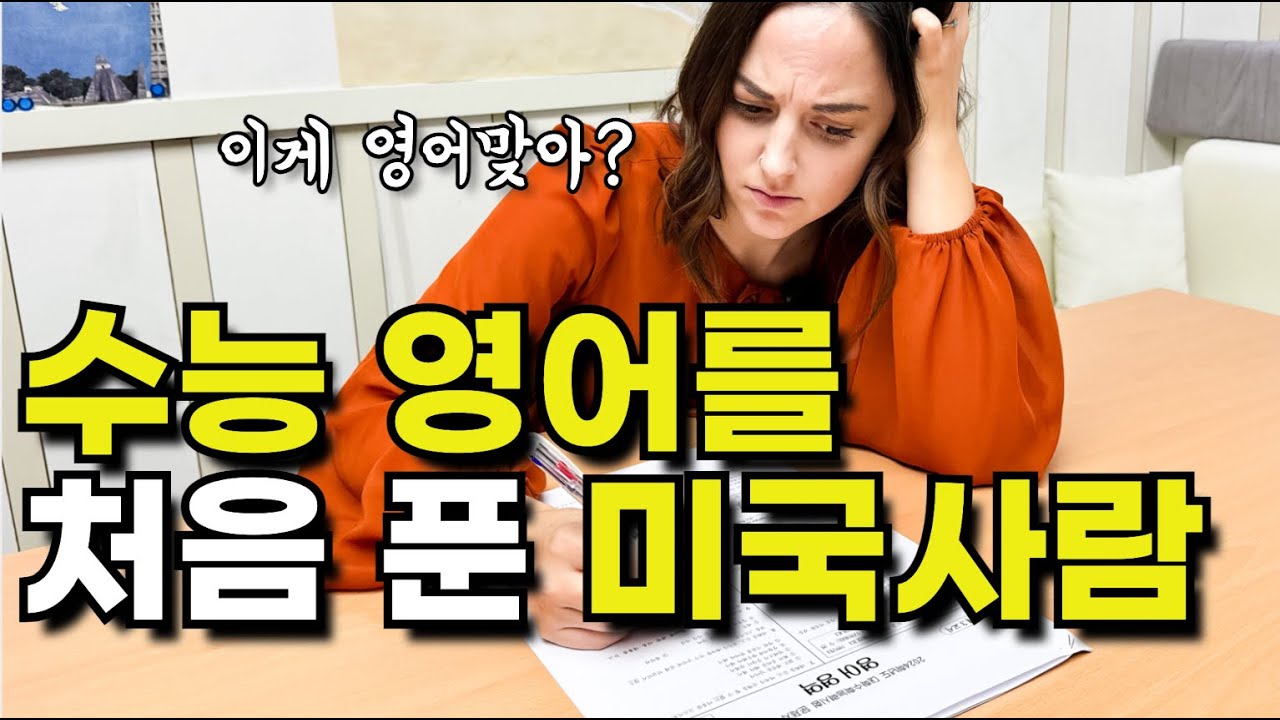
Callie Anderson, a summa cum laude native English speaker, tackles Korea's Suneung English section alongside a Korean test-taker. She discovers the exam's vocabulary-heavy, unnatural phrasing trips her up despite her fluency, revealing that test-taking skill and real conversation are different things entirely.
Chapters
I think it's wrong. This is awkward. This sounds really unnatural. I'm dead. Hello everybody! Today we have some serious business. We are taking the Suneung test. You've taken it before, right?
16 years ago. What do you think of Suneung?
Hmm, it sounds very stressful. In the US, the only comparable thing would be the SATs, and it's not taken quite as seriously.
Really?
I heard that in Korea they stop air traffic and there's police escorts and people cheering for you. Like, we don't have this kind of culture with the SATs.
So the score is not important?
It's not as important. I feel like in Korea the stakes are definitely much higher and it's more intense. But in the US, when you're applying for colleges, they don't just look at your SAT score. They also care a lot about what extracurricular activities you did, your essay. So there's a lot more factors impacting their decision.
How do you think you'll do on today's test?
Piece of cake. Not to brag, but I was summa cum laude. Plus, I'm a native English speaker, so I think that definitely is working in my favor. How about you? Do you think you can beat a native English speaker?
Like, I'm not perfect in English, but when it comes to tests, I have some skills too, you know. I was a very trained Korean student.
Oh, and you think you got the skills?
Yes, there are some formulas. I still remember it. Today is the day I'm shining.
Good luck.
Good luck.
We've got our test here and we're gonna get started. Moment of truth.
This gives me PTSD a little bit. I didn't want to study this again.
Trauma, trauma. All right, let's do this. I'm stuck between two. Gotta go with my instinct. My brain has stopped working. I keep reading the same sentence again and again. You make me go out drinking the night before to get an advantage? I feel bad for the students doing this.
Yes, I'm struggling.
I can't imagine a high school student having to do this. I'm dead. I can empathize with these students now.
Seriously, this is tough work.
My brain just gave up. Of course, the way things are worded in many of these questions aren't like how we would say them in everyday life. They just try to throw in these big advanced vocabulary words that no one would actually say in real life. But to be fair, in English exams in the US, it's the same way. They're trying to trick you.
So time for moment of truth.
Let's see what's more more important here, being a native English speaker or past experience?
I was surprised that I still got some skill, like, however, that's very important keyword, you know.
There's definitely some test-taking skills involved here.
So usually if you want to go to like Seoul University, I think you gotta make it perfect. Depends on the major though. If you want to go to medical major, definitely 100%.
Yes, no wrong. Let's see if SNU would accept me. 5. Oh, okay, neck and neck so far.
21, 4.
Yeah, really? And that looks like 5.
4. Number.
Okay, okay, okay. 22, 1. Oh, oh, this is Hangukgo Dae-mune. Hangukgo Dae-mune. Jin-sa, Hangukgo Dae-mune.
Yes!
Wow, because it's all in Korean.
No, it's translated.
Yeah, but still the wrong translation. What was this one? No, that's too specific. Oh, most important? No, you said the topic. Topic and most important are very different.
This is answering the brand compliments.
Compliments, thank you. I think there was a miscommunication here. He said it's the topic. I'm finding it's not.
23?
23? 2?
2. Yes.
Oh!
Horrid!
Topics should be broader, right? Topics are usually a bit more broad. But these are like one fact or very specific.
Here. But is important thing, you know.
But, but I saw the but here.
Non-value, market value may exceed the economic value of the timber.
I did it differently, so it's not right here.
24, 24, 5, 5. Got it, I got it. It was a lot.
Okay, okay.
Yes, which one?
What is it? Which? Okay, same. I should ask you, do you know what it should be?
I was thinking something is missing here. It's a skill.
Okay, okay. Yeah, 2.
2.
Okay.
32. 2. Big X.
That's when I was stuck.
What would you be in between?
I don't know. I put an X by all of them. I thought none of them sounded good.
Okay, okay, okay.
No, but what's surprising? What's striking about them?
Oh, I read this wrong. Wrong!
Okay, this is not going to reflect well on American education, maybe.
But it's okay, Tyler carry on. Tyler speaks 7 languages, he's still very popular.
Thank you, Tyler, for paving the way. I'm definitely not going to SNU. Game? Is this a game for you?
Yes. Look at the subscribers, I'm not too bad.
Do you want to teach them English then? Should it be Hong's channel? So according to this test, his English is better than mine. Yes!
You know what, actually some of the paragraphs I didn't even read through it.
Really?
Yeah, there's some skill after however and then this part makes sense. I'm surprised that I still remember.
It was more strategic.
It was more skill. Some of the paragraphs I didn't fully understand, but I still can make it correct.
You can find clues.
Yes, then I don't have much time, and most of the students don't have much time, so they have to pick what sentence they need to read.
That's true. He was much faster than me. I was reading every single word. I mean, I do believe that your English is really good, but I also think that test-taking is a skill, a certain skill. So I think that you have better test-taking skills than I do, and maybe that can be cultural too because you grew up in a culture where tests like this are very important.
And I mean, my whole life was taking tests from like elementary school, middle school, high school.
We took many tests too, right? But I was like saying how your tests are more intense. There's a lot more like pressure to do well on the test, whereas in the US it's like we have tests and there is a certain amount of pressure, but it's not, I think, to the same level as it is in Korea. I just showed up. I didn't buy a textbook on how I get a good score on the SAT. I literally just showed up to my test and took it, and that was it.
Just because I'm good at taking tests, it does not mean I'm good at English. When we did the speaking challenge thing, I got some of the comments like, "Wow, having an American wife, your English is kind of soft." But you only got -2! I mean, I agree on some of the parts of it, but yeah, the fluency doesn't really matter with the speaking.
That's true. So someone can be really, really good at taking these English tests, but it doesn't mean that they can actually speak English well or use English well in day-to-day life, right?
So when I got into college, uh, like, I couldn't speak one word to a foreign teacher or friend.
So this doesn't necessarily reflect someone's English abilities. I just want to say I'm very humbled by this test. Before, I was feeling so confident. I was like, whoa, I'm from the US, summa cum laude, easy. But no, I was humbled. I mentioned before too that some of the wording of the questions and the answers and the text is a bit unnatural. I think it's good to know these advanced vocabulary words for when you do have to take tests like this, but we would not use it in conversation. So I would not say maybe even half of the things that were in this test. So I think it's important that if you actually want to communicate with others in another country using English, that you should focus more on, yeah, everyday English phrases, expressions. Yeah, so all of the students that are about to take this test, I'm cheering for you. Best of luck and you got this!