순수 국내파 한국인이 실리콘밸리 빅테크 개발자로 입성한 특급 영어 공부법
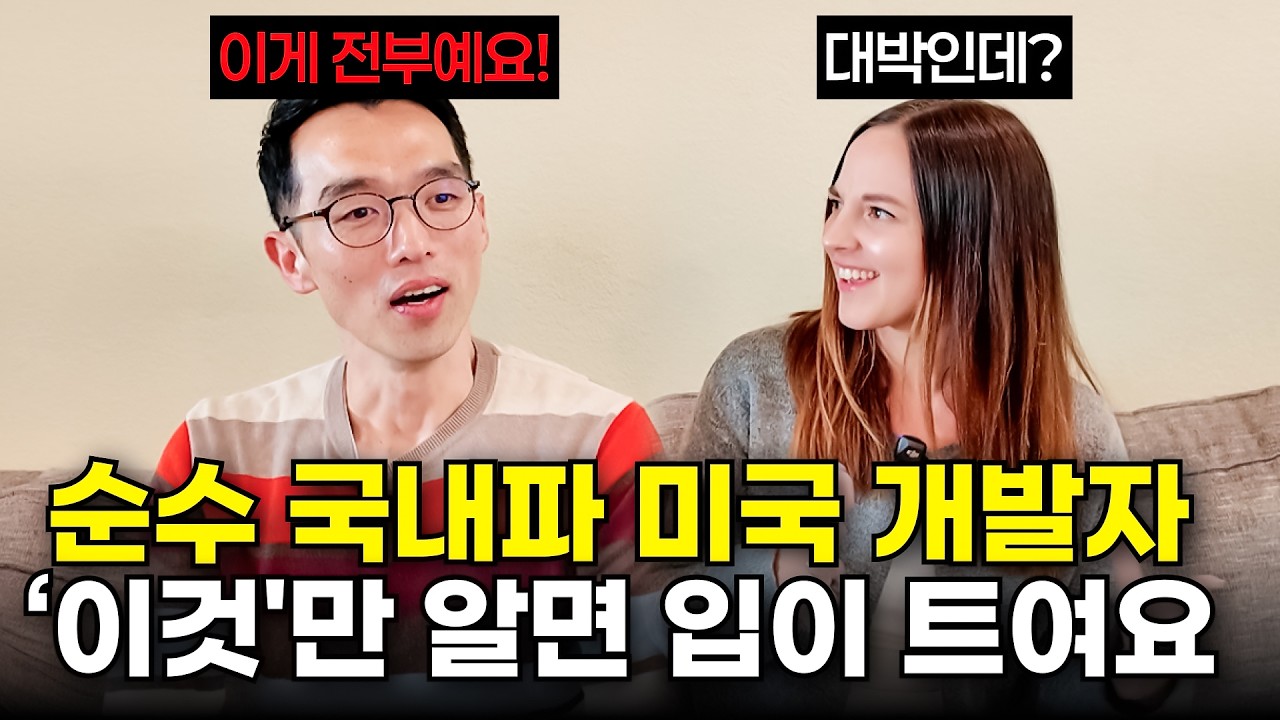
Sean Choi, a Korean-born software engineer, shares how he landed a job at a major Silicon Valley tech company. He discusses his English learning methods, the visa and job-search challenges he faced, networking strategies that worked, and what big tech work culture is actually like.
Chapters
I work at a big tech company. I jokingly say it's a fruit company.
Hint hint!
I came from Korea. I didn't study here. I was very desperate to get a job. It was very difficult times. I failed a lot. Honestly, I cannot believe that I'm here. What's more important than learning the language was—
Can you introduce yourself?
My name is Choi Woo-hyun in Korean, and I go by the English name Sean. I'm an engineer. I work at a big tech company. Tech company. I jokingly say it's a fruit company.
Hint hint.
I live here in United States, in Bay Area. I've been here with my family for almost 13 years.
Can you tell me a little bit more about your job? Like your day-to-day responsibilities or like what you're in charge of there?
I make iPhone apps. I work in front of computer just coding. These days I use AI a lot.
Have you been doing this the whole time, like the 13 years you've been in the US?
Yes. I got a job as a software engineer back in Korea too, and I always wanted to move here in Silicon Valley because this is like a center of all the tech industry. I was like desperately looking for opportunity here for quite a while, like 1 or 2 years. I tried many things. I contacted many people on Twitter. I mean, I have talked to people who work here in Silicon Valley. I made some connections also back in I think 2011, I was traveling here in Bay Area and I filmed a YouTube video. I made a video about Bay Area and tech industry, and I interviewed many people like we are doing right now who's working in tech industry, and I made some connection there. So yeah, that was a start. Back in Korea, I went to like a tech conference where many tech industry people came, and I made a business card and I gave it to many people, and I told everyone that I'm looking for a job in Silicon Valley, and one of them Knew someone who founded a company here, so he connected me to the founder. So that's how I got the job.
Wow, that's really cool. So a lot of word of mouth, networking, just putting yourself out there.
Yeah, that was important, putting myself out there. I don't believe in career advice, but I believe people get inspiration from other people's stories. And what I want to tell other people who also want to maybe get a job in the United States or work in tech industry, just put yourself out there and don't be afraid. It's okay if it doesn't work, you know, you don't lose anything. I think it started from my love for United States, actually. When I was a kid, I have some relatives who lives in here in California, Sacramento, and I have visited them a few times back in '90s. It dates me, but— I fell in love with this California life. The sun is shining all the time, and to like a younger self, it would look like a dreamlike life here. So I wanted to move to the United States, and I dreamed about studying here for high school and college. That didn't work out, but I still had that dream in my mind. So after getting a job in Korea, I started looking for opportunities here. When I was in high school, I liked drawing. I liked drawing cartoons and comics.
Mmm!
And being an animator or cartoonist was my dream. I also wanted to put my work out there. Back then, the internet was starting. Again, it's a long time ago. So I wanted to make my own website to put my art online. That's how I started programming. And later I fell in love with technology. I love making computers. Like, you could build your own computers back then. That was the first computer I bought, which was a MacBook made by Apple.
Mm-hmm.
Back then, no one was using MacBooks around me. So I fell in love with it, how intuitive the user interface is, things like that. So I was like telling everyone how good this device is.
That's really cool how your passion, your life experience, like traveling to California, all of that kind of led you here. That's wild.
I admire Steve Jobs. He's one of my heroes. He made a speech in Stanford before he died, and he was talking about connecting dots. If you look back at your life, everything is just connecting dots. You don't know when things are happening, but if you look back later, everything you experience leads to where you are right now. So I believe that.
Yeah, I think you're living proof of that.
Thank you.
Before, like you said, you had this kind of American dream, and now you're living here. When you first moved here, was it challenging, or was it kind of everything you dreamed of? Were there hardships?
Yeah, there was challenges for sure. But for me, it was like my dream coming true. But I think it was more challenging for my wife, Wonji. I asked her to come here with me after we got married. But yeah, there was some challenges, culture shock, things like that. First thing I remember right after I came to the US was that my uncle was picking me up from the airport and he brought me to Taco Bell.
Mm-hmm.
Franchise, you know, fast food place. And after eating, back in Korea, I'm very used to recycle everything, like separate everything, right? But he was just dump everything in one bucket or one trash can. I was very shocked. That was like first culture shock that I experienced.
That's so funny. That's very true. Korea takes like the sorting, recycling very seriously. Here it's like everything goes in one bin.
Yeah, here in California, people are better at recycling and composting, but still it's Very different from Korea.
Not in Michigan. All in one band.
But there are very positive sides of American culture. It's a very diverse culture here. So many races, many different people. So people are very used to being careful about stereotyping. Not stereotyping other people, right? And that's one of the reasons I wanted to move to America.
Even just coming back here this time, we were walking down the street and we heard so many different languages around us. And I was like, wow, it really is so global.
Mm-hmm, yeah.
Just super international.
Yeah, especially here in the Bay Area, there are a lot of different cultures mixing.
Yeah, that is really cool. I think you get to experience a lot of different cultures in one place.
And one good thing about that is that they have really great food from all around the world.
Yes.
We have great Asian food, even Korean food.
Mm-hmm, we've been eating well here. Too well, probably. How about language when you first moved here? Did you face any language barriers, or how was your English at the time?
I think I was lucky. I was exposed to English since I was a kid. My dad traveled to the United States many times. He brought some VHS tapes. Again, a long time ago. Maybe some of the viewers don't know what it is. So he brought like Disney videotapes. I watched a lot of them without Korean subtitles. That's how I got exposed to English from early ages. Because of that, I built confidence. And after I moved here, even though I don't speak perfect English with perfect grammar, I was not afraid of speaking to people. And I was actually enjoying it, enjoying meeting new people, speaking to people from different cultures. And that confidence was built up. And I think that helped a lot. I think that's very important when you learn a language, to have confidence and just try it out, you know. I think the other one is like social media. In the beginning time of Twitter, there was something called TweetUp.
Okay.
I made a community with foreign people who live in Seoul, and we had like off-site or in-person meetings and made friends with them. I learned a lot of English from them too. I ended up creating like a startup company with people I met at Twitter.
Oh, that's so interesting. I think a lot of people are always asking and they're always curious about like how to meet foreign friends in Korea to practice their English, and I always just tell them to like go to Itaewon. Definitely you can use a platform. I think now it's a lot easier. Easier with social media to make friends that way?
I think I would say it's better if you find friends who speak English who have common interests with you. So being in a, like, for example, movie community or, I don't know, some sports community, that would be great because you have other stuff that you can connect with other than the language. So I think to me, living here in the United States, what's more important than learning The language was to learning the culture, I think. That's what I felt. If you think about some foreign people who are living in Seoul, you have lived in Korea for a long time, right? You feel more familiar with them if they understand the culture and they respect the culture. Like, for example, Korean drinking culture, you know?
I know nothing about that.
If someone is very good at the culture and they try to respect it, their friends will like it more. And I think if you live in different countries like us, You try to learn the culture and what's offending to the people, what makes them happy. Learning those things are more important, I think, than learning language perfectly.
That's a good point. It goes deeper than just learning the grammar, learning the vocab. You have to understand the culture. Huge part of it. When you talk to other people here, and especially like, you know, 13 years ago when you first got here, if your English wasn't at the level it is now— now you're really great— but, you know, when you first moved here and were engaging in In conversation with other people, were they usually pretty friendly? A lot of people worry like, oh, I'm like slow when I talk, or if I don't say something right, like, will people understand me? Were people like pretty good about that when you engage in conversation?
Yeah, I think we are also pretty lucky because we met a lot of people who became our friends who were very nice to us, and they were very understanding of our English not being perfect. And we were involved in like an American church, and we made great friends there. And I think that helped us a lot in the beginning to be used to speaking to American people. And like you said, they are very understanding, so it made us to not be afraid of speaking more.
That makes me really happy because I always think it does take a lot of confidence, and it is scary speaking in a different language. But I think sometimes the biggest critic is yourself. Other people won't judge you, but maybe we judge ourselves too harshly.
You don't need to do that.
Yeah, and I think finding a great community can also probably be a great way to practice.
And I also— what I learned from working here— working is also a little bit different than just making friends, right? At first I was not confident about work because it's, again, it's different. You have to use professional terms. But what I learned was that even people who were born and raised here, some people don't speak perfect I mean, they don't speak well, right?
100%! Yes, yes!
And even like me, when I speak Korean, I was not a person who speaks very well, especially like public speaking. Sometimes when I speak Korean, I feel like, why can't I speak well? It takes a long time to think about a word. And I think it's the same when I speak in English. So that thought made me more confident. Like, I think one benefit of being a non-native speaker is that you use You use easier words and you speak slowly, so other people understand you better, I think.
That's a great perspective. I never thought of it like that, but that's very true.
Yeah, and you also prepare a lot because you're not perfect. You write down, you memorize it, and speak it so you don't use a lot of filler words. So that's easier for people who are listening. So I think there's some benefit of that.
That's true, because sometimes even I have a hard time understanding other people if they speak really fast. I'm like, wait, what? That's a really good point. I know you said you watched Disney. Do you have a specific movie you remember watching at that time that kind of made you curious about English, or—
Yeah, I learned a lot of my English from movies and TV shows. I also watched a lot of Friends, the American TV show, and I watched many times the whole season. BTS also learned English from Friends, and also other TV shows like Lost or 24, which are also popular in Korea. While I have been to learn English was to immerse myself in English-speaking environment. I intentionally don't turn on Korean subtitle. I always turn on English subtitle though. Sometimes I cannot understand it, I can read it, right? I also read books in English, which doesn't help my reading habit. I don't read a lot of books. But I also read books that I'm interested in and that I know well. I read a lot about like tech industry, and it's easier to digest for me.
Working at a big company like this, like you said, the English is very different, it's very professional, and especially in the tech industry, they use a lot of like tech jargon. Was that really challenging at first?
Yes, at first it was challenging, but I listened to a lot of podcasts too, tech industry podcasts, and that helped me a lot to getting familiar with the jargons or Some terms, like professional terms. And also listening to other people at work in meetings, that helped a lot too. When I heard some phrase that I've never— or expressions that I've never heard of, I remember that, try to use that in a similar situation in the future. So yeah, I learned from coworkers and friends a lot too.
That's really awesome. I love how proactive you are about learning English. That's really great. Your whole journey of learning English is actually very inspirational.
But I don't feel like I try hard to learn English. I just enjoy it. I like speaking English, and I think essentially I like learning about new culture, meeting new people who grew up in different environment than me. And that curiosity helped me a lot to kind of learning English without trying too much.
That's great. I think if you can find a way that you enjoy it, that's the best way to do it. So now you're working at your dream job.
Yes.
Can you kind of tell me how you achieved that, especially since it's such a competitive market?
Honestly, I cannot believe that I'm here. There's a thing called imposter syndrome. I had that when I first got my dream job in a big tech company because I came from Korea. I didn't study here. I didn't graduate here. It was hard to compete with other people who graduated in a more famous school and For my age, usually my peers are younger than me because I came here at an older age, right? But I still love that I'm working here. And because I started at an older age, I have some other different experience compared to other younger people. That's an advantage too.
Do you have like a specific or practical action item?
Start from the company that you don't really like and make that as a learning experience. And if you think you're ready, you can try a company you like, or you can just try to interview with the company you like. Even if you fail, I think it also helps if you have a friend who works in tech industry. You can ask them to do like a mock interview with them. I don't think I can even count. It was like maybe around like 40, 50.
Wow.
Yeah, it was very difficult times. I failed a lot. But as that accumulates, you fail less. You can see that. You can see the progress.
I really respect you for that because I'm sure that must be so discouraging. You start questioning yourself and, am I good enough? Am I on the right path? Can I do this? But you pushed through all that and you've landed your dream job, and it's well deserved. That's really cool.
But there was also another reason that I was very desperate to get a job, like a visa. If I didn't get a job here, I had to go back to Korea.
That's another level of pressure.
Yeah, pressure. Yeah. Also recently, because I have been working here for a while, I got an opportunity to interview other people to hire to my team. And if you be in the other side of the interview, that helps tremendously too.
Yeah, I bet.
You know what kind of person you like to hire. So if you flip that, if you want to get hired by someone, you can use that knowledge.
What kind of person do you like to hire?
Maybe it's different for other people, but for me, if you make me laugh during the interview, you have a higher chance to get hired.
I made you laugh maybe once, right? Did I get a job?
That means like not making jokes or anything, but try to be comfortable with the interviewer and talk about something that's not related to the interview. Like maybe you can find common interest with the person. I think that made both of them relax So that's kind of my practical tip for interviews. Recently, I interviewed someone, and it was very obvious they're using AI to answer the questions. It sounded very like AI. Every sentence they said like, "Oh, in summary, this is this." Don't do that.
Keep it yeah authentic genuine. Can you tell me a little bit about the working environment where you are? Maybe the company culture. What do you do to survive there?
So I think American culture, especially in the tech. In the tech industry, it's very important to show what you did, your results. And I'm a kind of shy person, so I'm not used to that too. But I learned that it's important. So like, if you have opportunity to show what you did to some leaders of your organization, find those opportunities and do that. But I also think it's same in Korean culture and American culture. But if you try too hard to kind of promote yourself, other people don't like it.
Yeah, yeah.
But if you have opportunity and if you can keep the balance of being humble and show yourself more, you have to catch that opportunity and do that.
Just— there's a line, right? You gotta be careful of the line.
There's a line, definitely.
Just my own curiosity. I always see like all the TikTok videos and stuff of the big tech companies, day in the life of someone working at this big company, and they always show like all the breakfast buffets, all the lunch buffets. Is it really like that? What are some of the perks you get to enjoy?
Companies I have worked at, they had catered free lunch. At my current company, I have to still pay for the food from our cafeteria. We didn't have a lot of layoffs recently where other companies had a lot of layoffs. So being frugal like that, you know, I think it's positive.
Yeah, you're like, I'll pay for my lunch.
I pay for my lunch, don't fire me.
That's so funny. That makes sense. Are you currently working on any projects, or do you have any future goals?
I cannot talk about my work stuff, but personally, I really like movies, and one of the goals this year was to write more movie reviews. So I started an account on Threads. It's called @baemoviechat.
@baemoviechat.
Yeah.
Okay.
I write movie reviews in Korean, so I connect with movie fans in Korea.
Wow.
It's very small. I don't have a lot of followers. It's fun to get connected with other people who have same interest. Yeah, that's what I'm trying to do this year.
What's a movie you've watched recently that you recommend?
Recently I watched Project Hail Mary. I don't know if you have watched it.
Yes, loved it.
You loved it? Okay. Loved it.
I didn't love it.
No! I had too much expectation, so I didn't love it. I didn't get it as much as other people, but I enjoyed it. I enjoyed watching it. The one movie I liked recently was 28 Years Later. It's like a horror movie, but I'm a horror movie fan, so I really liked that movie.
I like horror, but I haven't watched it. I'm like this half the time, but I enjoy it. I know it's a series, right? There's a couple of them?
Yeah, the latest one is called The Bone Temple. So it's a really great movie.
I'll have to watch it. I have to start from number 1 and watch them, maybe.
You don't have to watch everything to enjoy this movie, but it's better if you watch from the beginning.
Okay, I'll do that. Thank you so much for letting me interview you today and for sharing your story with us.
Thank you so much. I really enjoyed this chat.
I would love to do this again in the future, so hopefully see you again back here. Thank you so much for watching and see you next time.
Bye!