COO Alliance Testimonial | Guy Berry
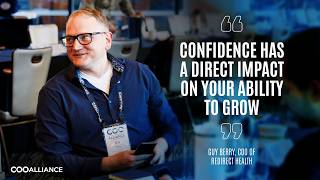
Guy Berry, COO of Redirect Health, joined the CEO/COO Alliance to escape imposter syndrome and build peer relationships. He credits the network with normalizing his struggles, teaching him that confidence creates a flywheel for organizational growth, and showing him the value of candid feedback with his founder. In-person events proved most valuable for real problem-solving.
Chapters
I'm Guy Burey, COO with Redirect Health, and really Redirect Health's focus is about making healthcare easy and affordable here in the United States. I joined the CEO Alliance in 2016. In the beginning, when you're especially newer in a role like, like a COO, you've got predetermined expectations like this is what it means to be a COO, or this is what it means to be a leader at this level. And then as you get into the actual doing, the actual aspect of a job, you start to see things that maybe are a disconnect, like, hey, I didn't realize this is what I'd be doing, or I didn't realize this is what happens at this level at an organization. And so you start to create a picture in your mind of, is this normal or not normal? And you're putting them into these categories of, this is probably abnormal, this is probably normal, based off of some experiences. But honestly, in this role, you don't have experiences to go off of because you're newer. To the role. And then going into the COO Alliance, you start to realize you've mixed those categories up. Something you thought completely is abnormal is very normal when dealing with entrepreneurs or being at a second command of a company or what it even means to be a leader in an organization. And I think that's where you start to get rid of these, these expectations or lack of understanding, and you start to bounce this off of other companies. And that it creates a picture of honestly, every role is unique because every entrepreneur is unique. And then you start to rebuild what does success look like and what does that picture look like? In that beginning, I'm going, okay, am I not doing a good job? Is it because my lack of experience? So then you have that imposter syndrome starting to slip in because you're thinking, I'm not getting it, I'm not understanding it, I must be doing something wrong. And that doubt, that just ability to— when you have your energy focused on the doubt, that might play a role in your performance, whether you realize it or not. The ability to get out of your own head, the ability to say, "No, no, this is normal," or "This is okay," starts to build your mind into a positive manner, which now goes right into your role, the way you show up. The way you interact with other people in the business can begin to have that positive effect with your relationship with the entrepreneur, but also your relationship with the company. When I went into the CEO Alliance and started to realize what does it mean to be second in command with an entrepreneur is really about how do you help the entrepreneur be successful with their vision. Okay, so now every entrepreneur has different visions. Every entrepreneur has a different personality. So then the role of the second in command is different for every single person. You're just trying to figure out how do I help this person get success out of their vision? So now you got to figure out, okay, leveraging tools and things that work to help you be successful in your role, how do you bring all that together to then create success with people around you and that entrepreneur's vision? Getting in the CEO Alliance, I started picking up on those tools that were helping people, and a lot of it is the relationship with you and the owner. I mean, you have to have a a bond, a really good relationship so that you can challenge each other, but also you can be honest with each other. If you're not able to be honest with each other, that relationship doesn't take it to another level where you can get past some of the things that are blockers in your own brain. The ability to tell the owner, hey, this is where I think I'm failing. Can you give me some feedback and have open and honest conversations, but also open and honest conversations where you know that owner's going to challenge you and say, hey, I need you to step it up here. And you not feel like a boss is telling you something. You feel like, no, no, no, this is good feedback. The owner's being direct with me right now. I need to go address this. The most valuable thing that I've gotten out of the SEAL Alliance is confidence. That confidence comes with experience, but it also comes in your relationships you build and grow with other people. When you are able to talk to people dealing with some of the similarities that you are dealing with, an example would be entrepreneurs and especially trying to grow a business is not an easy job. If it was easy, everybody'd be doing it. And so it's tough. And if you're in this tough role and you don't have a network of people to bounce ideas off of or even just bounce off some of the struggles you're dealing with, which could be personal, which could be within the organization, those things, you need a network of people you can bounce stuff off of. That ability to bounce it off so that I can move on starts to grow your confidence because you realize that everyone is dealing with something. Everyone's got something they're dealing with. So it's not just you, it's other people. So now that we've normalized it, now I can just use tools to create success in each and given day and, and keep building. It's building blocks. Build on stack, build and stack and get better and better and let some of the other things know that they're just normal. Dealing with hypersensitive growth. Like, you're trying to grow and you're trying to just keep creating this hockey stick growth. Put yourself and the owner into a flywheel. Once you build your own confidence within the flywheel of you and the owner, that flywheel starts turning faster. The confidence has a direct impact on your ability to grow with you and the owner, which then grows the organization. I think the challenge is a lot of organizations, you, you find yourself polarizing to like-minded people and like organizations, but then you miss out on what other organizations are doing to innovate. So just the fact that the network of the CEO Alliance is going to get you into other people, other organizations, helps you get rid of that box. My ability to communicate and talk and grow within the CEO Alliance transforms into my ability to grow and talk with other organizations, with other networks. The big breakthrough moment or aha moment with CEO Alliance is that nobody's perfect. And what I mean by that is you are with very successful, smart people in a room. And these CEO Alliance members run organizations from $5 million to $500 million, and they all have some of the same challenges and the same problems. And it's all very hard and we're all trying to figure it out together and bounce things off each other. You're all going to make mistakes. It's how do we learn from those mistakes so we keep getting even better. Don't beat yourself up. When there's failure, just what could you learn from that failure so that you could get better? Too many times we put pressure on the last news article we read about some company that raised $300 billion or some, you know, social media post where you saw that this entrepreneur is traveling the world and you think everything is rosy and it's not. And I think that it's important to learn that lesson. And definitely I had an expectation of what does successful entrepreneurs look like? And once you get behind the curtain, you start to realize we all have similar struggles and we're all trying to figure it out together. And that was probably the biggest aha moment because again, it frees, it frees you up and gives you the confidence of what you need to focus on to help be better. Since I've been with the CEO Alliance, I've watched our organization double a few different times. So we've been able to continue to double, and I mean by revenue, profitability, lots of just, just continued focus and growth. The company has changed every couple of years, meaning we've changed when we double, because you have to think that whatever a $10 million company is not going to operate the same at $20, is not going to operate the same at $40, $80. It keeps changing as you grow as an organization. And so the ability to change and adapt has been very key for me as a leader to be successful. I have been able to to take the tools that I'm learning from in the CEO Alliance and apply them at different stages of growth in the company. So maybe a tool that didn't quite work at one stage has worked better at a next stage. That's the key piece is that in this group you've got companies at various levels that you're learning from and bouncing off ideas from, and each one of those might impact you and your team and organization at a different point in your growth. So you just have to find the right tool at the right time to help you with that growth. I've been able to tap into that, which has helped me in my relationship with the owner, but also helped our ability as a team to keep getting through and breaking through each one of those ceilings, um, to keep the growth happening. I'm constantly thinking, how do I get better than yesterday? Bringing that mindset is what keeps me active, and that is why I'm excited to continue to be a part of SEO Alliance I can guarantee you I will not be the same leader a year from now and definitely won't be the same leader 2 years from now because I do have to continue to adapt. And I'm excited by that. The difference between where I was when I started the CEO Alliance and where I am in the aspect of learning is I would have viewed learning in the, in early years of CEO Alliance as a necessity. I need to learn because I'm new, I'm not as confident. It's a necessity to learn because I feel like that's the only way I can be successful. Today I learn because I want to, because it gives me motivation. And I love that I am trying to be a better version of myself than I was a day ago, than I was a month ago or a year ago. And I'm more interested in seeing what level or capabilities I can get to by just focusing on learning and reinventing myself. And that brings excitement to me. How can I value what I had in the past, but learn from it and then build on top of it going forward? So it's, it's a different mindset. That's what overall creates better success and happiness when you're able to do that. I think the in-person events is where I get the vast majority of my value. That is because I find human interaction, people talking, coming together, like When I have a whiteboard meeting in my company, I have excitement about that. That's fun to me. So I like having those interactions with people.
More from Cameron

Flutterwave Former Global Head of Operations Awa Kone | When Growth Outruns Operations (Podcast 611)







Optomi Professional Services COO Nick Murphy | The COO Can’t Know Everything (Podcast 607)


