COO Alliance Testimonial | Mist Ferris
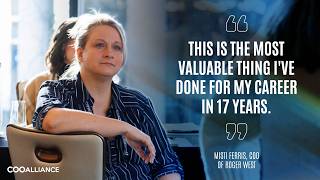
Mist Ferris spent two years in the COO Alliance to build confidence as an executive after a merger. She used the peer feedback, Cameron Herold's hiring framework, and hybrid operating systems to improve leadership retention and save over $500k per executive turnover. She calls it the most valuable investment of her 17-year career.
Chapters
I've been in for 2 full years and it has been absolutely a wonderful experience. How I decided to join the COO Alliance was a pretty fun story. A lot of people would recognize this in themselves. People who are in the COO or similar roles were very behind the scenes, and networking is not something that we're very— certainly not excited about and maybe not so comfortable with in some situations. I have a great relationship with my CEO, always have, and that was one of the things that we were like, hey, this is, this is a deficiency in our skill sets. So we really need to get you a lot more comfortable in rooms where you can talk to different executives and be very natural in those settings. She got me someone who I could talk with as a reference. She couldn't stop talking about how comfortable everything was for her. That was my biggest fear, was that I couldn't be helpful, like I wouldn't be able to contribute something that other people would be like, oh, that's kind of a cool idea, let me see if I can incorporate a piece of that. Because to me, that's It's not really my only value, but that feels like, hey, that's something I should be able to do. Her and I have been really good friends since, and we're actually in an accountability group together, and it's been really great. Don't hesitate. Like, if you're— if you've ever spent money on a single thing for your growth and development, this money will be better spent here. What I was lacking was one of the challenges would be that our team came into a very experienced, very tenured team. So that was a really tricky dynamic to be able to gain trust and gain, you know, authority in a role where they had typically always reported to the CEO before. So that was a very hard dynamic to overcome. Personally, for my role, I was just having a very hard time. I felt confident in our scaling and, you know, the day-to-day, the tactics, like the things that you can feel. Here's your checklist of steps to take and get them done. You know, I felt very confident in my ability to have good judgment around those things and to get those things done. But I wasn't very confident in my ability to communicate to team members the why behind being able to say this is the best way that we're going to get these things done. And I wasn't super confident in my ability to be able to push back when people thought that their way might be a little bit better. I've learned through the COO Alliance that really my role is the only role that is close enough to the operations of the work that we're actually doing and yet close enough to the vision of where we're going to be able to take all of that and make very good judgment calls around what is the right action to take in the day-to-day middle of, you know, crazy project going off the rails or some big initiative that no one really likes. To take the feedback from the team or any, you know, vested members that might be interested in making a decision around how we're doing things, be able to understand their point of view and test my own theories about, okay, is this the right decision? But then ultimately come to a decision and feel very confident in how I explain explain that or how I roll that out to people who may have a little bit of a different feeling of how we should have done it. In layman's terms, I refer to that as owning my role. We've done a really great job of keeping all of the team members that we had pre-merger and post-merger, so there was no one that left. The most valuable thing that I've gotten out of COO Alliance is the peer testing environment that it creates. I'm able to have an idea about how I want to run something or change something within my business and I can take that to whether it's the Circle community or if I just wanna have a one-off conversation with somebody who maybe I've had a conversation around something relevant to that topic. Sometimes it'll be in the breakout groups from the monthly masterminds, or it'll be at the in-person events. Those are really great to connect. So I'll reach out to that person specifically and say, hey, here's what I'm thinking. Do you have like 20 minutes to talk through this with me? I can also stay grounded in what I know is the right way to move the business forward and do that from somewhat of an empathetic standpoint. There's so many different businesses within the CEO Alliance. You can literally like have your pick and choose. You're like, oh, I know that person's really good at onboarding and I'm changing my onboarding stuff. So let me reach out to them and see what they think about my program. They'll give you such honest feedback. It is unreal. And from our role, I think that is something that is a very rare resource because people are sometimes afraid to tell you what they're really thinking. And so to have someone who has done this type of stuff that you've done and has had success in it, to be able to sit and just have a candid conversation. And you can pull your theories and you can say, well, if you had done it this way, do you think that would've made a difference? Those conversations are so wildly helpful. I don't think I've implemented a single new program at my company without finding someone who was willing to give me at least 10 or 15 minutes where I'm like, hey, this is what I'm doing. What did you see when you did this? That's worth all the money in the world to me because that gives you the confidence to be able to go back and say like, hey, this is not just my idea. This is, you know, something I've talked about with some of my peers and this is what's worked in another business and here's what that business looks like. So you can give your team, they don't just have to rely on your credibility. They can say, oh, I've heard of that business before. That's interesting that that's how they've done that. The other one that really helped me out of the Invest in Your Leaders course was actually Cameron Herold's interviewing process, just gone round and round in a million ways of interviewing here. We've done it the right way. We've done it unconventional ways, whatever. And I just finally said to the CEO one day, I was like, listen, neither, neither one of us are great at this. Like, we need to lean on somebody else to help us do this. And we've done all the ways that the books tell us that we should be doing it. This is our results. It's not ideal. Let's try something different. And he went through the Invest in Your Leader course module around hiring, and he said, that's crazy. Like, you can't actually do that. And I was like, I know, it sounds crazy, let's try it. It was tough and it felt a little awkward in some places, but we thought it was really great and we made a great hire out of using that process. So we'll try it again when we're ready to hire again. I know he says that he's not the group and the group is the people, but he does impart a lot of really valuable wisdom onto the group. And one of them is that, uh, minimum viable everything, That's my favorite, favorite saying of his, because as operators, we want to overanalyze and overplan and over everything. We want to do everything to the fullest detail. And having someone like Cameron, who is not just an operator, but also someone who has that high-level view but understands the operational needs, that really does give credit to saying, okay, we don't have to have everything at 100%, get it to 80%. And get it out the door, get it moving, and adjust as you go, which was a huge pain point for this company specifically. So as a business, we're moving so much faster now because we're prioritizing getting work out the door when it's about 70% ready instead of trying to overplan every single detail until it's 100% perfect. Prior to joining, we went through a lot of different operating systems as a company, and one thing that I've gotten a lot of information in from the COO Alliance, whether it's from members or the guest speakers that we have, or different operating systems. I've been able to gather enough information about what's working across other businesses to kind of create my own hybrid operating system that has been a huge success. 7 years of working with this business with largely the same team, being able to implement our own custom operating system has contributed to retention. We were told to quite a bit of, you know, churn and quite a bit of even loss of our leadership team. Since we've implemented our own custom system, we haven't had any loss. We've got people who are actually more integrated into leadership roles than we previously had. So that's a huge win for us across the board because our people are our asset. I want to say it was well over half a million dollars for each person that you lose at an executive level. Agency life, it is crazy to have people who are with your company for more than 2 years. Like, that's just— it doesn't happen. And we have here almost half the team has been here for more than 5 years. Minimum would be like $200,000 in retention savings over, over a period of 5 years. When I first joined the CEO Alliance and just feeling kind of hesitant to put myself out there because, like I mentioned, like networking just wasn't super comfortable for me. The amount of confidence I have is completely different than, than what I had, and I know I've still got tons of growing to do and a lot of change still needs to happen. There is no amount of money that would keep me from telling somebody that they should join the group if they are in any kind of operator role and they see any room for growth or development, or they want to improve relationships with their team, or they want to improve the relationship with their CEO. It is the most valuable thing that I've done for my career in 17 years.
More from Cameron

Flutterwave Former Global Head of Operations Awa Kone | When Growth Outruns Operations (Podcast 611)







Optomi Professional Services COO Nick Murphy | The COO Can’t Know Everything (Podcast 607)


