FAN FAVORITE - How to Scale a Neobank to Hypergrowth | Jamal Al Awadhi (Podcast 586)
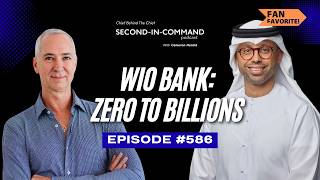
Jamal Al Awadhi, COO of Weo Bank in Abu Dhabi, explains how the neobank launched with business banking first, backed by UAE sovereign wealth fund ADQ. He covers hiring for hypergrowth, his servant leadership style with three executive coaches, and why word-of-mouth beats heavy marketing.
Chapters
looked around and said, look, this is clearly a growing trend across the world. This will not stop at the borders of the UAE. And we need to move quickly, move ahead and create something that's homegrown that will also lead the way and challenge the existing players in the landscape here to also start to move in that same direction. So create, create change, ultimately elevate the level of financial services in the market, both for the UAE as a nation.
Welcome to the Second Command Podcast. Our special guest today is Weo Bank's COO, Jamal Al Awadi. Jamal and Weo Bank are based in Abu Dhabi in the United Arab Emirates, where I'm actually now resident, and he's our first guest from the region. This episode was a lot of fun to record. You're in for a treat. And if you can watch it on our Second Command Podcast YouTube channel, Jamal is a stellar leader who went to school at Tufts in Boston, has over a decade in marketing and strategy. He's married to a Canadian from Yellowknife, and his international perspective is a valuable asset in growing Weobank. He works with 3 executive coaches, and that totally shines through as he's a really strong leader. As Weobank's COO, Jamal focuses on strategic priorities, innovation, and cultivating teamwork. The bank is in a rapid hypergrowth phase right now, as one would expect considering they're disrupting the industry as a platform bank. Jamal and his team are funded by ADQ Investment Bank and the region's sovereign wealth fund. You're gonna love this episode with Jamal Alwadi as he shares his experience and insights on leadership, teamwork, and the exciting journey of Weobank. We'll see you on the inside. This is definitely going to be an episode that you will want to share. So Jamal, welcome to the Second Command Podcast.
Thank you, Cameron. Great to be here.
Yeah, I've been looking forward to this for a long time. I am actually a new client of Weobank, which you're the COO of. I'm a new resident of Emirates. Um, and then I just found out prior to coming on that you're married to a Canadian, and I'm a Canadian, so this is pretty cool.
Welcome, welcome on a number of levels. And I guess, well, I guess I'm part of your club now too. Yeah, you are.
Well, and, and the CEO. So you got to just tell me really briefly, and for our listeners, like, how does somebody from Abu Dhabi get to meet somebody from Yellowknife, Canada, um, and marry a Canadian?
The answer to that question, I think, is really exploring, putting yourself out there, looking to grow in a number of different ways, whether it's within the UAE, outside of the UAE, just being open to those opportunities. And I think that's, that's how it really brought me to, to where I am. And of course, along the way, met my wife through the process in one of my roles at, funny enough, the airline in the UAE, actually.
Okay. So you, you meet her at an airline in the UAE. You've been to Canada a bunch of times. One of my favorite cities in Canada is called Kelowna and your mom or her mom now lives there. You've been to Kelowna a few times.
Yeah, I love it. You know, the nature and, and, and, and of course the landscape's stunning. I don't think, I think where we are today, I think we have a lot of beautiful places around us and I think North America is still on the further end of the, of the spectrum, let alone sort of the West Coast. And if you start to go a bit higher into Canada, slightly even, even further, but it's definitely worth the visit. Definitely worth the experience and the nature is just just overwhelming. And I think it's nice to have that when you run at the pace that we run at here, to disconnect and have that time just for yourself. Or just to kind of even— I usually use the word, you know, it's like you, the colors that you see in the nature that you see, it really feeds your eyes. And I think it's very healing, it's very nurturing, and I get immense value from it.
I do too. It's funny that you mentioned the colors. I don't know if I've ever had anyone say it, but I go hiking so often and I see the greens and there's like 20 different shades of green. Like, it's kind of mind-blowing that nature is so beautiful. And then I guess for both of us, you know, we need to get out of the Emirates June, July, and August when it's just so crazy hot. And Cologne is pretty darn inviting at that time of year. I recommend you do not go to Cologne in January or February unless you're ready to be pretty cold, though.
No, the only time I've been in winter was around December, around Christmas time, and it snowed heavily. I did, I did a bit of skiing. I ended up ended up skiing into a house. So that's my, that's my story. Everyone at the, on the hill saw it. Everyone was talking about it in the après-ski.
I'm getting to bring my two boys over. They're 20 and 22 and they're coming over to Dubai to meet my wife and I at Christmas. And I'm going to take them skiing at the indoor mall because they're big skiers in Canada. So I'll take them skiing in Dubai just to make sure we check off that.
That's a little different than Big White.
Yeah, exactly. That was a great trip. We took them to Big White too. All right. So let's talk about WIO. When do you sit down and say, let's start a bank? What was the impetus for doing this? And then to start one in such a beautiful way, kind of like Tesla, I'm going to start a car company, but we're not going to have dealerships. Weo doesn't have locations. You can walk us through what Weo is and what really the early, early days of Weo was.
I think the early days, if I look back to how we started, I think there was definitely a need in the market. I think that the financial services landscape at the time filled with a number of traditional players in the market. And when you looked around outside of the region and the UAE, look at what the trends that were happening in Southeast Asia, in Europe, and in some parts of North America as well, you saw these digital disruptors, the neobanks that were coming out into the market and really taking market share, you know, really disrupting the landscape. And the key stakeholders here within the UAE, and this was the sovereign wealth fund at the time, ADQ, had done a piece of work and looked around and said, look, this is clearly a growing trend across the world. This will not stop at the borders of the UAE. And we need to move quickly, move ahead and create something that's homegrown that will also lead the way and challenge the existing players in the landscape here. To also start to move in that same direction. So create, create change, overcome that initial inertia that is so hard, ultimately elevate the level of financial services in the market, both for the UAE as a nation. We're increasingly looking to attract a number of businesses, foreign direct investment into the country. And a core part of that, as you probably know, and a number of other people know, is providing banking services or financial services. I think that's critical. That's integral. And you want it to be up to a standard and a level that your customers expect, especially those that are coming in from markets where this is the norm.
Who are your target clients? Who are your target customers? Is it consumer? Is it business? It feels like it's a business bank more than a consumer bank.
Well, you're not wrong in getting that sort of a feeling. We started off, we had a choice. Do we go after the business? Segment or do we go after the retail or consumer segment? Honestly, the problem that needed solving the most, and that was the business sector and the business segment. Business customers have had a very, very painful experience in the past. And that's where we decided we're going to focus our energy. We're going to crack this problem. No one else has been successful to crack it. And we said, we'll take on this challenge. We received a lot of questions in the early days as to this approach. Wouldn't it be better to go out onto retail? Easier to spread a brand new brand. Of course, you know, there's more obviously retail customers than business customers, but we decided to align ourselves with the goals of the wider sort of country, the industry build goal, the foreign direct investment goal, and create a better business environment. And really go after and solving that problem. And that's why we went out September of last year in the market with our business product, our business banking product, Weo Business. Very recently, just a few months ago, we went out with our retail product and we have a roadmap of products and services that we plan to launch. But being a startup, we didn't have a ton of people constrained in that way. And so we have to really focus. And that's what we did. We started with business and have moved on to retail and are continuing to develop both products as well as expanding the product offering into other areas.
And it's interesting, you, you really have touched on the fact that it is a business problem that you're going after, but it also is the country's focus right now. I don't know if I've ever really seen a country that has this kind of a vision and a plan that businesses are rallying around, and also the, the locals are like, everyone seems to be rallying around this vision. Is that something that is very unique to the UAE?
I think the vision of our leadership has always been there, even when you look back and then you look forward as well. I think that we believe that we obviously have much more to go and do and goals that we need to reach and deliver to. People do rally around the leadership and the vision. It makes sense. First of all, it is aspirational, but also inspirational as well. We're a country that has always punched above our weight. And we're looking to continue to do that through innovation, through technology, through the way and the role of government, I think is very, very unique to this region. You know, that sometimes you'll find that people are quite surprised as to how developed the government sector is and the innovation in the government sector and the advancement within that sector. Times even leading the private sector developments, right? And that's why you, you start to see the level of services, which I'm sure you've experienced already. Totally. The setting up, whether it's a business or an individual moving here, 10 years ago, they spoke of electronic services and whatnot. Today, it's hard for you to do anything with the government without going through some sort of an app, you know, back in the day when I was growing up, it was very different. And every time. I would come back while studying in the US and even while working in the US, the country was growing in leaps and bounds and it was at times almost unrecognizable, but all in a positive way. And that's, I'm one small sort of tool in this sort of master plan and I'm happy to be helping that, be part of that change and be part of the growth. It makes me extremely proud and very, very fulfilled with the work that I do, the satisfaction you get because it's not just words on a piece of paper or in thin air. It's actually being put into practice and the leadership take a personal interest in this and they're very hands-on, very focused on what needs to happen and when it needs to happen. And that level of drive, I mean, is it helps move the entire nation in the same direction. I think it's fantastic.
Yeah, it's unbelievable to watch. I've written 6 business books and one of my books is called Vivid Vision. And it is all about that vision that's inspirational and aspirational, and it helps align everybody. And I don't think, I've been to 69 countries so far, and I don't think I've seen a single country on the planet that is as aligned, that is as forward-driving, and that is where government is actually inspirational. In most countries, government is something to be avoided and something to be, like, we're all so frustrated with them, and government seems to be getting in the way The government in the UAE doesn't seem to be getting in the way. They seem to be leading the way. It's incredible to watch.
Yeah, we're very fortunate to have the leadership that we have.
Was it easy starting a bank with the government regulations, or were there many government regulations in starting a bank?
Yes, uh, the, the financial services sector, like in many other countries, is extremely, uh, highly regulated, and we needed to make sure that we complied with those regulations and built the bank in accordance with those regulations and laws, and then also continued once we launched the bank to operate under those very same laws and regulations. I wouldn't say it's not easy, but it's not entirely challenging in the sense that the regulator was extremely supportive of us coming in because once again, it helps mature the overall financial services landscape. And the regulator, as once again, similar to what you just mentioned, is also trying to push the envelope and leading the way in a lot of the change that needs to happen within the financial services sector, not just from a banking service part, but from other types of products and services, other types of institutions that should be accessible within the region. And they're constantly leading the way, bringing in new technology, new system, new tools to help enable the banks to adopt and then grow from that point on.
I'm curious about competition, and I'm not going to name names, but there's a couple of other brands. You know, every country has lots of brands in the banking sector. There's a couple of other brands that I was introduced to in the early days when I was setting up my company in residency. And when I looked at them, you know, they felt good and clean and modern and progressive. How have they been to compete with? Have they assisted? Have they gotten in your way? Have they, are they starting to adopt some of what you're doing now and watching you as a leader?
We've seen that change. And I think if you look at the primary differences, you know, Weo we came out into the market, not just as another bank, we came out as a platform bank, right? And it's a very new concept to the region, but it didn't have, it wasn't without its challenges. The rest of the market, I think, are traditional banks that have started to heavily invest in a digital channel, if you will. So the guts and the core of the bank have remained as they are, whereas what we did is we had to build a bank from scratch, from the ground up. Completely digitally native.
It's pretty strong.
It's strong, but even the tech that we built, and I'm very open and honest to say, we're giving it a hard look now, a couple years into from the build and selection of our tech and saying, is this tech still fit for purpose? Right? Can we still go in and rip some parts out and bring in even better tech in? And it's shocking that we would look to even think of something that looks, actually you would call a transformation. This early on, but that's the mindset, continuously improving. I talked about challenges, you know, the rest of the market, they've been here for a longer period of time than we have, way much more of a head start, but also having some of that brick and mortar that we don't have. We've run into some challenges early on, on people really feeling that sense of trust. Is this a real bank? That's how new this concept is. People find comfort in physical banking locations. And the way we worked around these concerns are, of course, through our many platforms, whether it's our website or on social media. We're constantly reiterating the message of our strong shareholder base, talking about how we're regulated by the same regulatory body that every other bank here is regulated. We're trying to communicate our authenticity. And we have very, very strong shareholder base that have an extremely strong reputation and presence in the market that we are leveraging to give us that credibility. I have to talk about this because I know you've experienced it, but the significant game changer for us has been the power of word of mouth. I mean, when we first launched, we did very little above the line marketing and promotion, and we kind of did a soft launch and we kind of kept it that way for two reasons. We didn't want to go out there and flood our platform that wasn't truly tested. We had done a number of tests ourselves.. But you know, when you go out there and you shout and scream, you know, you could be flooded with demand that at times could be challenging, especially if you're testing a brand new platform in the market. So we thought we would be a little bit more low-key. And when we launched in the market, the growth numbers that we were experiencing purely through the power of word of mouth, I mean, there's customer experiences that were shared, particularly within a community. Especially in our case, the business community, carried more weight than traditional marketing tactics. You know, you saw it's businesses that all of a sudden who had take— it had previously taken them weeks and months to open a business bank account, has they opened their bank account in hours or days. To them, that was mind-blowing and they couldn't help but start to talk to other people and share this. Hey, you need to go check this bank out. You need to open an account with with Weobank. And that alone started to create a lot of demand. And by the time it was all said and done, I'll be honest with you, like, you know, we did turn on our marketing engine at some point in time. And we're really happy that, you know, a year ago when we launched, the numbers that were coming through the door are actually the same numbers that are coming through the door today, 13, 14 months after launch. And that's a testament to how strong of a response we've had in the market. And we continue to get, you know, new traffic flows. There's a lot of new businesses that are setting up and a lot of people are saying you should open an account at WIO. And that has, of course, you know, resulted in the rest of the market taking notice and starting to up their game, which overall is good for the UAE.
Yeah, I think it's good for the UAE. So it's the whole concept of the rising tides lift all boats, right? So if everybody starts building better online banking, it will give a lot more credence to what WIO is doing because you will be the leader because you're not stuck in the old traditional model. As you said, you are really more of a platform bank versus a, a bank with an online portal. And it's interesting you mentioned word of mouth. I went out when I was setting up there about a year ago, kind of getting up my residency. I went out into two communities online and asked people what bank they would suggest. And then I asked some friends that have lived in the UAE for 15 years and I got very different responses. The friends that have lived in the UAE for 15 years gave me the very traditional couple of brands. And then I went into a group called Internations and another one called Dynamite Circle. And both of those groups, WEo is in every conversation as well as the other brands were kind of mixed in. But it was like, we, we, we, we. I'm like, what the heck? And then I spoke to another young female entrepreneur who's set up her residency in Dubai about probably 2 years ago, and she was just like, we, we, we, we forget the others completely. I'm like, all right, I guess I'll give you guys a try. The customer experience is what grabbed me. The ability to just have my questions answered via WhatsApp very quickly and then realizing I didn't have to go through the pain in the ass factor of driving down to a branch and figuring out parking and probably get a speeding ticket on the way.
Another one.
Another one. Yeah, it all just worked out. Working with a sovereign wealth fund, working with the investment community to, to build a company. Some would look from the outside looking in and say, well, then it's easy to grow a company because you have money. It's never, I don't think it's ever easy to scale a company when you have access to money. What have been some of the challenges of having those kinds of investors coming in versus, you know, a traditional VC investor? Or is the sovereign wealth fund more of a traditional VC investor?
Having the sovereign wealth fund, and in our case was ADQ at the time, and this also extends into our existing shareholder base. They have been extremely supportive of our growth. Our pace. They have a view that while we do need to hit our targets, we need to do it in the right way. There's no shortcuts here. You know, our shareholders have come from, of course, diverse backgrounds, but come also from the financial services background. So they know what it takes. They've actually been involved in some of the largest institutions in the region. And, you know, with that comes, you know, an approach that is very measured, it's calculated. There's a lot of thought that goes into the decisions that, that we make. And I found the relationship to be honestly one of the best that we could have. Even when we do face any setbacks, they're there, they have our backs, they support us, they make sure we have the right level of access that we need to, and that we're growing in the right way. And if they ever feel that we're either growing too fast in the wrong way— growing too fast is a reality for us, but doing it in the right way and the wrong way, I think they're very aware of that. They connect in with us and they're very accessible for individuals that have a number of other roles and responsibilities. It is a blessing, honestly, to have them be as accessible as they are. And give their time to— honestly, if you look at the breadth of the portfolio, we're teeny. We're still teeny. I mean, we've only really started our journey, you know, a little over a year ago in the market. And so from that perspective, I mean, yes, we have a lot of potential, but we're also very humble that they're able to provide that level of commitment, engagement, and direction.
Talk about some of growing the right way. I'm curious about the hiring because from my experience, the interaction that I've had has been very strong. Can you talk about some of the systems that you have in place of hiring? What kind of people you're looking for? Where do you find them?
On that topic, you know, the kinds of individuals we look for initially, we look for a mix. That's the short answer. And when I say mix, not just from a diversity perspective, but from a background perspective, you look at people who come primarily, do they have financial services experience? Preferably yes, that's a good thing. But if they don't, that's okay too. We have a number of individuals within my organization that don't come from a financial services background. I don't come from a financial services background either. And I think that's a good thing for an institution that is trying to challenge the ways of working, challenge the norms, challenge the status quo, and really do something different and bring a different flavor, and allow us to stand out. So we look for people that are extremely hardworking. It's not easy being at Weo. As you know, we're in a stage of sort of hypergrowth. You know, every day it's around keeping up with the demand, understanding the market, ensuring our teams are delivering without compromising customer satisfaction. But at the same time, and we know that they're hardworking, but I try to be as as mindful that I don't want to overwhelm the teams during this phase. We want them to last. We want them to stay with us because burnout can happen very easily. But the challenges and the opportunities lie in the constant need to evolve. And we're always innovating sort of new ways of working to match the pace of our growth. I always say every sort of 6 months, I'm almost looking at a different business. And I need people around me that can do that, right? That can elevate their game, or switch to look at things at a different angle or a different facet. And so that we can keep up with, with the change. The rate of growth has been so high, you have to almost change your operating model every 6 months. To change your operating model in that way every 6 months is just, is not an easy task. And to have people that can mentally do that with you and ride those waves with you, uh, it takes a bit of resilience. And then that's one of the other factors that we look for.
Yeah, you really do have to hire for that. I was the COO of a company called 1-800-GOT-JUNK, and we had 6 consecutive years of 100% revenue growth, and I think you're going to be trumping that by a long shot. And the resilience isn't in everybody. People don't always understand that making it up as we go is actually the way.
Like, yeah, it's, you know, what do they call it? I think the military, they call it the VUCA mindset, right? And it's funny enough, people in the military are very good at this and adapting to this, but we're seeing a lot of our talent able to move and shake with the business. And, you know, you're right. It's not for everyone. Obviously, we've had people since we've started come in, stay with us. Some people have left us, but we have people that have been with us from day one that are still here. And they're in it for the long run. And they, you know, they love being part of this. They truly believe and they're invested in this business.
Are you getting to the stage now where you're starting to hire some senior leadership people over top of the current team? Like, are you bringing in that seasoned talent.
Yeah. Yeah. So funny you say that, you know, it's, it's what's the right point where you hit that sense of maturity. And, and, and for me, you know, when you first come out of the gates, you know, you've kind of designed everything, you kind of feel like you've done all your thinking. And so now you build an engine that can run and you continuously fine tune it. And, and personally, that was the focus for me. I want to make sure I have an engine that can run in, in that way, which, or I call it the run side of my business. There was a lesser focus on more the design and the change part of the business. But I'm increasingly now focusing more on the change side and realizing that that is where I need to focus my attention and bring in the right talent that can do more of the thinking. We have excellent people that are doing and operating, and, and now we need to get some good thinking and then link the two.
Talk about the balance right now for you. I'm curious what it's like for you as a leader and for your employees leading them to have some semblance of balance? I mean, or is it for now, for like the first 3 to 5 years, it's heads down, go 100 miles an hour, you'll see your wife when you can see her? Is it just complete monomaniacal focus right now, or do you have any semblance of some balance as well?
We realize this hypergrowth we're in, and it's not easy to manage. I think we are increasingly taking steps to provide people that switch-off timeframe to be able to come up for air a little bit. I'll be honest, I don't get to come up for air as much as I would like to, but to your point, this is the stage we're in and this is the focus, right? It is head down and get through it. But we do celebrate our wins, right? We absolutely do. We do stop for only a few minutes to celebrate our wins, but we do it often, right? And I think we're extremely excited by this. We know that we will reach a point where we will be able to do a little bit more as we continuously improve the business and do more for our employees. We try to provide them as much support as we can. You know, we have a flexible sort of a work environment here. You know, it's not every day in the office where a majority of institutions have already moved to that. We've retained this piece at WIO. We allow, we have a remote work policy that allows people time to work remotely. You know, a lot of our employees are very much skewed in the younger demographic, and this is just something now, it's a non-negotiable, especially when a lot of other institutions are clamping down on this. This has helped us attract new talent, better talent, and also retain the ones that we have today.
I was just about to ask the question of hybrid or, and I was not expecting to be so progressive. That's, it's super intriguing for such a traditional industry of banking to say, yeah, of course, like it's a non-negotiable. You have to be hybrid.
I think that allows you to bring in a different type of talent than the rest of the industry. And for us, that's an advantage. I think here at Weo, if you're different, that's good.
Are you global with any of your talent? Like, do you have like a tech team in Romania and a, you know, marketing team in UAE? Do you have any of that going on? Or are you mostly—
We do leverage talent from around the world. I think Even within the UAE, the team that you see here are from all over the world and literally like all over the world. And we've had, when we're having more and more people, I have a couple more people joining my team that aren't even here yet, you know, and one starts next week, the other one starts in February coming in from different parts of Europe. Everyone's really looking at this region as the place to be and thankfully Rio as as one of the, the employers of choice. What in terms of other centers around the world, we are exploring having development centers, tech centers, potential operation centers in other parts of the world as well.
If you're the CEO of a company and you'd like to see how you stack up against the 8 core skills of other COOs working as a second in command in their business, go to cooalliance.com/downloads, grab a free a free copy of our scorecard where you can measure yourself against those 8 other areas, and we'll send you back a report showing you how you stack up, where you can improve, and where we may even be able to help you in your growth. Again, go to cooalliance.com/downloads. All right, I want to talk about, um, customers. You know, when you're building a tech product and a tech platform, which Weo really is doing, customers all have our opinions, right? Like, um, everybody has their opinion on what should be in the product, and if your product did this, I would work with you. How do you balance the needs of customers and the desires of customers when you need to also say no or not now?
Our customers, uh, as you, as you mentioned, are very open with their feedback of what they expect from you in terms of product roadmap, what they would like, what they don't like. If something's out in the market today and we don't, and, and customers don't like it or it's not working for them, that's something we take very seriously. To us, that's that's something that we're going to go and fix. However, if there's a new product that a customer is looking for, we take that feedback in, we pass it on to our design teams. The design teams are continuously iterating and improving our products while working on new products. And as part of that new product development process, both the product and design teams work together to really bring the customers into WIO. And depending on what segment we're looking to target with that product, We'll make sure that we listen to the customer, understand what their pain points are, what are you looking for, what are their needs, what are their dislikes, likes, and eventually come up with a product that will address those needs, satisfy the customers, but also deliver value to the bank.
Curious what percentage of your customers are, you know, local Emirati and what percent are the local or the expats that are setting up businesses? Do you know what the split is and do you have a focus on that?
I don't have a split right now off the top of my head, but we do have customers from both segments. The Emirati segment is growing. We've taken a bit more focused approach to addressing the Emirati customers. When we went out with the retail customer proposition, we started to see a larger number of Emiratis come on board. And of course, we have a healthy base with Emirati entrepreneurs as well and business owners. Have onboarded onto our platform. Some onboard because they've obviously heard about us and want to test us out, and that's fantastic and we're fine with that. And there are some that have just set up new businesses and for them there's no other choice than Weo. And we're really happy about that. This is, you know, we are an Abu Dhabi and a company based out of the UAE. So the UAE segment is extremely important to us and we are You know, are always going to have an eye and an ear to the, to the local segment or the Emirati segment. Um, and I wouldn't be surprised if we really started to look at areas of focus that address them specifically with their specific needs as well.
Yeah, I think you're right. I think your retail is going to take— I think going in deep in the retail and the Emirati segment will give you the business segment there for sure. And then I think the business segment for the expats will gain you the retail with them as well. So one of my newest books is called The Second in Command, and it's all about, you know, your role as the CEO, my role of having played it. I want to talk about a little bit of the role of the second in command and what the differences are between you and the CEO with Weobank. First, how do you stay in sync with them? How did you divide and conquer in terms of who does what in the organization? And then third, how do you think you see the business differently than they do?
Look, I think the role of the COO and the CEO, I think they're complementary roles. And this is the way that I work with our CEO. You know, we, from a collaboration perspective, we collaborate on all strategic aspects and projects, especially ones that concern the community, the customers, and overarching business strategies. The CEO definitely leverages the fact that I am Emirati and there, that is an opportunity in this market. We are in the, in this environment and having that kind of a steer is vital and important. And I think he leverages my, I guess, knowledge and in this space and my experience in this space and also just a better understanding of the landscape. Are there any political sensitivities here? Anything we need to be careful about? What would work, what wouldn't work, things of that sort. However, when it comes to sort of division of responsibilities, we do that in a way that of course is joined up as well, right? And it sounds counterintuitive, but I look at him as a CEO focusing on sort of the high-level strategy, definitely managing the board and our shareholders and some key stakeholders within Abu Dhabi and the UAE. While I sort of take over more of the day-to-day operations, the execution side, addressing any of the escalations that may occur, which do occur, and ensuring that we're meeting the expectations of the market and our customers. Escalations and sort of, I mentioned, you know, fires that start, as you probably know very well, not uncommon in an operational environment. These are always channeled to me, and I do feel that he has that confidence that I will deal with it, I will take care of it, I'll handle them effectively to ensure that the customers are satisfied. And of course, that we have stability in the market that we're not, you know, causing panic and concern. And I think this collaborative approach, you know, it really ensures that we drive our teams to meet sort of high-level objectives while managing operational intricacies as well. And I'll be honest, you know, we kind of back each other up as well. I, I leverage him when I need it, um, and I think he does the same, uh, on his side.
I'm curious, if you were only able to work for 2 hours a day, you know, you had some, some illnesses in the family or whatever, and you literally for 6 months could only operate 2 hours a day, tactically, specifically, what would you do in those 2 hours a day that would really leverage, you know, the WIO brand, or that would be the biggest you know, return on your time?
2 hours a day. Okay. Well, I can do a lot in 2 hours. Right? A, I would check in with my team. I would look at the data that we have on our dashboards right away to understand what's going on. That makes sense. I need to know how they're doing, what they're feeling challenged by, where they need additional support, you know, what's really not working well. They need guidance, they need direction. I need to make sure that they're confident that, they have my, that presence and I, and, you know, and I think that that's normal to have that kind of support in that relationship. I definitely want to check in with my CEO, not every single day, but within those, some of those 2-hour blocks for sure, I would do that. And then I would just also take the time to just think. I think it's valuable to stop and to think and come up for air and to think. And I really don't think As COOs, we do enough of that. You know, every COO I speak to, you know, finds themselves coming up for air, doing a bit of thinking, and then getting pulled back into the weeds. And I think that we need to take that time to think. Otherwise, I can't see us providing the value that we should provide.
I love the insight on that. I also, I really loved your initial response, which was, wow, I could do a lot in 2 hours a day. So many people are like, oh my gosh, I don't know what I'd do if I only had that much time. You're right, like 2 hours is like so much time, right, that we really— if you use it effectively. You seem to be a very supportive leader. You're not like the autocratic, dictatorial, telling people what to do. You seem to be more of the servant leadership. Would that be kind of the model that you subscribe to?
Yeah, I mean, if you look at, you know, it's funny, I had a similar conversation about one of my coaches recently about my sort of style, and it is that I almost look at it, uh, you know, they asked me to draw a picture of what you thought your style was, and I drew drew this image of just a large group of people, little stick figures, because I'm not a great artist, but a large mass of them. And I drew these two big arms sort of just behind them, these two hands, and then obviously my big bald head right above it smiling. And when I had to interpret it and I have to explain it, and then it was really that I see myself You know, and I think this was probably a difference in my own growth where I used to want to be front and center all the time. And I found that I'm actually more valuable sort of standing sort of behind and around my team to really make sure they get what they need so that they can be successful. And I can, if things get blocked, I can unblock areas that are holding them back, whether that's within the organization or within themselves. And that's been a huge part of sort of my shift and my change in style. And that's, for me, that's the kind of leadership style I want to have. That doesn't mean I will come down hard on you. Even when I do it, I'll make sure that I'm explaining why this is happening. And it's more of a questioning. I want people to come to those conclusions themselves. And for me, that means asking the right questions that leads them to that to that, uh, to that outcome. And it's very satisfying.
Yes, you're more, you're more of a Socratic leader. That's, it's interesting. I love that you actually mentioned working with one of your coaches. And, and I think I've done about 330 episodes with COOs, and I know a lot of them are learning. They're out there always kind of continuing to grow. How did you find a coach? What were you looking for in a coach? And what kinds of coaches do you work with?
It's a funny story. I, I knew, to your point, I needed to sort of more understand myself, my core values, determine what I'm doing. Am I doing things that are aligned to those values or not? Just more, I guess, more inward looking so that I can understand myself better and then better understand how the world perceives me, ideally my team and my colleagues and my peer group. So then I can be a more effective leader in that way. I went out to— I had an experience with a coach actually It's funny, and I'm probably gonna take a few more minutes than I would normally take to answer this question, but this sort of journey of sort of inward-looking reflection happened when I was in a previous role. I was at 2454 in the film and television industry here in Abu Dhabi, and my manager at the time was extremely supportive of sort of development and learning and encouraged me to go to a university in the UK called the, called Henley Business School, but I didn't go there to do business. He asked me to go and look at their continuing education and executive education and pick something that I thought would be great. And I was in an environment where at the time I was extremely performance driven and I wanted to deliver to targets and he was driving us really hard. And I saw this thing that said something along the lines of, oh, driving high performance teams. And I thought, this is perfect. I have teams, I need to drive high performance out of them. This is what I'm going to take. And so I went in and it was a two-part course and I went in this environment and I met all these amazing people. And I remember sitting down and they're about to start the session and these two lovely English women walked in that was very older in their age. And I thought, okay, they have a ton of experience. I'm gonna learn all these techniques about how I'm gonna apply things that are going to deliver results. When they started, I didn't realize it, but they were more like development coaches. And what did we start to do is this whole program was all about understanding one thing, which was me. They didn't come out with anything. People started to— I mean, it can get very heavy. It can get very, very emotional. People start to really understand who they really were. And ask very, very hard questions of themselves. It was the best thing ever. And I came back, I didn't come back with all these tools, but I came back just knowing myself a little bit better. Then I was able to just be able to do things a bit differently. And I thought to myself, oh, I must come across this way. Oh, this is probably why I react to things in this manner. And give you a bit of that self-awareness, which I thought was amazing. So, fast forward, I had an interaction with a coach some number, maybe about a year ago now, actually, here at Rio. And I thought, you know, it really kind of turned that light on again, saying, wow, it's been a long time since I've done some sort of self-development. And I've, of course, matured and I've changed as an individual. So, I need to go back in and see who is Jamal today, right? How is Jamal operating? And I decided I was going to go look for a coach. And as you do, I didn't just go get one coach. I decided I was going to get 3 coaches and create a bit of a customer success team for me and this is the model that I operate today. They coach me individually. They have their own individual strengths and they have different backgrounds. Every, each and every one of them has been in corporate life. Some, two of them out of the three here in the UAE, one of them outside of the UAE. So they get that perspective, but have also worked with clients here. And I needed that because I wanted to make sure I wasn't really clouded by the realities of the UAE. I like to think that, you know, you could pick Jamal up and you can drop him anywhere in the world and he'll perform, he'll be productive and deliver value. And so that's what I do. Whatever I share with each and every one of them is sort of private unless I tell them I'm okay with them then conferring and debating and coming back to me. So I allow that to happen.
You have your coaches are able to talk to each other? Yeah, that's a first. Never heard that yet. That's extraordinary. I love that. That's complete open vulnerability, great trust, the ability to have— that's fantastic. I mean, it would happen in the sports world. I think it's in the business world that you're doing that. It's amazing. All right, I want you to go back to the 21-year-old Jamal and give yourself some advice. What advice would you give the 21-year-old that you know to be true today but you wish you'd known back then?
Oh, I would say number one is is trust the process and don't be too impatient because processes, as we know, can take time, but also organizations and how things move within organizations are different from one place to the other. Organizations are very complex spaces and how decisions come about and how actions are taken can be very, very different, but you need to trust the process. Understand the organization and then have a bit of patience because things will happen. The second is conflict and is not the same as being assertive, right? Or avoiding conflict and not the opposite of being assertive. So you can be assertive and not be conflict-ridden because I think that it's healthy to do that. It's healthy to challenge in the right environment. Then as long as the space is created, For me, you mentioned my sort of leadership style, and for the longest time I thought, well, this is one that doesn't enter into conflict. That's not true. I used to think that that would be off-brand for me, but it's not.
I love that. And if your coaches have not mentioned this, I think one of your biggest strengths is you have this incredible demeanor as a human that you're very welcoming, charming, friendly, engaging. It's just like you kind of just want to hang out with you. I have a feeling like your people really like you and they're going to stay loyal with you. And you're, you're on a path of building something really fantastic in the UAE. And I think globally it's going to be really fun to watch. So Jamal Alwadi, thank you so much for sharing with us on the Second Command podcast. Very appreciative today.
Cameron, thank you so much for having me. It's been, it's been lovely speaking with you.
More from Cameron

Flutterwave Former Global Head of Operations Awa Kone | When Growth Outruns Operations (Podcast 611)







Optomi Professional Services COO Nick Murphy | The COO Can’t Know Everything (Podcast 607)


