Michael Erath’s 5 Obsessions That Make Companies Truly Elite
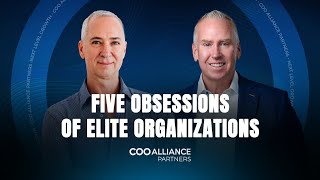
Michael Erath and Cameron Herold discuss what separates elite companies from the rest. Erath covers five obsessions from his book, including how to coach underperforming employees and why customized business systems matter more than off-the-shelf ones.
Chapters
Four out of five times the underperforming employee will end up just fine. The challenge is that individual never had anybody invest the time and effort to coach and train and develop them. We miss a lot of A players that are in our midst that are just not getting the time and attention they need.
Or we spend all our time coaching the C players and ignoring the A players because we don't have a process in place to coach everyone.
What often happens is for the people who are not able to get to the level of meeting the expectation through this process, they need to leave the organization.
So, Michael Erath from Next Level Growth, you are our newest silver partner for the CO alliance, but you're also a lifelong friend and you run an incredible business that I was excited to introduce to all of our CO alliance members and really to all of our viewers for our YouTube. So can you just start us off with telling us, I don't want to read your bio. That gets kind of boring. Tell us who you are, where you came from, and how you came about to start Next Level Growth.
Yeah. So kind of a short story for this. My whole background was in manufacturing. Had a business. I was second generation, we were in Virginia. We manufactured hardwood veneer for the furniture, kitchen cabinet, door and panel industries. And one of the things when I took the business over, we were about 8 million in revenue, about 70 employees. 100% of our business was domestic. And one of the biggest challenges was sourcing our raw materials. So I wanted to vertically integrate the business. I set up a subsidiary, brought in a partner, and we started buying standing timber. Got a lot closer to the resource that way, and we were able to scale the business over a number of years. We grew to about 45 million. Around 200 employees transitioned to a primarily export.
How many years was that over?
That was from late 90s, around 1998 until 2008. So about 10 years. Nine or 10 years. And so the partner that I brought on, he did all the timber merchandising. We kept what we wanted to produce for veneer and I ran the manufacturing side. He ran the timber merchandising business. That transitioned us to an export company. And we ended up with sales offices on six continents. We were shipping about 200 containers per month of product. So it had gotten quite busy. And he and I became best friends. I was his son's godfather. We vacationed a lot together. And when the housing market collapse started in late 2008, I found out not only had he been embezzling to the tune of about half a Million dollars. But he'd also been committing bank fraud. So we went through a significant investigation. I brought in a former faa.
And before you continue on that, because I think it's really important to also illustrate that I don't want people to hinge on the whole bank fraud and embezzlement this guy had done. You built a really successful business.
Right.
Like to $45 million over that 10 year period.
So.
So you clearly know what you're doing.
Yeah, we had built a great business. I had allowed our friendship. In hindsight, I allowed our friendship to allow me to have some blind spots that I think I was a little bit too trusting of him because we were so close.
So he ended up going to jail and did his time.
He spent two years in federal prison. We were able to navigate that outside of bankruptcy, fortunately, which is a whole nother story. But I, my wife and I, by doing that outside of bankruptcy, my wife and I kept our credit intact. So we, after we had lost that business or unwound that business, we were able to get an SBA line of credit and we cashed out the equity in our house, downsized, and used that to start another business. That business. So prior to that, I had been through Mastering the Rockefeller habits. Thought that Vernon's book was great. Picked up a number of things from that. I'd been through top grading and I had cobbled together bits and pieces of different things from different systems. I came across Traction Red Hat.
And you've been a YPO member and an EO member too.
Right. So I was a YPO member during all of that time. And then with the new business, I didn't qualify for YPO anymore. And rather than kind of follow a grace period for a while, I transitioned to eo. So I was seven years overall in ypo, seven in eo. Now I'm back in YPO gold.
Okay. Now that I'm one of the qualified.
Now that I'm one of the.
And you. And I met. You and I met in the Entrepreneurs organization as well, years ago. So probably like about 10 or 12 years ago.
Yeah, that was about 10, 10 years ago here in Scottsdale. Yeah.
All right.
And so I really, when I, when I read Traction, I felt like somebody had kind of gotten their arms around all the disparate things that I had been trying and had built somewhat of a holistic approach. So I started using that. But I was substituting out tools. Like there were things I didn't really like. The People analyzer tool, I thought it was a little too Vague and weak. And I liked things I'd seen in top grading more. So we incorporated different tools from different systems and kind of built a custom approach to how we self implemented eos. Had a lot of success with that.
It was also partially like, I've been around the EOS world now since 2012 is when I first learned about them. And I like the operating model to a point, but it feels a little bit high school ish in some ways. Like once your business is big enough, you kind of, you kind of need the next level.
Right.
But you also, you need a more professional system that a real solid leadership team is going to use. Is that what you started to see as well?
It is. And what I. There were, I think, a couple of things that I saw as frustrations and opportunities. And in 2015, when I exited my businesses, I actually became an EEOS implementer for six years. For a couple of years I had, I set a few records for, for earnings. So I'd had a lot of success with that. But I was always kind of teaching a hybrid customized model. If clients needed things that weren't part of eos, flywheels, profit per X, things like that, I would work with them on those, those tools and.
Sorry, and I know I'm interrupting, but I think it's helpful. But when you were doing the EOs, you were working with about 35 different CEOs and their leadership teams concurrently. Right.
At my peak, I had 35 clients. That was the most and it almost killed me.
So there's not a lot of business coaches that have more than five or six clients. Companies you were coaching 36 companies. You really knew your stuff.
Yeah, yeah, that was. And what happened was I felt like, number one, I felt like in many ways it was too prescriptive, too much of a kind of one size fits all approach. And I was working with lots of companies in different industries, in different scales. And where I was finding additional value was in some of the customizations to those businesses and really trying to make the way I taught fit the user, not force the user to fit the system. When EOS went private equity and then they went franchise model, the franchise agreements basically forbade me from teaching anything that wasn't one of the 20 EOS tools which devalued me. And I felt like that was just a foolish decision. So we were no longer values aligned. And I decided, really, and much to your credit, because you were the one who pushed me to really find my own path and do my own thing. And that's what led to the five obsessions approach me starting next level growth, building out a firm. And what I really wanted to do is I wanted to create something that rather than being about the system, was about the user. And in order to do that, I felt like I needed to step back and really understand what are the core principles that really drive what Jim Collins talked about in Good to Great, but that really drive what I call elite organizations, the really best of the best.
And so Next Level Growth is an organization that does these kind of customizable business operating systems where you take the best from all of them, really, and then what the client really needs. But then you've also got a whole host of, I think 12 or so CEOs, former CEOs of successful companies, YPO size. They've all run like $10 million plus companies. They're actually ones that are guiding your clients now. Is that right?
It is. And you know, it was interesting because in eos there's a massive delta. There's some fantastic EOS implementers with great experience that have scaled businesses. There are people that have been school teachers, right? Oh, wow. And that's, that's the delta. And when I was actually part of the founding of Pinnacle Business Guides and the original idea was we would be 25 to 30 of like the best of the best coaches. And even that model, they kind of began to have to be about the numbers. And so there was one person that I think had been a solopreneur doing like candles out of their home, and now they're a business coach. And so what I wanted to do was really set a baseline that the only people that can be guides at next level growth and join us as partners. There are 10 of us currently have to have been an owner, CEO or president of a company with more than 10 million in revenue and at least 50 employees. And those were the old YPO qualifying standards when I joined. And what I felt was once you've reached that level of scale, you've dealt with just about every complexity that $100 million business deals with. They just have more people and more zeros attached to the issues. And so what that's done for us is the average lifespan right now of our clients is around five years. And I think a lot of that, I mean, I have some clients that I'm in my 10th year with, and I believe a lot of that is attributed to the fact that because of our experience, we're able to adapt and evolve with our clients to continue to provide value that makes it well worth them continuing to Invest in working with us.
Makes sense. So recently I grabbed this book, Five Obsessions of Elite Organizations. I read this while I was in Sydney or no, Melbourne, Australia last year and I think I sent you a note when I was halfway through. It blew me away. Your first book, Rise, was more about what happened during the rise and fall of your timber business and how you went through those trials and tribulations. But this one's actually packed with some pretty solid take home value on how to run your company. This isn't just a story. Can you speak to why you wrote the book Five Obsessions of Elite Organizations and how does it tie in with the company next level growth?
So when I was working as an EOS implementer and getting to know Gina Wittman pretty well, I thought the strategy behind how and why he wrote Traction the way he did was really, really brilliant because what he did is he gave away a lot of what they were teaching.
Gave away all of it?
Yeah, basically gave away. There's a handful of tools that aren't in the book, but very, very few. And so what I realized was the brilliance in that is, number one, people who cannot afford to hire a coach or who just prefer not to have a roadmap to begin to use the system.
Okay, right.
And I wanted people to be able to understand the Five Obsessions framework and actually be able to start using it.
Okay, so you wanted to give away the content, let people run with it as starting point.
Right. And so that was really the idea was how can, how can I get this evolved content and this framework in front of as many people as possible in a way that they can start using it? And the ones that can afford to and desire outside coaching and guidance, they know how to find us. And that will help obviously drive clients and drive growth. But it also, I thought would help get our brand and our philosophy more widespread and more adopted because it's also, I think it's, I think it's both an alternative to eos. So there are some people that are still at that 4 or 5 million dollar number. They're looking for a business operating system and they really, there's not much to choose from. And everything that seems to be out there is prescriptive, which means it's more about the system than about the user.
I saw that. So you mentioned Vern Harnish with the Rockefeller habits. His next book was called Scaling Up. When we were building one, 800 got junk. We were the poster child for the Rockefeller habits. He talked about us all the time. We used all of the systems to scale. Scale the company. One of the systems was the daily huddle and he used to say every single employee has to talk. I'm like, well that's great if you have 20 employees. But we had 148 showing up at Huddle. We don't have time for 148 to talk every day. So he missed the whole point that the systems need to iterate. And I think that's what I love about your model. Something also that I noticed with five obsessions of lead organizations. Yes, you're giving away the tools, but even if I want to self implement this kind of program, if I want to just teach my own company this stuff, most employees don't listen to their CEO as much as they listen to like the Uncle Cameron or the guide that you bring in. It's kind of like when I was a kid growing up, I thought my parents were idiots, but I probably would have listened to your mom and dad. Right, and you thought your mom and dad were kind of stupid, but you would listen to my mom and dad.
Right.
Is that where some of the value comes in of working with elite or next level growth is that you have a guide who proven and it allows the team to listen to this other CEO. And I think the second part is it allows the CEO of the company to sit at the table to participate and not have to be in the leading role all the time. Is that part of the value as well?
It is. I mean it's kind of like, you know, we have boys, you as well. Right. And so we always, when our boys were younger, we tried to get to know their coaches well because they would listen to their coaches before they would listen to us. It's kind of the same, the same idea. And the other thing is, I think so an interesting story. So Jim Small, one of my partners and guides, he was in Columbus, Ohio earlier this week doing a two day annual with a client. And there was a point in the meeting he was telling me about this last night where the owner was trying to articulate a certain thing that he wanted. The entire team was confused, he wasn't making sense to them. And they kept asking for clarity. And his response was, it's clear. Like this is really clear right now. You understand this. And they're like, no, we don't. And so finally Jim basically called him out as being like, you're the problem right now. You need to articulate this in a way that they understand. And so they ended up getting in a shouting match in front of the entire team. And when they kind of worked all of this and got resolved on what was going on, the owner of the company looked at Jim and said, that's why I hired you. I hired you to not be a p. That's amazing. That was exactly what he said. But it's, you know, sometimes as CEOs, we can't see our own blind spots.
Of course.
Right.
And you can't see the forest for the trees.
And a lot of times the team doesn't always feel comfortable voicing it. And having a, having a coach who's willing to be fired for saying what needs to be said or for telling the truth is the right.
And that's part of the value of having a next level guide growth. Okay, so give us kind of the overall view of some of the systems, maybe front to back, that a company who brings next level growth into the organization is going to get. What are they going to start working on? Because you run the annual, two day annual planning and strategy meetings and then you run the quarterly meetings, correct?
Right, yeah, we take clients through a base camp and that's really about meeting them where they are. If, if a company hasn't really done much in the way of instilling systems into the business, then we typically spend about 90 days over three to four meetings with them to really get all the foundational pieces in place. Once we get past that, then it's more of the strategic quarterly and annual planning meetings. But if we zoom out and think about these five principles, what we want to focus on, and we use the term obsessions in intentionally because I think the, if you think about the best of the best leaders of the best organizations, the best sports teams, things like that, they truly do obsess about the things that are important to them. And so what we found is that the best organizations, they all obsess about great people and filling the organization with great people. And so when we take a principled approach to that as guides, we don't care what tools tools a company uses to ensure that they have people who are a great cultural alignment and who are performing well. They have clear expectations and we have ways of measuring that. We just want to make sure they're obsessed about that principle. And we'll help them find the tools and the concepts that are going to fit them based on their industry, their culture, their unique circumstances, as long as.
They end up with that net result.
Correct. And so we've got about 100 different tools we've curated and nobody uses all of them. Right. That'd be nuts. But if there's a certain tool, for example, that a company like, for example, Titan, we're going to get started with next month, if there are certain things, and they've already developed lots of systems and they've done fantastic things in the business. So some of the things we're going to stress test and see if there are ways to make them better, make them actually produce better results, there may be some things they want to blow up, there may be some things they don't have. And so we're going to kind of figure out where those starting points are. But at the end of the day, I want to make sure that they end up with a systemized approach in the business to how they ensure that they're filling the company with a players, they're coaching people up or out that are not performing, they're setting clear expectations, things like that. So that's the obsession around great people. And the tools are very custom tailored to the organization. The second is an inspection, inspiring purpose.
Okay.
So I think great, great organizations really.
Give me the five tools really quickly and then we'll go high level.
It's great people, an inspiring purpose.
Okay.
Optimized playbooks.
Okay.
A culture of performance.
Okay.
And an obsession around growing profits and cash flow.
Okay.
So those are the five. And so if you think about great people, so if you have people that come to work at 1-800-got junkie, for example, you could have somebody who was culturally aligned and who had the skills to perform and the desire to perform their role to a high level. If you could help them form an emotional connection to their job and the purpose behind why they do what they do. So not just external marketing, but internal marketing. Simon Sinek writes a lot about this with just cause and trusting teams and the things in the Infinite Game and some of his earlier works. But when you can get people to connect the work emotionally, yeah. They will always bring more passion and creativity and energy to their work, which allows them also to work with more autonomy in a way that's more.
I tell the story of the three bricklayers in Barcelona 120 years. Right. One guy's making bricks. Second guy's building a wall, and he gets to make the bricks for a wall. Third guy is making the bricks to build the left wall of the cathedral, and they're building the Sagrada Familia, one of the most incredible cathedrals to worship God.
Right, right.
The. They're all making bricks, but one guy has purpose. Is that what you do is try to find that in the Companies and.
Help them articulate that it is in some companies it's really obvious. And we work with. There was one company I worked with that was in behavioral health for young adults and adolescents. And their whole thing was about reversing the suicide trend. That's obviously easy to come up with. Your inspiring purpose. There are also commoditized businesses where oftentimes the employees inspiring purpose is actually about what they're doing for the people inside the company and the families that are part of that company.
Well, junk junk removal. I mean, the inspiring purpose wasn't hauling junk. We were building a globally admired brand.
Right.
And so that became our inspired purpose.
Correct, right. And you know, so, you know, you think about like jobs in the early days of Apple, it was building a company that believed that an individual should be able to stand up to Big Brother to the corporations. Right. And so Cynic writes a lot about.
The status quo and change the. Exactly.
And so that attracted people who. What that entity believed is what they believed. And so that creates a connectivity that is really, really difficult to measure, which is why a lot of people ignore it. But it's amazingly powerful. So that's the inspiring purpose piece. The third is optimized playbooks. It's interesting. So our YPO gold chapter had an event last night with the Phoenix Symphony. There's a conductor from New York. His name escapes me.
Ben Zander.
It might have been. He does a lot of business presentation.
Benjamin Zander, wow.
Yeah. So he was there and he had, he had only met the orca, the orchestra.
He's like 80ish.
Yeah, yeah. He's incredible guy, but yeah, brilliant guy. And so you've been through that presentation? Probably. Yeah. And so what was so interesting at.
An EO event at. Yes.
So this was speaking of playbooks. And when we talk about playbooks, SOPs and work instructions and that level of detail are things we need for onboarding new employees. But when we talk about optimized playbooks, it's workflows, it's checklists on how we do things. And what was interesting, there was one point where he asked the orchestra to play a section of the composition. He showed them where to start. Close your eyes. And the entire orchestra played it. And he asked one person to begin to play the piece. And everybody else would join in without line of sight to their conductor or their leader. They also, without looking at the music, played it perfectly and in perfect harmony. It was beautiful. And one of the, one of the comments around that, that I made was that these were people who The Playbook was the sheet music that they had studied. They had practiced those playbooks to the point that they had developed muscle memory. Right. And so in your organization, most entrepreneurs have this dream of having a self managing organization. The way you do that is to train people on optimized playbooks and practice to the point that everybody knows at any given time, it's if this is what happens, this is the triggering event. Here's what everybody's going to do as a result of that. And we can trust that everybody's going to do that because they've practiced the plays, they know what they're supposed to be doing. As new people come on board, they can train to those playbooks. And that creates a tremendous amount of synchronicity within the organization.
99% of companies don't even think of this as an opportunity.
Absolutely not.
Let alone the 1%.
Right. And what's interesting is his historically the challenge has been, well, it's a lot of work to build playbooks and 100% that's true. But now in the age of AI, if there was a process that you were the 65 year old guy that's about to retire and has all this tribal knowledge and I'm like, oh my God, we're going to lose this. I could sit down and record a conversation with you where I ask you about explaining how you do things. I could run that through a transcriber, throw the transcript in a GPT that spits out a playbook and an sop.
We use a tool called Scribe how and Scribe how will literally watch your screen capture of you doing the work. And then we'll create the SOP including screenshots of different tasks.
It's becoming incredibly easy. So the excuses to not do that, and the irony is, and you don't.
Know you need it until that person quits or gets hit by a truck.
It's true. And the other thing is the irony. Often as I hear people say, well, we're too busy to work on our Playbooks. Well, you're busy doing things you wouldn't be busy doing if you had playbooks in place.
Right.
So it's, it's, it's a little bit, you know, a little bit silly.
I just spoke to an AI firm that's going to become one of the partners for the CO alliance and what they do to automate with AI different parts of your business is they first do the Playbook.
Okay.
And then they take the Playbook and they run that through AI. So the AI can then do it for you. But without the playbook, they don't even put an AI tool in place. They're like, you need to optimize the system to then have an AI tool even do that system. Okay, so that's number three. What's the fourth?
Fourth is a culture of performance. And so this is really about, like.
Jim Collins, discipline, thought, discipline, people, discipline, action.
It is, but what this is about is, and it's interesting because I've had conversations with people who have said, well, you know, this, that's all great, but that's all like, the concept, how the hell do you actually do it? And that's the challenge. And that's one of the things that's always the challenge.
By the way, with Jim Collins book good to great for me is the concepts were all good, but he didn't teach us how to do it correct. He talked about get the right people on the bus, but how right.
And you always give me a hard time about my eight fact finder. But what I love, what I get really passionate about, is figuring out how to operationalize things that are conceptual. That's something that I feel like is a unique ability of mine. And that's where in this culture of performance, I think most of our frustrations with people are a result of all unclear expectations. And so we start by making sure we have really clear expectations. And so we've got a whole evolved approach to accountability charts that's designed to help create more clear expectations. And then when we have somebody who's not meeting an expectation in a certain area, having a culture, performance is about having a systematic approach to support and develop that individual to the point that they're coachable, to the point that they have the aptitude to develop. But it's also a system that will coach them out if they're not coachable, if they're not able to coach up and it's through. It requires a significant number of conversations and meetings. And so the manager or the leader has to be very involved in that process. And what usually happens is statistically, I would say, on average, about about 80% of the time the individual is able to develop to a point they're fulfilling the role.
I'd say 80% of the time, the manager doesn't have the conversation because they don't have the tool to even have it.
Well, yeah, and so those are the ones that just.
80% of the time. Exactly.
But when this happens, what we find is when people really follow this and are really intentional about it, four out of five times the underperforming employee will end up just. The challenge is that individual never had anybody invest the time and effort to coach and train and develop them. So we miss a lot of A players that are in our midst that are just not getting the time and attention they need. And then.
Or we spend all our time coaching the C players and ignoring the A players because we don't have a process in place to coach everyone.
Exactly. And so the other side of that is what often happens is for the people who are not able to get to the level of meeting the expectation through this process where they have sufficient conversations, it's a relational type of series of meetings. They eventually decide that they need to leave the organization. But it's done in a way where it's not a surprise to anybody. Right. We've had been having these conversations. I now come to my boss, and it's like, you know what? I'm not gonna. I'm not gonna be able to meet what you need me to here, but I've already found something else. And so now, from the employees perspective, they're exiting the business at a time where now they've already found something else. So it's not like it does harm to their family. It's the most. I believe it's. It's the most fair and amicable way to either coach people up or out.
Okay. And then the last one was growing.
Profits and cash flow.
Okay.
And this one, I get a. I get wrapped around the axle sometimes on this because I.
Well, give us the. Give us kind of basic. Because I've talked about the jigsaw puzzle of growth. And the last side of the jigsaw puzzle, you kind of start with the pictures, then the four corners. The four sides. For me, the fourth side is all the financial system. So. Yeah, give us the basics on that. Yeah.
I think the thing that was a frustration for me going into this coaching world is so many business coaches and even systems will say that profit and cash is a byproduct of doing all this other stuff. Right. And I think that's somewhat malpractice in our world, because I feel like if you do. If you treat profit and cash as a byproduct, that's all it will be. And if you're not intentional, I can't tell you how many people I've talked to that I'll ask, you know, well, help me understand your pricing strategy. They have no words. Yeah, right. They've never really thought of it that way. When's the last time you looked at your cash conversion cycle and look for some incremental improvements to free up cash. Don't know. And so it's just there's. I believe there's a lack of financial literacy. And so that's something that we try to be very intentional about. And having been former CEOs and owners, we've had to be very deep in our financials. So even if our background is not accounting and finance.
Right. You've still been around it.
The exposure to it was. Was so much that we know the things that we need to guide people to look into and to work on.
Makes sense. Okay, so I wrote down a couple questions. I want to make sure that I cover these with you. One is around the principled centered approach. So what did I have here? You have a. Are you talking about a difference between a principled approach and prescriptive systems? What does that mean?
So it goes back to kind of earlier. We talked briefly about if I come to you with a system and I got 20 tools and this is what system, and this is how it works, no matter what your business does, no matter your culture, no matter any of that, I'm forcing you to fit into that system. That's prescriptive. Right. And when you instead focus on a principled approach, it's not about the system, it's about the principles, which puts primacy on the user, not primacy on the system. And that's one of the biggest things that I hear when I talk to prospects or I'm talking to audiences. There's a genuine frustration with that's not pure. We have to be pure to this system. Well, no, you don't. You need to be pure to what's going to get you the best result for your company. And if it's not that, there's other things, like scaling up is really good in some areas that EOS is weak and EOS is better at accountability than scaling up. But there's no one size fits all. I just need to this system, if you compare them all, you need a little bit from all of them.
Does the principal center tie into kind of explaining why we're doing all this with each of the systems to the team as well, or is it a higher layer than that, do you think?
Ask that again.
Is it explaining why each of these systems are important and why we're doing the work this way, or is it kind of approaching systems from more of a principled approach?
I think what I discovered was all of these systems are one person's approach to try and advance these principles. But they do it in a way that becomes very myoptic around that system.
Yeah, I've got it right.
You know, Vern says scaling up's the right way to go. Geno says eos's instead of a more holistic approach. Right. And at the end of the day, my approach is no. Whatever you need as an entrepreneur based on lots of criteria that are different from company to company that will determine what you need. And if you focus on the principles, that allows you to have more creativity and flexibility to develop the systems.
Makes sense, right?
If you're going to go climb Kilimanjaro, and if you and I were going to versus a team that climbs mountains all the time and incredibly fit and all these other things, we would take different approaches. We might end up going up the same path, but we're not going to go at the same pace. We might need different equipment. There's lots of things that are going to be different to suit our needs in order to get to that same outcome.
I like the analogy too. I'm leaving tomorrow for hiking in Nepal, so keep that in mind. Make sure I'm on the right trail. Okay. Next level. Grides are known for being more experienced than the average coach. So you talked about the fact that they're former CEOs. I want to ask you about something I've always felt, and you clarified this for me the other day, that a COO might be a better guide because they're often the more operational person in the business. And you kind of agreed in some cases, sure, they might be operational. But what does the CEO bring to the table as a guide that the COO doesn't Tell me that again, because I think it was really insightful.
So there's a reason that peer groups like CEO alliance, like Vistage, like eoipo have so much value, because it is that peer to peer relationship and network. And at the end of the day, in my experience, when we've tried to have CEOs act as guides with next level growth in our approach, the Challenge is the CEOs of that kind, company of the client company, will still often view them as a CEO who's never actually sat in their shoes. And for us, as former CEOs and owners, you come in with more of a peer to peer mindset. And so it's a small nuance, but I think, I think that's what has led to the longevity of.
I think it's such an important nuance though, because if a CEO is not going to listen to the guide because they're a CEO, coo, it's game over.
Right.
It's like a guy walking into a group of women and giving advice on raising kids.
Right.
Even if we're right, they would rather listen to our wife give the advice than us.
Right, Exactly.
Okay, so that makes perfect sense. It really did kind of clarify for me why you're doing it that way as well. You have a unique kind of approach to accountability within the whole accountability chart. Can you walk us through how that works? The next level growth?
Yeah. So the idea, so, you know, I believe EOS was kind of the first evolution of an accountability chart from an org chart, at least that I was aware of.
Yeah. They kind of took the org chart and instead of saying roles and responsibilities, they said, what is each person accountable for?
Right. And so, but, but if you, if you look at how it's laid out in traction, and I've seen this with a lot of companies that have transitioned from EOS to us, and I take a first look at their accountability chart, you know, their director of Operations or COO might have one of their roles like make the product. Like, that's really vague, like, how do I hold somebody accountable for. What does that mean? And so what we realized was if we take the logic behind an accountability chart and we want to really. And this goes back to the frustrations around unclear expectations, if we want to make sure that the accountability chart creates crystal clear expectations so that we can have an effective culture of performance and coaching tools, we need that foundational clarity. And so what I realized was if we could build a framework within one seat for each of the individual seats, where we clarify in one sentence, what's the high level mission for this role. So if, if you're going to justify the investment in a seat in this.
Their core purpose for that role, it is.
Right. And so how would you explain to me the mission of a director of sales, a CEO, a chief finance officer, a warehouse employee, a forklift operator? You can articulate that. And then the second thing is, once we know the mission, and I think this was always, you know, the, the data component with eos, the second bullet point is measurables for all the idea that everybody has an number. And a lot of companies we talk to that have been using us for years, they haven't cracked that code yet. They don't have a number for everyone. Well, what we focus on is what we call a most critical outcome. And rather than just getting obsessed about all the leading indicators, at the end of the day, we're Hiring people to produce results. If you know the mission for your role, we can figure out what's the single most critical outcome that we could measure that would prove success in achieving that mission. Let's identify that, let's set a goal around that. And then there's also kind of a second side to that. If you think about most organizations, the biggest expense is their fully burdened human capital investment. But nobody looks at human capital through an ROI lens. We look at return on investment for capital investments. But if we know the most critical outcome for a role and we have a goal for that, does achieving that goal consistent consistently prove that for the salary, the fully burdened investment in Cameron being the person in the seat, are we getting a reasonable ROI if that's the outcome? So now it starts to give you great clarity on this is the hurdle I have to cross consistently to be successful. And if it starts with a CEO who usually has something around enterprise value to goal or return on invested capital or some, some value based, most critical outcome. If all of the roles in the company based on their specific function have a most critical outcome that supports the outcome of their leader, it ladders up through the organization and helps you actually build really kind of Jim Collins talks about an economic engine. It really helps solve for building an economic engine. So every role on our accountability charts has a clear mission, a clear most critical outcome with a binary goal and then a handful of obsessions, typically 2 to 5 obsessions. But back to the COO where I mentioned in traction, it might say make the product. We would say something to the effect of the COO owns the operations playbooks, execution and outcomes. That's how we make the product. But that's a very specific statement. So now if you're my co, I can say show me our operations playbooks, let's review those together. You own the execution, which means you own the training. And that if I walk through our facility, everyone that reports to you is following those playbooks and executing those playbooks and are they getting us the outcomes we want? If not, and you're the right coo, you're going to fix that, you're going to change the playbooks, you're going to fix it and make it get the outcomes we want. If you're not, I have something very specific now that I can coach you around and I can work with you on as opposed to make the product.
So something that's come apparently clear is that sure, you might give away a lot of the systems and ideas and tools in here. There's no way. A company can literally put this stuff like they're just way better off to talk to you and get a guide to help because this is not a come in for one meeting. This is going to be over a course of a couple of years probably to help them as well. But you're also giving it away in another way. You created and AI version of yourself, right. Uploaded all of your content. Can you talk about your AI clone?
Yeah.
So the, and we're going to link, we'll put a link to it in our notes in the. In.
Yeah, it's, it's easy to find. It's. I, you know, you always talk about rip off and rip off and duplicate as R and D. Right. So Joe Polish had had his clone as ask JoePolish.com I thought that was pretty smart.
And so what's yours?
Ask Michael eth.com bingo. It's.
It's not ripped off michael.com but that's it. What's the clone do? What.
How's it. So they've turned off the video feature now, but it's currently you can do voice calls with it or just chat back and forth via text. There will be a video feature coming. But the idea with a clone was for companies who wanted more than just the book. Either didn't want to hire a guide or couldn't afford to. Would have access to insights and guidance that could, could be customized to them based on how I would likely talk to them or work with them. So that's kind of in a lot of products you have a good, better best option. And like with eos you had good which was the book best, which was hire the implementer. But there was no better in the middle. So I wanted to have kind of a middle ground solution another way.
It's also good for companies that have a next level growth guide working with them quarter by quarter to then ask questions in between all of those meetings.
Right. So all of my active clients have free access to the guide. One of the things we're working on and hopefully will launch in Q1 is basically a mirrored image of the guide that will have a different name that all of our clients working even with other guides can use. Because kind of it's, you know, if you're working with one of our other guides but you're using the clone, that's Michael Erath. That can feel a little weird to some people.
Yeah.
So we're gonna stand up essentially an identical version of that clone with some, you know, great neutralized name and that way all of our clients can use it because sometimes you're working on something at 9 o' clock at night, you can't get me on the phone.
Ask a question, you can chat with.
My clone for 10 minutes and get your answer.
Okay, so I didn't want this to be a sales video, but I want you to explain why would it be crazy for people. Again, this is kind of, kind of our wrapping question anyway, but why would it be crazy for people not to get the next level growth guide team in place? I'm giving you permission to sell us because I think it's silly if we don't know. So what's the big reason why we.
Want to do the biggest reason why? And you know, Tiger woods has this great quote about why he always has a coach and he says, I can see the shot, but I can't see the swing. Right. And if he's going to be a better golfer, he needs somebody to help him analyze the swing and see what he's doing when he's swinging the club. And so that's kind of where we come in. And so for people that really want to build something elite, I think you have to have somebody who's on the sidelines, who's observing how you're playing the game, giving you feedback and guidance and coaching to that. And we've done some case studies. On average, companies with us grow their enterprise value. The rest of the at enterprise value 5.9 times, they're on average doubling revenue about every three years, but doubling profit every two and a half. And what's critical about that is it's, it's validation that they're growing profit faster than revenue, which is ultimately what we want. Lots of businesses do the other. They don't grow profit at all while they're growing revenue. And so if you think about the impact and the value, then our goal, and I heard Joe Polish say this not too long ago, and I thought it was a brilliant way to frame it. The ROI that the clients get that work with us. You could look at this as though they're actually getting paid to work with us. Yeah, because the upside is so great for them. And we're easy to hire and easy to fire. We don't do contracts. Clients can quit anytime they want. There's no penalty. They're not stuck in any 12 months at a time contract. And I think the fact that we have clients on average with us at least five years is a testament to the fact they're only doing that because they're getting value.
Yeah, they're getting huge value, right? Well, I think when Jim Collins wrote the book Good to Great, this was the piece that was going to get companies to go from good to great.
So, yeah.
Michael Erath, the founder and CEO of Next Level Growth, the author of 5 Obsession of Elite Organizations, CEO Alliance Partner. Thank you.
Absolutely. Thank you. Enjoy it.
Thanks, man.
Appreciate it.
More from Cameron

Flutterwave Former Global Head of Operations Awa Kone | When Growth Outruns Operations (Podcast 611)







Optomi Professional Services COO Nick Murphy | The COO Can’t Know Everything (Podcast 607)


