The CEO-COO Dynamic: Unlocking a Power Partnership
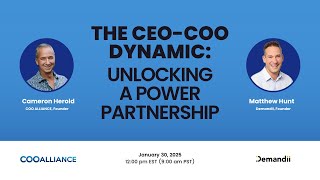
Cameron Herold defines the COO as the person who owns what drains the CEO and ensures execution of the vision. He prioritizes hiring for cultural fit and prior scale experience, recommends behavioral interviewing with scorecards, and prescribes quarterly reads of a Vivid Vision: a 3-5 page narrative of the company's future state.
Questions this video answers
Around 4,000 managers
September 10–12, at MIT's Endicott House in Boston
About 60 COOs
Written around 2010 and published circa 2011
4393
Chapters
Okay, I think we should be live. And today at today's event, we're going to be sitting down with Cameron Herald from the COO alliance and we're going to be talking about the CEO and the COO dynamics and how we're going to unlock this power partnership. Now, before we get into this today, I need to confirm that this is actually live. If you wouldn't mind telling me down below if you can hear me and if you can see Cameron here, Cameron, can you give us a wave? And if you can see me waving here, that'd be fantastic. And as you're commenting down below, what we find really useful as people are joining is maybe if you share with us where you are in the world. Cameron, where are you today in the world.
Well, and funny, because this was actually so live that I'm actually in Dubai right now and I was placing an order for some room service because I have three and a half hours of calls left. And after this, this live goes. I'm still going to be on for a while. See, I'm over in Dubai right now.
That's amazing. And I'm here in Toronto, Canada and I can see people coming in right now from the U.S. i see Texas, I see Vancouver, Chicago. Yeah. Oh my goodness, there's people coming in from everywhere I really appreciate. So if you put down below where you are, that'd be amazing. Also, we like to treat live events is an opportunity for you to network with each other. So some people are watching this live right now on LinkedIn, some people are watching it live on YouTube, some people are watching on X. If you'd like to share, just tell people down below like who you are, how you help, maybe even drop in your URL and network with each other and take this as an opportunity to say hi to other cool people that are in this space. That'd be wonderful. Okay, great.
Yeah, I, I'd even love to know in the, in the comments just how did they learn about me? Or I think we'll talk a little bit about CEO alliance too. But how did they come across me? I'm just curious where people are starting to learn about me because we're getting more and more traction around that.
I think that's a great idea. It'd be wonderful if you could just share how did you first hear about the CO alliance or Cameron Herald or some of the work around this? Put that in. If you listen to the podcast, put it in. If you've read his book, put that in. If you're part of a member already share what your experience has been like as a member down below. It's always great for people to hear what this community is about. I'd also really appreciate that if you can, as you're going through this, we're going to try to answer as many questions as possible. But I'm just telling you right now that even if you are not getting your question answered, if you could put in the comments down below, we promise we're going to circle back later on after the event, after we're live and answer those questions for you. And also I want to let you know that we're also going to send you the replay should you want it. All I want you to do is comment below, replay that you want it just in case you have to duck out to another meeting or have something to do during this, but this wasn't the right timing for you. We want to make sure you can get access to that, but we won't know unless you start commenting down below. That'd be fantastic. Okay, cool. I see replays coming in already, which is great. I see people from all over the different world. Cameron, I'd love to dig in. I know people have some questions. I did see one of the questions that comes in, which I think is the perfect question to ask. Understanding the CEO and the CEO dynamic is this is like, what does the CEO actually do from day to day?
What does the COO or CEO?
Coo.
Coo. It really depends. And this is what the magic of this role is versus, I think, every other role in an organization. The CFO runs finance, the CMO runs marketing. The CTO runs tech, the chro runs hr. The COO tends to oversee everything that the CEO sucks at or drains the CEO of energy. So in some cases, marketing rolls up to the coo. In some cases finance rolls up to the CEO. It just really depends. Overall, though, the COO is there to make sure that the plan is in place to make the vision of the CEO come true. They're there to ensure that all of the functional heads of all the business areas are collaborating and communicating and almost like a traffic controller. And they're there to make sure that they're always growing people.
Right.
That the organizational structure is growing and focused, but the people are growing because if you double the size of the company and you don't double the skill sets of your people, you're constantly replacing your team.
Yeah, there's another question that just came in that I saw here. This is a good one, actually. And I think this is actually probably what People are trying to get at it is what are the key traits that defines a very successful coo?
Wow. What are the key traits to describe a successful coo? You know, it's interesting, I think, about Gino Wickman. In his book Traction or eos, Traction talked about how the integrator, the second in command or the COO needs to be the tiebreaker. And I completely disagree. I think the COO's role is to not be the tiebreaker. It's actually to facilitate good debate amongst the leadership team. It's to facilitate good discussion amongst the leadership team. It's to get everyone collaborating, collaborating and sharing ideas and really digging in and looking at the numbers and then walking out of the room with consensus. The last thing you want is like, oh, it's like, you know, mom or dad saying it's my way or the highway or it's because I said so. That's kind of the tiebreaker role which, you know, you need to have in a very small company. But I think the COO needs to be really good at getting the team to discuss and debate and look at numbers and share ideas and then come together with consensus so they walk out of the room as that joint team. I think that is something they have to be very, very good at. Another thing they have to be really good at is continually being almost like a two sided funnel of information. They need to get all the information distilled up to the CEO in executive summaries, in very brief statements. You know, the CEO doesn't want all of the data, they want the key numbers, they don't want all the information, they want the succinct kind of executive summary. So they have to be that funnel all the information up to the CEO. And they need to be able to take the vision and the ideas and the culture and all the often miscellaneous, random, you know, add bipolar moments of the entrepreneur's world. And they need to somehow organize that in a way that the team doesn't feel jarred or doesn't feel swayed. You know, that they can see that there's a joint force. And then I think lastly that they have a core role to make the CEO iconic. Right? Their job is to make the CEO the Colonel Sanders or the Ray Kroc or the, the Howard Schultz from Starbucks or the, you know, my job at 1-800-GOT junk was to make Brian Scudamore iconic. And I think that's a core role of the CEO, is to make the CEO look good.
Hmm. Has there been like, is, is there certain questions you Ask when you're hiring to determine whether they have those traits or not. What would be an example of some of those questions you like to ask?
Well, it's interesting. One of the things I'm looking for in a COO is it's somebody that I really like to spend time with. Right. They're my business spouse. Right. So I really have to like them. I have to want to spend time with them. I don't want them to be the same as me. I don't want them to approach the business the same. I don't want them to have the same personality profiles. But I have to like them, I have to want to spend time with them. I have to be able to trust them and them with me. Right. If. If either of us drive us drive each other crazy, it doesn't matter what the skills are. So I'm often, first and foremost, looking for that cultural fit with that COO to make sure that they really can be my business spouse. And then I'll look for the skill set second. The other thing that you're often going to look for with a true CEO is they've done this before, Right. If they're coming into your company as a CEO, it's not their first go round. If it's their first go round, they're probably a director of operations or maybe a vice president. At best, a COO should be coming in, telling you what needs to happen, showing you how to make your vision come true, taking over a lot of P and L responsibility, coming in with a level of strategic insight. So I'm really looking to see, have they done this before? Have they built companies of our size before? Let's say I'm at a $30 million company and I want to get to 50 million over the next two years. Have they done that a couple of times. Right. I don't want to bring somebody in from a billion dollar organization into a $30 million company. They've never built a billion dollar company. They've never built a $50 million company. So that's kind of what I'm looking for is have they done it before? Do I really like them? Can I hang with them? And then are they true? C level?
Yeah. It's really interesting. I think everything you just said, at different times in my life, I've made those mistakes. I tried to promote the VP of operations to a bigger role. And some of these things, even the spouse concept that you came up with is fascinating. I probably needed, with my previous partners, marriage counseling.
I remember meeting you and your two.
Your two prior partners.
That was when we first. I don't know, about. About 10 years ago. We, we met. And I don't think you needed marriage counseling. I think you were a very traditional, very traditional partnership. You guys were polyamorous. There were three of you in that partnership.
That's right. Maybe that was the problem.
Yeah. So you guys built. You guys built a great company. You guys, you guys built a great company. I think it was just a starting company for all of you.
We did. Yeah. We were all sort of first time founders in our career as well, too. And that's part.
It was the first marriage.
That's right. It's the first marriage. Now there's a good question for you. How many marriages need to have before you get this right?
I don't want to. Well, that's a great question. I don't think people in a traditional marriage.
Yeah.
Should get good at being married by getting divorced seven times. I think that if you want to have a good marriage, you should get a marriage counselor very early on in your marriage to help you build a good marriage. And I think a good CEO and a good CEO should get coaching early on in the relationship. They should get the COO into a group like the CO alliance to become a better coo, get the CEO into a CEO mastermind like YPO or EO or vistage, you know, et cetera, so that you can learn how to become better in that role and get some marriage counseling, get some coaching, work on personality profiles to build that solid relationship before you're broken. I think so often people come to me and say, oh, can you help us? We're broken. You should have come to me two years ago when you weren't broken.
Yeah.
To build something even, even stronger. Right. And I think that's something to think about, that, that, you know, whether you're married or a business marriage.
Yeah, I would. I 100% agree with you. If I actually look back in my career over 15 years of building businesses now, the thing I always tell people is I wish I got count. I got coaching sooner. And not only that even it was a game changer for when we hired you in our business, but also it was a game changer for us when you coach some of our other senior leadership team members, you know, and, and it's not. And like you said, I think it was really important is many CEOs and founders do believe in coaching for themselves. They understand that all the greats have coaching, but sometimes they forget to invest in the coaching for their other team. Members like the CEO.
I was coaching a CEO of a company called Bluegrace Logistics. Years ago, I'd coached them from 40 people up to 300. Ended up ranking as the number one company to work for in the state of Florida. They were entrepreneur of the year in the state of Florida. Fantastic company culture. And I was teaching Bobby Harris, the CEO, one of the actual modules of my invest in your leaders training. I was teaching him one of these skills and he said, wow, this is going to change my company. I'm like, no, it's not. You have 27 mid level and senior level people that lead people in your company. Like you have 27 management people. What will change your company is teaching those management people those skills. Right. Train those people up. I think so often CEOs miss the point. If you're only giving yourself the skills skills, that means the rest of your team is still running blind.
Yeah, 100%. And for those people who haven't yet gone to the website, invest in your leaders. If you want a good program to level up all your leaders, Cameron's created a great course of invest in your leaders. And I've had all my team members and all my leaders do that course. And how many members or how many people have gone through the course Now, Cameron, you have a lot of.
Yeah, it's around 4,000 managers going through it right now. We have One of our COO alliance members has 56 management people. He's got a company of about a thousand people. He has 56 of his people going through the course right now.
Yeah. Totally recommend that you sign up for this today. Just go to investinyourleaders.com and grab that. I also see a lot of the questions coming in. I'm just gonna let everybody know, keep asking them. We're definitely going to get to answering some of these questions. I really appreciate it. Let us know as we're going along if you can relate. So, you know, if you've had a partnership that was tough before, put it in. If you've invested in coaching, what did that do for your business? Share in the comments what that was, what, what that was like for you.
Matt, if we, if we don't have time to answer all the questions right now or today, I'll go back through the threads and try to answer as many of them as I can. I'll even answer some of them with quick video responses like I'll do some of them videos that require it. So yeah, don't worry if you think we're running out of time. That we can't answer your question. I will come back into the thread and answer it later too.
There you go. Awesome. Okay, I see a great question that came in here that I think is on theme for what we're talking about today around the CEO and the COO dynamic, which is this. How do you divide the responsibilities effectively between these two roles?
The first is for the CEO to remember that they get to delegate everything except genius.
Right.
They get to kind of stay in their zone of genius, stay in their unique ability. So when the CEO understands what are they really good at and what gives them energy on a day to day basis, try to delegate everything else to your team, specifically to your COO to oversee it all. So it's what makes the COO role so different is we are, have to, we have to be good at all the stuff the CEO is not good at. In some cases you could have a CEO who's very engineering focused, like Tobias Luque, the CEO of Shopify. He's a very engineering, finance focused, you know, process focused CEO Harley Finkelstein. The COO is very outward facing culture, sales, marketing, PR operation, kind of a very outward facing coo. In other companies you could have a very inward facing coo. So the way that you divide up the roles and responsibilities is for the CEO to think about what are you good at, what gives you energy, and then on the opposite side of that page, what are you not good at, what drains you of energy. And let's try to find a COO who loves those things. Right? So if you're bad at hr, find a COO who loves HR and is really good at it. If you're a CEO who's bad at marketing, find a COO who is also great at marketing and loves marketing. They have to be the yin to your yang.
Yeah, that's a really good point. I think the first time I heard about this was what I experienced before. They said, if you both like doing the same thing, one of you is redundant.
Well, it also leads to arguments, right? Yeah, yeah. You know, it's interesting. Like my, my brother and his wife talk about the pink jobs and the blue jobs, and they don't mean what the traditional 1950s his and her jobs. What they mean is that the blue jobs are all the jobs he does in the house. But some of the blue jobs are laundry. He loves doing laundry. She doesn't. Right. She likes cutting the grass. So that's A pink job in their house is lawn cutting.
Right.
So just decide what are the blue and pink jobs and then Stick in your lane. Right. Try not to get in the other person's lane when you're the CEO or the coo.
That's cute. I like that. Tell us in the comments below, what are your favorite pink jobs? What are your favorite blue jobs? I think it's. You know what, sometimes this is how you need to simplify things just to make it work. Sometimes we over complicate things and I think that's a, it's, it's a really great way of thinking about it.
It's also really important to communicate to the rest of the family or to the rest of the company who does what. Right. So that they know if there's a problem with the landscaping, go to the mom because she's got the landscaping as a pink job. Right. If marketing falls to the coo, don't talk to the CEO about marketing. If finance rolls up to the CEO, don't talk to the CEO about finance. So it's very important to have roles and responsibilities, clear reporting structure. Not because you're building an autocratic, dictatorial, top down management structure. Just to clarify who does what. To clarify communication, to remove frustrations, remove obstacles, just to make it easier and faster.
Yeah, totally. Is there, is there a, a section in your course that you remember that covers some of the chain of command and the best practices? Do you cover that in investing your leaders?
No, not that I can remember. In the Invest in your leaders, I definitely cover parts of it. In my book Double Double in Investing youg Leaders. You know, we talk about conflict management. That's a key one that we talk about. We talk about one on one coaching and delegation and time management and project management, but nothing per se related to roles and responsibilities.
Yeah.
And there's a, there's a great section on interviewing and hiring.
Yeah.
But, but no, nothing on that drug.
On that one. And it's funny that you brought up Double Double is, I think actually is the first book ever read of yours. It's an excellent book. If anybody hasn't ordered that book, it's still relevant today. It's an evergreen book that still applies to today, which is nice.
A couple of chapters are dated. I think the chapter on technology might be a little out of date now.
Yeah, it's kind of hard to keep up with that one, isn't it?
Well, you know, I'll give you a funny example of that. So I wrote Double double back in 2010. I think it came out in 2011.
Yeah.
And in the chapter in technology in 2010, I said you should be using Skype Video to talk to every customer and every supplier and every partner and all of your remote employees and whoever controls the relationship will control their market. And I said you can get way ahead of the competition by leveraging video calls. That was game changing. In 2010, I had banks taking that and teaching their leadership team that like the vice president level in C suite at bank of Royal bank of Montreal were getting their entire company Canada wide to leverage video calls via Skype in 2010, 2011. But now if I say that's a technology tip, people like, thanks, Grandpa.
I don't know, man. Sometimes you see people join video calls and it's still a struggle for them. You know, they do need some training on how to show up on camera and run these calls, leverage these calls or they forget.
They forget the opportunity to have a connection and have some good energy exchange. Right. Yeah. Video does still deliver a way bigger punch than a slack message does.
I think so as well too. Yeah. So speaking of that, there were some questions about tools and what do you see today as being good tools, tools to help out a team, or at least the relationship and dynamics between the CEO and the coo. What do you see other teams using?
I was just speaking to one of our COO alliance members about this three days ago and they asked me about personality profiles and they said which personality profile is the right one for the company? I said, it's not a question of which is the right profile. What I like to do between the CEO and the COO and actually the entire leadership team is every year have the entire leadership team do a new personality profile. Let's say this year for 2025, you're all going to do Colby profiles to learn how you initiate projects. Have everybody do a Colby profile. Have people from Colby teach you about your personality profiles. Using Colby, teach you how to work better with each other using your Colby profile. That's a game changing tool. Next year, do Strength Finders. The year after, do Disc. The year after, do Love Languages, whatever it's going to be. I think there's an opportunity for once or twice a year to use some of these tools to learn how to communicate and collaborate and build stronger relationships with each other. That's what those tools are best used for. Not for how to hire someone, but how do you actually work with someone and build a higher functioning relationship?
Yeah. And I would even like, say even if you want, if you did want to use higher technology of how to use it, there's probably ways or someone's going to figure this out on how you could use AI and upload some of the profiles and results you have and asking questions before you get into the meeting. So for, for example, if you're about to have a meeting with the CEO and you have their profile and you and maybe there's something you want to cover or before you send an email, you could probably ask it, does this, you know, serve the information the way this person likes to receive it? Or how would be it more effective for me to work with this individual in that meeting? I think there's probably some interesting things. Do you see anybody using it in that way or thinking about it in that way? Cameron?
No, but it's brilliant. Like now that you actually mentioned that, it would be really interesting just to say, you know, I have a 4393 Colby profile and my EA has a, you know, 7624 personality profile. How do we work better together with Colby? I'm actually going to test that out. I think you're bang on right with that. Super cool.
And I think you could even build a GPT that probably has these all built in for your company. And what you can do is even if you're going to send an email or a slack message or something that has some girth to it besides one line that you need to think about or meeting, no sort of agenda, you could just cut and paste it there and it'll give you the feedback on how to improve it for that individual or that team of thinking. And it should adjust it pretty quickly. Someone's going to build this. So if you're an AI and you're out there today, I'm sure there's lots of people who are specializing this. Go build us some tools that help us with. What do you call this genre of tools or this? Personality assessments. What's the need? Is there a special name for this?
I just still call them personality profiles. I have no idea.
Yeah, go build something that we can all use that we can better communicate and serve each other. Which leads us actually into another question that came up which I think is perfect. Someone is asking about trust and how could a, you know, two new, you know, people are working together, the CEO and the CEO, establish better trust with each other?
You know, one of the things, I was talking to a CEO one day and he said that he was hiring a new COO for his company. And he said it's probably going to take about 90 days to know if I've hired the right person. And I said, well, that's because you suck at interviewing and he was like, pardon? I said, if you were better at interviewing, if you were better at actually doing, you know, reference checks, if you were better at using the entire spectrum of interviewing style questions, you would know everything about that person day one. And you would know implicitly that you could trust them because you would have interviewed for that. So the key is to actually build that into your interview process so that you show up up implicitly trusting the other person and letting them break your trust over time versus making them earn your trust from day one. Right. And I think that's just a different paradigm shift.
I think you're bang on with that now. That and I, I think everyone here is agreeing with you. I guess the next question is like, if you had, could you give me three things on how to do that that's actionable that I could take away.
How to do what built like, build.
That into my interview process that I know from day one, I hire the right person, the trust is already established. What are the three things that people miss?
Well, so, so you, you mentioned, you know, going into ChatGPT for, for every behavior. Let's broaden it a little bit. For every behavioral trait that you're interviewing for, you need to first have a very easy to understand definition of that trait. And then you need to have four or five questions that you will ask to start the examination around that trait to be able to rank people on a bell curve of somewhere of one through five. 40% of the candidates can get a three out of five, 20% of the candidates can get a two, 20% can get a four, 10% can get a one out of five, and 10% can get a five out of five. Right. That's the bell curve distribution of candidates. So let's say as an example, I don't know what the definition would be for trust, but let's say we were looking for tenacity. Tenacity might be the dog like work ethic to get over, under, around any obstacle put in one's path. So I would go in into, you know, chatgpt and say, give me a grade three definition of trust. Right. Or how I, how I could trust someone in a workplace. And then what are five great questions that I could ask in a job interview? You know, what are things that I can look at on the person's resume to see whether there's some areas to probe around trust? What are reference check questions that I could ask around trust? What are areas that I could ask under the threat of reference check around trust? And I would build out the basics of a. Of an interview model, but around each of the traits you're looking for. So even at, you know, at college, Pro Painters, a company that I helped build 30 years ago, we had five core behavioral traits that we looked for in interviewing franchisees. We had leadership attainment, tenacity, introspection, and interdependence. Those were the five things that we looked for. And then we also had tenacity and precision as two additional. So for each of those seven things, we had a definition and we knew the questions that we would ask to start the process and we knew how to rate people on the bell curve. I think that's the key starting point.
Yeah, it is a game changer. So when I learned this from you.
We actually, by the way, I get into that in a pretty good detail in my invest in your leaders course. That entire model that I just kind of fast forwarded over.
Yeah, when I learned that from you, we actually created a one page scorecard. The same thing with the rating of one to five that everybody actually listens to. One thing I did that's new. Speaking of the AI thing is I actually validated at the end with the transcript of asking pros and cons of how accurate it is on how they answered the question. It actually hits that metric and it's surprisingly very accurate at what everybody else is saying. And I was like, if you don't have a partner or more than one person evaluated, it could be a really interesting tool to help you out with. With. Okay, keep the questions coming, everybody. We have probably we still have like another 10 minutes here, which is awesome. So if you have any questions about how the dynamic needs to work between the CEO and the CEO, please put that into there. That's today's themes. But if you have any questions about, you know, CEOs or CEOs and, and how to hire and how to support them, put that down below as well too. Let's see here. The questions are coming in very quick.
So sometimes, Matt, just while you're looking at questions, I got to tell you something pretty funny because. Because I'm a quick start. My colby profile is 4393. I kind of act now, plan later.
Yeah.
I decided to write into ChatGPT. I'm a CEO with a Colby profile of 4393 and my VP Ops has a 7634 profile. How can we work better together knowing this? Oh my gosh. You should see the information that came back to me on ChatGPT. Like it tells me what my profile is, what her profile is, how to work better. It's succinct, it gives collaboration tips. It's like it did exactly what you were suggesting. It actually takes the two skills and matches them in a beautiful way.
That's amazing. It's scary sometimes what these AI tools can do as a starting point to just get fast track things. It's absolutely amazing. I think it's going to, for me, it turns my really smart people into super smart people. I don't know how much people are using it in their business, but it's been super helpful for me and I just love seeing that in action. There's a great question that actually came in. Cameron, I think is actually getting into some more of the nuances of the relationships here between the CEO and the CEO. And I really like this question. It says here, how do I, I think this is coming from COO. How do I challenge my CEOs ideas productively?
So the first thing is to remember is our job is to make the CEO look good. So if we're going to tell them no, you never want to do that in front of the board, in front of the other leadership team members, in front of other employees. You want to try to do it privately. That's number one. Number two is try to show them how their idea is a good idea. But maybe it's a not now. Or how after thinking about their idea, it doesn't necessarily drive towards their vivid vision, it doesn't necessarily drive towards their core purpose, it doesn't necessarily drive towards living the core values, it doesn't necessarily drive towards the bhag. So it doesn't necessarily, even though it might be a good idea, it doesn't help them with their greater purpose of what they're trying to do. So you're not saying it's a bad idea, you're just saying it in the scope of all the other ideas you're probably going to come up with. And we already have that we're working on. It's more of a not now. Right. That's number one. The other thing that I like to do before I say no is I first say I love your idea, I love that idea. Let me ask you a few questions so I understand that idea even more. Right. And then you can kind of go through the who, what, when, where, why and how of the idea. You can talk about the potential roi. What does it need to look like, how much time is it going to take us to do? What are the other projects that are going to have to get shuffled aside or put to the side so that we can then work on that idea. And then based on those, that new insight, it's a no or it's a not now. Right. And when you approach it that way, the CEOs like, okay, now I understand why it's a no, because I hadn't thought about it from the perspective you were thinking about it. But if you just come right out, flat out and say no, they're going to have to defend themselves a little bit. And if you do it in front of other people, they're really going to defend themselves.
Yeah, that's great advice. And obviously from someone where you've been experiences where it didn't go that way before you did say something that was interesting in there that I don't know if everybody knows knows what you're referencing. Like I know what it is, but maybe everybody else does is you wrote a great book called Vivid Vision. But can you just define what the vision is? Because you talked about anchoring your response back to the vivid vision. And I don't think most companies like, I know it's. Lots of companies do have this, but there's also many, many companies who don't have it. You don't know what it is. Could you unpack that for us?
Yeah. Vivid Vision is actually my number one best selling book. We've got a couple, I don't know, 1200 or 1300 five star reviews on Amazon already. A Vivid Vision is a four or five page description of what your company looks like, acts like and feels like three years in the future. So it's a written description of the future state of your company that the CEO helps draft. You get a professional copywriter to polish it so it really pops off the page and it describes what your customers are saying about you, what your employees are writing about you online. It describes every single business area on the org chart. It really, it describes your culture and your meeting rhythms and your dashboards. It's really almost like the CEO was walking around your company three years from now describing it without knowing how it came true. And then the leadership team can figure out how to make that come true later. That's. So the Vivid Vision is that written description of the future state of your company.
Yeah. And the reason why I want you to articulate that, Kim, is because I think what this person was asking was how do you challenge an idea productively? I think if you bring it back to what the CEO's vision is like, the what, what the true North Star is By doing the exercises and reading the book of your vivid vision, then you're going to have much more productive conversations. And I think you nailed it. But I don't know if everybody got that. And so I want you to take a minute to make sure that they that really for you to to have these productive conversations. Step one, really for all companies is both for all C suite leaders is to read the book vivid vision and then exercise of building out your three to four page vision of what it looks like that then is going to allow you to have a lot more productive conversations. If some ideas come up that don't seem to be pointing towards true north.
It also really allows all the employees to not be as frustrated because now you're all pulling in the direction the CEO wants you to be pulling in. It allows the CEO not to be so frustrated because he's wondering why are people all making these stupid decisions? They're not making stupid decisions. They're making decisions with what they can see. But if they don't know what you can see, then they don't know that direction to pull it. Right.
Yeah, totally. I think that for me was the biggest thing when I did it was I realized that my team is not mind readers and I just assumed they knew what I'm thinking. And until you document, you'd be surprised how many different visions your team thinks that you do until you document this. And then what's the other? Another point of view that you talked about the vidvision, not to get stuck on the vid vision too much, but I thought one of the points that you told me was you don't just write it and forget about it. And even though you told me not to do that, I still did that. Of course, of course the opposite of what you tell me to do. But what's the most important thing after you do the division, you have to do what?
Yeah, you've got to take this draft, this document, this PDF document. You have to get all of your suppliers to read it it, all of your customers to read it, all of your current employees to read it, all of your potential employees to read it. And then I like once a quarter to have all of my suppliers, all of my employees, all my customers reread it again. So that every quarter we're all thinking about the future, but we're actually executing and focusing on today. You know, it'd almost be like if a homeowner was going to pull together the contractor and show them the vision of what the house is going to look like and Then never show the contractor that vision again for the next 12 months. The contractor, they would lose sight of what they're building. Right. So it's just keeping people aligned by rereading that document. It also keeps them inspired and excited because they're reminded that the work that they're doing on today is maybe making one sentence come true or maybe making one paragraph come true so it starts providing meaning behind some of their work.
Work. Yeah, that's great. And if you've read Viva Vision put down below, you know what was the best thing for you. And if you haven't read it, we'll drop some links in the comments of where you can go purchase it on Amazon. But if you just search it, Vivid Vision, Cameron Herald, you're going to see it on Amazon, be able to pick it up. We have time for maybe like two more questions today, but I want to tell you before we get to these two more questions, put all your questions down below if you have those. You know Cam's team's going to come back and answer those questions at a later date. Also remember, if you want to see the replay, like put replay and we'll try to get you the replay so that you can watch it later if you have to bounce to another meeting. We understand that might be the case. And if you're a COO and you're looking for community and some coaching, I highly recommend that you go to CO alliance and you sign up and talk to someone. It's a great program that you should sign up for. I would even personally say if you're a CEO and you're, and you're not a part of this program, it's almost irresponsible. And I would say the same thing if you're a CEO. From my experience, if you're not signing up your second in command into this program, you're kind of setting them up to fail as well too. Like everybody needs community and support. So go over then, do that. I saw a great question come in. I pinned it for myself and I've been meaning to ask it. I think it's such a good one. It talks about burnout and asked how can I help my CEO from like not totally burning out?
Well, number one is just to remind them that this is not a sprint, this is a marathon.
Right?
It's the, the emotional roller coaster. It's the highs and lows of CEOs that they're going to go through. You know, when you go to a theme park, to an amusement park, you, you ride the roller Coaster. And then you get off the roller coaster and you go to another ride. The entrepreneur never gets off their roller coaster. You know, they get back to the start and they get to ride it again. They ride it again like everybody else gets off the roller coaster. They keep riding it. So your job is to remind them that they're like a racehorse. They need to take time to decompress. They're like a. They're like an iPhone. They need to take time to plug themselves in and recharge their batteries because no one is ever going to. You kind of have to take care of them, right? You got to tell them to disconnect and tell them to take time for themselves. And also it's sometimes good for them to get the heck out of the office and get away from the rest of the company to let everybody else get their work done. CEOs don't recognize how often they're like the Tasmanian Devil, right? They're just like swirling around and creating all this energy that sometimes isn't always the right energy to get stuff done inside of a company too.
Yeah, it's so true. Cam, you have an event coming up. You know, I obviously, everybody should order your book. The second in command. This event coming up, I believe, very soon. What's the theme of the event? I think it's in March. Is it not.
Sold out? We've got 60 COOs coming now from all over North America, a bunch coming in from global. We have another one coming up in September, September 10th to the 12th, which will be held at MIT's Endicott House in Boston. But yeah, the March one is now sold out with 60 employees. There's actually no theme per se, on this one. We have a few very, very strong speakers coming in in September. I think we have Peter Diamandis coming in, who is one of the founders of the xprize and Singularity University. The way that the in person events run is we get a few fantastic guest speakers to come in. We get five of our members to actually present at events. You've actually been a guest speaker at prior events for us before, and then now we're running hot seats where we have members present problems and the other members will contribute to help unstick them on those problems. So it's more. It's less about there being a theme and it's more about 60 COOs being in a room together for two and a half days at a spectacular venue. Every spring, we hold it in Vancouver, Canada, and then every September, we hold it at MIT's Endicott House in Boston.
And.
And these are now selling out. We. We used to. To struggle to try to get 25 or 30 people in a room, 60 people coming in in Vancouver. And we'll definitely sell out the September events at MIT again.
Yeah, there's so much fun if, if, if you like community and being around people in a physical experience, you gotta go. It's not just all work too, Cam. If I remember, you did some. There was some really cool stuff. You did fire walking. You've done some. There was a cool workshop with, with breathing that was done. There's a lot of really fun things that are there. I saw one picture. I wasn't there at this one. But weren't you guys all dressed in onesies as well too?
Yeah, we did. We've done it twice now. We did the co Olympics and the co Olympics we had. We had everybody dress up in onesies and we ran three legged races and wheelbarrow races and piggyback races and an egg toss. We actually got banned from a hotel in Scottsdale, Arizona. We're not, we're never allowed to hold an event at Mountain Shadows again because they didn't like our egg toss and everybody wearing onesies.
Oh yeah, is that right? That's too. Obviously they don't have a sense of humor.
We don't like Mountain Shadows that much anyway. We'll go back to the Royal Palms in Scottsdale.
The Royal Palms is a very nice place. That was a very nice place to be at. Yeah. Okay. Well, look, Cam, we're basically at time. I know you gotta get to the next thing. I really appreciate you coming in today. Everybody who's attending, don't forget to put your questions down. If you want the replay, put the replay in. Go to the COO alliance, you know, website, go buy Cam's book, second in command. Go to the invest in your leaders course and for sure get ahead. And sign up for one of the events on Cam's website as well too, because March is sold out. And if you want to attend September, you better sign up right now. All right, Cam, really appreciate your time today. Going live if everybody wants you, connect with you on the social medias.
Yep. Thanks, Matt. Appreciate it. Thanks everybody.
No problem.
Ciao all.
Bye Bye.
More from Cameron

Flutterwave Former Global Head of Operations Awa Kone | When Growth Outruns Operations (Podcast 611)







Optomi Professional Services COO Nick Murphy | The COO Can’t Know Everything (Podcast 607)


