The Core Lessons in The Second In Command book | Joe Polish, Genius Network
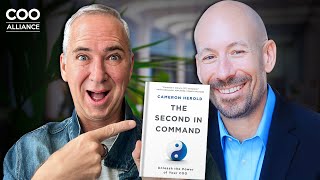
Cameron Herold explains when and how to hire a second in command, whether that's a COO, operations director, or executive assistant. CEOs are visionaries; COOs are system-builders who handle facts and operations. A seasoned COO costs $250,000–$350,000 and can return 5–10x that investment by freeing the CEO to focus on what only they can do.
Chapters
They could relieve all that stuff off our plate to free up our time to truly just be in their unique ability. That's massive. You're going to get a 5, 10x return off that investment very quickly. So you might not need one, but it's like, what would happen if I had one?
So I'm holding in my hands the second in command. All right, unleash the power of your coo. We're going to go through the book and anything that's not in the book, obviously people need to read the book. They need to get the book, but this will be sort of a setup for anyone that's already read it. It's a great book, or why should they look into this book? And what does that even mean? So the second in command is obviously the coo. So I'm going to ask you to define what a COO even is. But first, who is Cameron Herrel?
Okay. I'm Cameron Herold. I was the founder of the COO alliance, the founder of the Second In Command podcast. A lifelong entrepreneur, I've also played the second in command role a few different times for a few different companies. And one of the reasons I even called the book the second in Command is sometimes it's a coo, sometimes it's a VP of operations, sometime it's a director of operations, sometimes it might even just be your executive assistant. But it's who is really the yin and yang to you as the entrepreneur. So I wrote the book as a way to help companies understand how to recruit one, how to onboard them, and how to build a really strong relationship with one, because a lot of times kind of people screw that one up as well.
At what point does someone determine they need a coo? Because usually it's when it's so messy that, oh, now we're trying to fix it versus but let's look at the preventative aspects of it and let's approach it for someone who their business is kind of chaotic and they don't have any. So how do you approach this?
Both sides? Okay, so at the end of the day, we only start a company for one of three reasons. Either to give us money, to give us free time, or to put a stake in the ground and say we accomplish something right after we've got our business up and running, we've pretty much accomplished something at some point. We have enough cash, but often we don't have the proper life. So sometimes our business is draining us. You like to talk about elf, right? Easily fun. And if an entrepreneur is working on Stuff that is draining them of energy is frustrating them on a day to day basis, their business is destined to flatline. So you can bring on a second in command as a way to actually get all this stuff off your plate that drains you of energy that you're not good at, that usually will really accelerate the growth of your business. That's number one. Secondly is if you're just not able to spend the time on the areas that you could be. Right. If you're so busy managing the day to day and you have no time for strategy, no time for culture, no time for networking, no time for growth, and, and no time to really grow your direct reports if you're merely managing them and overseeing them, but you have no time to remove their obstacles, grow their competence, grow their competence. You're really kind of dead in the water there as well. So that's really the other part is to give you that time to actually scale it properly.
Have you found that with the differences between like an operational person and a visionary entrepreneur that most of them clash in terms of how they do things? And the reason I bring this up is that it's real easy to resonate and be chummy with people that think like we do to kind of feed off of our energy. But oftentimes the very best person that you may be a visionary entrepreneur brainstorming with is not the person who's going to be executing and doing the operational aspects of the business. But how does one go into this prepared to not either hire the wrong person or look for the wrong person or the wrong talent and behavior to match what it is that actually needs to get done?
I'm going to use an example that if we're trying to find a partner, we want to find a woman who matches us. We're not hairy versions of women. We see the world differently, we approach the world differently, we perceive things very differently. And for us, we have to try to learn how to talk with women and they have to learn how to talk with men. And when we do, to understand each other and communicate better, we have a really strong relationship. Very similar for the CEO and the coo. We have very different personality profiles. Most you're familiar with the Colby profile. Most entrepreneurial CEOs are very high on the third number, which is quick start. They like to start now, plan later. They initiate very quickly. Momentum creates momentum. They're shooting from the hip. They're the perpetual motion machine. And they need to be. Most COOs are very high in the first two numbers. They're either a Very high fact finder. So they like to ask a lot of questions before they start something which often drives entrepreneurs crazy because we just want to get started. They're actually just trying to understand us. The second number is called follow through. I believe it's kind of misnamed. I think it should be more like the systemer, because they put systems or playbooks or processes in place before they initiate a project. Most COOs are high in those first two numbers. When we learn how to speak COO, we learn how to say, do you have any more questions for me? What else would you like to know about my idea that I'm dumping on your plate right now? Do you want to show me the system that you've got and see if I can poke holes in it so you truly understand my idea so that I can really release myself of it? The biggest gift that COOs can give us is, is to talk faster, to speak in bullet points, to give us the executive summary of the executive summary. Like three bullets is all we need. We don't want the pages of information that they have. We don't want all the, we don't have room for it. But if we ever ask them a question, they better have that for us. So we have to learn how to communicate with each other. That's part of the interviewing process as well, is understanding yourself. When you really understand yourself, then you know what you're looking for in that yin and yang partner of the coo.
So in your mind, do you think they, they tend to slow down the visionary entrepreneurs? Do they slow them down perceptually, but really so they can speed them up? Yeah, I mean, that's what I was going to get at because I think the perception is, well, oh, all these questions I'm going to ask, I'm going to prepare, I'm going to pause, I'm going to think. But in the long run, I think that'll get you going to where you want to go faster with less zigzags. But I think in the beginning, perceptually, it's going to be like, well, this is like slowing me down. Correct.
So what we try to teach all of our members of the CEO alliance, when an entrepreneur comes to you with an idea, we say, I love that idea. Let's go for a two minute walk so I can ask you some quick questions so I understand it more. Entrepreneurs love to walk and talk. They love to pace while they're thinking out loud. The fact that we've already said I love your idea gives it a Safe place to ask questions. I'm not debating you, I'm trying to understand it. They're like, great, let me tell you more about my cool idea. They want to do that and you give them a small container of two minutes. It might take 10 or 15, but they're fully committed on the two minutes. And if you keep asking questions, they want to keep telling you about their project. So that's exactly what it is. You're kind of slowing down to speed up.
What are the warning signs or the indicators that you need a COO in a company? I mean, I want to get to compensation, I want to get to different ideas. And part of it too is at what stage do you outgrow talent? And then you, you know, because you can have.
We do this whole session there too.
Yeah, you have this need. How do we know we need it? When do we do it?
Sometimes it's a need and sometimes it's an opportunity.
Right?
Like the opportunity is what would happen if I had a coo? Could that accelerate the growth of my business? Could that free up time? So I'm working in my unique ability, as Dan Sullivan talks about, Right. If we look at our activity inventory as an entrepreneur, we're often working on 80% of the time on stuff that drains us of energy and we're really not that great at. So maybe we don't need one, but if we had one and we paid 250,000, 350,000 for a really good seasoned COO, they could relieve all that stuff off our plate to free up our time to truly just be in their unique ability, that's massive. You're going to get a 5, 10x return off that investment very quickly. So you might not need one, but it's like, what would happen if I had one? How do you know if you need one? If you just don't have any time to spend with your team, if you're literally running from day to day, if the projects that are related to you, that fall on your shoulders are so backed up that you've got like a three month Runway of projects, you're just getting in your own way, right? And it's your business, so you're not hurting anyone else but yourself.
When you say, you know, five to 10 times return, then let me just take that number. Because the big elephant in the room is like, well, I would have all of these things if A, I had the money to do it and B, the money I was spending was not an expense, it was an investment. Right? So I try to look at every one of my team as an investment, not as an expense. And, and I have made bad investments and some of the bad investments have been because I've made wrong decisions, they weren't trained well, or I just picked the wrong person. Right. So there's all kinds of reasons. I mean, is there a sort of way that you look at COOs is like they're going to do money making activities, they're not just going to do operations. But let's talk about how do you self liquidate and finance not just COOs, but team in general? Because you help people build companies.
So let's say that you're an entrepreneur of a 30 person company and you're managing a team of five or six people that are running the whole business for you. And you're deep in the day to day of operating the business, running the business, taking care of people, but you're also an amazing rainmaker. Like every time you go to an event, you show up at a mastermind, you do a speaking event, you do a podcast interview, you're this big rainmaker for the company, but you have no time to do it. If you just hired a COO to take 80% of your schedule off your plate, to free you up to spend two more hours a day, 10 more hours a week on rain making activities, your business goes through the roof. And because you can actually show up, even if you only did two more hours a week on that stuff, but you showed up with the right energy because you're not drained working on all the areas that suck up your time and energy, you're going to actually show up and perform better. Or if you can actually take care of your body and take care of your mind and take care of your health and take care of your relationships, you're going to show up better as an entrepreneur, where the CEO is the Chief Energizing Officer. Right? We have to show up and infuse energy and then it's the opportunity, is it good energy or is it draining energy? So if you can remove it, that's one way that you'll actually get the 5 to 10x return. So don't stop now. Click here. There's more great videos that you can keep learning from and together we're unlocking amazing leadership lessons together.
More from Cameron

Flutterwave Former Global Head of Operations Awa Kone | When Growth Outruns Operations (Podcast 611)







Optomi Professional Services COO Nick Murphy | The COO Can’t Know Everything (Podcast 607)


