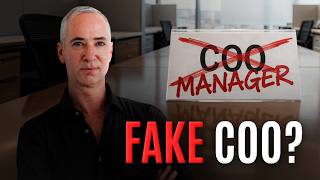
Cameron Herold explains why most COOs are overpaid managers without real authority. A true COO needs $250k-$350k compensation, P&L responsibility, and skills that fill the CEO's gaps. Harley Finkelstein at Shopify and the internal COO at 1-800-GOT-JUNK show how the role changes based on what the company needs.
Chapters
The second in command has to be really good at the stuff you suck at and has to want to work on the stuff that you don't. And then neither of you get in each other's swim lanes. Do you guys know the name Harley Finkelstein? Harley's the COO at Shopify. He's a very outward-facing biz dev, sales, marketing, PR, COO, right? I've known Harley since they had 50 employees. I'm a very outward-facing COO, speaking on stages, talking to the press. But my current replacement at 1-800-GOT-JUNK?, who's been there for 13 years, never talks to the media, would never write a book, and never goes on stages. He would have been horrible in the first 6 years because he wasn't entrepreneurial and had never built a franchise company. But he was perfect to go from $100 million to $1 billion. Over the last 25 years, there's been a lot of title inflation, meaning that 1994 to '95, the banks started to give away vice president titles, even though the VPs were 7 to 8 layers below the CEO. They did that because if you sent out an email with the term VP on it, you could get through the gatekeeper. Prior to that, to get a C-level title, you had to be a major player at a major company. Now you see guys with like 8 people going, I have a COO and a CMO and a CTO. No, you don't. You have a director with a big title. So a true COO or a true C-level in any functional area is probably making $250,000 to $350,000 minimum. My salary at 1-800-GOT-JUNKED 19 years ago was $306,000. To be a true C-level person, you're coming in with a level of strategic insight where you're often telling the CEO what needs to happen. You're coming in with a level of autonomy that you know how to do your job. Nobody's telling you how to do your job. No one's really telling you what to do because you already understand all of that. You probably have P&L responsibility, budget accountability. You can actually manage cash flow. You understand that stuff and you tend to bring employees and partners with you like you show up at the company. You got, oh, I got a good marketing partner. Here's a law firm. Like you have those resources with you. You're like the Pied Piper. Of people coming into a role. And then lastly, the roles and responsibilities you have actually match the compensation that someone is paying you. That's what a C-level is. If you're telling the person what to do, it's a director. If you're making decisions together, it's a VP. If they're coming in and showing you what needs to get done to get you to your vision, that's a C-level. Okay, so that's the starting point. When I showed up at 1-800-GOT-JUNK, I showed Brian the 7 or 8 core projects we needed to do over the next 1 to 2 years. To grow the company, he's like, I don't know how to do any of that. And he didn't even know we needed that. That's a true C-level, right? I've done it before. I know what to do. I can show him where to go. I just showed up and ran with it. If I was building a home and you were the contractor, I'm the CEO, but I don't know how to do electrical. I don't know how to do plumbing. I'm not going to tell you how to do those things. I just want you to know what the home looks like so that you can figure out the blueprints and you can hire the employees. If it's a vice president, then there's going to be a lot more interaction. So then where do you want to find one? Where people are always like, I want to hire a COO. Where do I find one? Do you know who you are first? You have to really understand yourself because even though I was a really good COO for 1-800-GOT-JUNK, I would probably be a horrible COO for most of your companies because they either don't match you and your style, or I don't match the size of your company, or I don't maybe understand the industry well enough, or the stuff that you're really good at, I'm really good at and I want to work on it, but so do you. So the second in command has to be really good at the stuff you suck at and has to want to work on the stuff that you don't. And then neither of you get in each other's swim lanes. What's different is some CEOs have finance report to them. Some don't. Some have it. Some don't. Most CEOs are very inward facing, right? And the CEOs are very outward facing. Do you guys know the name Harley Finkelstein? Harley's the COO at Shopify. He's a very outward-facing biz dev, sales, marketing, PR, COO, right? I've known Harley since they had 50 employees. I'm a very outward-facing COO, speaking on stages, talking to the press. But my current replacement at 1-800-GOT-JUNK?, who's been there for 13 years, never talks to the media, would never write a book, never goes on stages. He is very inward, engineering, strategic, corporate, right? He would have been horrible in the first 6 years because he wasn't entrepreneurial and had never built a franchise company. But he was perfect to go from $100 million to $1 billion because he was corporate, strategic, methodical, you know, precise. Right. So even though we had to match the same CEO, we had to match different stages in a company. So where you find one is understanding yourself first so you can describe them. If you haven't read my newest book, The Second in Command, go grab a copy right now on Amazon and you'll learn how to unleash the power of a COO. And if you already are a COO, you'll learn how to really build an incredible partnership with your CEO. The second point is there's not a good second in command anywhere. In fact, there's not a really good A-player anywhere that's looking for a job. They have a job. They're not looking for a job. And you have to have someone go and poach them to have a coffee or come and talk to you or just open the door to have a conversation. And then your culture is so strong and your vision of where you're going is so strong that they just want to come and work with you. Every single woman, no matter who we're with, is going to drive us fucking crazy at some point in our lives. Right? So then you get, then you get somebody else's woman and she drives you crazy too. Like, the grass is always greener on the other side of the fence. Water your own side of the fence. With every second in command that you have, there's something about them that will drive them crazy. So the insecurity and nervousness is also going to keep him with you because he doesn't really want to go somewhere else and doesn't think people love him. But if you can actually help him with the confidence and love bomb him and make him feel safe and secure— Maslow's second hierarchy of needs— then you're going to handcuff him, right? If you love him more than anybody else will, you handcuff him. But you could get rid of that security and have a new COO who comes in with all the confidence in the world, but they would suck at automation. It's better a W you know than a W you don't.