
$0 To $100M by 2034: The Predictable Path To 9 Figures w/ Branden Coluccio
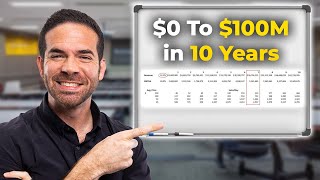
Branden Coluccio maps a 10-year path to a $100M business: start at $1M EBITDA, grow revenue 32% annually, reach $12.3M EBITDA, and sell at an 8x multiple. Once you hit $5M EBITDA, strategic acquisitions and rolling equity become key levers for acceleration.
Questions this video answers
32.2% compound annual growth rate
10 years
~8.1x EBITDA (noting a typical mid-market range of 8–10x)
Approximately $12.3 million EBITDA per year
About $1 million EBITDA (cited as ~$83,000 per month)
Chapters
Ever since I was a kid, I had a dream and a goal of making $100 million, accumulating a net worth of 100 million by the end of my career. I don't know why I picked that number, but it was probably because as a young kid from a low middle class family in Cleveland, Ohio, who had no idea how he was going to make his way in the world, that dream felt impossible. And I just wanted to see if I could figure out how something like that could be accomplished. Now, to this day, that still feels fairly impossible to me because I've never done it before. I've built million dollar businesses, I've built $10 million businesses, I've never built $100 million business. And that seems one step above my current knowledge base, my current set of capabilities. But to some people in this world, believe it or not, that is not only possible, but it is a very logical step by step framework. And I have always found it to be beneficial to get around those people for whom big ideas or big success is a very logical flow because it makes it more tangible, it makes it more real. For example, I have kind of built my career on being the 0 to 1 million guy. I have helped hundreds of entrepreneurs, maybe thousands at this point, build their first million dollar business. Because I break it down into very logical steps. First of all, if you have four products at 25 sales a day that sell for an average price point of $30, you have a million dollar business. And of course there are many steps along that journey of getting 100 sales a day and building $1 million business. But once you frame it into a very logical flow, it becomes tangible, it becomes doable. There's still work, there's still a process. But now all of a sudden, it's not so crazy, it's not so impossible. So what I've been doing recently is getting the advice from people for whom $100 million is not so crazy. $100 million is just a logical flow for them. And I've been listening to them as they break down how they build nine figure visions. And the more that I hear them talk, the more that I hear them break it down into a logical flow, the more tangible it becomes to me. I still haven't done it, there's still lots of work to be done. But I've found it helpful as they break down the individual steps that can take you to $100 million and beyond. And that's what I want to share with you today. I recently had an event for my Mastermind group which is called the capitalist pigs. And one of our members is named Brandon. Brandon comes from the private equity world in which $100 million is still a relatively small business. He said this in his talk to our group that a $50 million business or $100 million business is still very small in the grand scheme of business. Now, as scrappy entrepreneurs, we often don't think about it that way because we're solo person shows with dreams. We're just trying to create better lives for ourselves and we don't need to make $100 million in order to accomplish that. But to the big business world, $100 million is still still a fairly small business. And when you know that and you can see how other companies or other entrepreneurs get there and break it down into logical steps, it all of a sudden doesn't feel so impossible. I've made the 0 to 1 million journey very possible for a lot of people, and now I'm seeking the counsel of people who can make $100 million just as logical. So, so today I'm going to share with you the talk that Brandon gave to our mastermind, and we're going to break down that logical flow of getting to $100 million. And if you're like me, after you process this, you'll realize that it's not such a pie in the sky idea. If you have a framework and a plan to get to $100 million, then every entrepreneur who has any experience at all can set out with that goal and accomplish it within a handful of years. The reason why I asked Brandon to come share in front of our group is because he has seen both sides of this world. He has seen the private equity world where the big groups are buying up businesses and then professionalizing them and preparing them for a ridiculous exit. And he also works with entrepreneurs who are doing low seven figures and helps them carve out a path so they can go much bigger. He helps them cast a bigger vision, helps them set a timetable for accomplishing those goals.
Help.
And he also uses a few strategic tools in his tool belt, like acquisitions. Once you're at a certain point in order to get to that hundred million dollar valuation. So to kick things off, I want to share with you this clip that Brandon shared at our mastermind group and then we'll break down the summary of each of the major pieces of his overall plan.
So yeah, so he kind of starts with like setting a vision. And then we're going to, like we did yesterday, we're going to kind of just reverse engineer that vision. I'M going to make some more assumptions which I'm going to start to go through in a moment. I'm going to kind of hopefully shift your mind a little bit on instead of thinking like a business owner, I'm going to think, I'm going to try to get you to think about your business as if you are the one buying your own company. That's a subtle but important shift because it's going to change the way that you look at your own business. Right. You're going to be viewing it from a different lens. So this might break some hearts, but I'm going to assume that we're starting with a business that is generating at least a million dollars of EBITDA. EBITDA, not revenue. EBITDA, that is $83,000 per month of theoretical cash flow. And I say theoretical cash flow because it even does like a kind of a made up concept, but it's supposed to be a good proxy for your actual cash flow.
If you're not at that point. Right. Like, and I've broken down again, like what your sales need to be per day at, you know, certain assumptions. Right. This might be something to kind of pay attention to. These are all achievable targets, right? Why, why am I assuming this? Because how many of you guys know what like a platform company is? If you've heard of like Cody Sanchez, right. She'll talk about like buying a platform company, right. So a platform company, these things come in in varying types. Can you begin this strategy at a. With a smaller business? 100% you can, but it makes it a little bit more difficult. I think that to execute this strategy correctly, you want to be able to bring on the right talent to help you execut. And when you have a smaller business, you're often strapped for resources and more hesitant to hire, you know, big expensive talent. Right. We're going to use a 10 year time horizon. That may make some of you very sad. I think it is doable faster, but I think just having the discipline to say I'm going to commit to this thing, whatever that thing is, for 10 years at least and I'm going to try to hit certain targets during that period of time. I think it's a very healthy kind of mental shift to just make that commitment and just promise yourself that you're going to do it for a period of time and it will be a bumpy road. That is how it goes. Again, we're going to go back to that terminal exit. Multiple average of 8.1x 8.1x EBITDA. Okay? That is a average based on businesses valued between 50 and $100 million. There are examples where that average. It's an average, right? So there are plenty of examples below, and there are plenty of examples that are like 20x. That's a possibility as well. But we're going to make some assumptions and we're going to lock in that 8.1x. And that was. There is some data to support that. I did actually research that. I didn't just make it up. Right. So that means that we have to hit a $12.3 million EBITDA number in by the end of our 10 years. So we've got to go from 1 to 12.3. And so here is where the 32.2% compound annual revenue growth rate comes in. That is what gets us from our original assumption in year one. Okay? Remember, million of EBITDA, 20% profit margin. EBITDA margin means 5 million in revenue. What do we have to grow our revenue to hit our target? That's the thing we're solving for. In this case, it's 32.2% per year. Does that sound ridiculous to you?
If you, if you're running Apple, then yes, it's ridiculous. But if you're running a small brand, it's not ridiculous. This guy did. He tripled that.
Right? It's absolutely possible. And I'll show you something, like ways we can really juice the growth rate later. But that's the growth rate that you need to hit. And it's a, it's a metric worth measuring in your business today to see where you're at. If you're not measuring your growth rate month over month, that's something to start implementing on your KPIs and your scorecards today, right? At least, you know, and if you know it and you're measuring it, you can improve it. If you're not tracking these things, you're just sort of guessing, right? So now we know what our assumptions are. And so this is maybe a little bit more in the weeds on the magic of the 32% growth rate. And it's really about, like, how quickly your business can double in a period of time. So you guys have all heard of the rule of 72, right? For investments, right? Well, you can apply it to rule of 70. Anybody know this? 72 divided by the annual rate of return gives you the amount of time it would take for that investment to double. Okay, so we're applying that same logic to the growth of a business. It's A very manageable growth rate. And it means that your business is going to double every two and a quarter years.
It's like I just. That blows my head off. Like that's just. That is incredibly powerful to me.
Okay, so there are a few important pieces to take away from that clip. Number one, we're making the assumption that a business can grow at 32% per year, which is a healthy but normal growth rate. Now, are you going to have that every year? Of course not. There will be years in which you double and therefore have 100% growth rate. And there will be years that you may only grow by 20 or 25%. But if we have a long enough time horizon, in this case it's 10 years, then it's enough time for us to average a 32% growth rate per year. And I find that number really interesting because in the entrepreneurial world, especially in the podcasting, YouTube, social media world, we sort of obsess over the stories of people going to $100 million in two years or four years. And I have added to this narrative. I've had people like Moise Ali who sold for $100 million in 18 months, or Tara Bosch who built a $360 million exit in four years. These are wonderful stories, but they're outliers. They're not the normal businesses. Normal businesses will grow at 15 to 40% per year and sometimes you're going to go down. And if we're not aware of the time horizon that it takes to build a really valuable company, then we could beat ourselves up for the years that we only grow by 10% or that we have a down year, or that the market changes. But given enough time, if we just set the average growth rate of 32%, then we can have a nine figure net worth over a period of 10 years. So those are the two assumptions. A 32% average growth rate and we have a time horizon of 10 years. The second thing that was really interesting to me about this clip is that in middle market, meaning when you have a middle sized business, the average acquisition, the average sell price of a business is between 8 and 10 times your profit or your EBITDA. So if we know that the average business, not the big successes, not the duds, but the average is going to sell for 8 to 10x your EBITDA, then we know that we need about a 12 million dollar yearly profit in our business in order to have a nine figure exit or a nine figure net worth. So knowing that just gives me the, the goal. Okay, I need to have a business that in 10 years profits $12 million a year. And if I'm an average business, then I'm going to have a net worth of $100 million. Is that so crazy to think about? Well, people have done much bigger things over a ten year period. People have done that in a five year period, so. So if I have a business that grows at a normal and healthy growth rate and I have a long enough time horizon and I get an average exit price of 8 to 10x, then I can have a 9 figure business. These are the assumptions that I need to solve for, and those are the pieces that Brandon shared. And the steps to get there are what Brandon shares next. So in this next clip, Brandon picks on me. He reverse engineers a business that I built and sold and he talks about what I did wrong or what could have gone better if I had known what I know today.
So let's, let's pick on Ryan for a little while. And Ryan, if I get some of these numbers wrong, correct me. I did this from some interviews that you did and the data that I could find. So I tried to fill in the gaps where I could. So when Ryan exited, he was roughly 3.5 million of EBITDA on about 10 million of revenue. And that was about four years after you started. Okay, so I was roughly correct. Let's look at the growth rate. So the number that I have circled in red is called a cagr, Compound Annual growth Rate. Okay. And it's how much your top line has to grow in order to achieve a certain end result. And so we look at Ryan's end result and he grew at 115% per year. Assuming you started at a million dollars in your first year, which was another assumption I made. So I wanted to know, well, what if Ryan just kept going? What if you were able to sustain and this is going to hurt. I'm so sorry. What if, what if, what if you were. I, what if you were just like going to con if you were able to continue that growth rate? Now, 115% compounded is. It gets stupid quick, right? But what if he just went for another couple years? Well, based on our assumptions that over a hundred million dollar exit. Well over. Okay, interesting. What if you just, you weren't able to grow at that rate? You were just kind of thinking a little bit longer term and I back the growth rate down to 32% for a reason. I'll get to it in a second. But what if you just made that 10 year commitment? Well, you're still, now you're over 150. Right? So do you see the power of extending your time horizon? We reduced his growth rate by whatever, a third and extended the time horizon and still had a more significant outcome.
Pretty powerful.
Okay, so in that clip, Brandon picks apart a business that I sold for $16 million back in 2017. And what Brandon is showing is that if I had had a normal growth rate of 32% per year over a period of five or six years, I could have made maybe a lot more money. And the point that he stresses so much in this clip is the importance of having that time horizon. My partner and I built that company over four years. And having a $16 million exit in four years is nothing to sneeze at. It is a huge accomplishment. But if we had had a longer time horizon and not been in such a hurry to cash the check, there's a chance that we could have grown that business to $50 million or $100 million over a period of a few years. Now, how do we withstand a 32% growth rate? How do we set ourselves up to be able to have those compounding returns over a very long period of time? That's what we're going to go through in this clip from Brandon's talk.
And what are the common things that take a business from like, let's just say 7ish figures into, know, 8 figures up into the 20, 30, $40 million in revenue. It's usually doubling down significantly on the things that work extremely well. And hopefully by the time you hit that point, you figured out exactly what is working in your business and you, I don't know if it's just you need a little push, but you need some additional confidence to be able to actually like double down on all those things. That's usually what it is. It's not always add, add, add, add, add. Because what happens is, is you end.
Up spread too thin, a 32% compounded growth rate. How the heck do you do that? Well, Brandon hit on this point that is really important and it's that a lot of times as entrepreneurs, we try to go wider in order to go bigger. I can think of an example in my business that I sold in which we wanted to go retail. We wanted to be in retail stores across the country and we accomplished that. We were in a thousand retail stores across the nation and we considered it a huge accomplishment. But we didn't know the first thing about being in retail. We didn't even know the first thing about hiring to be in retail. We got in. But what do you do then? And then we had three different parts of the business that we were trying to manage. We had the direct to consumer, we had Amazon, and now we have retail. We thought that that's what we had to do in order to have a really valuable company. Company. But I've now learned through my own experience, my own businesses, and through advising other businesses that the way that you maintain a really healthy growth rate is often, not always, but often by doing the things that you're already doing better, rather than spearheading brand new initiatives that you have no business being in. This next clip is very short and it just covers going from 1 million to 5 million. And I want you to pay attention to what he says here.
So how do we get to $5 million of EBITDA by year seven? Essentially all we need to do is 5x our daily sales over a period of six years. Does that sound impossible?
Maybe to some of you it sounds hard, but to me it doesn't sound that hard. You've got six years to five extra daily sales.
Okay, did you catch this point that Brandon just shared? This was really important for me to hear. He just shared how to go from a million dollars in profit to $5 million in profit, which by the way, in the grand scheme of business is still a fairly small business. And what Brandon is, is he just ran the numbers. He said if you have a million dollars in profit and you're growing at 32% per year, then over about six to seven years, you're just going to naturally grow to a $5 million profit business. The reason why that was so transformational for me is because oftentimes we're so obsessed with fast growth, we're so obsessed with going from $1 million in profit to $10 million in profit, that we start making these big bold decisions or taking these big bold risks. And there's a time and a place for that. But if you remember that if you just have a normal healthy growth rate that will compound over a handful of years, then we can be calm in our approach. Now, I understand for the vast majority of people, we're already far ahead of where you might be in your journey. Of course, the starting point is building a business that does a million dollars in revenue. And once you are there, then we can grow and we can do the things that allow you to have a million dollars in profit. That's kind of step two. But once we're there, then we just need to grow at a healthy rate and have enough time and Within a handful of years we'll be at $5 million in profit. Brandon then talks about what happens at that point. He talks about how once you're at about $5 million a year in profit, you are at a decision point. You can either scale the business that you have or you can use a few different strategies in order to grow to that $12 million profit, which is where we need to be to have a nine figure valuation. He talks about how you either need to decide if you're going to become the leader that is capable of growing a business to $12 million in profit per year, or if you need to develop a new skill set. And this is where he talks about some of the options to take you to that nine figure valuation.
And so once you kind of hit like this, you know, five to $10 million EBITDA number like that, I was really going off revenue like 25 ish million. It starts to kind of plateau a little bit. And this is where maintaining that 32% year over year growth rate can be difficult. That's not a hard and fast rule. I'm not saying that every business plateaus, but it does happen at that point in a lot of cases. Like what does the next leap look like? Right now you have to double your sales. So if you remember, we 5x our sales over six years now, from this point on, we have to double our sales to hit our 10 year target. But I've got three years to do it. Does that sound impossible? Doubling sales in three years? No, it's not. It doesn't sound impossible. But now we've hit a certain size where putting up these outrageous growth rates, these 100% per year growth rates, now it's a little bit more challenging. So what can we do? Do we double down on organic growth or do we start to introduce other strategies like M&A plus organic? And is there a correct answer to this? I think that this next push is more a question of am I interested in becoming the leader who I need to be to take the company to that next level? Because that is a different person than the one that got you to the point that you're at today. Introducing mergers and acquisitions strategies can be complicated. You have to hire more people. You have to, I think, know the right decisions to make. Mergers and acquisitions can be a. It sounds sexy. It's also a wonderful way to tank your business if you do it wrong. Obviously at this point you've had to let go. You've had to hire really smart people. You've had to put them in place and you've had to let them do their thing and actually get out of the way. Something that's very difficult for a lot of entrepreneurs. And the other kind of deeper question is, and this is back to the poker table we talked about yesterday, but is your market big enough to support the level of growth that you're shooting for?
I don't know. It depends on your market and that's where a deep market analysis will make sense. But if the answer is no, maybe that's not the end of the world. This is where mergers and acquisitions can come in and you can begin to expand your, your market, your total addressable market by acquiring your way into that market. So maybe there's a tangential product that is related to, but would also expand your potential growth. Right? That's where this can come in. You at least want to identify whether that's an issue because if you're just focusing on organic growth, you may end up capping out at some point.
The other thing is making sure that you're staying ahead of trends. I think this is particularly relevant for E commerce brands. The consumer is rather fickle and these trends can move quickly, but when you're at this size, you have the resources and power to be able to invest in those things, whether through M and A or organic growth liner line expansion. So this is an interesting one. The example Adam Coffee uses is like the, the Mercedes S class, right? So Mercedes sells an S class to somebody who wants to drive $150,000 luxury sedan. Well, they also sell an E class and then they sell a C class, right. Each for different price points. Well, how can you apply that to your same business? Right? Is your core avatar the E class person? Well, what if you added an S class? What if you added a C class? This is the time to begin to do that. Right? And that's another way of expanding your potential market. More expensive product, less expensive product. Selective M and A I think is really, really powerful. But it has to be done correctly. And I think that your choice here is going to depend on a number of things. Is your cash flow truly what we said it Was? Is it really 6,7 million of cash flow or is that funny? Accounting math? Right? And I think the accounting for E commerce business is particularly interesting because. Right. A lot of that inventory purchase goes right on the balance sheet, right. If you're doing accrual accounting, right? So if you have cash based books, your books are going to look completely different. If you guys don't know what I'm talking About, we'll talk about it later because it does get a little bit tricky. But I'm talking real EBITDA, right? If you have real cash flow in the 6 to 7 million dollar range now, you start to have the ability to write checks, you have enough retained earnings that you can make investments outside of your core business. And so you want to make sure that it's sufficient. If it is not, then I would say avoid M and a double down on organic. In theory, mergers and acquisitions is the fastest path to a hundred million or a billion or whatever, right? But like there's clearly a lot that can go wrong. And so. Well, what if we did mergers and acquisitions correctly first? Step one, fire all the Harvard MBAs, okay? Throw their Excel models in the trash and get rid of all the Fortune 500 people with the crazy resume, right? What we need are real builders and we need real operators. Back to the operator. And so if you know somebody, if you are that person who feels like you're capable of stepping into that role, like I said a few slides ago, then that can be you. If that's not you, then you want to bring somebody on who has that capability, who knows how to build businesses through acquisition.
I think understanding your deal criteria and your long term vision for the business is super important to get crystal clear on because making one wrong acquisition can, can tank their entire plan. And so you have to be very, very careful and very selective about what you do. And I think it's easy to get like deal, it's called deal heat where everybody gets like super excited about a deal, they fall in love and they want to just, you know, close the deal despite all of the problems that are kind of right in front of them. Right. I mean you, you want to avoid deal heat as much as possible. So I think that they have to be very well run businesses. They have to be strategic acquisitions in the sense that they align with your long term vision. And here are some of the kind of different ways that, different paths that you can go, right? Like I said earlier, acquiring talent, buying traffic, buying eyeballs, right? Vertical integration. So maybe buying manufacturing, if that's something that's interesting, or value add for your business. And then what segments of your, of your industry are like the most fragmented? And so what I mean by fragmentation is, Evan, actually we were talking about this, right? Like there are very few players in your business that are big. There are lots of little mom and pops. That's called fragmentation. And industries that are highly fragmented often becomes targets for private equity. Why they have a Lot of money and they need a place to put it. So they come up with these fancy Excel models that say, well, if we bought all these companies, there's no competitor. We're going to be the biggest, baddest player in town. It's an oversimplification, but that's roughly how it goes. So. Well, what if you were to just do that? What if you took that same approach? Why does it have to be them? You have all the operational expertise. You ha. You know the industry like the back of your hand. You know your customer far better than they ever will. Why don't you just do it, but do it in a highly selective manner. And so.
Step five, don't do too much at one time. Um, yeah, I think that's, that's like a really key point to maybe just kind of focus in on. A lot of this is probably feeling a little overwhelming. Does it feel overwhelming to you guys at all? Yes. No. A little bit. Yeah. Now the heads are starting to spin. Right. Yesterday it was like, oh, I can do this. Now you're like, wait a minute. It's hard.
Yeah, it is hard. It is hard. Um, but I think if again, we have our foundation in place, that's kind of back to the organic piece of this. That's number one. If you don't have a solid foundation in place, ignore everything that I'm saying. Just put it off until that is done and you're ready. Because when you're ready, this can be extremely powerful. If you're not, you can get yourself in a big jam.
This is exciting for me. I love the idea of growing through acquisition. And in my mind, I've sometimes thought that I need to get good at that now in order to put together a nine figure portfolio. And I think I could get good at that now. But what Brandon shared about thinking about it once you're doing $5 million a year in profit, allowed me to kind of see where that is appropriate in my journey. First step is to take a business to $5 million in profit. Okay. Maybe the first step is getting to a million dollars in revenue, then a million dollars in profit, and then $5 million in profit. But once you are there, that's when it's time to start thinking about strategic acquisitions. Now, what type of acquisitions would grow the business that is right in front of you? Is that buying the high traffic website that has a big email list and a newsletter that you could use to promote your existing products? Is that buying a business that excels in a channel where you are not Good. So you can have different forms of distribution for your products. Is it going out and buying a team that is really skilled at some area where you are weak? Once you're at this point in the process, it makes sense to think about what other acquisitions you could bring into your portfolio. And when you do that, then it becomes a very logical, logical process for going from $5 million to $12 million in profit. And once you're there, you have a nine figure business, meaning you can sell that business for $100 million or more.
So let's kind of take a look at some math and maybe see what would happen to our theoretical business here if we started to layer in some selective mergers and acquisitions. So in this example, I am, this is really just where we are. I put that there just to remind us what, what year we're in. So we're in year seven, we're generating. Was that say about five and a half, $5.3 million of EBITDA. Good business. Great business. Every single person in this room would be excited to own a business just like that. Right? We probably, if we, if we apply our multiple and we're probably in the, I don't know, $40 million range ballpark, maybe more, maybe less. Great business. Now what if you were like, I'm going to double down on my company and I'm going to go for 100 million. And we started to do that with acquisition. So what I essentially tried to do was come up with a theoretical company that we're going to buy million and a half dollars of ebitda. Okay, so it's a relatively small business compared to ours. Maybe there's some really good talent and maybe they have a capital and add capital opportunity. The last one is called, is called an accretive transaction which I'm going to go into in a second.
And so here is roughly what that deal might look like. We can buy that business for, let's just say three and a half times. I'm using the approximate current EBITDA valuations on E commerce businesses. I just sold one out of our portfolio. We got a little over 3.1 times for it, like a fine deal, but it was a smaller deal. So I'm giving a little bit more credit for a slightly bigger business here, maybe a better brand. The revenue of the Target is about $6 million and that's about a 25% EBITDA margin. Remember that's slightly better than ours, which is about 20. And so what's going to happen is, is our blended EBITDA Margin is going to increase.
And then if we kind of continue down the slide, current EBITDA about 5.3, we're going to add 1.5. We very simply combine them and that gets us to 6.8. And at the bottom, the bottom three lines are really the structure of the deal. This could go. I could do four talks on this whole concept of how do we structure a deal. Like it can blow your mind on some of the things that you can do. I kept it super simple. And what I think right now are roughly market terms. Okay, if I'm wrong on this, call me out about 2.6 cash at close, which if you recall, if we have 6 to 7 million dollars or 5.3 million in this case of actual cash flow, we have probably built significant retained earnings in the business that is going to be looking for a home. One of the transitions that I think a good CEO makes is not just a good operator, but they have to become a good capital allocator. I now have built a business that's accumulating significant financial resources. Where do I put that money? Do I distribute it out to shareholders? Do I invest in new products? Do I hire? Do I do acquisitions? I don't know. That's where actually measuring the return on your investment within your organization becomes an important metric anyway. So we're going to take some of those retained earnings and we're going to write a check at closing. Do you have to do this? Does it have to be 2.6 million? No, it could be zero. And it could be seller financed for 10 years. It could be anything you can think of. Any combination you can think of, you can structure it. And the better your corporate development person is, the better rapport you've built with that seller, the more likely you are to be able to structure a deal that is what I'll call asymmetric for you, meaning that your downside is relatively protected and you have really strong upside. That's the type of structure you're looking for.
Also, the seller is going to roll some equity. So you've done a really good job of convincing that team that there's hope in their future that they're going to be a part of a big nine figure exit at some point. And they say, you know what, I want to be a part of that. Or you require it. And you say, we only want to partner with companies that actually see our vision and believe in that vision and are willing to put their money where their mouth is. It's a structuring strategy. And then the Other piece is a small earn out. And I kept that really small. Which basically an earnout is if you don't hit this, then you don't get this. Very simple, right? And you can make that time, you can make it revenue targets, you can make it an EBITDA target, you could use net income, you could use a number of different metrics to, to determine the success of that earn out.
And so now what? What does that business look like? So if we didn't do anything else, if we didn't do any additional mergers and acquisitions and we just continued to grow at our 32% growth rate, we added another $16 million in enterprise value.
So what do we do with this? Why does this matter? Well, for me, what this does is it contextualizes the entrepreneurial journey to $100 million. It helps me see the different phases and the different steps that I will need to go through in order to get to $100 million. When we're building our business, especially when we're first starting out, we learn from all these different people who have had all this different success. And it's hard for us to put it together into a plan. For example, I work with entrepreneurs who are on the road to making their first million dollars. And even building a million dollar business can be a thousand different decisions if you don't have a clear plan to get there. So I break it down into, first you need to choose who your customer is going to be. Then you need to choose what products you're going to sell to them. Then we need to build a small audience of people that we launch to. Then we need to get reviews, we need to get the first product to 25 sales a day. Then we need to release three more products that get to 25 sales a day. And that whole process takes about a year. And if we do that, and we know it's going to take a year, then we can have a million dollar business at the end of those 12 months. That's the phase that I excel in teaching and helping entrepreneurs do. But the rest of that journey to get to $100 million is not so clear to me because I've never done it before. But when I hear Brandon talk about how he sees the journey journey, it helps me know what decisions are appropriate for today versus what decisions need to wait until later. For example, I probably don't need to be thinking about acquiring other businesses until I'm at $5 million in profit. So the only thing that I need to think about right now is how do I get More customers that are really, really happy. Serve them so that they are delighted. So they go into my other programs and my higher level experiences and how do I do that over the next two to four years? So they've got a $5 million profit business. Then I can think about acquisitions, or in the case of my supplement company, I need to get really good at developing the best products in the world, getting lots of customers, having a wonderful customer experience, dominating on a platform until that business is doing $5 million in profit. And then I can think about buying that blog or that influencer or that other supplement business that serves a different demographic. That's when that is appropriate. And it gets the noise in my head to sort of be organized into a natural flow rather than this panic of feeling like I got to be good at everything now or I'm going to go bankrupt. That's what hearing this process helped me synthesize in my brain. So what I took away from all of this is that if you give yourself a long enough time horizon, in this case 10 years, and if you have a normal healthy growth rate of about 30% per year, you can absolutely have a nine figure business over 10 years or so. Problem is, most people don't want to wait 10 years. They don't want to sit and think about what they're going to do and what value they're going to create over a long period of time. They want the result now. And so they try to scale really quickly, they try to skip steps, they try new initiatives that don't work. And we wonder why we're stressed and panicked all of the time. But if you have a 10 year time horizon and you know the different stages of getting to $100 million, then you don't have to feel so rushed, you know that you're going to get there just by creating value at a very high level and doing that better than anybody else in the marketplace. This is weird to say, but the older that I get, the less that I actually care about having a hundred million dollars. The older I get, the more that I care about feeling valuable, like I'm contributing, like I'm making a difference, like I'm fulfilled in my work. And the interesting thing is that the more that I'm in that zone zone, the more that I'm thinking about creating value, being useful and being fulfilled in my work, the more calmly I approach my businesses and the more value that I ultimately create, which ironically means that I'll likely have a healthy 30 to 40% growth rate every single year, because I'm not trying to rush, I'm not trying to scale, I'm not trying to get anywhere fast. I'm trying to create as much value as possible and feel useful and fulfilled in the process. So in a weird ironic way, the less that I care about getting to the 100 million, like it's this goal that I need to do in order to feel fulfilled and valuable, the more that the plan actually becomes possible. And I hope that laying out this framework helps you relax into the process and see how much wealth can be created over a period of 10 years or so. It's really amazing when you run the numbers and you see how rich, how wealthy, how valuable an asset you can create. If you are thinking about a very long time horizon, some people balk at the fact that it takes 12 months to build a million dollar business. Some people think that's way too long. I gotta scale there, I gotta get the result now. But if you know that it's a 12 month process and that year is going to come and go anyway, you might as well hunker down and build the million dollar business now. And these are the steps that you need to take in order to get there. Those are the people that we see get really amazing results because they're not worried and stressed about today's results. They're thinking about building the foundation of a seven figure business which is just four products at 25 sales a day at a $30 price point. And that is the starting point to an entrepreneur entrepreneurial career that can compound into many, many millions of dollars. If you need some help starting on your journey, you can find some free resources around this video. I specialize in helping entrepreneurs get to a million dollars within about 12 months. Have hundreds of case studies to be able to show it, and if that's where you are in your journey, I'd be happy to help with the free resources around this video. I'm Ryan Daniel Brand with capitalism.com thanks for watching. I'd love to hear your thoughts about what this overall context does for your brain. Feel free to leave a comment below on this video and I'll interact with you there. Thanks for watching. I'll see you next time. Take care.







